
Have you ever asked an AI for a specific fact, only to have it answer with absolute certainty-only to find out later that the information was completely wrong? This is the core problem of confidence calibration in large language models (LLMs). It’s not just about getting the right answer; it’s about knowing when the model doesn’t know.
When we deploy AI in critical fields like healthcare, law, or finance, we need more than just helpful responses. We need trustworthy ones. A well-calibrated model should say, "I’m 90% sure this is correct" only when it is actually correct 90% of the time. If it says it’s 90% sure but is only right 50% of the time, that’s a dangerous gap. This article breaks down how researchers are fixing this overconfidence issue, the metrics they use to measure success, and the practical techniques you can apply today.
The Overconfidence Problem in Modern LLMs
To understand calibration, we first need to look at why modern LLMs are so prone to lying with confidence. Most state-of-the-art models, such as ChatGPT, GPT-4, and Claude, undergo a training process called Reinforcement Learning from Human Feedback (RLHF). The goal of RLHF is to make models helpful, harmless, and honest based on human preferences.
However, research shows a side effect: RLHF often makes models overconfident. Before alignment, unsupervised pre-trained models had conditional probabilities that were surprisingly well-calibrated. After being fine-tuned to please humans, they started guessing more aggressively. They learned that sounding confident gets better ratings, even if the guess is wrong. This creates a misalignment where the model’s internal probability scores no longer match its actual accuracy rates.
This matters because in real-world applications, we often want the system to defer to a human expert when it’s unsure. If the model never admits uncertainty, you lose the safety net. You end up trusting a hallucination because the tone was authoritative.
Key Metrics: How Do We Measure Calibration?
You can’t fix what you can’t measure. Researchers rely on specific metrics to quantify how well a model’s confidence matches reality. Here are the most common ones:
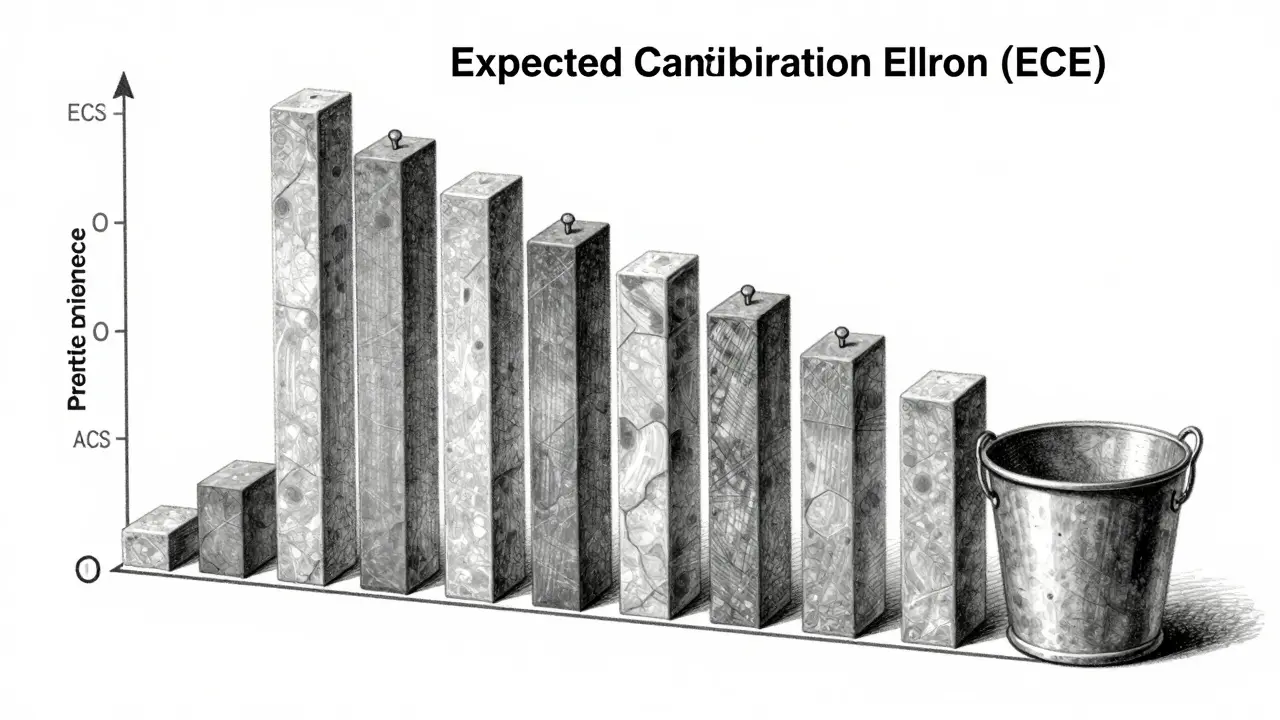
- Expected Calibration Error (ECE): This is the standard metric. It divides predictions into buckets (e.g., 10 buckets from 0-10% confidence to 90-100%). For each bucket, it calculates the difference between the average predicted confidence and the actual accuracy. A lower ECE means better calibration.
- Information Probability Ratio (IPR): Introduced in recent EMNLP 2024 research, IPR offers a different perspective by analyzing the ratio of information content to probability. It helps identify cases where a model provides high-confidence answers that contain low informational value relative to their certainty.
- Calibration Error (CE): Similar to ECE but often used in broader contexts to assess the overall discrepancy between predicted probabilities and empirical outcomes across various tasks.
These metrics allow developers to compare different calibration methods objectively. For instance, if Method A reduces ECE by 20% compared to Method B, Method A is statistically providing more reliable confidence estimates.
| Metric | Description | Best Use Case |
|---|---|---|
| ECE | Averages error across confidence buckets | General purpose evaluation |
| IPR | Ratio of information to probability | Detecting hollow confidence |
| CE | Overall discrepancy measure | Broad performance assessment |
Technique 1: Verbalized Confidence
One of the simplest yet most effective ways to improve calibration is to ask the model to say how confident it is, rather than relying on its raw internal math. This is known as verbalized confidence.
Research on models like GPT-4 and Claude has shown that verbalized confidences (output tokens like "I am very confident") are often better calibrated than the model’s raw conditional probabilities. In benchmarks like TriviaQA and TruthfulQA, using verbalized confidence reduced expected calibration error by roughly 50% compared to using raw log-probabilities.
Why does this work? When you prompt the model to generate a confidence score as text, you engage its reasoning capabilities. It forces the model to reflect on its answer before committing to a level of certainty. You can implement this in two ways:
- Numerical Probabilities: Ask the model to output a percentage (e.g., "Confidence: 85%").
- Linguistic Expressions: Ask for qualitative terms (e.g., "Highly likely," "Probably not," "Uncertain").
A pro tip here is to separate the answer generation from the confidence assessment. First, get the model to generate multiple answer candidates without any confidence rating. Then, in a second step, ask it to evaluate the probability of correctness for each candidate. This two-step process significantly improves calibration because it prevents the initial bias of the answer generation from skewing the confidence estimate.
Technique 2: The Thermometer Method
If you’re worried about computational costs, the Thermometer method is a game-changer. Developed by researchers at MIT and the MIT-IBM Watson AI Lab, this approach addresses the high energy consumption of traditional calibration methods.
Traditional methods often require sampling from the LLM multiple times to get different predictions, then aggregating them. With billions of parameters, this is slow and expensive. The Thermometer method uses a smaller auxiliary model-a "thermometer"-that runs on top of the large LLM. It leverages a classical technique called temperature scaling.
In temperature scaling, a single parameter (the temperature) adjusts the sharpness of the model’s probability distribution. A higher temperature flattens the distribution (making the model less confident), while a lower temperature sharpens it (making it more confident). The Thermometer model learns the optimal temperature for a given input, effectively calibrating the larger model’s output without needing to re-run the heavy LLM multiple times. This preserves accuracy while drastically cutting down on compute resources.
Technique 3: UF Calibration and Decomposition
Another sophisticated approach is UF Calibration, introduced at EMNLP 2024. This method recognizes that a model’s confidence isn’t just one thing-it’s a mix of two factors:
- Uncertainty (U): How hard is the question? Does the model lack knowledge about the topic?
- Fidelity (F): How faithful is the generated answer to the model’s internal beliefs?
By decomposing confidence into these two components, UF Calibration allows for more granular adjustments. For example, a model might be highly uncertain about a niche medical question (high U) but very faithful to its limited training data on that topic (high F). Traditional methods might treat this as a single "medium confidence" signal, missing the nuance. UF Calibration treats them separately, leading to more accurate final confidence scores. This plug-and-play method has been tested on six RLHF-trained LLMs across four multiple-choice QA datasets, showing robust improvements.
Technique 4: Self-Consistency and Chain-of-Thought
For complex reasoning tasks, simply asking for a confidence score isn’t enough. You need to see the work. This is where Chain-of-Thought (CoT) prompting comes in. By forcing the model to explain its step-by-step reasoning before giving an answer, you expose logical inconsistencies. If the reasoning steps contradict each other, the model’s confidence should drop.
Building on CoT, Self-consistency-based confidence involves generating multiple responses to the same query. The logic is simple: if the model arrives at the same answer through different reasoning paths, it’s likely correct. High agreement across varied conditions indicates high confidence.
Researchers use several aggregation strategies here:
- Consistency Measure: Checks how often the model gives the same answer across different prompts or seeds.
- Average Confidence (Avg-Conf.): Computes a weighted average, giving more weight to answers that appear frequently and have high individual confidence scores.
- Pair-Rank Strategy: Useful for Top-K predictions, this ranks responses based on both likelihood and consistency.
Multi-step Confidence Elicitation takes this further by capturing confidence scores at every stage of the reasoning process. The final confidence is derived as the product of all individual step confidences. This compounding effect ensures that a single weak link in the reasoning chain drags down the overall confidence, which is exactly what you want for safety-critical applications.
Technique 5: Listener-Aware Fine-Tuning (LAcie)
Most calibration methods focus on the model’s internal mechanics. LAcie (Listener-Aware Confidence Improvement via Elicitation), introduced at NeurIPS 2024, flips the script by modeling the listener’s perspective. It’s a pragmatic fine-tuning method that teaches the model to communicate uncertainty in a way that humans actually understand.
LAcie calibrates both implicit cues (tone, detail level) and explicit markers (words like "maybe" or "certainly"). Qualitatively, models trained with LAcie hedge more when they are uncertain and adopt an authoritative tone with relevant details when they are correct. This leads to better separation between correct and incorrect examples in terms of perceived confidence.
Interestingly, LAcie demonstrates strong generalization. Models trained on trivia questions (TriviaQA) showed large increases in truthfulness on entirely different datasets like TruthfulQA. This suggests that teaching a model to be aware of the listener’s need for honesty transfers across domains.
Practical Implementation Checklist
If you’re building an application that relies on LLM outputs, here is a quick checklist to improve confidence calibration:
- Use Verbalized Confidence: Always prompt the model to output a confidence score alongside its answer. Prefer numerical percentages for easier processing.
- Implement Temperature Scaling: If you’re using open-source models, experiment with adjusting the temperature parameter during inference. Lower temperatures reduce randomness but may increase overconfidence; find the sweet spot for your task.
- Apply Chain-of-Thought: For reasoning-heavy tasks, require the model to show its work. Use self-consistency by generating 3-5 variations and checking for agreement.
- Monitor ECE Regularly: Set up a pipeline to calculate Expected Calibration Error on a hold-out validation set. Track this metric over time as you update your prompts or model versions.
- Consider Auxiliary Models: If compute is a constraint, explore lightweight calibration heads like the Thermometer method instead of full re-sampling.
Conclusion
Calibrating confidence in large language models is no longer optional-it’s essential for trustworthy AI. Whether you’re using verbalized confidence, advanced decomposition methods like UF Calibration, or efficient approaches like Thermometer, the goal remains the same: align the model’s stated certainty with its actual accuracy. By implementing these techniques and monitoring metrics like ECE and IPR, you can build systems that know when to speak up and when to stay silent, ultimately creating safer and more reliable AI interactions.
What is the difference between accuracy and calibration in LLMs?
Accuracy refers to how often the model gets the right answer. Calibration refers to whether the model’s confidence score matches its accuracy. A model can be 80% accurate but poorly calibrated if it claims 99% confidence for those correct answers and 1% confidence for the wrong ones. Good calibration means if it says it’s 80% sure, it’s right 80% of the time.
Why does RLHF cause overconfidence in LLMs?
RLHF optimizes models to be helpful and aligned with human preferences. Humans tend to reward confident-sounding answers, even if they are slightly inaccurate. As a result, models learn to prioritize sounding certain over admitting uncertainty, leading to a divergence between their internal probabilities and their expressed confidence.
How does the Thermometer method save computational resources?
Traditional calibration often requires running the large LLM multiple times to sample different outputs. The Thermometer method uses a small, lightweight auxiliary model to predict the optimal temperature scaling factor for the LLM’s output. This avoids the need for repeated, expensive LLM inferences, making it much faster and cheaper.
What is Expected Calibration Error (ECE)?
ECE is a metric that measures the average difference between predicted confidence and actual accuracy. It groups predictions into confidence buckets (e.g., 0-10%, 10-20%) and calculates the error within each bucket. A lower ECE indicates that the model’s confidence levels are more closely aligned with its true performance.
Can verbalized confidence replace raw probability scores?
In many cases, yes. Research shows that for RLHF-trained models, verbalized confidence (where the model outputs a text-based confidence statement) is often better calibrated than raw conditional probabilities. However, raw probabilities are still useful for mathematical operations, so many systems use both: verbalized confidence for user-facing transparency and raw scores for backend decision-making.