
You’re staring at a bill from your cloud provider. It’s high. You know you can run the model yourself, but which one? The open-source landscape in late 2025 shifted violently. Qwen overtook Meta's Llama as the most downloaded model family on HuggingFace, signaling that the center of gravity for AI development is moving East. But downloads don’t equal deployment success. If you’re trying to pick between Llama, Mistral, Qwen, and DeepSeek, you aren't just choosing a model; you're choosing a compliance strategy, a hardware budget, and a geopolitical risk profile.
This isn't about which model has the highest score on a leaderboard. It's about fit. A US government contractor can't use Chinese-origin models. An EU bank needs GDPR baked into the architecture. A startup needs MIT licensing to avoid legal headaches. Here is how these four giants stack up when you strip away the marketing fluff.
The Architecture Battle: Dense vs. Mixture of Experts
Under the hood, these models are built differently, and that dictates what they are good at. Qwen 3 uses a Mixture of Experts (MoE) architecture. Think of it like a hospital. Instead of one general practitioner knowing everything, you have specialists. When you ask a question, only the relevant "specialists" activate. For the flagship 235B parameter model, only about 10% of parameters fire during inference. This means you get massive knowledge capacity without the massive compute cost of a dense model running at full tilt.
Mistral Large sticks with a dense transformer architecture. Every neuron fires for every token. It’s heavier, more predictable, and easier to optimize for specific European enterprise workflows. Then there is DeepSeek R1. It pioneered a reasoning-first architecture. Unlike standard models that guess the next word, DeepSeek generates a transparent chain-of-thought before answering. This makes it slower but infinitely more verifiable-crucial if you need to debug why an AI made a bad decision.
Llama 4 tries to bridge the gap. Variants like Scout offer a staggering 10 million token context window, far exceeding the typical 128K-200K range of competitors. If you need to process entire codebases or long legal contracts in one go, Llama Scout is currently unmatched in raw context length.
Licensing and Legal Landmines
Before you download weights, check the license. This is where many teams get burned.
| Model Family | License Type | Commercial Use Risk | Key Compliance Feature |
|---|---|---|---|
| DeepSeek R1/V3 | MIT License | Lowest | No patent grants needed; pure permissive |
| Qwen 3 | Apache 2.0 | Moderate | Includes explicit patent grants |
| Mistral Large | Commercial/Apache mix | High (for large scale) | GDPR & EU AI Act ready |
| Llama 4 | Llama Community License | Moderate | Restrictions on military/surveillance use |
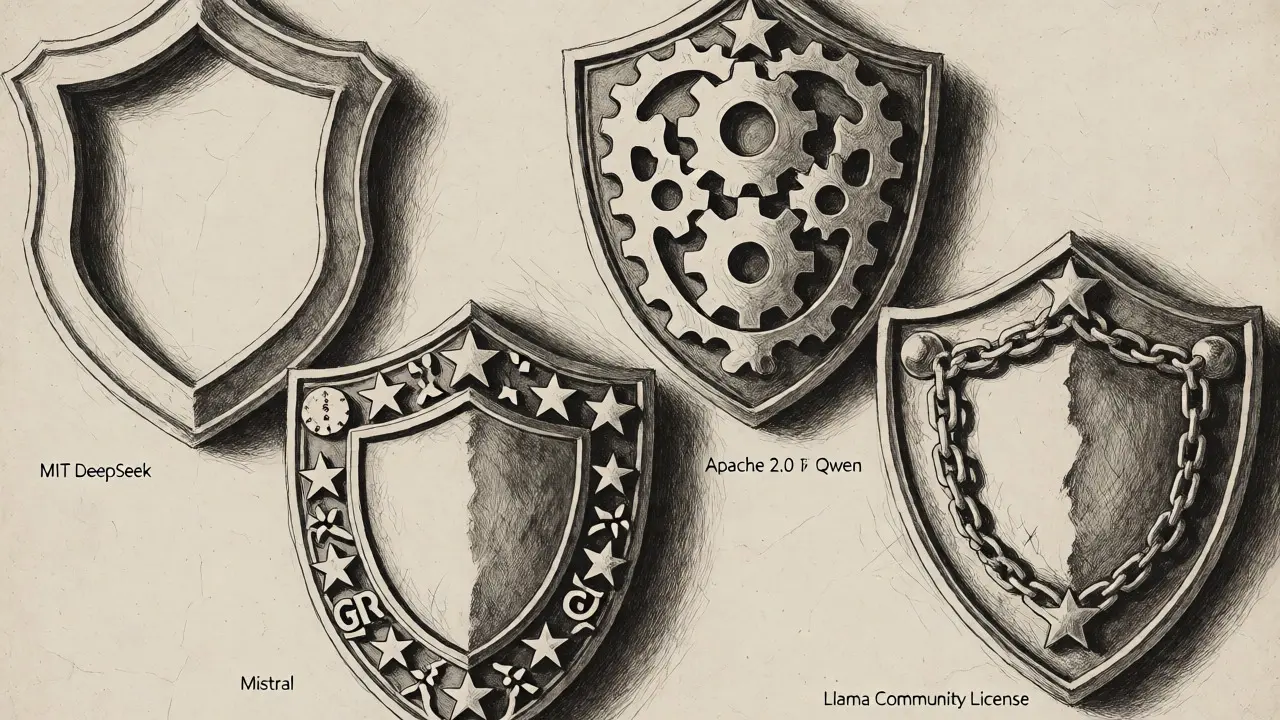
DeepSeek's MIT licensing is the gold standard for startups. You can do almost anything with it. No strings attached. Qwen uses Apache 2.0. This is also very permissive and includes patent grants, which protects you if Alibaba decides to sue someone else over patents later. Mistral is trickier. While they offer Apache options, their enterprise-grade features often require commercial agreements. However, for EU companies, this friction is worth it because Mistral bakes GDPR compliance directly into its data processing architecture. Jean-Luc Moreau from Bracai noted in early 2026 that this isn't just marketing-it's structural. If you are an EU firm, using Mistral saves you roughly 200 hours of legal review compared to retrofitting another model.
Benchmarks That Actually Matter
Leaderboards are noisy. Let's look at what matters for production. According to Digital Applied’s January 2026 analysis, Qwen 3 dominates mathematical reasoning with a 92.3% score on AIME25. That is higher than most closed-source models. If your app involves complex calculations, financial modeling, or scientific logic, Qwen is the clear winner.
DeepSeek R1 scores around 80% on AIME25, but here is the twist: it provides step-by-step verification. In academic research papers requiring verifiable reasoning chains, DeepSeek appears in 73% of cases versus Qwen’s 19%. Why? Because researchers need to see the work, not just the answer. DeepSeek shows its thinking. Qwen gives you the right answer fast.
Mistral Medium 3 offers a different value proposition. It delivers about 90% of top-tier performance at 1/8th the inference cost. For scalable chatbots where speed and cost matter more than perfect logical deduction, Mistral is efficient. Llama 4 excels in multimodal tasks and long-context retrieval, making it ideal for document-heavy applications rather than pure reasoning engines.
Deployment Reality: Time, Cost, and Talent
Downloading a model is easy. Running it reliably is hard. Interconnects AI reports that self-hosting can cut inference costs by 80-90% compared to APIs, but you pay in engineering time.
- DeepSeek R1: Takes ~40 hours to deploy for experienced teams. Documentation is excellent and in English. The challenge is optimizing the reasoning pipeline for production latency.
- Qwen 3: Takes 60-80 hours. The tooling ecosystem is heavily Chinese-language focused. Unless you have Mandarin-speaking engineers or buy Alibaba’s enterprise support (which cuts setup to 35-45 hours), expect friction.
- Mistral Large: Takes 50-70 hours. Requires knowledge of EU compliance frameworks. Once set up, it’s turnkey for GDPR, saving significant legal overhead.
- Llama 4: Variable. Scout’s 10M context window requires specialized memory management techniques that few engineers have mastered yet.
Community support varies too. Qwen has the largest GitHub community with over 42,000 contributors, but much of the active discussion happens in Chinese forums. DeepSeek maintains the most active English-language forum with 18,500 monthly participants, making it easier for Western developers to find help.

Geopolitics and Vendor Lock-In
You cannot ignore geography anymore. As of December 2025, updated Federal AI Procurement Guidelines prohibit 41% of US government contractors from using Chinese-origin models. This effectively bans Qwen and DeepSeek for a huge chunk of the public sector market.
For private enterprises, the risk is subtler. Data residency laws are tightening. If you use Qwen, ensure your data doesn't inadvertently leak to entities subject to Chinese jurisdiction. Nodewave’s survey found that 67% of enterprise AI leaders cite potential fragmentation of the open-source ecosystem along geopolitical lines as their biggest fear for 2026-2027. Choosing Mistral is a hedge against this. Choosing DeepSeek is a bet on technical merit overriding political tension.
Which One Should You Pick?
There is no single "best" model. There is only the best model for your constraints.
- Pick Qwen 3 if: You need the best math/logic performance, multilingual support (119 languages verified), and have the engineering bandwidth to handle Chinese-centric tooling or budget for enterprise support.
- Pick DeepSeek R1 if: You need transparent reasoning for debugging, want the simplest license (MIT), and operate primarily in English-speaking markets.
- Pick Mistral Large if: You are based in the EU, need strict GDPR compliance out of the box, and want a stable, dense architecture for enterprise apps.
- Pick Llama 4 if: You need massive context windows (10M tokens) for document processing, multimodal capabilities, or are already invested in the Meta ecosystem.
The market is shifting toward MoE architectures for high-performance tasks (projected 78% share by 2027) while dense models hold edge devices. Keep an eye on Mistral Sovereign, scheduled for Q3 2026, which promises air-gapped installations for national governments. The race isn't over; it's just getting more specialized.
Is Qwen better than Llama for coding?
Generally, yes. Qwen 3 scores 88.5% on HumanEval, significantly outperforming previous Llama versions in code generation tasks. However, Llama 4 Scout offers superior context handling, which helps when refactoring large existing codebases.
Can I use DeepSeek commercially?
Yes, DeepSeek R1 is released under the MIT license, which is highly permissive. You can use it for commercial products, modify it, and distribute it without paying royalties or sharing your source code.
Why is Mistral recommended for EU companies?
Mistral Large is designed with GDPR compliance embedded in its architecture. This reduces legal risks associated with data processing in Europe and aligns with the EU AI Act requirements, unlike some non-EU alternatives that require additional compliance layers.
What is the main downside of Qwen?
The primary hurdle is the tooling ecosystem. Much of the documentation and community support is in Chinese, which creates a steep learning curve for non-Mandarin speaking teams. Additionally, geopolitical concerns may restrict its use in certain government sectors.
How much cheaper is self-hosting compared to API?
Interconnects AI reports that self-hosted open-source models can reduce inference costs by 80-90% compared to proprietary API alternatives. However, you must account for the upfront infrastructure costs and engineering time required for deployment and maintenance.