Imagine sending your most sensitive patient records or proprietary financial algorithms to a cloud server for AI processing. You trust the cloud provider with storage, but what happens while the Large Language Model (LLM) is actually reading that data? Traditionally, the data sits in plain text in memory during inference, visible to anyone with root access to the server. This gap in security is known as the "AI privacy paradox." The solution emerging in 2026 is confidential computing, which uses hardware-based Trusted Execution Environments (TEEs) to keep data encrypted even while it is being processed.
This technology solves a critical problem for enterprises: how to deploy powerful AI on sensitive data without compromising either model security or data confidentiality. By leveraging encryption-in-use, organizations can ensure that neither the cloud provider nor malicious actors can peek at the inputs or outputs of an LLM inference job. Let’s look at how this works, why it matters now, and what you need to know to implement it.
What Is Confidential Computing?
At its core, confidential computing moves beyond traditional encryption-at-rest and encryption-in-transit. It protects data in use. When an LLM processes a prompt, the data must be decrypted to be useful. In standard setups, this decryption happens in system memory, which is vulnerable to attacks like cold boot attacks or hypervisor escapes.
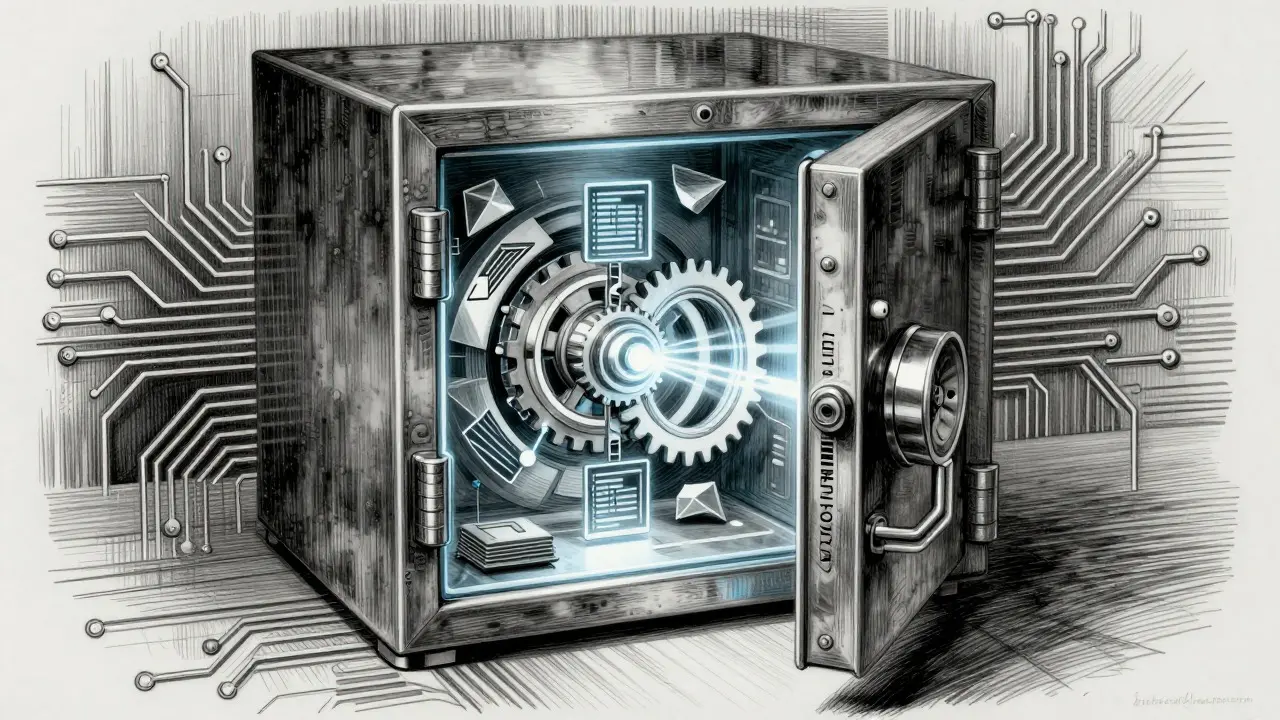
Confidential computing changes this by creating a secure boundary called a Trusted Execution Environment (TEE). Inside this TEE, data is decrypted only for the duration of the computation. The hardware itself enforces this isolation, meaning that even if the operating system is compromised, the data inside the TEE remains safe. Think of it as a digital vault where the only key holder is the specific application running inside, verified through cryptographic attestation.
The concept isn't new-it evolved from Intel SGX launched in 2016-but it has matured significantly for AI workloads. Recent advancements, particularly with GPU-accelerated TEEs, have made it viable for large-scale LLM inference, which was previously too heavy for CPU-only secure enclaves.
How TEEs Protect LLM Inference
To understand how this protects your models and data, we need to look at the technical flow. A typical confidential LLM inference pipeline involves several critical steps:
- Client-Side Encryption: The user encrypts their prompt using a public key that belongs to the attested TEE.
- Remote Attestation: Before any data is sent, the client verifies that the server’s TEE is authentic and untampered. This proves the "vault" is real.
- Secure Transmission: Data travels through load balancers and networks, often with additional application-level encryption (like Azure’s Attested Oblivious HTTP).
- In-TEE Decryption: The data enters the TEE boundary and is decrypted only within the encrypted memory region.
- Inference Processing: The LLM processes the request. Both the model weights and the input data remain protected by hardware-enforced memory encryption.
- Re-Encryption: The response is re-encrypted before leaving the secure environment to return to the user.
This process ensures that at no point is the plaintext data exposed to the host operating system or the cloud provider’s infrastructure team. For proprietary models, this also means your intellectual property-the model weights-stays hidden from competitors who might share the same cloud infrastructure.
Hardware Foundations: GPUs vs. CPUs
Not all TEEs are created equal, especially when it comes to the massive computational demands of LLMs. Historically, CPU-based TEEs like Intel SGX were used, but they struggle with the throughput required for modern AI.
| Hardware Platform | Performance Overhead | Key Feature | Best For |
|---|---|---|---|
| NVIDIA H100/H200 | 1-5% | GPU Memory Protection | High-performance inference |
| Intel SGX/TDX | 15-25% | CPU-based enclave | Smaller models or pre-processing |
| AMD SEV-SNP | 5-10% | Memory encryption | General VM isolation |
NVIDIA’s introduction of Confidential Computing capabilities for H100 GPUs in late 2023 was a game-changer. It delivers 95-99% of native performance while protecting model weights. This low overhead is crucial because earlier CPU-based solutions incurred 15-25% penalties, making real-time inference for large models impractical. With NVIDIA’s Blackwell B200 GPUs launching in late 2025, support for 200B+ parameter models with less than 3% overhead is becoming the new standard for high-end deployments.

Cloud Provider Implementations
You don’t need to build your own data center to use confidential computing. Major cloud providers have integrated these capabilities into their services, though each takes a slightly different approach.
AWS Nitro Enclaves isolate LLM inference workloads from the host OS using lightweight VMs. While robust, they lack native GPU TEE support, requiring complex architectural patterns for high-performance inference. Leidos successfully deployed this for healthcare data processing in late 2024, achieving accuracy matching non-confidential baselines while keeping patient data encrypted.
Microsoft Azure Confidential Computing offers Confidential Inferencing within Azure Machine Learning. Their approach combines hardware-backed TEEs with application-level encryption to protect prompts as they pass through untrusted frontend layers. This hybrid method addresses the challenge of securing the entire pipeline, not just the compute node.
Red Hat OpenShift brings a Kubernetes-native approach. By combining sandboxed containers with Confidential Virtual Machines (CVMs), Red Hat allows developers to manage confidential workloads using familiar orchestration tools. This requires additional components like Tinfoil Security’s mutual attestation framework for secure model loading, but it offers flexibility for multi-cloud environments.
The Challenge of Secure Model Loading
One of the biggest hurdles in confidential computing is getting the model into the TEE securely. This is often called the "chicken-and-egg" problem: how do you load a 70B+ parameter model (requiring 140+ GB of VRAM) into a secure enclave without exposing the keys?
Solutions like those from Phala Network and Tinfoil Security use "mutual attestation." In this process, the enclave proves it is authorized to pull the encrypted model image, and the LLM provider’s private key is securely transferred to the enclave. The model weights are then decrypted only inside the TEE’s encrypted memory. Without this, the entire security chain breaks down because the model itself could be stolen during the loading phase.
However, this adds complexity. Loading a 30B parameter LLM into an Intel SGX enclave can take nearly an hour, compared to minutes in a standard setup. This latency makes real-time pipelines difficult unless you use optimized GPU TEEs.

Who Needs This Now?
While confidential computing is still maturing, certain industries are adopting it rapidly due to regulatory pressure and IP risks.
- Healthcare: HIPAA mandates protection of electronic protected health information. With 42% of confidential AI implementations in healthcare, providers are using TEEs to process patient records without de-identifying them first, preserving data utility.
- Financial Services: Banks and insurers handle highly sensitive transaction data. A European insurer implemented a confidential VM-based claims assistant that reduced breach risks while maintaining high customer satisfaction.
- Government & Defense: With strict data residency requirements, government agencies are moving toward hybrid approaches, combining cloud confidential computing with on-premises controls.
Gartner projects that by Q4 2026, 65% of enterprise LLM deployments handling sensitive data will incorporate confidential computing, up from just 15% in mid-2025. This surge is driven by the realization that software-only security is no longer sufficient for AI workloads.
Implementation Challenges and Costs
Adopting confidential computing isn't plug-and-play. It requires specialized knowledge across hardware security, container orchestration, and cryptographic engineering. The learning curve typically spans 8-12 weeks for teams new to AI-specific TEEs.
Common pitfalls include:
- Complex Orchestration: Managing the attestation chain and secure key transfer adds significant operational overhead.
- Performance Bottlenecks: If you don't use GPU-accelerated TEEs, the performance hit can make inference too slow for user-facing applications.
- Limited Availability: Not all cloud regions offer the latest GPU TEEs. You may be constrained to specific zones or hardware generations.
Despite these challenges, the market is growing fast. Valued at $1.7 billion in Q3 2025, the confidential AI computing market is projected to reach $8.3 billion by 2027. The investment is justified by the risk mitigation: a single data breach involving sensitive AI inputs can cost millions in fines and reputational damage.
Future Outlook
The trajectory points toward standardized confidential AI APIs. The Confidential Computing Consortium’s LLM Working Group, formed in September 2025, is developing common interfaces for secure model serving. As these standards mature, the complexity of implementation should decrease.
By 2027, confidential computing is expected to become a default requirement for enterprise LLM deployments handling sensitive data. With 90% adoption projected in healthcare and financial services, ignoring this technology could leave your organization exposed to both regulatory scrutiny and competitive disadvantage. The era of trusting the cloud provider with your plaintext data is ending; encryption-in-use is the new baseline for AI security.
What is the difference between encryption at rest and encryption in use?
Encryption at rest protects data stored on disks, while encryption in transit protects data moving over networks. Encryption in use, enabled by confidential computing, protects data while it is being processed in memory. This prevents exposure during computation, which is the most vulnerable phase in traditional systems.
Does confidential computing significantly slow down LLM inference?
It depends on the hardware. CPU-based TEEs like Intel SGX can add 15-25% overhead. However, GPU-accelerated TEEs, such as those on NVIDIA H100 and B200 chips, reduce this overhead to 1-5%, making them viable for real-time production workloads.
Which cloud providers support confidential computing for AI?
AWS offers Nitro Enclaves, Microsoft Azure provides Confidential Inferencing via Azure Machine Learning, and Google Cloud has Confidential VMs. Each has different strengths, with Azure and AWS focusing on integration with their broader AI services, while NVIDIA provides hardware-level solutions compatible with multiple clouds.
Is confidential computing necessary for all LLM deployments?
Not necessarily. If your LLM processes public data and uses open-source models, the risk may be lower. However, for any deployment involving personally identifiable information (PII), proprietary business logic, or regulated industry data (healthcare, finance), confidential computing is increasingly considered essential.
How does remote attestation work in this context?
Remote attestation is a cryptographic process where the client verifies that the server's TEE is authentic and running trusted code before sending any sensitive data. It ensures that the "vault" is genuine and hasn't been tampered with, providing verifiable assurance of security.


