
Large language models are powerful, but they have a fatal flaw when it comes to enterprise work: they hallucinate. They guess answers based on training data that might be months old or completely irrelevant to your specific business context. If you ask an LLM about your company’s internal HR policy from last week, it will likely make something up. That is where Retrieval-Augmented Generation (RAG) comes in.
RAG is the bridge between general-purpose AI and your private knowledge base. It works by fetching relevant documents from your database before the model generates an answer. For enterprises, this isn't just a nice-to-have feature; it is a requirement for accuracy, compliance, and cost control. According to recent benchmarks, optimized RAG architectures can improve response accuracy by 3-4x while cutting costs by 60% compared to basic setups. But building a system that scales securely is not as simple as connecting an API to a chatbot. You need a robust architecture.
The Core Components of Enterprise RAG
To build an enterprise-grade system, you need to understand the moving parts. A naive implementation often fails under load or returns irrelevant results because it skips critical steps. A mature architecture consists of several distinct layers working in harmony.
First, you have the Embedding Pipeline. This process converts your text documents into numerical vectors that computers can compare. The quality of these embeddings determines everything. In 2026, models like Cohere Embed v3 allow for multilingual support across over 100 languages within a single model, eliminating the need for separate encoders. This simplifies maintenance significantly for global organizations.
Next is the storage layer, typically a Vector Database. This is where your embeddings live. Unlike traditional SQL databases that search by exact matches, vector databases search by similarity. They use algorithms like HNSW (Hierarchical Navigable Small World) to find the closest matches to a user's query in milliseconds. Performance here is critical. Benchmarks show that systems using PGVector can handle 500,000 embeddings with sub-second latency, while solutions like LanceDB can process 15 million rows with metadata filtering at similar speeds.
Then comes the retrieval and re-ranking stage. Simply finding the top five most similar documents isn't always enough. Sometimes, a document is semantically similar but factually weak. Re-ranking models step in here to score the retrieved chunks against the original query more precisely. Finally, the Large Language Model synthesizes the query and the retrieved context into a coherent answer. Each of these components must be orchestrated carefully to ensure low latency and high relevance.
Choosing Your Architectural Pattern
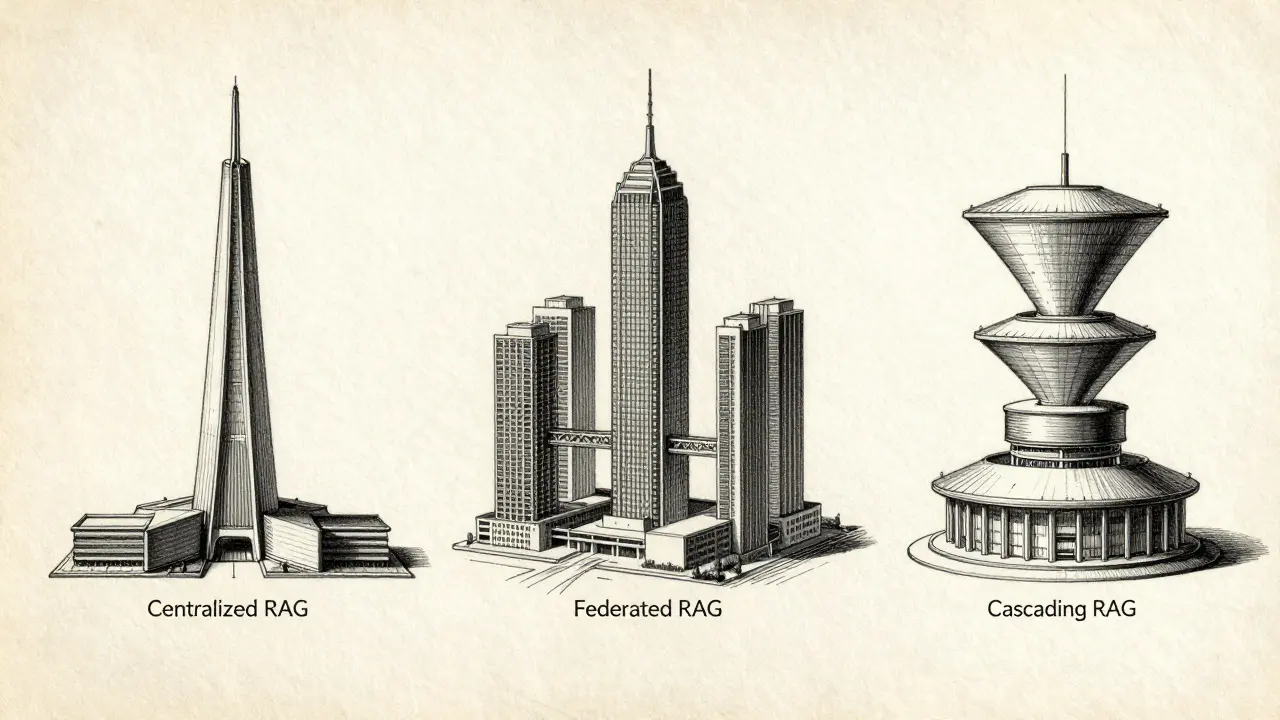
There is no one-size-fits-all design for RAG. The right choice depends on your organization's structure, data sensitivity, and scale. Here are the three dominant patterns used in enterprise environments today.
| Architecture Type | Best For | Pros | Cons |
|---|---|---|---|
| Centralized | Uniform knowledge bases, single department use cases | Easier to maintain, lower initial complexity, consistent governance | Becomes a bottleneck at massive scale, harder to customize per domain |
| Federated | Large enterprises with multiple departments (Legal, HR, Sales) | Domain-specific customization, isolated security boundaries, scalable | Higher development cost (6-9 months), complex orchestration |
| Cascading | Cost-sensitive applications with mixed query complexity | Reduces LLM API costs by routing simple queries to cheaper models | Requires sophisticated query classification logic |
A Centralized Architecture uses a single pipeline for all queries. It is ideal if you have one main knowledge base, like a product manual repository. It is simpler to deploy, often taking 3-6 months for full implementation. However, as your user base grows, this single point of failure can become a performance bottleneck.
In contrast, a Federated Architecture deploys multiple domain-specific retrievers that route to a shared LLM layer. This allows the legal team to have strict privacy controls while the marketing team accesses public-facing content. It takes longer to build-typically 6-9 months-but offers superior flexibility and security isolation. For large corporations, this is often the only viable long-term strategy.
Cascading RAG Models focus on efficiency. They use lightweight, cheap models to handle general queries. Only complex requests that require deep reasoning are escalated to more powerful, expensive LLMs. This hybrid approach can drastically reduce operational costs without sacrificing quality for difficult questions.
Vector Databases: Postgres vs. Specialized Solutions
The choice of vector database is perhaps the most technical decision you will make. Two options dominate the conversation in 2026: integrating vector capabilities into existing PostgreSQL instances via extensions like PGVector, or using specialized vector-native databases like LanceDB.
Postgres with PGVector is attractive because you already know SQL. It provides high accuracy, especially at small-to-medium scales, using brute-force KNN or HNSW indexes. It fits well if your data is already relational and you want to minimize new infrastructure. However, its scaling is vertical. As your dataset grows, you need bigger servers, which gets expensive quickly.
LanceDB, on the other hand, is designed for horizontal scaling. It allows storage to scale independently from compute. Its decentralized design means data can live in various cloud buckets, offering different privacy considerations compared to Postgres' centralized encryption. If you expect your embedding count to reach millions or billions, a specialized solution often handles ingestion throughput and query latency better than a modified relational database.
Security and Compliance: Non-Negotiables
In an enterprise setting, accuracy is useless if your data leaks. Security vulnerabilities in RAG systems can expose sensitive customer information or proprietary strategies. An enterprise-grade architecture must incorporate microservices principles where each component operates separately. This enables horizontal scaling and, crucially, isolated security policies.
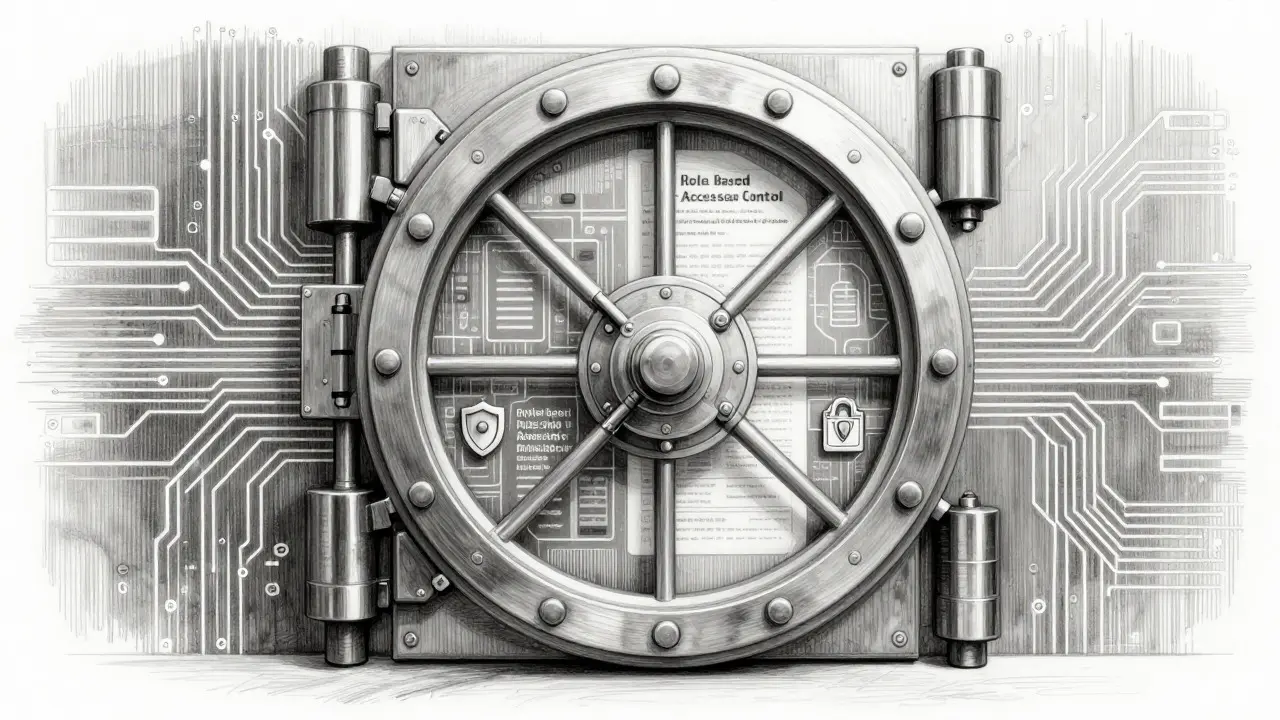
You need Role-Based Access Control (RBAC) at the retrieval level. Just because a user can access the AI chat doesn't mean they should see every document in the vector database. Centralized governance policies are essential for compliance with regulations like GDPR, HIPAA, and SOC 2. Every retrieval event should generate an audit trail. Modern platforms now offer built-in PII masking and air-gapped deployments for highly sensitive environments, ensuring that even if the LLM provider is external, your raw data never leaves your secure perimeter.
Implementation Challenges and Pitfalls
Building RAG is easy; building it well is hard. One common pitfall is poor chunking strategies. If you split documents too aggressively, you lose context. Too loosely, and you overwhelm the LLM's context window. Document understanding must preserve structure and meaning. Another challenge is balancing precision versus recall. High precision means fewer false positives, but you might miss relevant info. High recall ensures you catch everything, but adds noise. Re-ranking models help strike this balance.
Monitoring is also frequently overlooked. You need real-time tracking of system health metrics, query latency (aiming for sub-second responses), and user interaction patterns. Without this feedback loop, you won't know if your RAG system is actually improving or just guessing faster. Remember, not every task requires RAG. For static knowledge or tasks requiring stylistic consistency, fine-tuning or prompt engineering might be superior. Use RAG when you need up-to-date, factual, and explainable answers.
Future Trends in Enterprise RAG
The landscape is evolving rapidly. By 2027, Gartner forecasts that 85% of enterprise knowledge management systems will incorporate RAG architectures. We are seeing a shift toward multimodal RAG, handling text, images, and structured data simultaneously. Multi-agent pipelines are emerging, where specialized components handle retrieval, reasoning, and validation collaboratively. Continuous data update mechanisms are becoming standard, keeping knowledge bases current without requiring full model retraining. The goal is clear: seamless, secure, and intelligent access to enterprise knowledge.
What is the difference between RAG and Fine-Tuning?
Fine-tuning updates the model's weights to learn new patterns or styles, which is expensive and static. RAG keeps the model unchanged but feeds it external, up-to-date context during inference. RAG is better for dynamic data and factual accuracy, while fine-tuning is better for specific tones or formats.
How long does it take to implement an enterprise RAG system?
A centralized RAG system typically takes 3-6 months to deploy fully. Federated architectures, which require domain-specific customization and complex orchestration, may take 6-9 months. The timeline depends heavily on data cleanliness and integration requirements with existing ERPs or CRMs.
Is PGVector sufficient for large-scale enterprise needs?
For small to medium datasets (up to hundreds of thousands of embeddings), PGVector is highly effective and convenient. However, for millions of records requiring horizontal scaling and independent compute/storage separation, specialized vector databases like LanceDB or Pinecone often perform better and scale more cost-effectively.
How does RAG improve data security?
RAG improves security by allowing data to remain in your private vector database rather than being injected into the LLM's training set. With features like RBAC, PII masking, and audit trails, you control exactly what context is sent to the model for each query, reducing the risk of data leakage.
What are the key metrics for monitoring RAG performance?
Key metrics include query latency (targeting sub-second responses), retrieval precision and recall, hallucination rates, and user satisfaction scores. Real-time monitoring of these metrics helps identify issues like poor chunking or irrelevant retrievals early in the lifecycle.


