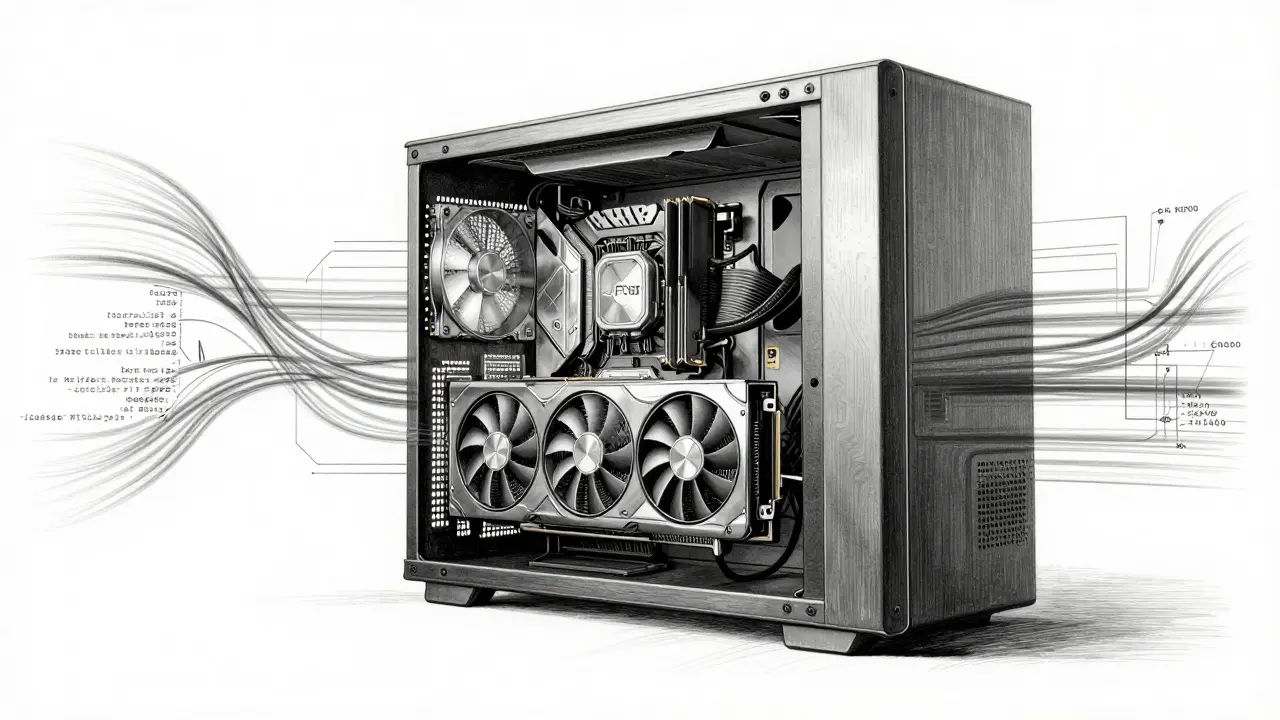
Imagine describing a feature in plain English and watching your IDE generate, test, and deploy the code before you finish your coffee. That is the promise of vibe coding, a development paradigm where natural language drives software creation rather than line-by-line typing. But for this to feel instantaneous, the hardware running the large language models (LLMs) has to keep up. In 2026, the bottleneck isn't just model size; it's the speed at which silicon can process tokens. The convergence of high-end Graphics Processing Units (GPUs), dedicated Neural Processing Units (NPUs), and efficient Edge AI chips is transforming vibe coding from a cloud-dependent luxury into a local, real-time reality for developers everywhere.
The Rise of Local Inference Power
Vibe coding relies on rapid context analysis. When you ask an AI agent to refactor a module, it needs to read the surrounding code, understand dependencies, and generate new logic in milliseconds. Cloud APIs introduce latency that breaks the flow state. This is why developers are increasingly turning to local hardware. The standard for desktop power remains the NVIDIA GeForce RTX 4090, which offers 24 GB of GDDR6X memory and roughly 82.6 TFLOPS of FP32 compute. For individual developers, this card allows running 7B to 70B parameter models locally, ensuring that privacy stays intact and response times drop below human perception thresholds. It’s not just about raw speed; it’s about having enough video RAM to hold the entire context window of a complex repository without swapping to slower system memory.
NPUs: The Silent Workhorses of Modern Laptops
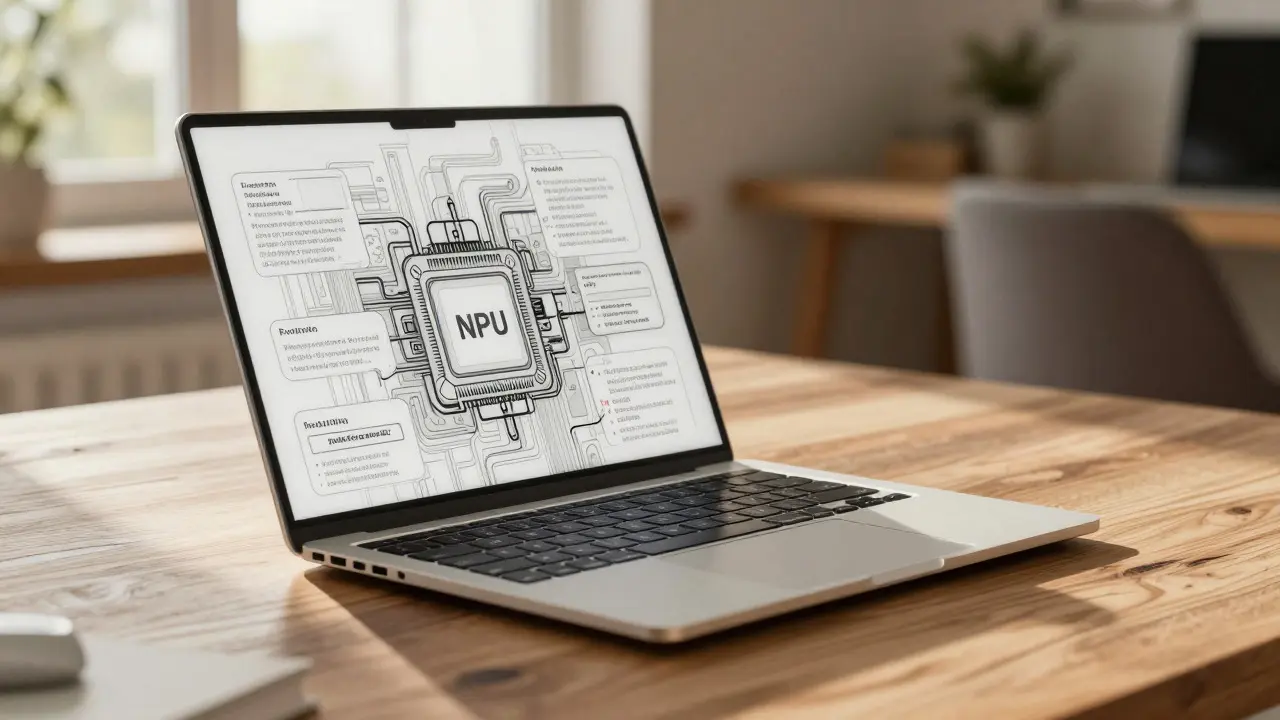
While desktops handle heavy lifting, laptops have evolved with a specific focus on battery life and continuous background tasks. Enter the NPU. Unlike general-purpose CPUs or GPUs, NPUs are designed exclusively for matrix operations-the core math behind neural networks. Qualcomm’s Snapdragon X Elite platform, widely adopted in Windows AI PCs since late 2023, integrates a Hexagon NPU rated at 45 TOPS (trillions of operations per second) at INT8 precision. When combined with CPU and GPU resources, these devices reach 75 TOPS total AI performance. This matters because it means your laptop can run a coding copilot continuously without draining the battery or throttling performance. Microsoft’s Copilot+ PC initiative sets a minimum bar of 40 TOPS for certification, signaling that future mainstream laptops will be capable of hosting substantial AI agents natively. For a developer working remotely, this translates to offline capability and zero-latency autocomplete, even in a plane or a remote cabin.
Edge AI: Coding Where the Action Happens
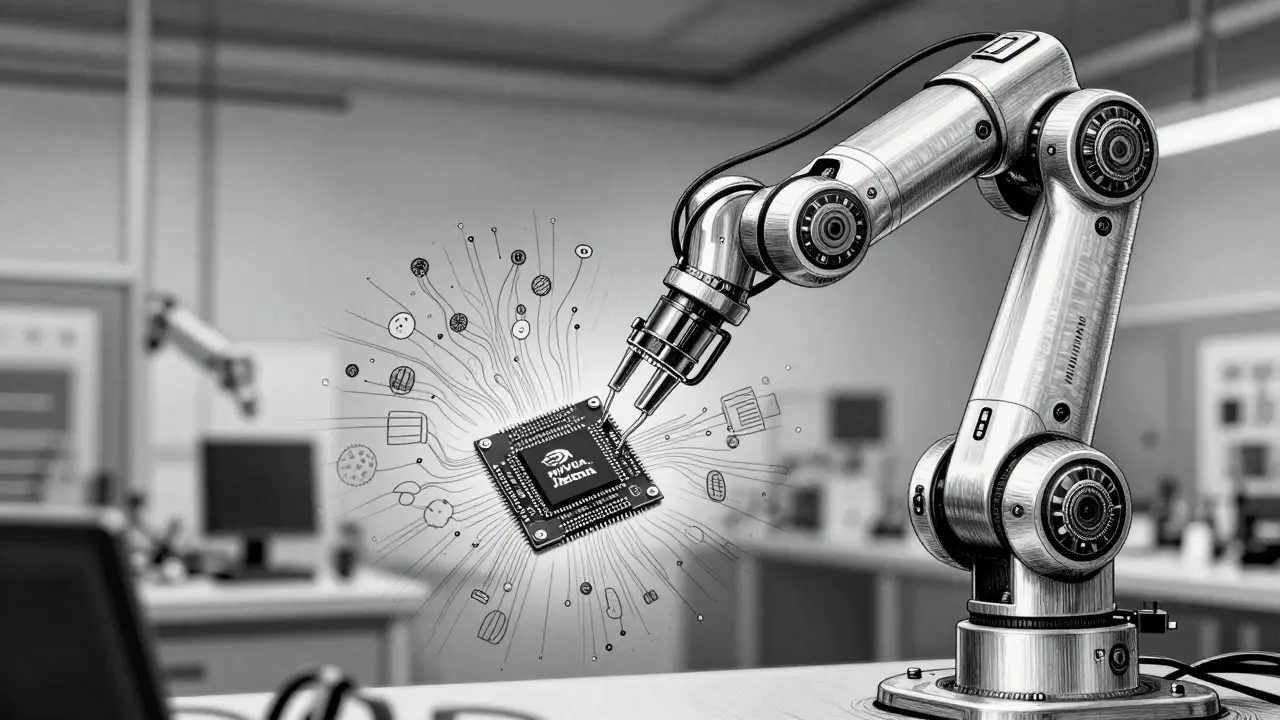
The most exciting frontier for vibe coding is the edge. Imagine a robot arm that rewrites its own motion scripts based on visual feedback, or an industrial sensor that adjusts its data filtering logic via a voice command. This requires running LLMs on small, low-power devices. NVIDIA’s Jetson Orin Nano series has become a go-to for this use case. The newer "Super" variant, released in late 2024, delivers up to 67 sparse INT8 TOPS in a package measuring less than 7 centimeters by 4.5 centimeters. At a price point around $249-$299, it makes sense to embed an AI coding agent directly into IoT gateways or robotics platforms. These devices operate between 7 and 15 watts, making them ideal for always-on applications where cloud connectivity is unreliable or unnecessary. While the raw TOPS number might look modest compared to a desktop GPU, the efficiency per watt is what enables persistent, autonomous behavior in embedded systems.
| Platform Type | Representative Model | AI Performance (TOPS) | Power Consumption | Primary Use Case |
|---|---|---|---|---|
| Desktop GPU | NVIDIA RTX 4090 | ~82.6 TFLOPS FP32 | 450 W TDP | Local LLM inference, multi-agent workflows |
| Laptop NPU | Qualcomm Snapdragon X Elite | 45 TOPS (NPU only) | 8-12 W (NPU load) | Continuous IDE assistance, offline coding |
| Edge Module | NVIDIA Jetson Orin Nano Super | 67 TOPS (Sparse INT8) | 7-15 W | Embedded agents, robotics, IoT automation |
| ASIC Accelerator | Google Edge TPU | 4 TOPS | ~0.5 W per TOP | Distilled micro-models, ultra-low power tasks |
Why Raw Specs Don't Tell the Whole Story
It’s easy to get lost in marketing numbers like TOPS or TFLOPS, but practical vibe coding performance depends heavily on software maturity and memory bandwidth. Benchmarks from early 2025 show that while a Snapdragon X Elite NPU claims 45 TOPS, sustained performance under heavy generative workloads often lands closer to 43.8 TOPS due to thermal and power management. Similarly, on Jetson Orin modules, advertised compute capacity can be limited by memory bandwidth constraints when running larger LLMs. This means that choosing the right hardware is only half the battle. You also need optimized runtimes, such as CUDA for NVIDIA GPUs or ONNX Runtime for cross-platform deployment. Furthermore, driver stability plays a critical role. Early AI laptops required firmware updates to fix NPU latency issues, and antivirus software scanning AI libraries can still introduce stutters. A smooth vibe coding experience requires a holistic setup: fast silicon, updated drivers, and lightweight security configurations.
The Market Trajectory: From Billions to Trillions
The investment in this hardware stack is accelerating rapidly. The global data center GPU market was valued at approximately $14.48 billion in 2024 and is projected to reach nearly $190 billion by 2033, driven largely by AI inference demand. Meanwhile, the edge AI hardware processor segment is expected to grow from around $1.4 billion in 2024 to over $13 billion by 2032. These figures reflect a shift from centralized cloud computing to distributed intelligence. As models become more efficient through quantization (INT8, FP16) and architectural innovations, smaller chips can handle tasks that previously required massive server farms. This democratizes access to advanced coding tools. Developers no longer need enterprise-grade infrastructure to enjoy instant AI assistance; they just need a modern laptop or a compact edge board.
Best Practices for Hardware-Accelerated Vibe Coding
To get the most out of these trends, developers should adopt a few key practices. First, match the model size to your hardware. Running a 70B parameter model on an 8 GB edge device will fail; instead, use distilled 7B or 13B models optimized for INT8. Second, monitor your thermals. Sustained high-load inference can throttle performance if cooling is inadequate. Third, keep your software stack current. Frameworks like PyTorch, TensorFlow Lite, and specialized serving engines update frequently to exploit new hardware features. Finally, don’t skip testing. Just because the code generated instantly doesn’t mean it’s correct. Use the speed advantage to iterate faster on tests and reviews, not to bypass validation. The goal is to augment human creativity with machine speed, not to replace engineering rigor with automated guesswork.
Frequently Asked Questions
What is the minimum hardware requirement for effective vibe coding?
For basic local assistance, a laptop with an NPU rated at least 40 TOPS (like those in Copilot+ PCs) or a discrete GPU with 8 GB+ VRAM is sufficient. For heavier, multi-agent workflows, a desktop with a high-end GPU like the RTX 4090 provides the best balance of speed and capacity.
Can I run vibe coding tools completely offline?
Yes, provided your local hardware can host the necessary LLM. Devices with NPUs or powerful GPUs allow you to run open-source models locally, eliminating internet dependency. This is particularly useful for privacy-sensitive projects or remote work scenarios.
Are edge AI devices suitable for professional software development?
Edge devices are best suited for embedded, robotics, or IoT-specific coding tasks where the software runs close to the hardware. For general application development, desktops and laptops remain superior due to their higher compute ceilings and better developer tooling integration.
How does quantization affect vibe coding performance?
Quantization reduces the precision of model weights (e.g., from FP32 to INT8), significantly lowering memory usage and increasing inference speed. This allows larger models to run on smaller hardware, making vibe coding accessible on laptops and edge devices that would otherwise struggle with full-precision models.
Will cloud-based vibe coding become obsolete?
Unlikely. Cloud services offer access to the largest, most capable models without requiring expensive local hardware. The trend is toward a hybrid approach: using local hardware for low-latency, private tasks and cloud resources for complex, resource-intensive generation jobs.