
You hit 'Accept' on the AI suggestion. The function works. The tests pass. But now you have a pull request with 300 lines of code that you didn't write, and your team lead is asking for a review. Do you really need to read every single line? If you're practicing vibe coding-where you direct an AI agent to build features through natural language prompts-the answer is no. Not anymore.
The old rule was simple: if you commit it, you must understand every byte. That worked when humans typed every character. It breaks down when large language models (LLMs) generate entire modules in seconds. Reading line-by-line is slow, expensive, and frankly, boring. But skipping review entirely is dangerous. So how do we strike a balance? We shift our focus from syntax to intent, from code to evidence.
The Mindset Shift: Treat AI Code as Untrusted Input
Before looking at any tools, you need to change how you view the code in front of you. Think of AI-generated code like user input from a web form. You don't trust it by default. You validate it. You sanitize it. You check its boundaries.
Security firm BrightSec argues that AI output lacks intent and accountability. An LLM doesn't care if your database gets wiped; it just predicts the next likely token. This means the code might look perfect syntactically but fail catastrophically under edge cases or malicious attacks. Your job as a reviewer isn't to debug the logic line-by-line. It's to verify that the assumptions the AI made are safe.
Ask yourself: What does this code assume about the user? About the network? About the data format? If the AI assumed the input is always a string, but it could be null, that's a risk. You aren't reading the code to find typos; you're auditing it for logical holes.
Decision Review: Auditing the Process, Not Just the Output
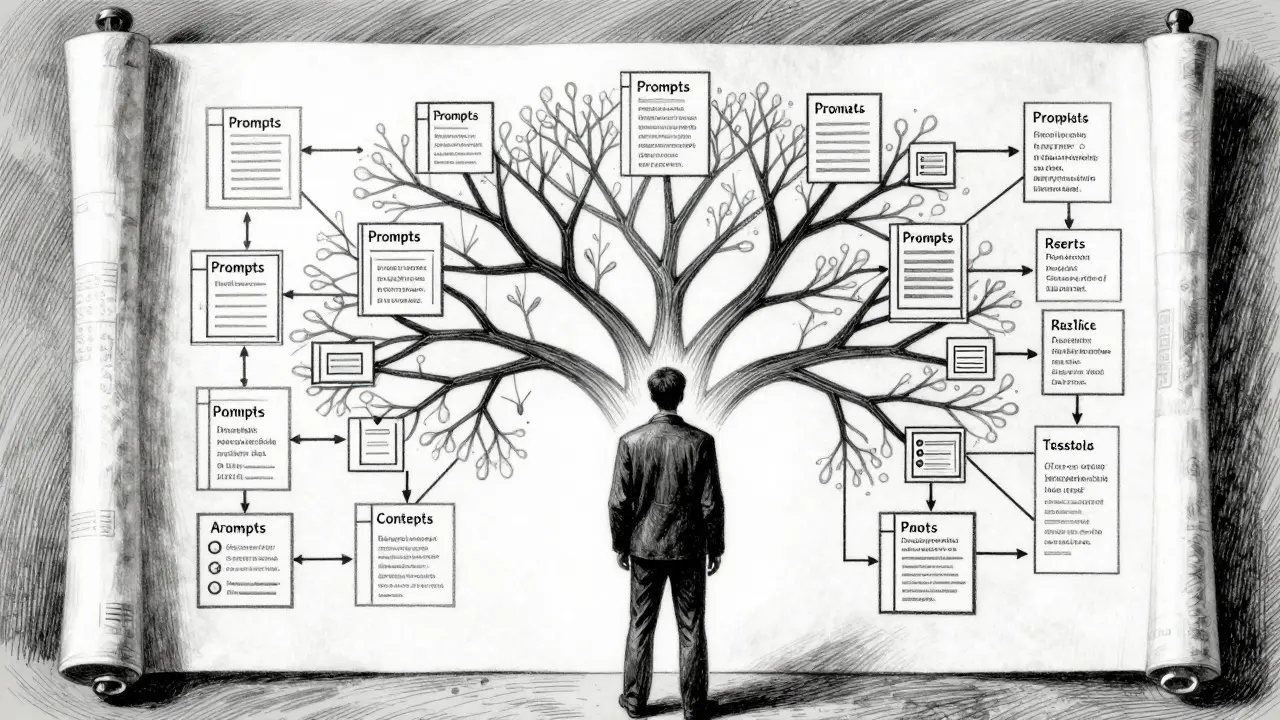
This is the core technique for modern AI code review. Instead of inspecting the final artifact (the code), you inspect the process that created it. Imagine reviewing a contractor's work. You wouldn't just look at the finished wall; you'd check their blueprint, their material receipts, and their inspection logs.
In the context of vibe coding, this means looking at the decision trail. Many advanced AI coding agents now record their sessions. Tools like Entire allow you to see exactly what happened:
- The Prompt: Did you ask the right question? Was the prompt clear?
- The Context: Which files did the AI read? Did it reference outdated documentation?
- The Tools: Did the AI run tests before writing the code? Did it search for existing implementations?
- The Attribution: Which lines were written by the AI, and which were edited by a human?
If the decision log shows the AI skipped running unit tests or ignored a relevant error handler in a previous file, you know where to look. You can spot a flawed process without reading the resulting 200 lines of Python or JavaScript. If the process was rigorous, you can trust the output more. If the process was sloppy, you dig deeper.
Risk-Based Focus: Where to Look Deeply
Not all code is created equal. A CSS tweak for a button color carries less risk than a function handling credit card transactions. Use a risk-based approach to decide how much attention to give each section.
| Risk Level | Code Type | Review Strategy |
|---|---|---|
| High | Authentication, Authorization, Payment Logic, Data Migration | Line-by-line manual review + extensive negative testing |
| Medium | Business Logic, API Endpoints, State Management | Decision review + targeted unit tests + static analysis |
| Low | UI Components, Boilerplate, Documentation, Simple Utilities | Automated tests + visual verification + light scan |
For high-risk areas, treat the AI code with extreme suspicion. Check for injection vulnerabilities, race conditions, and permission checks. For low-risk areas, rely on automation. If the linter passes and the UI looks right, you probably don't need to parse the JSX structure manually.
Demand Evidence, Not Explanations
One of the biggest traps in AI code review is accepting the AI's own explanation. If you ask the model, "Is this secure?" and it says, "Yes, this follows best practices," ignore it. LLMs are confident liars. They hallucinate facts and miss obvious flaws.
Instead, demand empirical evidence. Here’s what that looks like in practice:
- Test Coverage: Does the PR include new unit tests for the new functions? Do those tests cover edge cases (null inputs, empty arrays, network failures)?
- Static Analysis: Run tools like ESLint, Pylint, or SonarQube. These catch unused variables, type mismatches, and common security patterns instantly.
- Integration Tests: Does the feature work end-to-end? Can you create a user, make a purchase, and see the receipt?
- Performance Metrics: Did the AI introduce an N+1 query problem? Check the database logs.
If the tests pass and the scanners are clean, you have evidence the code works. You don't need to read the implementation details to believe the tests.
Leverage AI-Assisted Review Loops
Why use human brainpower to catch syntax errors when another AI can do it faster? Use a second AI model to review the first one's work. This is often called a "multi-agent" workflow.
Here’s a simple loop:
- Step 1: Agent A generates the code based on your prompt.
- Step 2: You paste the diff into Agent B (or use a tool like GitHub Copilot Chat) and ask: "Identify potential security vulnerabilities and performance bottlenecks in this diff."
- Step 3: Agent B highlights specific lines. You then manually verify only those highlighted sections.
This narrows your focus significantly. Instead of reading 500 lines, you might spend five minutes investigating three suspicious lines flagged by the reviewer AI. It’s not a replacement for human judgment, but it’s a powerful filter.
Maintain Human Ownership
Even if you don't read every line, someone must own the code. In traditional development, the author knows why they wrote something. With vibe coding, the "author" is a prompt. That’s risky.
Assign clear ownership. If an AI generates a payment module, a senior engineer on the backend team should take responsibility for it. They don't need to have typed the code, but they must be able to explain:
- What the code does.
- Why this approach was chosen over others.
- How to fix it if it breaks in production.
This accountability ensures that even if the initial review was lightweight, there's a human safety net. When bugs appear, you have a person to call, not just a chatbot history.
A Practical Checklist for Your Next PR
Next time you face a massive AI-generated pull request, try this workflow:
- Read the Summary: Understand the intent. What feature is being added?
- Check the Decision Log: Did the AI follow a sensible plan? Did it run tests during generation?
- Run Automation: Ensure all CI/CD pipelines pass (linters, unit tests, integration tests).
- Identify Hot Spots: Look for code touching auth, payments, or external APIs. Read these lines carefully.
- Verify Low-Risk Areas: Skim UI and boilerplate. Trust the tests here.
- Ask Questions: If something looks odd, ask the AI reviewer or the human owner for clarification.
- Approve or Request Changes: Based on evidence, not hunches.
This approach saves time, reduces burnout, and keeps your codebase secure. You’re not ignoring the code; you’re reviewing it smarter.
Is it safe to skip line-by-line review for AI code?
It is safe if you replace line-by-line reading with robust automated tests, static analysis, and decision audits. For critical systems like authentication or billing, partial line-by-line review is still recommended. For general utility code, relying on evidence (tests passing) is sufficient.
What is "vibe coding"?
Vibe coding refers to a development style where programmers use natural language prompts to guide AI agents in writing code, focusing on the outcome and flow rather than manual syntax typing. It emphasizes rapid iteration and high-level direction.
How do I audit an AI agent's decision process?
Use tools that provide session logs or decision trails. Look for records of the initial prompt, the files referenced, the tools executed (like test runners), and the sequence of actions taken. This helps verify that the AI had the correct context and followed a logical path.
Can AI reviewers replace human code reviews?
No. AI reviewers are excellent at catching syntax errors, style issues, and known vulnerability patterns. However, they lack business context and strategic understanding. Humans must still validate that the code meets product requirements and architectural standards.
What are the biggest risks of AI-generated code?
The main risks include hallucinated APIs (functions that don't exist), subtle security flaws (like SQL injection), lack of error handling for edge cases, and dependency on outdated libraries. These often pass basic syntax checks but fail in production.