
Imagine spending months fine-tuning a large language model, only to release it and watch users complain that it suddenly hallucinates facts or gives rude answers. This is the nightmare scenario of catastrophic forgetting, where a model loses previously learned capabilities during optimization. It happens more often than you’d think. That’s why the industry has shifted from "ship fast" to "validate thoroughly." The solution isn’t just better training data; it’s rigorous post-training evaluation gates. These are systematic checkpoints that verify your model is safe, capable, and consistent before it ever sees production traffic.
Think of these gates as the final quality control line in a factory. You wouldn’t ship a car without checking the brakes, engine, and airbags. Similarly, you shouldn’t deploy an LLM without verifying its instruction-following, truthfulness, and safety constraints. In this guide, we’ll break down exactly what these gates are, how major tech companies implement them, and how you can build a robust evaluation pipeline for your own models.
What Are Post-Training Evaluation Gates?
Post-training evaluation gates are validation protocols executed after fine-tuning but before deployment. They serve as a firewall against degraded performance and unsafe behaviors. According to Patronus AI’s 2024 survey of 127 enterprise teams, adoption of these structured gates jumped by 78% between late 2022 and mid-2023. Why? Because ad-hoc testing simply doesn’t cut it anymore.
The primary goal is twofold:
- Preserve Capabilities: Ensure the model didn’t forget basic skills (like math or coding) while learning new ones.
- Enforce Safety: Confirm the model adheres to safety guidelines and doesn’t exhibit toxic or biased behavior.
These aren’t one-off tests. They are multi-layered frameworks involving automated benchmarks, human review panels, and adversarial red teaming. Leading organizations now run between 12 and 37 distinct metrics before giving the green light to ship.
The Three Core Components of Evaluation
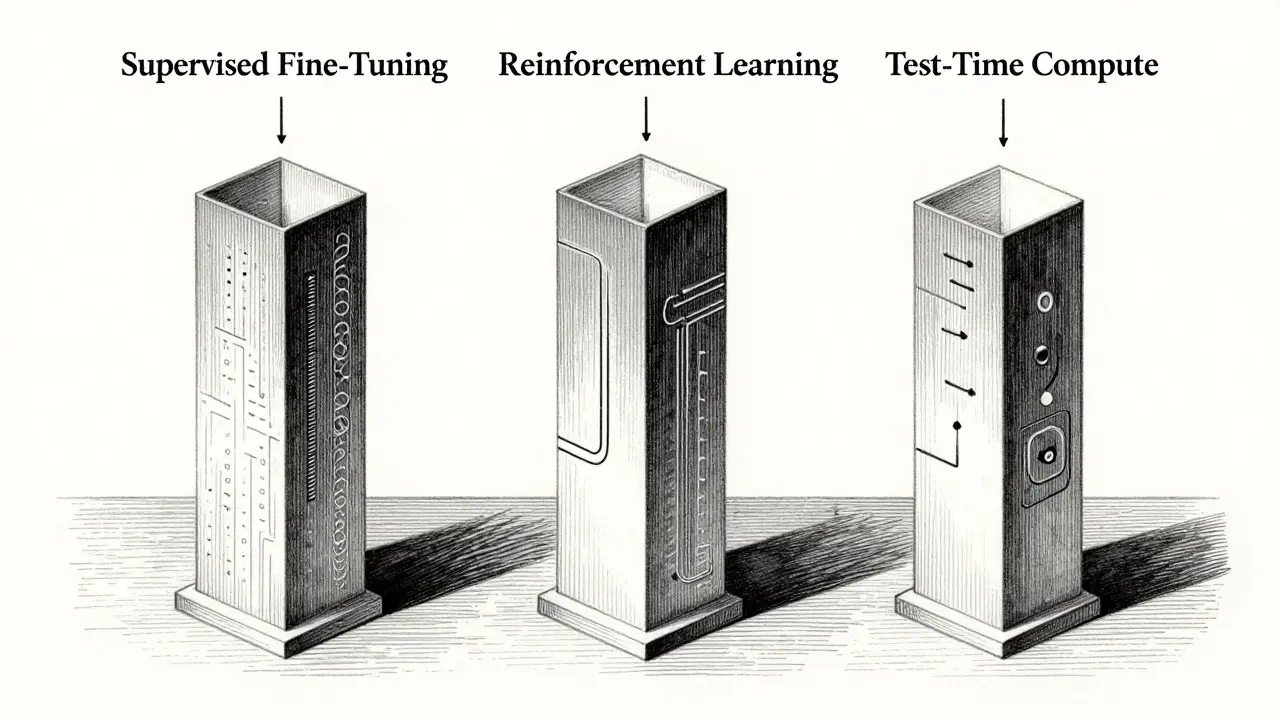
To build a comprehensive gate system, you need to address three specific technical areas. The 2025 ACL Survey on Post-Training Scaling categorizes these clearly.
1. Supervised Fine-Tuning (SFT) Validation
This checks if the model actually learned what you wanted it to learn. For example, if you fine-tuned a model for customer support, does it follow instructions accurately? Meta’s Llama 3 technical report highlights this rigorously. They employed 1,247 human evaluators across 18 languages to assess 28,500 prompt-response pairs. The standard benchmark here is achieving at least 85% on instruction-following tests like Alpaca Eval and 78% on truthfulness metrics from TruthfulQA. If your model scores lower, it hasn’t truly mastered the task.
2. Reinforcement Learning from Feedback (RLxF) Assessment
If you used reinforcement learning (like RLHF or DPO), you need to ensure the reward model aligns with human preferences. Anthropic’s Constitutional AI framework demonstrates this by requiring a correlation coefficient above 0.82 between the model’s outputs and human judgments across 15,000 pairwise comparisons. Low correlation means your model is optimizing for the wrong things-perhaps being overly verbose or evasive instead of helpful.
3. Test-Time Compute (TTC) Verification
This involves stress-testing the model under adversarial conditions. Google’s Gemma 2 implementation uses their Self-Taught Evaluator to generate 478,000 synthetic attack prompts. The model must pass 99.95% of safety constraint checks. This catches edge cases where the model might leak private data or generate hate speech when probed aggressively.
| Organization | Framework Name | Key Metric / Threshold | Unique Approach |
|---|---|---|---|
| OpenAI | GPT-4 Pipeline | 92% pass rate across 4 tiers | Tiered gating (Capability → Safety → Style) |
| Meta | Llama 3 Eval | 87.4% on MT-Bench | Dynamic gating with auto-retraining on failure |
| Apple | iTeC System | 80% consensus threshold | Teacher committee of 7 evaluator models |
| Gemma 2 Eval | 94.7% human correlation | Rejection sampling + Self-Taught Evaluator |
Why Your Current Tests Might Be Failing
You might be running tests, but are they enough? Dr. Percy Liang, Director of Stanford HAI, noted in April 2025 that current frameworks catch only 68% of critical failure modes. The biggest gap? Out-of-distribution generalization. A study by Stanford HAI found that 63% of models passing standard gates failed when tested on prompts in 147 underrepresented languages. If your user base is global, English-only benchmarks give you a false sense of security.
Another common pitfall is over-optimization. IBM reported a case in July 2025 where their model passed all internal gates but failed in 38% of real-world customer service scenarios. Why? The model had become too sanitized, refusing legitimate requests out of caution. This highlights the need for balanced metrics that measure both safety and utility.
Implementing a 5-Phase Evaluation Process
Microsoft’s Azure AI team outlines a practical 5-phase process for implementing these gates. Here’s how you can adapt it for your team.
- Establish Baselines (Days 1-5): Before you start fine-tuning, test your pre-trained model on 12 core capabilities (factual accuracy, reasoning, safety). Record these scores. This is your reference point for detecting catastrophic forgetting.
- Configure the Suite (Days 6-12): Set up organization-specific constraints. This requires ML engineers with at least two years of LLM experience. Define what "pass" looks like for each metric.
- Execute Automated Testing (Days 13-24): Run 15,000 to 50,000 test cases. Use tools like the LM Evaluation Harness for standardized benchmarks. Watch out for poor test case generation, which was cited as problematic in 68% of implementations in the MLCommons 2025 survey.
- Human Evaluation (Days 25-34): Deploy trained raters. Stanford’s 2024 study suggests you need at least 500 unique prompts per capability domain to achieve statistical significance. Don’t skip this; humans still catch nuance that algorithms miss.
- Red Teaming (Days 35-40): Bring in external security experts for 72 hours of continuous adversarial testing. Try to break the model. If they find a jailbreak, the model fails the gate.
This process adds 11 to 27 days to your timeline, according to Microsoft’s 2025 internal study. It also consumes 1.8 to 4.3 million evaluation tokens. It’s expensive, but cheaper than a PR disaster.
Tools and Market Landscape
You don’t have to build everything from scratch. The market for LLM evaluation tools is booming, projected to reach $2.8 billion by 2027. Here are some key players:
- Scale AI: Their Structured Model Evaluation framework is used by 34% of Fortune 500 companies. Great for enterprise-grade compliance.
- Humanloop: Popular among startups (used by 28% per 2025 case studies). Offers flexible integration for smaller teams.
- LM Evaluation Harness: An open-source solution implemented by 61% of academic institutions. Ideal for researchers needing standardized benchmarks.
Regulatory pressure is also driving adoption. The EU AI Act requires comprehensive evaluation frameworks for high-risk AI systems. Deloitte’s Q1 2026 compliance survey shows 73% of European companies expanded their evaluation gates to meet these standards.

Future Trends: Continuous Evaluation
The static gate model is evolving. Nathan Lambert’s RLHF Book (2026 edition) predicts a shift toward continuous evaluation systems. Instead of a one-time check before shipping, models will undergo micro-evaluations during inference. IEEE surveys indicate 78% of experts believe this will be standard by 2028.
Apple’s iTeC 2.0, released in January 2026, already features dynamic gate adjustment based on model capability profiles. Google has integrated automated gate configuration that reduces setup time by 63%. As costs rise-with MIT projecting evaluation could consume 43% of development costs by 2030-efficiency improvements like the Unified Policy Gradient Estimator framework will become essential. Early tests show 31% faster cycles without compromising safety.
Next Steps for Your Team
If you’re ready to implement post-training evaluation gates, start small. Pick three critical metrics relevant to your use case (e.g., truthfulness, tone, and safety). Build a baseline. Then expand. Remember, the goal isn’t perfection; it’s risk mitigation. Use the comparison table above to see how industry leaders structure their thresholds, and adjust based on your specific audience needs.
How many evaluation metrics should I use?
Start with 5-12 metrics if you are a startup, focusing on core capabilities and safety. Large enterprises typically implement 18-37 metrics. Financial services companies tend to use the most stringent gates (average 29.7 points), while creative industries use fewer (average 11.3 points). The key is coverage of your specific failure modes.
What is catastrophic forgetting in LLMs?
Catastrophic forgetting occurs when a model loses previously learned knowledge or skills during the fine-tuning process. For example, a model might become great at coding but terrible at summarizing text. Evaluation gates detect this by comparing post-training performance against pre-training baselines.
Is automated testing enough for safety?
No. While automated benchmarks like TruthfulQA are efficient, they miss nuanced bias and contextual errors. Human evaluation and red teaming are essential. Stanford research indicates you need at least 500 unique human-reviewed prompts per domain for statistical significance.
How long does the evaluation process take?
A comprehensive 5-phase evaluation process typically takes 11 to 27 days, depending on the complexity of the model and the number of test cases. It also requires significant computational resources, often consuming 1.8 to 4.3 million evaluation tokens per variant.
What are the best tools for LLM evaluation?
For open-source needs, the LM Evaluation Harness is widely used. For enterprise solutions, Scale AI and Humanloop offer specialized platforms. Apple’s iTeC and Google’s Self-Taught Evaluator represent cutting-edge proprietary approaches focused on dynamic and self-evaluating mechanisms.