Running a Large Language Model (LLM) in your local notebook is one thing. Serving it to thousands of users with sub-second latency is an entirely different beast. If you have tried to deploy a model like Qwen3 235B is a massive open-weight language model requiring approximately 600 GB of VRAM for full performance on standard hardware, you know the pain. The memory runs out, the context window collapses, or the bill from your cloud provider looks like a typo.
As of mid-2026, the landscape for serving these models has stabilized around specific architectural patterns. You are no longer just buying compute; you are engineering a pipeline that balances memory bandwidth, network throughput, and inference latency. This guide breaks down exactly what you need to build that infrastructure, from selecting the right GPUs to managing costs without sacrificing quality.
The Hardware Reality: VRAM Is King
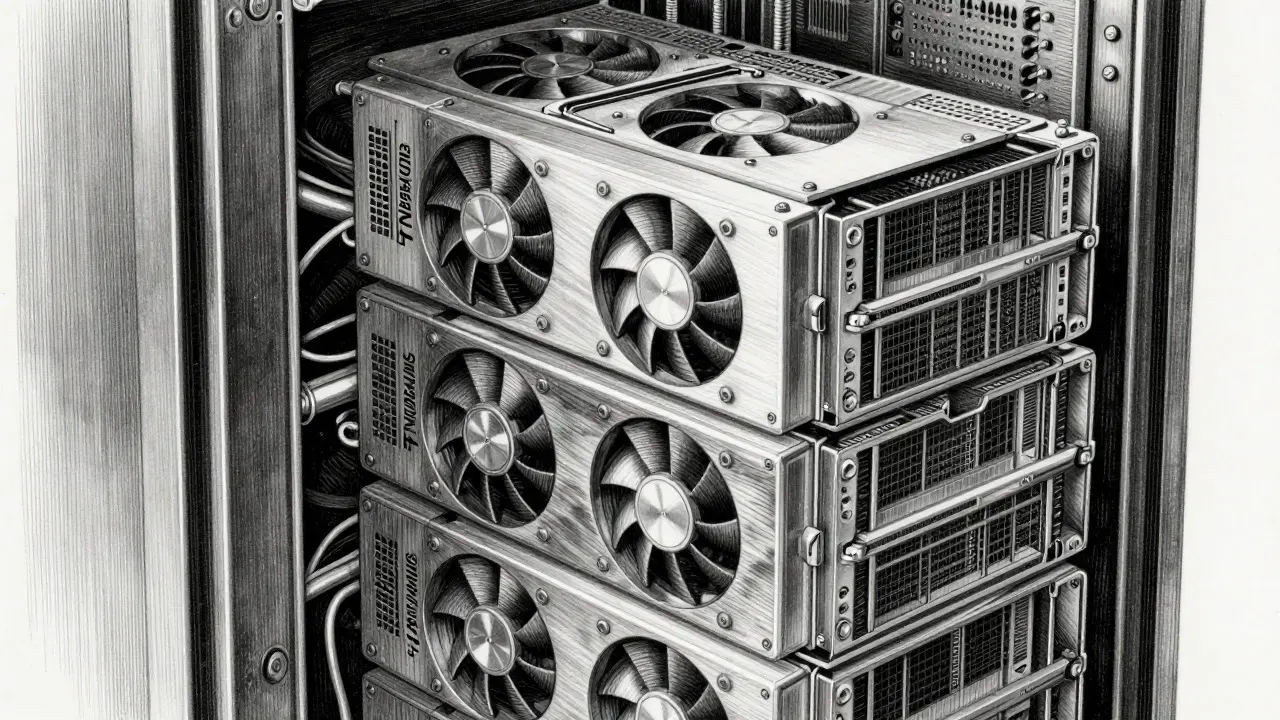
When designing infrastructure for LLMs, forget CPU cores for a moment. Your primary constraint is Video RAM (VRAM). The model weights must reside in memory to be accessed quickly during inference. If the model doesn't fit in VRAM, the system swaps to slower system RAM or disk, causing latency spikes that kill user experience.
For smaller models, like those with 7 billion parameters, a single modern GPU might suffice. But as soon as you move into the medium-to-large range, the math gets strict. According to analysis from late 2024 and early 2025, a model like Qwen3 235B needs roughly 600 GB of VRAM. That means you cannot run this on a single consumer-grade card. You need a cluster.
| Model Parameter Count | Minimum VRAM Needed | Recommended GPU Setup | Quantization Impact |
|---|---|---|---|
| 7 Billion (7B) | 16-24 GB | 1x NVIDIA A10G or H100 | Fits easily on consumer cards (RTX 4090) |
| 70 Billion (70B) | 140-180 GB | 2-4x NVIDIA A100/H100 | 4-bit quantization allows single high-end GPU |
| 235+ Billion (235B+) | 470-600+ GB | 8+ GPUs (Multi-node clusters) | Requires tensor parallelism across nodes |
The type of GPU matters just as much as the amount of memory. Bandwidth is the bottleneck. An NVIDIA A100 offers 1.6 TB/s of memory bandwidth, while the H100 doubles that to 3.35 TB/s. For large models, the difference isn't marginal; it determines whether your Time to First Token (TTFT) is 200 milliseconds or 2 seconds. If you are building for 2026, prioritize H100s or the newer Blackwell architecture chips, which promise further efficiency gains for LLM workloads.
Storage Architecture: Tiering for Speed and Cost
You might think storage is secondary, but loading a 10GB+ model file takes time. If your users wait 30 seconds for the model to load every time they start a session, they will leave. The solution is a tiered storage strategy.
First, you need fast access for active training and immediate inference caching. Non-Volatile Memory Express (NVMe) SSDs are non-negotiable here. They provide the throughput needed to stream model weights into VRAM quickly. On AWS, for example, NVMe-based storage costs around $0.084 per GB per month. It’s expensive, but necessary for performance.
Second, you need bulk storage for historical data, logs, and archived model versions. Object storage, like Amazon S3, handles this at a fraction of the cost-roughly $0.023 per GB per month. The key is automation. Your infrastructure should automatically move cold data to object storage and keep hot data on NVMe. This hybrid approach can reduce overall storage costs by 30-50% without impacting the speed of active operations.
Networking: The Hidden Bottleneck
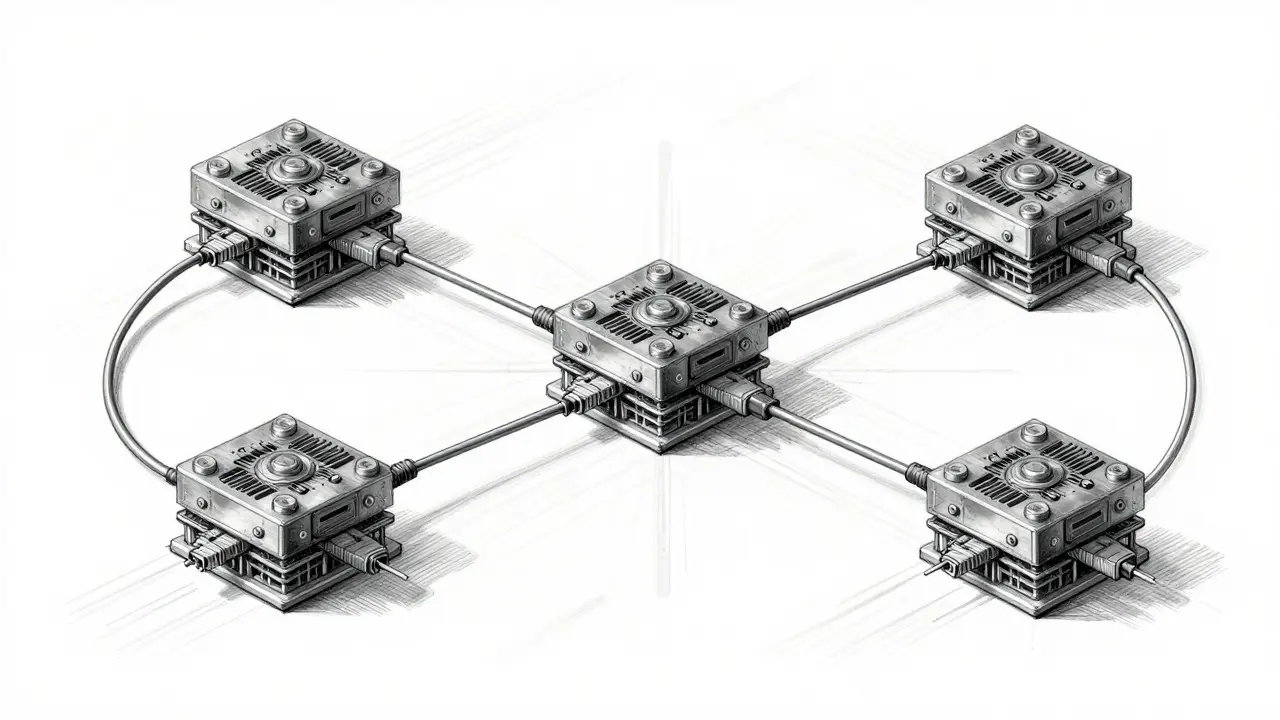
If you are running a model on a single server, networking is easy. But most production deployments of large models require distributed computing. When you split a model across multiple GPUs or servers, those components must talk to each other constantly during inference. This communication happens over the network.
Standard Ethernet connections will choke your performance. You need high-speed interconnects, typically 100 Gbps or higher. InfiniBand is often preferred in dedicated AI clusters because it offers lower latency and higher throughput than traditional TCP/IP networks. If your internal network latency is high, the GPUs will sit idle waiting for data, wasting money and slowing down responses.
Dr. Emily Zhang, an AI Infrastructure Researcher, warns that distributed GPU deployments across different data centers often introduce too much latency for interactive applications. Keep your inference cluster localized within a single availability zone or data center to maintain sub-500ms response times.
Software Stack: Containerization and Orchestration
Hardware is useless without the right software layer. You need to package your model, its dependencies, and the environment into a container. Docker is the standard, but LLM containers are heavy. They often exceed 10GB due to the model weights and CUDA libraries.
To manage these containers at scale, Kubernetes is the industry standard. It allows you to orchestrate hundreds of pods, handle failures, and scale dynamically. However, Kubernetes alone isn't enough for AI. You need specialized operators that understand GPU resources. Tools like NVIDIA’s Kubernetes Device Plugin ensure that GPUs are correctly allocated to pods.
For the actual serving engine, raw PyTorch or TensorFlow is rarely efficient enough. You should use optimized inference engines like vLLM or Text Generation Inference (TGI). These frameworks implement techniques like PagedAttention, which manages memory more efficiently than traditional methods, allowing you to serve more concurrent requests with the same hardware.
Optimization Techniques: Quantization and Batching
Even with the best hardware, costs can spiral. Optimization is not optional; it is survival. The two most effective techniques are quantization and batching.
Quantization reduces the precision of the model's weights. Instead of using 16-bit floating-point numbers (FP16), you convert them to 8-bit (INT8) or even 4-bit (INT4). This cuts memory usage by half or even a quarter. A study by Neptune.ai noted that while 4-bit quantization might sacrifice 1-5% accuracy, it allows you to run larger models on cheaper hardware. For many enterprise applications, this trade-off is acceptable.
Batching involves processing multiple user requests simultaneously. Continuous batching, supported by engines like vLLM, allows new requests to join the batch as soon as space frees up, rather than waiting for an entire batch to finish. This increases throughput by 3-5x, directly reducing the cost per token.
Deployment Models: Cloud vs. On-Premise vs. Hybrid
Where do you host this infrastructure? There are three main paths, each with distinct trade-offs.
- Cloud Managed Services: Platforms like AWS SageMaker or Google Vertex AI handle the heavy lifting. You pay a premium-often starting at $12/hour for basic instances and exceeding $100,000/month for enterprise setups-but you gain speed and ease of management. This is ideal for startups or teams without deep MLOps expertise.
- On-Premise / Self-Hosted: Buying your own servers gives you maximum control and data security. A single NVIDIA A100 server costs around $20,000, while a multi-GPU cluster can exceed $500,000. While the upfront cost is high, long-term operational costs can be 40-60% lower than cloud providers if you maintain high utilization rates. However, average GPU utilization in poorly managed on-prem setups hovers around 35-45%, negating these savings.
- Hybrid Approach: By 2025, 68% of enterprises had adopted hybrid models. Use on-premise hardware for steady, baseline traffic and burst to the cloud during peak loads. This balances cost-efficiency with scalability.
Security and Observability
Serving LLMs introduces unique security risks. Prompt injection attacks, where users trick the model into revealing sensitive data or executing unauthorized actions, are common. Your API gateway must include robust input validation and filtering.
Additionally, you need observability. Standard monitoring tools won't tell you why a model response was slow. You need to track metrics like tokens per second, queue length, and GPU memory fragmentation. Tools like Logic Monitor and specialized AI observability platforms help you detect anomalies before they become outages. Implement health checks with automatic failover to maintain 99.9% uptime.
Future-Proofing Your Infrastructure
The field is moving fast. Specialized AI chips, such as NVIDIA’s Blackwell architecture announced in early 2025, offer significant performance improvements over previous generations. When planning your infrastructure, choose hardware that supports these future upgrades. Avoid proprietary lock-in where possible by using open-source standards for model formats and inference engines.
Also, prepare for Retrieval-Augmented Generation (RAG). Most production LLMs don't rely solely on their training data; they pull from vector databases like Pinecone or Weaviate. Ensure your network architecture can handle the additional latency introduced by database lookups without degrading the user experience.
How much VRAM do I need for a 70B parameter model?
For a 70B parameter model using FP16 precision, you need approximately 140 GB of VRAM. This typically requires 2 to 4 NVIDIA A100 or H100 GPUs. If you use 4-bit quantization, you can reduce this requirement to around 35-40 GB, allowing it to run on a single high-end consumer GPU like an RTX 4090, though with slightly reduced accuracy.
Is it cheaper to self-host LLMs or use cloud APIs?
It depends on your scale and consistency of usage. For low-volume or sporadic usage, cloud APIs (like OpenAI or Anthropic) are cheaper because you only pay for what you use. For high-volume, consistent traffic, self-hosting or reserved cloud instances can save 40-60% compared to on-demand cloud pricing. However, self-hosting requires significant upfront capital expenditure and MLOps expertise.
What is the impact of quantization on model performance?
Quantization reduces the precision of model weights, typically from 16-bit to 8-bit or 4-bit. This significantly reduces memory usage and increases inference speed. The trade-off is a slight loss in accuracy, usually between 1% and 5%. For most general-purpose applications, this loss is negligible, making quantization a highly effective optimization strategy.
Why is memory bandwidth more important than raw compute power for LLMs?
LLM inference is memory-bound, not compute-bound. The GPU spends most of its time moving model weights from VRAM to the processing units rather than performing calculations. Therefore, higher memory bandwidth (measured in TB/s) allows the GPU to feed data faster, resulting in higher tokens-per-second output and lower latency. NVIDIA H100 GPUs are preferred over A100s largely due to their superior bandwidth.
What is the role of Kubernetes in LLM deployment?
Kubernetes orchestrates the deployment of containerized LLM services. It manages resource allocation, ensures high availability through pod replication, and enables autoscaling based on traffic demand. With specialized operators, Kubernetes can also handle GPU scheduling, ensuring that containers requesting specific GPU types are placed on compatible nodes.