
It is not enough to buy a chatbot. For the public sector, adopting generative AI means navigating a maze of executive orders, state mandates, and procurement rules that have exploded in complexity over the last two years. If you are a government IT leader or policy maker, the question has shifted from "should we use this?" to "how do we do it without getting sued, audited, or stuck with legacy systems?" The landscape is no longer theoretical; it is operational across all 50 states, Puerto Rico, and Washington DC.
The stakes are high because the regulatory environment has accelerated dramatically. In 2024 alone, U.S. federal agencies introduced 59 AI-related regulations-more than double the count from 2023-and these were issued by twice as many agencies. Globally, legislative mentions of AI rose by 21.3% across 75 countries since 2023. This isn't just about compliance; it's about building a governance structure that allows innovation while protecting the public interest.
Key Takeaways
- Procurement is shifting: The GSA and OMB are creating unified toolboxes to standardize how agencies buy AI, moving away from ad-hoc vendor contracts.
- Risk-based regulation is emerging: State frameworks like Washington’s distinguish between low-risk and high-risk AI, applying stricter safeguards only where necessary.
- Transparency demands data disclosure: Federal mandates now require researchers to disclose non-proprietary datasets used in AI models to mitigate bias.
- Accountability requires red-teaming: Executive Order 14319 mandates rigorous testing (red-teaming) to ensure AI outputs are unbiased and trustworthy.
- Infrastructure gaps remain: About 60% of federal agencies still struggle to integrate AI into production due to legacy system constraints.
The New Procurement Landscape: From Ad-Hoc to Standardized
For years, government agencies bought software like they bought office supplies: individually, often without a clear strategy for integration. That era is ending. The current approach, driven by America's AI Action Plan, mandates that agencies ensure employees whose work could benefit from frontier language models have access to appropriate tools and training. But "access" doesn't mean "chaos."
The General Services Administration (GSA) is developing an AI procurement toolbox in coordination with the Office of Management and Budget (OMB). Why does this matter? Because uniformity reduces risk. When every agency uses similar evaluation criteria for AI vendors, it becomes easier to compare bids, negotiate better terms, and avoid lock-in with proprietary systems. The Advanced Technology Transfer and Capability Sharing Program further accelerates this by allowing rapid transfer of AI capabilities between agencies, meaning one department’s success can become another’s starting point.
However, procurement isn't just about buying licenses. It's about ensuring the vendor can support the specific workflow. A common pitfall is purchasing a general-purpose LLM without considering the integration costs with existing case management or citizen service platforms. Agencies must now evaluate not just the model's accuracy, but its compatibility with their digital infrastructure.
Transparency: Beyond the Black Box
One of the biggest hurdles in public trust is the "black box" nature of many AI models. How did the algorithm decide to prioritize one citizen's application over another? To address this, transparency requirements have moved from voluntary best practices to mandatory disclosures.
Federally funded researchers are now required to disclose non-proprietary, non-sensitive datasets used during AI model development. This is a significant shift. By opening up the training data (within legal limits), agencies can audit for biases that might otherwise go unnoticed. For example, if a predictive policing tool relies on historical arrest data, disclosing that dataset allows independent reviewers to assess whether the tool perpetuates systemic inequities.
Washington State’s Interim Report, released in December 2025, adds another layer by recommending that developers disclose how training data is processed. This includes details on data cleaning, weighting, and exclusion criteria. The goal is simple: if you want to use AI in the public sector, you need to show your work. This mirrors broader trends in financial regulation, where algorithmic trading firms must explain their decision-making processes to regulators.

Accountability and the Risk-Based Approach
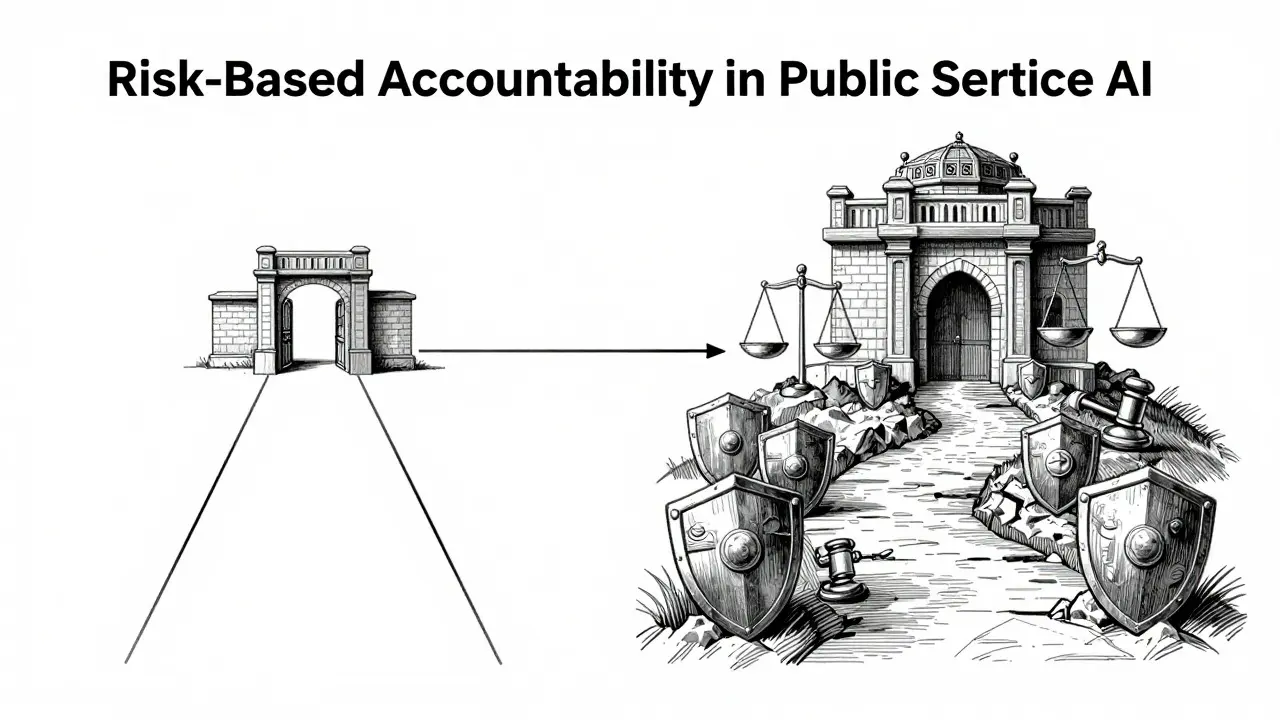
Not all AI applications carry the same weight. A chatbot answering FAQs about tax deadlines poses a different risk profile than an AI system determining eligibility for healthcare benefits. Recognizing this, Washington State’s AI Task Force established a risk-based framework that distinguishes between "low-risk" and "high-risk" AI systems.
High-risk systems-those that significantly impact people's lives, health, safety, or fundamental rights-require additional safeguards, restrictions, or even outright bans in certain contexts. These systems must adopt recognized governance frameworks like the NIST AI Risk Management Framework or ISO/IEC 42001. Low-risk systems, meanwhile, face lighter oversight, allowing for faster deployment in areas like internal document summarization or routine customer service interactions.
This tiered approach prevents regulatory paralysis. If every AI tool had to undergo the same rigorous review as a life-or-death medical diagnostic, adoption would stall. By focusing scrutiny where the impact is highest, governments can balance innovation with accountability. The NIST AI Risk Management Framework provides a structured way to identify, measure, and manage these risks, making it a critical component of any public sector AI strategy.
Federal Mandates: Executive Orders and Their Impact
The federal government has been actively shaping the AI landscape through a series of executive orders. President Trump's April 2025 Executive Orders 14277 and 14278 initiated America's AI Action Plan, focusing on accelerating innovation, building infrastructure, and leading international diplomacy. But perhaps the most impactful recent directive is Executive Order 14319, signed on July 23, 2025, titled "Preventing Woke AI in the Federal Government."
While the title may seem political, the practical implication is technical: agencies must implement "unbiased AI principles" and conduct red-teaming of AI capabilities. Red-teaming involves stress-testing AI models to find edge cases where they might produce biased or incorrect outputs. This is crucial for maintaining public trust. If an AI system consistently disadvantages a particular demographic group, the resulting backlash can undermine the entire program.
Additionally, OMB Memorandum M-25-22 on "Driving Efficient Acquisition of Artificial Intelligence in Government" sets the tone for how agencies should procure and deploy AI. It emphasizes efficiency and cost-effectiveness, reminding leaders that AI is not just a tech project but a budget line item. Agencies must demonstrate value early and often to justify continued investment.
Implementation Challenges: The Legacy System Gap
Despite the momentum, implementation remains difficult. Presidio’s 2025 analysis highlights a critical gap: many agencies have adopted foundational cloud infrastructure but remain unprepared to integrate AI into production systems. Approximately 60% of federal agencies still struggle with legacy systems that weren't designed with AI in mind.
This creates a bottleneck. You can buy the best AI model in the world, but if it can't talk to your 20-year-old database, it's useless. The solution isn't just technology; it's organizational change. Agencies need to build an "enterprise layer of AI" that acts as a central brain, connecting disparate systems and providing a unified interface for AI services. This requires not just IT upgrades but also workforce training. The America's AI Action Plan addresses this through a talent-exchange program, allowing federal staff to move between agencies to fill specialized AI roles, such as data scientists and software engineers.
Another challenge is change management. Public sector employees are often skeptical of new technologies, especially when those technologies threaten to alter their workflows. Successful implementations involve co-designing AI solutions with end-users, ensuring the technology augments rather than replaces human judgment. This collaborative approach builds buy-in and reduces resistance.
Comparing Federal and State Approaches
The U.S. has a complex patchwork of AI regulations, with federal and state levels sometimes taking different approaches. Understanding these differences is crucial for multi-jurisdictional agencies or vendors operating across state lines.
| Aspect | Federal Level | State Level (e.g., Washington) |
|---|---|---|
| Primary Focus | Infrastructure, Innovation, International Leadership | Risk-based Regulation, Consumer Protection |
| Key Mechanism | Executive Orders, OMB Mandates, GSA Procurement Toolbox | AI Task Force Recommendations, Risk Tiering |
| Transparency Requirement | Dataset Disclosure for Federally Funded Research | Processing Methodology Disclosure for High-Risk Systems |
| Accountability Framework | Red-teaming, Unbiased AI Principles (EO 14319) | NIST AI RMF / ISO/IEC 42001 Adoption for High-Risk |
| Investment Scale | $30B AWS Infrastructure Investment, Global Competitiveness | Targeted Grants, Local Pilot Programs |
The federal approach prioritizes scale and speed, leveraging massive investments like the $30 billion AWS commitment to build out AI infrastructure. This top-down strategy aims to make the U.S. a global leader in AI. In contrast, state approaches like Washington’s are more granular, focusing on specific risks and consumer impacts. This bottom-up approach ensures that local nuances are addressed, but it can create compliance complexity for organizations operating in multiple states.
Best Practices for Public Sector Leaders
Navigating this landscape requires a strategic mindset. Here are actionable steps for public sector leaders looking to implement generative AI responsibly:
- Conduct a Readiness Assessment: Before buying anything, evaluate your infrastructure. Can your systems handle API calls? Do you have clean, structured data? If not, fix the foundation first.
- Adopt a Risk-Based Strategy: Classify your AI use cases into low, medium, and high risk. Apply proportional oversight. Don't waste resources auditing a spell-checker with the same rigor as a welfare eligibility engine.
- Standardize Procurement: Use the GSA AI procurement toolbox to streamline vendor selection. Look for vendors who offer transparent documentation and support for open standards.
- Invest in Talent Exchange: Leverage federal talent programs to bring in specialized skills. Internal training is essential, but external expertise can accelerate deployment.
- Prioritize Red-Teaming: Make rigorous testing part of your deployment pipeline. Identify biases and edge cases before they reach the public.
- Maintain Human Oversight: Ensure that AI decisions, especially in high-risk areas, are reviewed by humans. AI should assist, not replace, public servants.
Future Trajectory and Global Context
The future of public sector AI is bright but competitive. Globally, governments are investing at unprecedented scales. Canada pledged $2.4 billion, China launched a $47.5 billion semiconductor fund, France committed €109 billion, and Saudi Arabia’s Project Transcendence represents a $100 billion initiative. This global race creates pressure for U.S. agencies to act quickly but wisely.
By 2027, sustained government investment is projected to exceed $200 billion globally. As regulatory frameworks mature, generative AI will become foundational to public sector operations. The key to success lies in balancing innovation with accountability. Agencies that master this balance will deliver more efficient, equitable, and responsive services to citizens. Those that don’t risk falling behind both technologically and politically.
The path forward is clear: standardize procurement, enforce transparency, apply risk-based accountability, and invest in the human capital needed to drive these changes. The tools are here. The policies are in place. Now, the execution begins.
What is the primary difference between federal and state AI regulations?
Federal regulations focus on broad infrastructure, innovation acceleration, and standardized procurement through entities like the GSA and OMB. State regulations, such as Washington’s, tend to be more granular, focusing on risk-based classification and specific consumer protections for high-impact AI systems.
Why is red-teaming important for public sector AI?
Red-teaming involves stress-testing AI models to uncover biases or errors before deployment. In the public sector, where decisions affect citizens' rights and services, catching these issues early is crucial for maintaining trust and ensuring fairness, as mandated by Executive Order 14319.
How can agencies overcome legacy system challenges?
Agencies should build an "enterprise layer of AI" that acts as a middleware, connecting modern AI tools with older legacy systems. This approach avoids the need to replace entire infrastructure stacks immediately, allowing for gradual modernization while enabling AI integration.
Agencies should build an "enterprise layer of AI" that acts as a middleware, connecting modern AI tools with older legacy systems. This approach avoids the need to replace entire infrastructure stacks immediately, allowing for gradual modernization while enabling AI integration.
What are the key components of the GSA AI procurement toolbox?
The toolbox includes standardized evaluation criteria, contract templates, and guidelines for assessing AI vendor capabilities. It aims to reduce procurement time and ensure consistency across federal agencies, making it easier to compare bids and negotiate favorable terms.
How does the risk-based approach work in practice?
Agencies classify AI systems based on their potential impact. Low-risk systems (e.g., internal drafting tools) face minimal oversight. High-risk systems (e.g., benefits eligibility determinations) require adherence to frameworks like NIST AI RMF, regular audits, and human oversight. This ensures resources are focused where they matter most.