
You send a message to an AI assistant. It processes your query, generates a response, and logs the interaction for debugging or analytics. That log file now contains your name, your account number, and maybe a snippet of a medical condition you mentioned in passing. For years, we treated these logs as harmless metadata. But in 2026, with large language models (LLMs) handling billions of requests daily, those "harmless" logs are a massive liability. Token-Level Logging Minimization is the practice of scrubbing sensitive data at the individual word-piece level before it ever hits your storage system. It’s not just about hiding names; it’s about preventing context leaks that simple filters miss.
If you’re running an enterprise LLM application, you’ve likely heard of data masking. But standard masking often fails in conversational AI. Why? Because LLMs rely on context. If you mask a name in turn one but leave a reference like "his wife" or "the patient" in turn five, you’ve still exposed private information. This article breaks down how token-level minimization works, why it’s becoming the industry standard for privacy compliance, and how you can implement it without tanking your model’s performance.
Why Standard Data Masking Fails in LLMs
Traditional database security uses column-level encryption or static masking. You hide the credit card number in the database row. Simple. Effective. But LLMs don’t work in rows; they work in sequences of tokens. A token is the smallest unit of text a model understands-often a part of a word, like "un", "believ", and "able". When you log an LLM interaction, you aren’t just storing structured fields; you’re storing unstructured natural language where sensitive info is woven into the syntax.
The European Data Protection Board (EDPB) highlighted this risk in their April 2025 publication, noting that 78% of enterprise LLM implementations had inadequate logging controls. The problem isn’t just obvious identifiers like Social Security Numbers. It’s quasi-identifiers. Think about a prompt like: "My doctor, Dr. Smith, prescribed me Zoloft." A basic regex filter might catch "Dr. Smith" if you have a list of doctors, but it won’t catch "Zoloft" as personally identifiable health data unless you understand the medical context. Worse, multi-turn conversations create indirect links. An innocuous question in turn 5 could indirectly reference private data provided in turn 1. If you only look at single messages, you miss the forest for the trees.
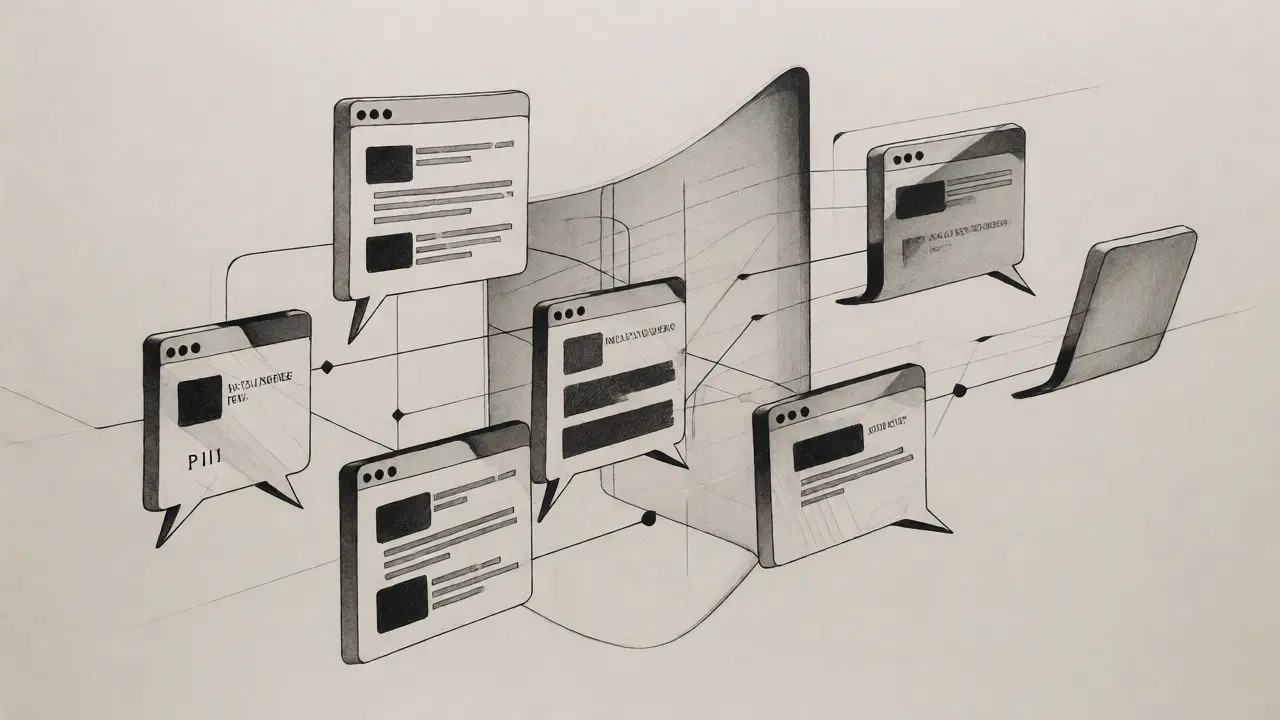
This is where token-level logging minimization steps in. Instead of treating the entire prompt as a blob, you analyze each token. You identify which specific tokens carry PII (Personally Identifiable Information) and replace them with consistent placeholders. This preserves the structure of the sentence while removing the identity. It allows your engineering team to debug why the model failed to answer a question about "NAME_1"’s prescription without knowing that NAME_1 was John Doe.
How Deterministic Tokenization Works
The most effective method for this today is deterministic tokenization. Unlike random hashing, which changes every time you hash the same input (making it hard to track users across sessions), deterministic tokenization maps the same input to the same output consistently. Protecto AI’s research shows this approach reduces privacy incidents by 92% compared to unmodified logging systems.
Here’s the workflow:
- Field Identification: You define what counts as sensitive. Direct identifiers (emails, phone numbers) are easy. Quasi-identifiers (job titles, locations, specific product names) require more nuanced rules.
- Token Format Selection: You choose a replacement format. Common patterns include
NAME_####,ID_, orEMAIL_HASH. The key is consistency. If "John Smith" becomes "USER_42" in one log, it must become "USER_42" in all subsequent logs so analysts can trace the conversation flow. - Secure Mapping Vault: You store the actual values in a highly secure, encrypted vault that is separate from your main log storage. Only authorized personnel with specific keys can reverse the tokens back to real names.
- Pipeline Integration: This is critical. You must tokenize before the data reaches the LLM for processing, or at least before it hits the logging layer. Then, you reverse the tokens only after results are produced and sent back to the user. As Protecto AI notes, "tokenize before data reaches the LLM, and reverse it only after results are produced."
There are alternatives. Naïve rule-based substitution is fast but less secure; a knowledgeable attacker can often reverse simple patterns. Contextual token manipulation is more secure because it uses semantic understanding to decide if a token is sensitive based on its neighbors. For example, "Apple" is a fruit in one sentence and a company in another. Contextual methods preserve 94.2% of original model accuracy while offering better privacy preservation than rule-based approaches, according to the 2024 PrivateNLP workshop.
Performance Overhead vs. Privacy Gains
Engineers hate latency. Every millisecond matters when you’re trying to keep user engagement high. Does adding a token-scanning layer slow things down? Yes, but barely.
IBM’s technical analysis from October 2024 confirms that token-level filtering adds approximately 12-18ms of latency per request. In a world where full data encryption can add 45-60ms, this is a negligible cost. Enterprise customers consistently accept this 0.8-1.3% performance overhead because the alternative-a GDPR fine or a reputation-damaging data leak-is far more expensive.
| Approach | Latency Overhead | Privacy Preservation | Complexity | Best Use Case |
|---|---|---|---|---|
| Token-Level Minimization | 12-18ms | High (Context-aware) | Moderate | Enterprise apps needing audit trails |
| Full Data Encryption | 45-60ms | Very High | Low | Static databases, non-LLM services |
| Sample-Level Filtering | 5-10ms | Low (Misses context) | Low | Simple chatbots, low-risk queries |
| No Logging | 0ms | Maximum | N/A | Debugging impossible |
The trade-off is clear. You lose a tiny bit of speed to gain massive visibility into your system’s behavior without exposing user secrets. Plus, unlike sample-level defenses that operate on the whole input/output block, token-level approaches achieve 37.6% better safety preservation while maintaining higher task performance, as shown in the TOSS framework benchmarks.
The Multi-Turn Conversation Trap
Here is where many implementations fail. You successfully scrubbed the first message. Great. But LLMs remember context. If a user says, "I live in Albuquerque," and then asks, "What’s the weather here?", the second message doesn’t contain the location. However, the context window does. If you log the second message without considering the first, you might miss that "here" refers to a specific, potentially sensitive location linked to the user’s session.
Galileo AI’s case study found that 73% of initial implementations failed to properly track contextual references across conversation turns. They call this "multi-turn drift." To fix this, you need session-level logging. Your system must scan the combination of older and newer messages. A semantic scanner should flag if a combination of tokens risks revealing something, even if no single token looks suspicious. Protecto AI’s "Multi-Turn Memory Scanning 2.0" release in January 2026 addressed this by reducing false positives by 34%, using improved semantic analysis to understand how context shifts over time.
Professor Michael Chen from MIT warns that token-level approaches can create "false confidence" if implemented without comprehensive session monitoring. Perfect single-turn filtering means nothing if the aggregate conversation reveals the user’s identity through accumulation. You must monitor the drift.
Regulatory Pressure and Market Adoption
This isn’t just best practice; it’s becoming law. The EU AI Act requires "data minimization by design." GDPR Article 32 mandates appropriate technical measures to ensure security. The EDPB explicitly recommends "token-level filtering that redacts secrets or identifiers before they're processed by the model" as a minimum standard for compliance.
Adoption is accelerating. Gartner reports that 68.3% of Fortune 500 companies now use token-level privacy controls, up from much lower numbers just two years ago. Highly regulated industries lead the pack: 87% of financial services and healthcare organizations have implemented these controls, compared to just 49% in manufacturing. The market for LLM privacy solutions is projected to hit $4.87 billion by 2026, driven largely by these compliance needs.
If you’re in retail or manufacturing, you might think you’re safe. But consider the ripple effect. If your vendor uses an LLM provider that leaks your customer data, you’re liable too. Supply chain privacy is real. And as homomorphic encryption techniques integrate with tokenization (expected widely by late 2026), the barrier to entry will drop further, making it harder to justify skipping this step.

Implementation Checklist for Engineers
Ready to deploy? Don’t just plug in a library and walk away. Here’s a practical roadmap based on successful enterprise deployments:
- Define Your Sensitive Classes: Start broad. Names, emails, phones, SSNs, addresses, dates of birth, medical conditions, financial figures. Refine later.
- Choose a Consistent Tokenizer: Ensure your tokenizer handles edge cases. What happens with nicknames? "Bob" vs "Robert"? Decide if they map to the same token ID.
- Implement Session Tracking: Do not log messages in isolation. Link them via a session ID and scan the active context window for leakage risks.
- Build Evaluation Sets: Create a test suite of known leakage patterns. Run your tokenizer against these regularly. Galileo AI suggests testing against the OWASP Top 10 LLM Security Risks to reduce false negatives.
- Secure the Reverse Map: The table linking tokens to real values must be encrypted at rest and in transit. Access should be strictly role-based.
- Monitor for Drift: Set alerts for unusual token density. If a log suddenly has 50 tokens replaced instead of 5, something might be wrong with your detection logic.
Expect a learning curve. IBM reports developers need 35-45 hours of training to implement robust token-level minimization effectively. Budget for that. Also, note that open-source alternatives often lack documentation quality compared to commercial leaders like Protecto AI or Lasso Security, which score significantly higher on reviewer platforms for implementation guidance.
Frequently Asked Questions
Does token-level logging affect the LLM's ability to answer questions?
Generally, no. Modern tokenization replaces sensitive entities with placeholders that maintain the syntactic structure of the sentence. For example, replacing "John" with "USER_1" keeps the subject position intact. Studies show that contextual token manipulation maintains 94.2% of original model accuracy. The model learns to treat the placeholder as a variable rather than a specific name, which is usually sufficient for logical reasoning tasks.
Is tokenization reversible?
Yes, if you use deterministic tokenization. The system stores a mapping between the token (e.g., "ID_55") and the original value (e.g., "Jane Doe") in a secure vault. Authorized administrators can reverse the process to view the original data for auditing purposes. Randomized tokenization, however, is often irreversible by design to maximize privacy, though this makes debugging harder.
How does this differ from standard API rate limiting or filtering?
Rate limiting controls traffic volume. Standard filtering often blocks entire requests containing bad words or PII. Token-level minimization allows the request to proceed but sanitizes the content stored in logs. It ensures that the operational data remains useful for analytics and debugging without retaining the raw personal information, striking a balance between utility and privacy.
Can attackers reconstruct the original text from the tokens?
It depends on the method. Naïve rule-based substitution is vulnerable to reconstruction attacks if the pattern is predictable. Advanced contextual tokenization and deterministic mapping with secure vaults make reconstruction difficult without access to the mapping table. However, researchers warn that sophisticated adversaries may use statistical analysis on large datasets to infer relationships, so continuous evolution of tokenization techniques is necessary.
Do I need to tokenize inputs, outputs, or both?
Ideally, both. Inputs contain user-provided PII. Outputs might hallucinate or retrieve PII from a knowledge base (RAG). If your RAG system retrieves a document containing a user's address, the LLM might echo it in the response. Tokenizing both sides ensures that neither the user's query nor the AI's answer leaves a trail of sensitive data in your logs.
Next Steps for Your Team
Audit your current logs. Pull 100 random entries from your production LLM application. How many contain raw names, emails, or unique identifiers? If the number is high, you are carrying unnecessary risk. Start small: implement a proof-of-concept tokenizer for one high-sensitivity endpoint. Measure the latency impact. Train your dev team on the nuances of multi-turn context. Then scale. By 2027, Gartner predicts 75% of enterprise LLM deployments will require certified token-level privacy controls. Getting ahead of this curve now saves you a scramble later.