
Most companies looking to scale Large Language Models are shocked by the bill. They budget for the training run, get excited about the demo, and then realize they haven't priced in the electricity, the data cleaning, or the engineers needed to keep the thing running. This is where Total Cost of Ownership (TCO) comes in. It’s not just about what you pay to build the model; it’s about what you pay to own it.
If you’re planning to deploy an LLM at scale in 2026, ignoring TCO is like buying a Ferrari without budgeting for gas or maintenance. You might afford the sticker price, but you’ll go bankrupt keeping it on the road. The gap between initial development and long-term operation is massive. In fact, industry analysis shows that initial setup often accounts for only 15% to 25% of the total lifetime cost. The other 75% to 85% comes from ongoing operations. That’s a huge chunk of money hiding in plain sight.
The Real Components of LLM TCO
To understand the true cost, we have to break down the TCO formula. It looks something like this: Acquisition + Operating + Maintenance + Disposal + Hidden Costs. For AI systems, these categories mean very different things than they do for traditional software.
Acquisition costs cover your initial infrastructure setup and the first round of training. Operating costs are the recurring bills for computational resources, data management, and monitoring. Maintenance costs include retraining the model as data drifts and updating the codebase. Disposal costs involve decommissioning old hardware or retiring outdated models. Finally, there are hidden costs. These are the sneaky ones: talent diversion (your best engineers stopping their regular work to fix AI bugs), currency exchange risks if you’re paying vendors in USD while earning in another currency, and unbudgeted contingencies.
Data preparation is usually the biggest time sink. It typically consumes 60% to 80% of total project effort. If you don’t clean your data properly, your model will hallucinate, and you’ll spend even more money fixing it later. So, when you’re building your TCO model, make sure you’re budgeting heavily for data engineering, not just GPU hours.
Training Costs: The Exponential Curve
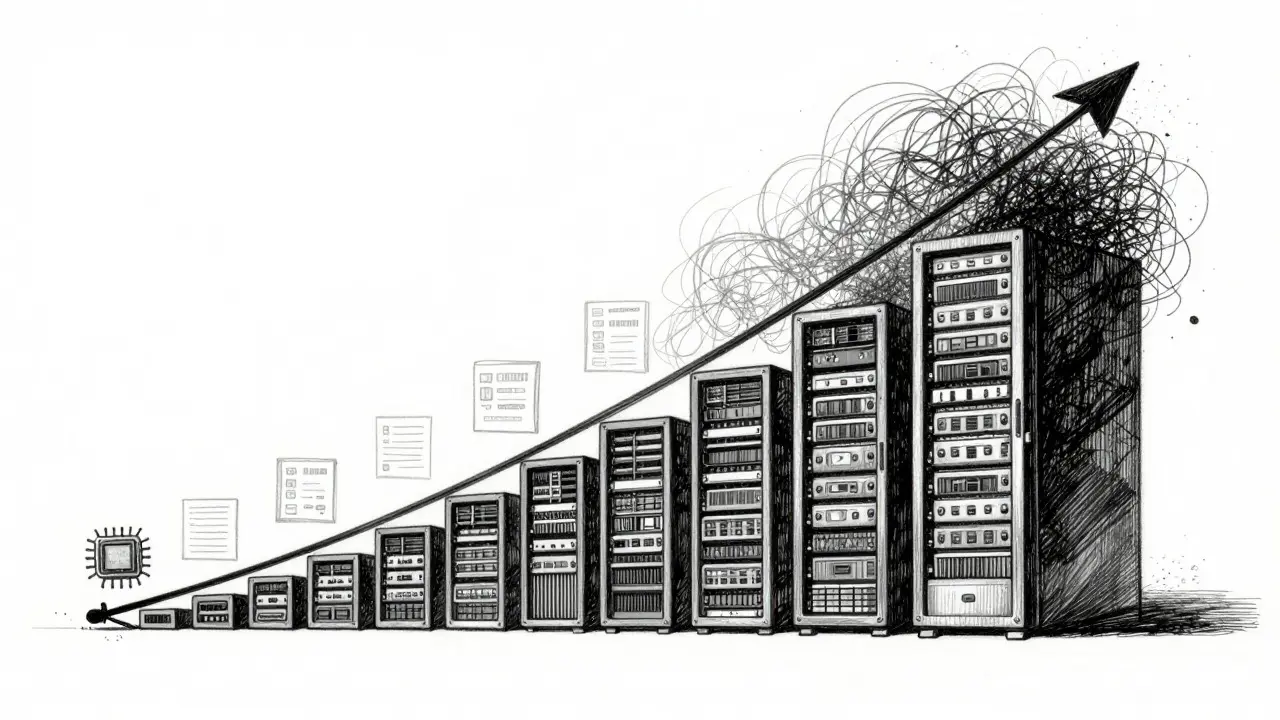
The cost to train an LLM has skyrocketed over the last decade. Back in 2017, the original Transformer architecture cost about $900 to train. That was a research experiment, not a product. By 2020, GPT-3 required an estimated $500,000 to $4.6 million in compute costs. Fast forward to today, and we’re talking about nine-figure budgets.
OpenAI’s GPT-4 reportedly cost over $100 million to train, with some estimates putting the compute cost alone at $78 million. Google’s Gemini Ultra is even higher, with training compute estimates reaching $191 million. These numbers aren’t just big; they’re exponential. As models get larger, the compute requirements don’t just grow linearly-they explode. This is driven by scaling laws, which suggest that performance improves predictably as you increase model size, dataset size, and compute power. But those laws come with a steep financial price tag.
| Model | Year | Estimated Compute Cost |
|---|---|---|
| Original Transformer | 2017 | $900 |
| GPT-3 | 2020 | $500k - $4.6M |
| GPT-4 | 2023 | $78M - $100M+ |
| Gemini Ultra | 2024 | $191M |
These costs reflect the sheer resource intensity of modern development. You’re talking about thousands of GPUs running in parallel for months. If you’re considering training a model from scratch, you need to ask yourself if your use case justifies a hundred-million-dollar bet. For most companies, the answer is no.
Hardware Infrastructure: Buying vs. Renting
Whether you buy or rent your compute power changes your TCO profile significantly. Let’s look at the hardware. A single NVIDIA H100 GPU costs between $25,000 and $40,000. If you want a pod of 1,000 units-which is a modest cluster for serious training-you’re looking at $25 to $40 million in capital expenditure just for the chips. And that doesn’t include the servers, cooling, networking, or electricity.
On the flip side, cloud rental offers flexibility but can add up quickly. Cloud providers charge roughly $1.50 per hour for A100 GPUs. With monthly commitments, that drops to around $1,125 per GPU-month. If you run 1,000 GPUs for one month, that’s $2 million in cloud bills. Operations using 5,000 to 10,000 GPUs for several months routinely reach tens of millions of dollars.
The key here is utilization. If you buy hardware, you need it running 24/7 to justify the cost. If you rent, you pay for every second it’s idle. For many organizations, a hybrid approach works best: buy baseline capacity for steady-state inference and rent burst capacity for training spikes.
Two Architectural Approaches: Host vs. API
When it comes to deploying LLMs, you generally have two choices: host your own proprietary models or use a pay-per-token API service. Each has distinct TCO implications.
Hosting Proprietary Models: This involves getting a pre-trained checkpoint (either open-source or licensed) and fine-tuning it on your own infrastructure. You avoid licensing fees per token, but you take on all the operational burden. You need DevOps teams to manage the clusters, security teams to protect the data, and ML engineers to monitor performance. The upfront cost is high, but the marginal cost per query drops significantly as volume scales. This makes sense for enterprises with massive, predictable usage patterns.
Pay-Per-Token Access: Services like OpenAI or Google Cloud let you access powerful models via API. You pay based on token consumption. There’s no upfront infrastructure investment, no hardware procurement, and no data acquisition headache. You can start small and scale dynamically. This democratizes access to advanced AI, allowing smaller companies to compete without prohibitive financial commitments. However, for high-volume use cases, the cumulative token costs can eventually exceed the cost of self-hosting. You also lose control over your data and model behavior.
The decision isn’t binary. Many companies start with APIs to validate their use case and then migrate to self-hosted models once they’ve proven ROI and secured funding for infrastructure. This phased approach helps refine your TCO model based on actual usage rather than theoretical projections.
Fine-Tuning: The Sweet Spot?
Full-scale training from scratch is reserved for tech giants. For everyone else, fine-tuning is the way to go. Fine-tuning takes a large pre-trained model-like LLaMA 2, which has 70 billion parameters-and adapts it to your specific domain. The cost is substantially lower. While full training runs into the hundreds of millions, fine-tuning a 70B parameter model typically costs tens of thousands of dollars.
The open-source ecosystem has made this process much more efficient. Tools like DeepSpeed and Fully Sharded Data Parallel (FSDP) allow you to distribute training across limited hardware through model sharding. This means you can fine-tune massive models on fewer GPUs, reducing both capital and operational expenses. If your goal is to create a specialized assistant for customer support or legal review, fine-tuning offers the best balance of cost and performance.

Best Practices for TCO Evaluation
So, how do you build a TCO model that actually works? Here are some practical steps:
- Think Long-Term: Evaluate costs over a three-to-five-year horizon. Don’t just look at the first year. AI systems degrade over time, requiring retraining and updates. Ignoring this leads to budget shortfalls.
- Budget for Data: Allocate 60% to 80% of your project effort to data preparation. Clean data is expensive, but bad data is more expensive.
- Include Monitoring: Model monitoring and retraining are ongoing costs. Set aside budget for tools and personnel to track drift and accuracy.
- Add Contingency: Add 15% to 25% to your budget for unexpected expenses. AI projects always encounter surprises, whether it’s a hardware failure or a regulatory change.
- Account for Talent: Include the opportunity cost of diverting skilled personnel to AI initiatives. Your senior engineers could be working on revenue-generating features. Factor that loss into your TCO.
- Check Currency Risk: If you’re paying vendors in USD but earning revenue in another currency, hedge against exchange rate fluctuations. A strong dollar can eat into your margins.
Finally, compare solutions holistically. Don’t just look at license fees or subscription rates. Look at the total cost of ownership, including integration, customization, and support. A cheaper API might end up costing more if it requires extensive post-processing or frequent retries due to poor quality.
FAQ
What is the typical split between initial development and ongoing operations in LLM TCO?
Initial development and deployment typically represent only 15% to 25% of the total lifetime cost of an AI system. The remaining 75% to 85% comes from ongoing operations, including compute, maintenance, and data management.
How much does it cost to fine-tune a large language model?
Fine-tuning a substantial model like LLaMA 2 (70 billion parameters) typically costs tens of thousands of dollars. This is significantly less than full-scale training from scratch, which can cost hundreds of millions.
What are the hidden costs in LLM TCO?
Hidden costs include talent diversion (engineers pulled from other projects), currency exchange risks, unbudgeted contingencies, and the effort required for data cleaning and integration.
Should I buy GPUs or rent them from the cloud?
It depends on your usage pattern. Buying is better for steady, high-volume workloads where you can maximize utilization. Renting is better for variable workloads or short-term projects, as it avoids upfront capital expenditure.
Why is data preparation such a large part of TCO?
Data preparation typically consumes 60% to 80% of total project effort. High-quality, clean data is essential for model performance, and acquiring, labeling, and cleaning this data requires significant human and computational resources.


