
Stop counting lines of code. If you are measuring your team's success in vibe coding by how much text the AI spits out, you are setting yourself up for a technical debt disaster.
Vibe coding-the practice of guiding AI systems through natural language prompts to generate and refine software-is no longer a novelty. It is the new baseline for 67% of enterprise development teams as of 2025. But speed without direction is just chaos. You might be shipping features faster, but are you building something that actually works?
The old metrics don't apply here. Traditional KPIs like 'lines of code' or even standard 'cycle time' miss the unique risks of AI-assisted development. You need a new dashboard. This guide breaks down the specific metrics that matter now: from reducing lead time for changes to managing the invisible killer known as vibe debt.
Velocity Metrics That Actually Matter
When we talk about speed in vibe coding, we aren't talking about typing fast. We are talking about how quickly an idea moves from your brain to production. The two most critical metrics here are Lead Time for Changes and Cycle Time.
Lead Time for Changes measures the duration from when a developer commits code to when it runs in production. In traditional workflows, this often drags on due to manual reviews and integration bottlenecks. With vibe coding, Cloudflare’s 2025 internal analysis showed a median reduction from 2.7 days to just 1.3 days. That is a 51% improvement. But here is the catch: if your CI/CD pipeline isn't optimized for AI-generated code patterns, that lead time will balloon back up within months.
Cycle Time looks at the active work period. For UI components, vibe coding teams are completing tasks in 3.2 hours compared to the traditional 6.6 hours. However, this speed varies wildly by task complexity:
- Boilerplate & Configuration: 81% faster completion. This is where vibe coding shines brightest.
- API Integration: 67% acceleration. Good gains, but requires careful endpoint validation.
- Business Logic: Only 34% improvement. Complex logic needs human oversight, slowing the AI down.
- Security-Critical Code: Just 12% gain. Rigorous review processes negate most speed benefits.
If your lead time drops but your cycle time for business logic stays flat, do not panic. That is normal. Pushing for 80% speed gains in core logic usually results in fragile code that breaks under load.
| Task Type | Avg. Speed Gain | Risk Level |
|---|---|---|
| Boilerplate/Config | 81% | Low |
| API Integration | 67% | Medium |
| Business Logic | 34% | High |
| Security Modules | 12% | Critical |
Quality Control: Defect Rates and Escape Risks
Speed is useless if the app crashes. The biggest fear with vibe coding is defect escape rate-the percentage of bugs that slip past testing and hit production. Early data is scary. Arsturn’s 2025 study of 147 enterprise projects found that initial vibe coding implementations had defect escape rates 18% higher than traditional methods.
Why? Because developers trust the AI too much. They assume the code is correct because it compiles. But AI hallucinates logic errors that static analyzers miss. However, this trend reverses. Teams that implement proper verification frameworks see defect rates drop 7% below traditional baselines after six months.
You must track Defect Density specifically in AI-generated modules. Snyk’s 2025 security analysis revealed that initial AI-generated code has a 27% higher vulnerability rate. If you are not running specialized linting rules for AI patterns, you are leaving doors open for attackers.
Another hidden metric is Performance Regression. Siddharth Bharath’s SaaS MVP guide highlighted that improperly optimized AI code increased API response times by 320ms in 43% of cases. A few hundred milliseconds doesn't sound like much, but at scale, it destroys user retention and spikes cloud costs. Monitor load times and memory usage continuously, not just during final QA.
Measuring the Invisible: Vibe Debt and Cognitive Load
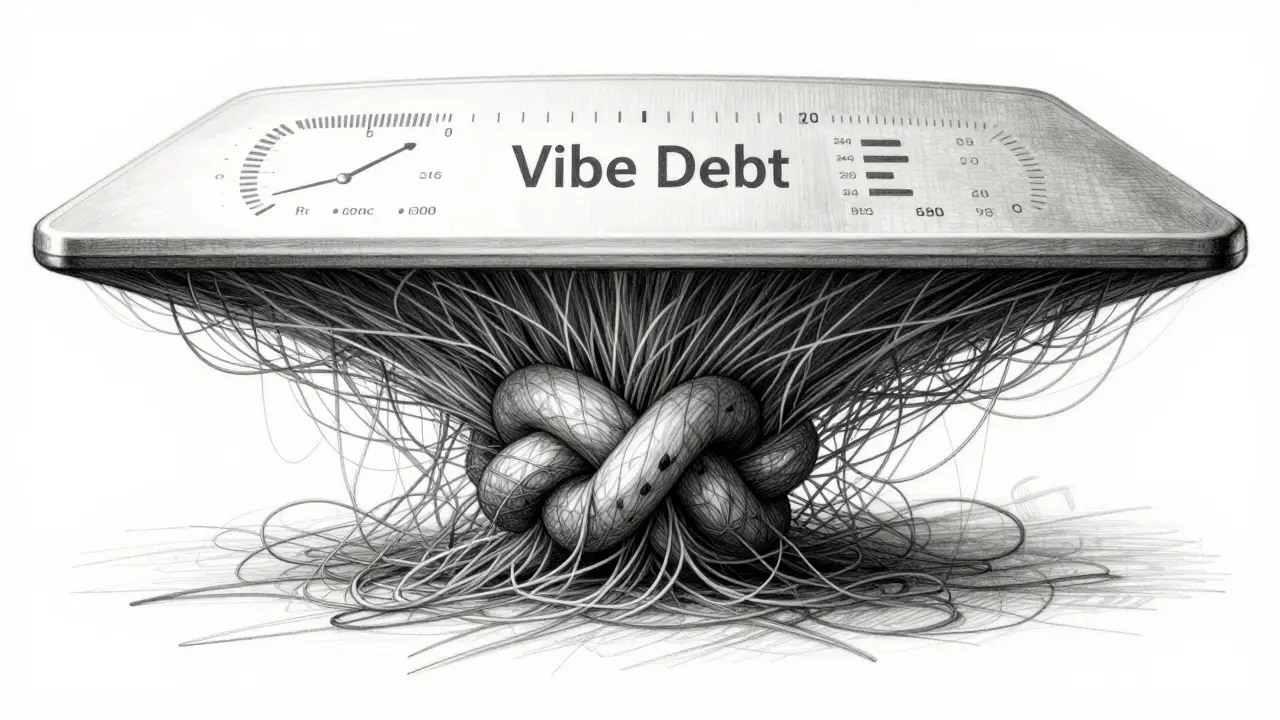
This is where most managers fail. They look at velocity and smile, ignoring the rot underneath. We call it vibe debt. It is the accumulation of poorly understood, hard-to-maintain AI-generated code.
Patrick Udo, a Senior Developer Advocate at Microsoft, points out that defect density alone is misleading. You need to track the Refactoring Frequency. How often does a team have to rewrite AI-generated code three months later? In poorly managed implementations, 38% of AI code requires significant refactoring. If your number is above 20%, you are paying a heavy maintenance tax.
Then there is Cognitive Load. Dr. Elena Rodriguez from Google Cloud AI argues that the optimal human-to-AI contribution balance is 60-40. If your team is spending 90% of their time prompting and 10% reviewing, they are losing architectural control. Track Prompt Iterations per Task. As Reddit developer 'CodeSlinger42' noted, if it takes more than three prompt iterations to get working code, the resulting module is likely fragile. Refactor manually instead.
Also, watch the AI Dependency Ratio. GitHub’s 2025 survey shows successful teams keep AI contribution between 30-50%. If it hits 80%, your developers are becoming operators, not engineers. Their skills atrophy, and so does the code quality.
Security and Compliance KPIs
With 75% of R&D leaders worried about data privacy, security KPIs are non-negotiable. You cannot treat AI-generated code like a black box.
Track Data Leakage Incidents. Are developers accidentally pasting sensitive customer data into public AI models? Even with enterprise guardrails, human error happens. Also, measure Prompt Sanitization Effectiveness. How well are your tools filtering out sensitive context before sending it to the LLM?
The EU’s 2025 AI Code Governance Framework now requires organizations to report AI Code Verification Coverage. This means you need to know exactly what percentage of your codebase was reviewed by a human after AI generation. Aim for 100% coverage on security-critical paths (auth, payments, data handling). For lower-risk UI components, 50% spot-checking might suffice.
Finally, monitor Vulnerability Density in AI Code separately from human-written code. If your AI modules have twice the vulnerabilities of your human modules, your prompt engineering process is broken. You need better constraints in your system prompts.

Implementation Checklist for Your Team
How do you start tracking these without overwhelming your developers? Here is a practical rollout plan based on Patrick Udo’s 'Ultimate Vibe Coding Checklist':
- Baseline Your Current Metrics: Measure lead time and defect rates for one sprint using traditional methods. You need a comparison point.
- Integrate 'Vibe-Aware' CI/CD: Add automated stages that flag high-risk AI patterns. SideTool’s case studies show this reduces production defects by 29%, despite a slight initial slowdown.
- Define 'Vibe Debt' Thresholds: Set a rule: if a component requires refactoring more than twice in six months, it gets flagged for architectural review.
- Train Junior Developers: They need 14-21 hours of structured training to use AI prompts effectively. Without this, their defect rates will spike.
- Create Role-Specific Dashboards:
- Juniors: Focus on learning metrics and prompt iteration counts.
- Seniors: Focus on quality oversight and vibe debt accumulation.
- Managers: Focus on delivery velocity and overall health scores.
Don't try to boil the ocean. Start with Lead Time, Defect Escape Rate, and Refactoring Frequency. Once those stabilize, add cognitive load and security metrics.
Future-Proofing Your Metrics
The landscape is moving fast. By 2027, Forrester predicts that 89% of organizations will track specialized vibe coding KPIs. The IEEE is already drafting standards for 'Measurement Practices for AI-Assisted Development,' expected in late 2026.
Google Cloud’s 'Vibe Health' dashboards are pioneering composite scores that combine velocity, integrity, and engagement into a single number. This is the future. Instead of juggling ten different charts, you’ll have one 'Health Score' that tells you if your vibe coding program is sustainable.
Tools like SideTool’s Vibe Analytics Platform are starting to use machine learning to correlate specific prompt patterns with downstream quality. This allows predictive adjustment-you can fix your prompting strategy before the bug even happens.
The bottom line? Vibe coding is powerful, but it is not magic. It amplifies both good habits and bad ones. If you don't measure the right things, you will amplify your mistakes. Track the debt. Watch the defects. Keep the humans in the loop.
What is the most important KPI for vibe coding?
While velocity metrics like lead time are tempting, the most critical KPI is Defect Escape Rate combined with Vibe Debt Accumulation. Speed means nothing if the code is brittle or insecure. Tracking how often AI-generated code needs major refactoring after three months gives you the truest picture of long-term sustainability.
How does vibe coding affect lead time?
Vibe coding can reduce lead time for changes by approximately 51%, dropping the median from 2.7 days to 1.3 days. However, this benefit depends heavily on having an optimized CI/CD pipeline. If your deployment process is slow, the coding speedup won't translate to faster releases.
What is 'vibe debt'?
Vibe debt is the technical debt accumulated from relying too heavily on AI-generated code that developers don't fully understand or verify. It manifests as code that requires frequent refactoring, has hidden bugs, or becomes difficult to maintain over time. It is measured by tracking refactoring frequency and the percentage of AI code needing significant modification after 90 days.
Are defect rates higher with AI-assisted coding?
Initially, yes. Early-stage vibe coding implementations can see defect escape rates 18% higher than traditional methods. However, teams that implement strict verification frameworks and specialized linting rules eventually see defect rates drop 7% below traditional baselines. The key is rigorous human review, especially for complex logic and security modules.
How do I measure the effectiveness of my AI prompts?
Track the Prompt Iterations per Task. If a developer needs more than three iterations to get working code, the prompt strategy is inefficient, and the resulting code is likely fragile. Additionally, monitor the AI Dependency Ratio; successful teams typically maintain an AI contribution ratio between 30-50%, ensuring humans remain deeply involved in the architecture.


