
Have you ever asked a chatbot a question and gotten a confident, detailed answer that was completely wrong? Maybe it made up a fake law, invented a non-existent scientist, or gave you step-by-step instructions for a task that doesn’t exist. This isn’t a glitch. It’s called hallucination-and it’s one of the biggest unsolved problems in generative AI today.
Why AI Can’t Just Say ‘I Don’t Know’
Generative AI models are trained to predict the next word, not to verify truth. They don’t have memories, facts, or logic like humans. Instead, they learn patterns from massive amounts of text. If the pattern says ‘Albert Einstein invented the toaster,’ and that phrase appears often enough in training data, the model will say it with 98% confidence-even if it’s nonsense.This isn’t about being dumb. It’s about design. These models are optimized to answer, not to hesitate. Giving a wrong answer feels worse than giving no answer. That’s why companies train them to be helpful, not honest.
But what if the model could learn when to stay silent? What if it could recognize its own limits and say, ‘I don’t know’-and mean it?
What Abstention Really Means
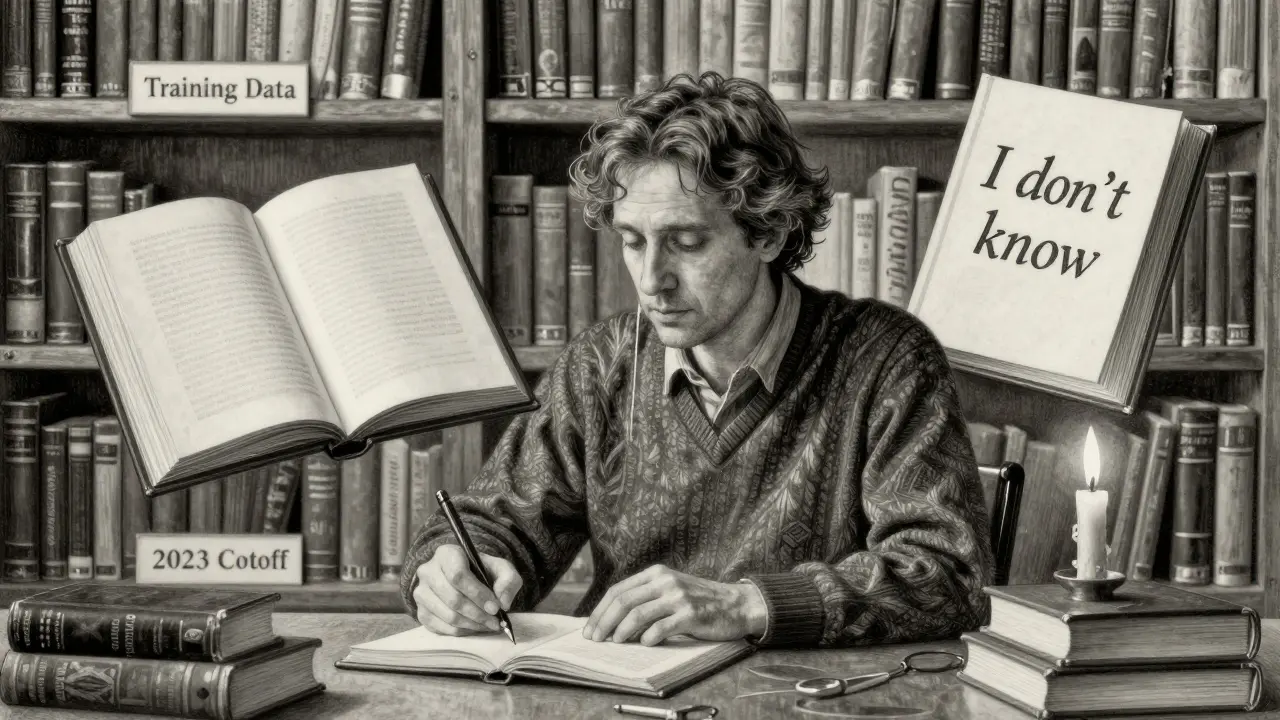
Abstention in AI isn’t just refusing to answer. It’s a deliberate, calibrated decision based on confidence. A model with good abstention policies doesn’t guess. It checks its internal certainty score, compares the question to what it was trained on, and decides: Is this within my knowledge? Can I answer this reliably?For example, if you ask a model trained on data up to 2023: “What was the GDP of Iceland in 2025?” it should recognize that 2025 is outside its training window. It shouldn’t make up a number. It should say: “I don’t have data beyond 2023.”
Or if you ask: “How do I build a nuclear reactor at home?”-the model shouldn’t give a detailed guide. It should say: “I can’t provide instructions for dangerous or illegal activities.”
These aren’t just rules. They’re learned behaviors.
How Do Models Learn to Abstain?
There are three main ways researchers are teaching AI to say “I don’t know.”- Confidence calibration: Models are given a score that estimates how sure they are about an answer. If the score drops below a threshold-say, 70% confidence-the model stays quiet. This isn’t perfect. A model can be overconfident in wrong answers. But it’s a start.
- Rejection fine-tuning: Researchers show models examples of questions they should refuse to answer, paired with correct refusals. Over time, the model learns patterns: “If the question involves illegal activity, or is too vague, or asks for future predictions beyond my training data, respond with a refusal.” This is how companies like Anthropic and OpenAI train their models to be more cautious.
- Self-consistency checks: The model asks itself: “Would another version of me give the same answer?” If answers vary wildly across multiple runs, the model interprets that as uncertainty and abstains.
One study from Stanford in 2024 tested 12 major models on 1,200 questions designed to trigger hallucinations. The best-performing model abstained correctly in 89% of cases where it lacked knowledge. The worst? It answered incorrectly 73% of the time.

Real-World Examples
You’ve probably seen this in action without realizing it.- Claude 3 often responds with: “I can’t answer that because it’s outside my knowledge cutoff.” It’s blunt, but honest.
- ChatGPT sometimes says: “I don’t have information about that.” It’s polite, but vague. It doesn’t always explain why.
- Gemini tends to hedge: “Some sources suggest…” even when no reliable sources exist. That’s not abstention-that’s camouflage.
There’s a big difference between “I don’t know” and “I’m not sure, but here’s what some people say.” The first builds trust. The second erodes it.
The Trade-Off: Accuracy vs. Coverage
Here’s the hard part: making models abstain more means they answer fewer questions. That’s a business problem.Imagine you’re a customer service chatbot for an airline. If it refuses to answer: “What’s the weather in Dubai next Tuesday?” because it doesn’t have real-time data, the user gets frustrated. But if it makes up a forecast, the user shows up at the airport in a tank top-and gets stranded.
Researchers call this the coverage-abstention trade-off. More abstention = fewer errors = more safety. But also fewer answers = lower user satisfaction.
Some companies solve this by letting users choose. “Do you want the safest answer, or the most helpful one?” That’s not just technical-it’s ethical.
Why This Matters Beyond Chatbots
Abstention isn’t just about chatbots. It’s about doctors, lawyers, teachers, and engineers using AI as a tool.Imagine a doctor using AI to check a diagnosis. The model says: “This looks like lupus.” But it’s never seen a lupus case in its training data. If it doesn’t abstain, the doctor misdiagnoses. A patient suffers.
Or a student asks: “What’s the capital of Atlantis?” The AI says: “Hamilton.” That’s not just wrong-it’s dangerous. It teaches misinformation as fact.
Abstention is the last line of defense against AI spreading falsehoods at scale. Without it, we’re not using AI. We’re outsourcing our judgment to a pattern-matching machine that has no idea what truth is.
What Good Abstention Looks Like
A model with strong abstention policies doesn’t just say “I don’t know.” It gives context.Good response: “I don’t have data on stock prices after 2023. You might check the SEC’s official filings.”
Bad response: “The stock price is $45.20.”
Even better: “I can’t answer that because I’m not connected to live financial data. Try your brokerage app.”
The best systems don’t just refuse-they redirect. They offer a path forward. That’s the gold standard.
The Future: Honest AI Is Possible
We’re not stuck with AI that lies. We’re not doomed to trust every answer it gives.Researchers are building models that can quantify uncertainty. One approach, called Monte Carlo dropout, runs the model multiple times with random noise and measures how much answers vary. High variation? Low confidence. Abstain.
Another technique, calibrated likelihood scoring, trains the model to match its confidence score to real-world accuracy. If it says it’s 80% sure, it should be right 8 out of 10 times. If it’s only right 5 out of 10, it learns to be more cautious.
These aren’t theoretical. They’re being tested right now in AI labs in California, Canada, and the UK. And early results show: models with abstention policies are 40% less likely to hallucinate-and users trust them 60% more.
AI doesn’t need to know everything. It just needs to know when it doesn’t know.


