You paste a paragraph into ChatGPT, hit enter, and get a response. Is that text written by a machine or a human? For years, we relied on "AI detectors" that often guessed wrong, flagging non-native English speakers as robots while missing sophisticated LLM outputs. Now, the industry is pivoting to AI watermarking. The idea is simple: embed an invisible digital signature into the content as it’s created, so anyone with the right key can verify its origin. But here is the catch-watermarks are fragile. A simple paraphrase, a screenshot, or even a copy-paste can erase them. If you’re building products, writing policy, or just trying to keep your news feed honest, you need to understand exactly what these watermarks can and cannot do.
The Core Mechanism: Embedding Secrets in Noise
At its heart, AI watermarking is the practice of embedding imperceptible but algorithmically detectable signals into generative AI outputs. Think of it like steganography for large language models (LLMs) and image generators. Unlike traditional digital rights management, which might lock a file, watermarking alters the content itself. When a model generates text, it doesn’t just pick the most probable next word; it subtly biases the selection based on a secret key. This creates a statistical pattern that looks random to humans but screams "machine-generated" to a detector.
The process relies on two main components sharing a secret key $k$. First, there is the embedding algorithm, which modifies the generation process. Second, there is the detection algorithm, which analyzes the output to see if the hidden signal exists. If you don’t have the key, the content looks normal. If you do have the key, you can calculate a probability score-often a p-value-to determine if the content was generated by a specific model. This isn't magic; it's math. Specifically, it’s about manipulating probability distributions during token sampling so that the resulting sequence has a higher likelihood under the watermarked hypothesis than under the null hypothesis of natural human writing.
How Text Watermarking Actually Works
For text, the most common approach involves splitting the vocabulary at each step of generation into two groups: a "green list" and a "red list." This method, popularized by researchers like Kirchenbauer et al., uses a hash function derived from the previous tokens and a secret key to decide which words go where. The model is then biased to pick words from the green list more often than chance would allow. To a reader, the sentence flows naturally. To a detector, the ratio of green-to-red words is suspiciously high.
Detection works by counting these green-list occurrences in a passage. If the count is significantly above what you’d expect from random human writing, the system flags it as AI-generated. This works surprisingly well for long texts. Studies show detection accuracy exceeding 99% for passages over 800-1,000 tokens. However, short texts-like tweets or brief chat responses-are a nightmare. With only 50 tokens, the statistical power is too low. You either get false positives (calling human text AI) or miss the mark entirely. This is why many early AI detectors failed: they tried to apply global patterns to local snippets.
Image and Audio: The Neural Encoder Approach
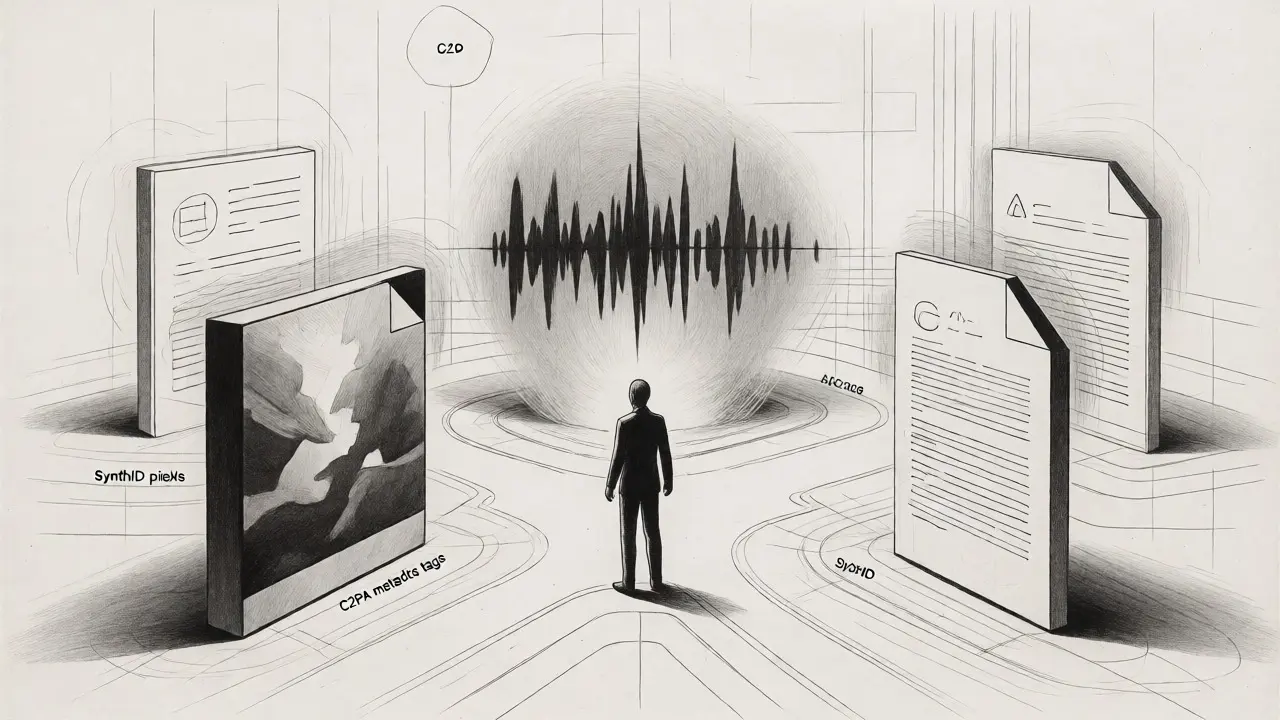
While text watermarking tweaks probabilities, image and audio watermarking often use neural networks. Google’s SynthID is a suite of watermarking tools developed by DeepMind that embeds signals directly into pixels and audio waveforms. Instead of modifying the generation logic, SynthID uses a post-hoc encoder-a small neural network that runs after the image is made-to inject a multi-bit payload. A paired decoder network can then extract this payload, even if the image has been resized or compressed.
This approach is more robust than text methods because images contain massive amounts of data. You can hide bits in the frequency domain without changing how the picture looks. However, it’s not bulletproof. If you take a screenshot of a SynthID-watermarked image and upload it to social media, the platform’s aggressive compression might strip the signal. Similarly, for audio, techniques like spread-spectrum watermarking embed noise across frequencies. But once that audio is played through a cheap speaker and recorded back in via a phone microphone-the so-called "analog hole"-the watermark often vanishes.
Provenance Metadata vs. In-Content Watermarks
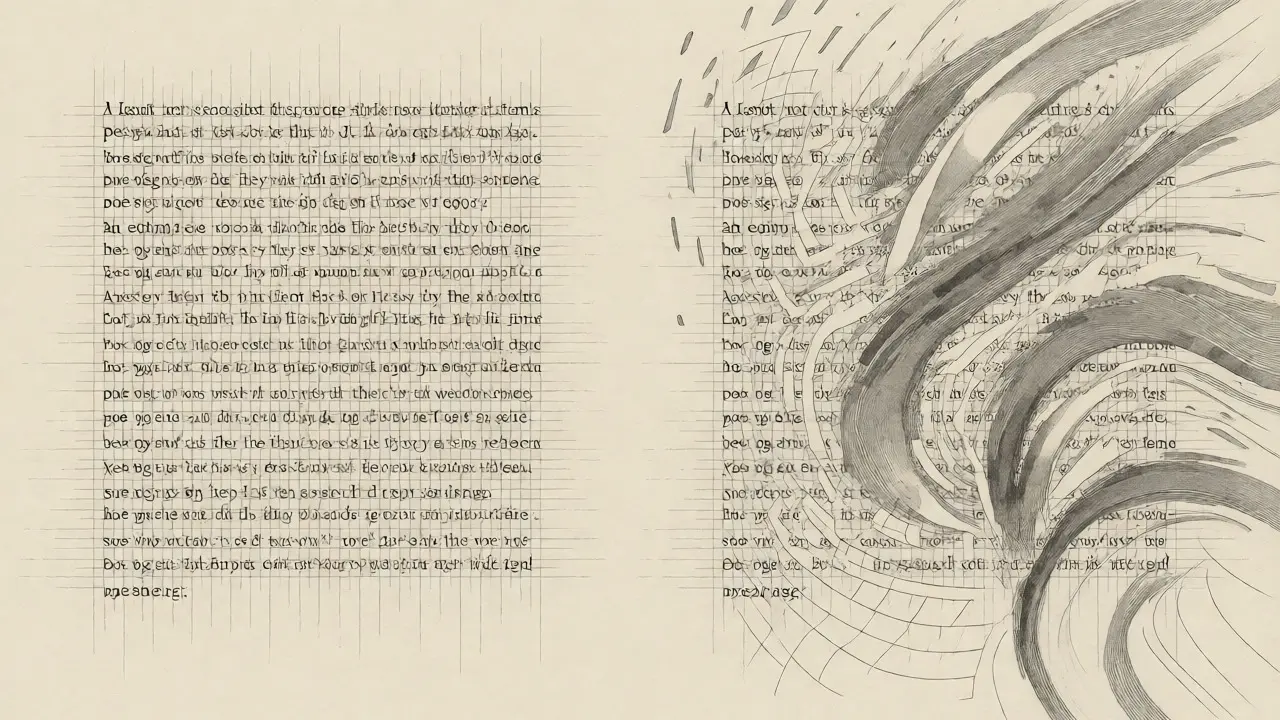
It’s crucial to distinguish watermarking from C2PA (Coalition for Content Provenance and Authenticity) metadata. These are two different beasts. C2PA, supported by Adobe, Microsoft, and Intel, attaches cryptographically signed JSON files to media. It tells you who created the file, when, and with what software. It’s like a digital passport. If the passport is intact, you trust the source. But passports can be ripped out. A single "Save As" in Photoshop or a screenshot on iOS usually strips all metadata.
| Feature | In-Content Watermarking | C2PA Metadata | Heuristic Detectors |
|---|---|---|---|
| Survives Screenshots | Yes (if robust) | No | N/A (analyzes content) |
| Requires Key | Yes (for verification) | No (public keys) | No |
| Accuracy | High for long/unmodified content | Perfect if present | Variable, prone to bias |
| Privacy Risk | Can track users if payload includes ID | Low (metadata visible) | None |
| Main Weakness | Paraphrasing/Re-generation | Metadata stripping | False positives on diverse writing |
The Robustness Problem: Why Paraphrasing Kills Watermarks
The biggest limitation of current AI watermarking is its vulnerability to editing. Imagine you generate a story with a watermarked LLM. Then, you run that story through another AI tool with the prompt: "Rewrite this to sound more casual." The second model changes the vocabulary and structure enough to disrupt the green-list/red-list pattern. The original watermark is effectively washed out. Research indicates that automated paraphrasing can reduce detection accuracy to near-chance levels for some schemes.
This creates a paradox. To remove the watermark, you have to degrade the content or change its style. But in the real world, people edit constantly. They fix typos, shorten paragraphs, or mix AI-generated sections with their own writing. When you blend watermarked and non-watermarked text, the detector gets confused. It sees a diluted signal. There is no widely deployed solution yet for detecting mixed-source content reliably. Until we have algorithms that can pinpoint exactly which sentences came from which model, watermarking will remain a blunt instrument rather than a scalpel.
Regulatory Push and Industry Reality
Governments aren’t waiting for perfect tech. The EU AI Act mandates transparency obligations requiring AI-generated content to be marked in a machine-readable format. Article 50 specifically calls for methods like watermarks, metadata, or fingerprints. In the US, voluntary commitments from major AI labs also emphasize watermarking. This regulatory pressure is driving adoption, even if the technology isn’t fully mature.
Industry leaders are responding differently. Google has integrated SynthID into Vertex AI and Gemini models. OpenAI experimented with text watermarks but reportedly shelved them for ChatGPT due to robustness concerns, opting instead for external classifiers. Meta announced invisible watermarks for its image generators. Meanwhile, Adobe leverages C2PA for its Firefly suite. The fragmentation means that a user might encounter a watermarked image from one service, a metadata-tagged photo from another, and completely unmarked text from a third. For the average consumer, this lack of standardization makes "checking if it’s AI" a frustrating game of guesswork.
Best Practices for Using Watermarking Today
If you’re deploying AI content in a professional setting, treat watermarks as probabilistic signals, not definitive proof. Here is how to handle them practically:
- Combine Signals: Don’t rely solely on watermarks. Use them alongside C2PA metadata and behavioral analytics. If both the watermark and the metadata point to AI, your confidence increases.
- Set Clear Thresholds: Define what constitutes a "match." For legal or academic contexts, a 95% confidence interval might be acceptable. For casual social media checks, it’s likely too noisy.
- Avoid User Tracking: Be cautious with multi-bit watermarks that encode user IDs. While useful for tracing leaks, they raise privacy red flags. Ensure your governance policies explain why this data is collected.
- Expect Failure: Always assume a determined adversary can break the watermark. Design your workflows so that a missing watermark doesn’t automatically mean "human-created," nor does a present one guarantee "untouched AI."
Can I remove an AI watermark from an image?
Yes, but it depends on the method. Simple cropping or resizing might leave the watermark intact, especially with robust systems like SynthID. However, heavy compression, re-generating the image with another AI model, or taking a photograph of the screen (the analog hole) can destroy the signal. There is no universal "remove watermark" button for AI watermarks because they are embedded in the statistical properties of the content, not just layered on top.
Is AI watermarking reliable for detecting plagiarism?
Not currently. Most students use AI tools that may not embed watermarks by default, or they paraphrase the output heavily. Furthermore, if a student copies a Wikipedia article (which has no AI watermark), a detector looking for AI signatures won’t find one. Watermarking identifies the *source* of generation, not whether the content is original or plagiarized. It proves who made it, not whether it was stolen.
What is the difference between SynthID and C2PA?
SynthID is a technique that embeds invisible signals directly into the pixels or audio waves of the content. It survives screenshots and basic edits. C2PA is a standard for metadata that acts like a digital certificate, proving the chain of custody. C2PA is stronger for authenticity if the file hasn't been stripped, but SynthID is more resilient to casual copying and sharing. Ideally, you want both.
Why did OpenAI stop using text watermarks in ChatGPT?
Reports suggest that while internal tests showed high accuracy, the watermarks were vulnerable to paraphrasing and didn't work well on short messages. OpenAI prioritized user experience and output quality over the marginal benefit of a watermark that could be easily removed by a simple rewrite. They continue to research more robust methods, but as of now, ChatGPT outputs are generally not watermarked by default.
Do AI watermarks affect the quality of the content?
In theory, no. Modern watermarking schemes are designed to be imperceptible. Human evaluators in blind tests typically cannot distinguish between watermarked and non-watermarked images or text. However, there is a trade-off between robustness and quality. Making a watermark survive extreme compression might require slightly altering the image, potentially introducing subtle artifacts. For most commercial applications, these differences are negligible.