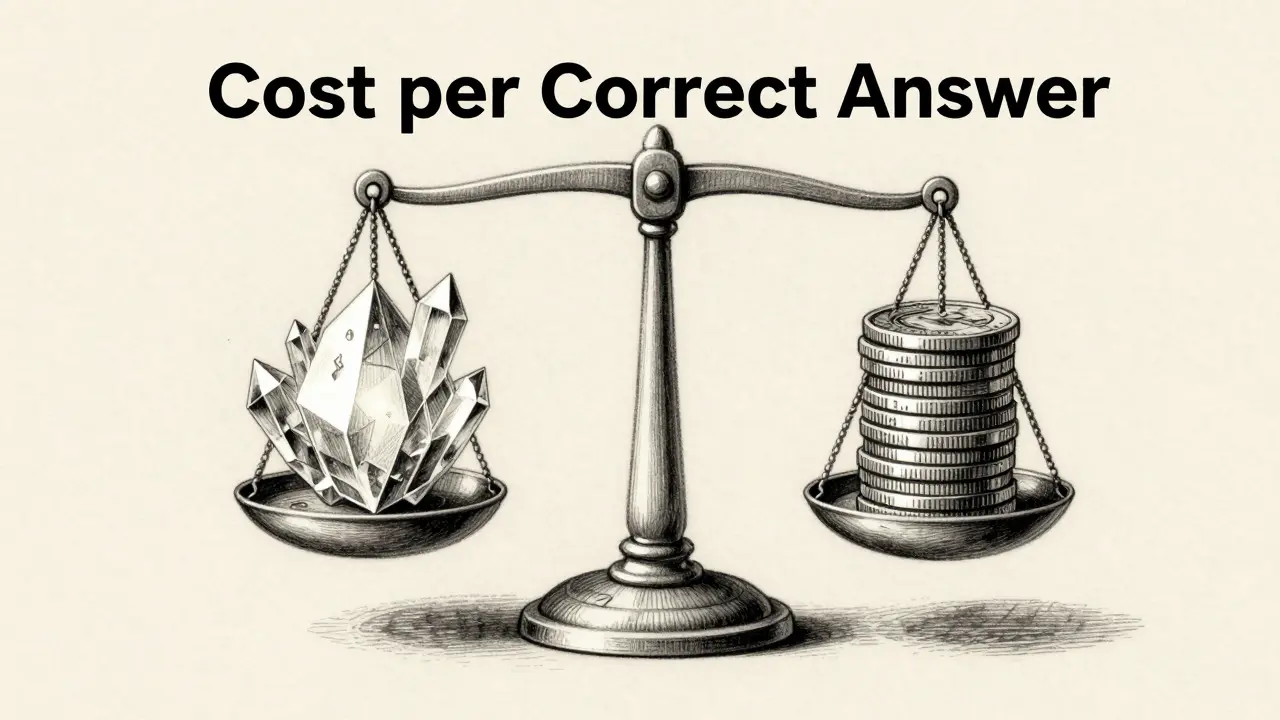
Accuracy is no longer the only metric that matters when you deploy large language models. If your model gets the right answer but costs ten times more than a competitor’s to get there, you are losing money on every query. This is where Cost per Correct Answer comes in. It is a simple yet powerful metric that divides the total inference cost by the number of correctly answered questions. By August 2026, as inference prices continue their steep decline, understanding this ratio has become critical for any team building AI-driven applications.
You might be thinking, "Why not just look at accuracy?" Because accuracy alone ignores the bill. A model with 95% accuracy that costs $1.00 per correct answer is often worse for business than a model with 90% accuracy that costs $0.05 per correct answer. The difference in scale can be massive. Recent data from Epoch AI shows that the price to achieve specific performance milestones has fallen by up to 50 times per year. But these drops aren't uniform across all tasks or providers. To make smart decisions, you need to know exactly what each correct response costs you in dollars and cents.
What Is Cost Per Correct Answer?
Cost per Correct Answer is a financial efficiency metric defined as the total monetary cost of running an LLM over a benchmark dataset divided by the number of questions the model answered correctly. Unlike traditional metrics that focus solely on performance scores, this measure directly ties model capability to operational expenditure. It forces you to consider both how well the model performs and how much it charges for that performance.
The calculation itself is straightforward, but getting accurate inputs requires discipline. You start by selecting a standard reasoning benchmark, such as GSM8K for math problems or MMLU for general knowledge. Then, you run your chosen model against every question in the set using a fixed configuration-same temperature, same max tokens, same prompt style. Next, you log the total input and output tokens used. Finally, you apply the provider’s current pricing sheet to convert those tokens into USD. Divide that total cost by the count of correct answers, and you have your metric.
Why Traditional Benchmarks Fall Short
For years, we relied on benchmarks like MMLU and HumanEval to judge model quality. These datasets, introduced around 2020 and 2021 respectively, were designed to test raw capability. They didn't care about the cost. In fact, early evaluations often ignored token counts entirely because research budgets weren't constrained by per-token billing in the same way production systems are today.
This gap led to misleading comparisons. A frontier model might score 5% higher on a logic puzzle than a mid-tier model, but if its output tokens are three times longer due to verbose chain-of-thought reasoning, its cost per correct answer could be double. Newer frameworks like OckBench are changing this narrative. OckBench explicitly measures accuracy alongside token efficiency, effectively treating token usage as a direct proxy for cost. This shift acknowledges that efficiency is part of intelligence.
The Impact of Chain-of-Thought on Costs
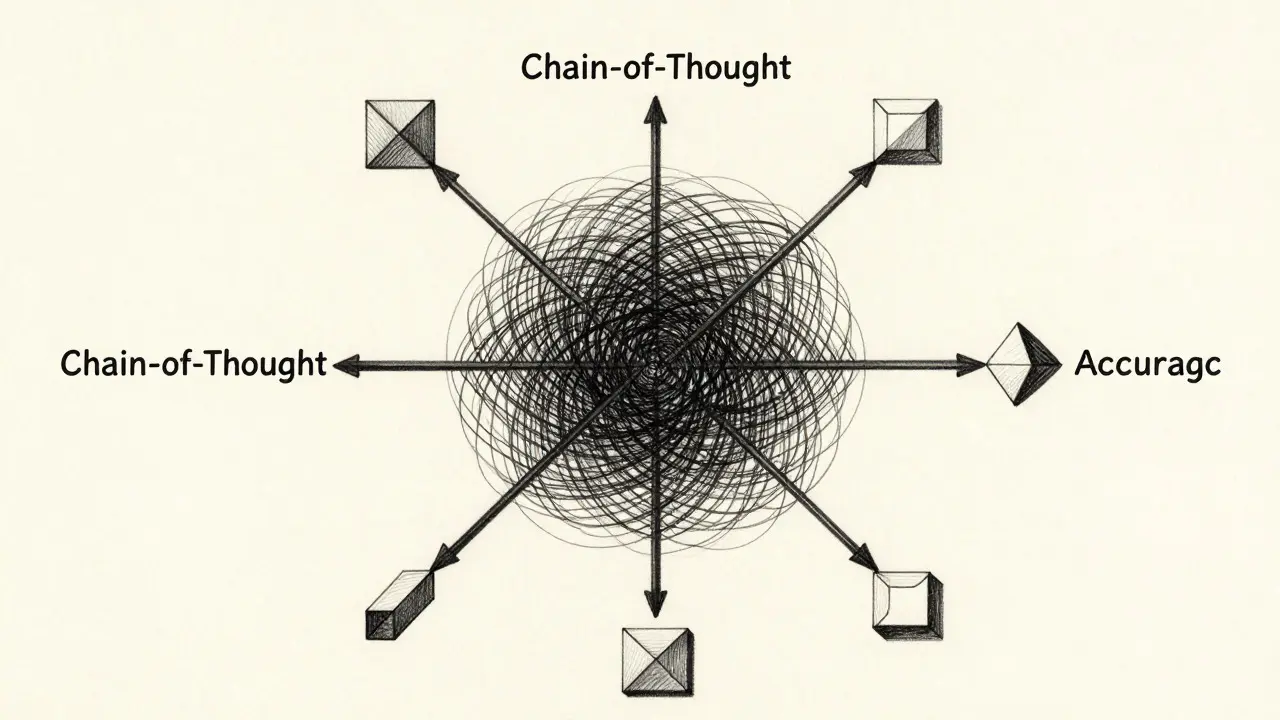
Chain-of-thought (CoT) prompting is one of the biggest drivers of variable costs in reasoning tasks. CoT encourages the model to break down complex problems into steps before answering. For difficult math problems on GSM8K, this technique can boost accuracy by tens of percentage points. However, it also multiplies the number of output tokens. Instead of generating a short final answer, the model generates paragraphs of intermediate reasoning.
Here is the trade-off: If CoT increases accuracy from 60% to 80% but triples the token count, does it lower your cost per correct answer? Often, yes. Getting more correct answers reduces the denominator in our formula, potentially offsetting the higher numerator. But this isn't guaranteed. If the extra reasoning doesn't lead to proportionally more correct answers, you are paying a premium for marginal gains. Self-consistency methods, which sample multiple reasoning paths and vote on the best answer, amplify this effect further. They can improve accuracy again, but they multiply token usage by the number of samples, making them expensive unless the accuracy jump is significant.
Comparing Model Tiers: Where the Value Lies
When you look at the market, three distinct tiers emerge. Understanding where each sits on the cost-per-correct curve helps you choose the right tool for the job.
| Model Tier | Typical Accuracy (GSM8K) | Relative Token Cost | Best Use Case |
|---|---|---|---|
| Frontier Models (e.g., GPT-4 class) | > 90% | High (3-5x Mid-tier) | Critical decisions where errors are costly |
| Mid-Tier Models (e.g., GPT-4o, Claude Sonnet) | 75-85% | Medium | General customer support, code assistance |
| Economy Models (e.g., Haiku, Turbo) | 50-70% | Low (1/10th Frontier) | Simple classification, high-volume low-risk tasks |
Frontier models offer the highest accuracy, but their per-token prices remain steep. For many enterprise applications, the slight accuracy drop of a mid-tier model is acceptable if it cuts costs by half. Economy models are incredibly cheap, but their accuracy on complex reasoning tasks like multi-step logic puzzles can lag significantly behind. The sweet spot depends entirely on your tolerance for error versus your budget constraints.

How to Calculate Your Own Metrics
You don't need to wait for third-party reports to find your cost per correct answer. You can build this into your evaluation pipeline today. Here is a practical checklist:
- Standardize Prompts: Ensure every model receives the exact same prompt format. Small changes in few-shot examples can alter token counts and accuracy unpredictably.
- Log Everything: Record input tokens, output tokens, and latency for every single request. Don't just average them; look for outliers.
- Use Current Pricing: Provider prices change frequently. Always pull the latest rate card when calculating costs. What was true in 2024 may not hold in late 2026.
- Account for Retries: If your system retries failed queries or uses guardrails that trigger re-asks, include those tokens in your cost calculation. Real-world costs are rarely just the sum of initial attempts.
By tracking these variables, you move beyond abstract benchmark scores to concrete financial insights. You can identify which specific types of questions drive up your costs and optimize your prompts accordingly.
The Future of Efficient Reasoning
The trend line is clear: inference costs are plummeting. Epoch AI’s analysis suggests median price declines of roughly 50x per year for achieving fixed performance levels. This means the cost per correct answer will likely continue to drop, even as models get smarter. However, complexity is also rising. As we move toward agentic workflows and multi-modal reasoning tasks like MMMR, the number of tokens per query may increase, partially offsetting per-token price reductions.
Don't treat cost per correct answer as a static number. Re-benchmark regularly. When new models launch or prices change, rerun your tests. The model that offers the best value today might be beaten by a cheaper, slightly less accurate alternative next quarter. Staying agile allows you to capture these savings automatically.
Is cost per correct answer better than cost per token?
Yes, for most business applications. Cost per token only tells you how much you spend, not what you get for it. Cost per correct answer combines spending with performance, giving you a true measure of value. A model with higher token costs might still be cheaper overall if its accuracy is significantly higher.
Do open-source models always have lower cost per correct answer?
Not necessarily. While open-weight models avoid API fees, you must account for GPU rental, energy, and maintenance costs. If an open-source model requires more tokens to reach the same accuracy as a proprietary model, its total cost per correct answer could be higher. It depends on your specific infrastructure setup and efficiency.
How does chain-of-thought affect cost per correct answer?
Chain-of-thought typically increases output tokens, raising the cost numerator. However, it often boosts accuracy, increasing the correct-answer denominator. For complex reasoning tasks, the accuracy gain usually outweighs the token cost, lowering the overall cost per correct answer. For simple tasks, it may increase costs without sufficient accuracy benefits.
Which benchmarks are best for measuring this metric?
Use benchmarks with clear ground-truth answers and standardized scoring scripts. GSM8K and MATH are excellent for mathematical reasoning. MMLU works well for general knowledge. OckBench is specifically designed to track accuracy and token efficiency together, making it ideal for cost-aware evaluation.
Should I use the same model for all tasks?
Rarely. Most efficient systems use routing strategies. Send simple queries to economy models and complex reasoning tasks to frontier models. This hybrid approach minimizes the average cost per correct answer across your entire workload while maintaining high accuracy where it matters most.


