You type a prompt into Cursor is an AI-powered code editor that generates entire functions and files from natural language instructions, hit enter, and watch lines of code appear. It feels magical. But six months later, when you need to swap out your database or update your UI library, you realize the AI glued everything together with duct tape. The business logic is tangled up with React hooks. The data models are hardcoded to use MongoDB syntax. You didn’t just build an app; you built a dependency nightmare.
This is the hidden trap of Vibe Coding is a modern software development approach where developers collaborate with AI assistants to rapidly generate code through conversational prompts rather than manual typing. While it speeds up initial creation, it often accelerates technical debt if you don't enforce strict architectural rules. The solution isn't to stop using AI. It’s to apply Clean Architecture is a software design principle popularized by Robert C. Martin that separates business logic from external frameworks like databases and UI libraries principles specifically tailored for AI-generated code. By keeping frameworks at the edges, you ensure your core logic remains pure, portable, and maintainable, regardless of how fast the AI writes.
The High Cost of Unstructured AI Code
It’s tempting to think that speed equals efficiency. If the AI can write a feature in five minutes, why spend time planning? The data suggests otherwise. A December 2024 analysis by Metronome found that 78% of early vibe-coded projects failed within six months. Why? Architectural debt. Specifically, 63% of those failures were caused by improperly embedded framework dependencies. The AI, eager to please, imported react directly into a service layer meant to handle calculations. It used specific SQL dialects inside domain entities. These small violations compound quickly.
Imagine building a house where the contractor decides to use only one brand of screws for every single joint, including the foundation. When that brand goes out of stock, you can’t fix anything without tearing down the walls. In software, this is what happens when frameworks leak into the core. You lose the ability to change technologies without rewriting the entire application. The "vibe" turns into a panic.
Why Frameworks Must Stay at the Edges
Robert C. Martin articulated the core rule of Clean Architecture decades ago: external tools should never dictate internal structure. In traditional development, this means your business rules shouldn’t know if they’re running on a web server or a mobile device. In vibe coding, this principle becomes even more critical because AI assistants default to the most common patterns they’ve seen in their training data-and those patterns are heavily biased toward specific frameworks.
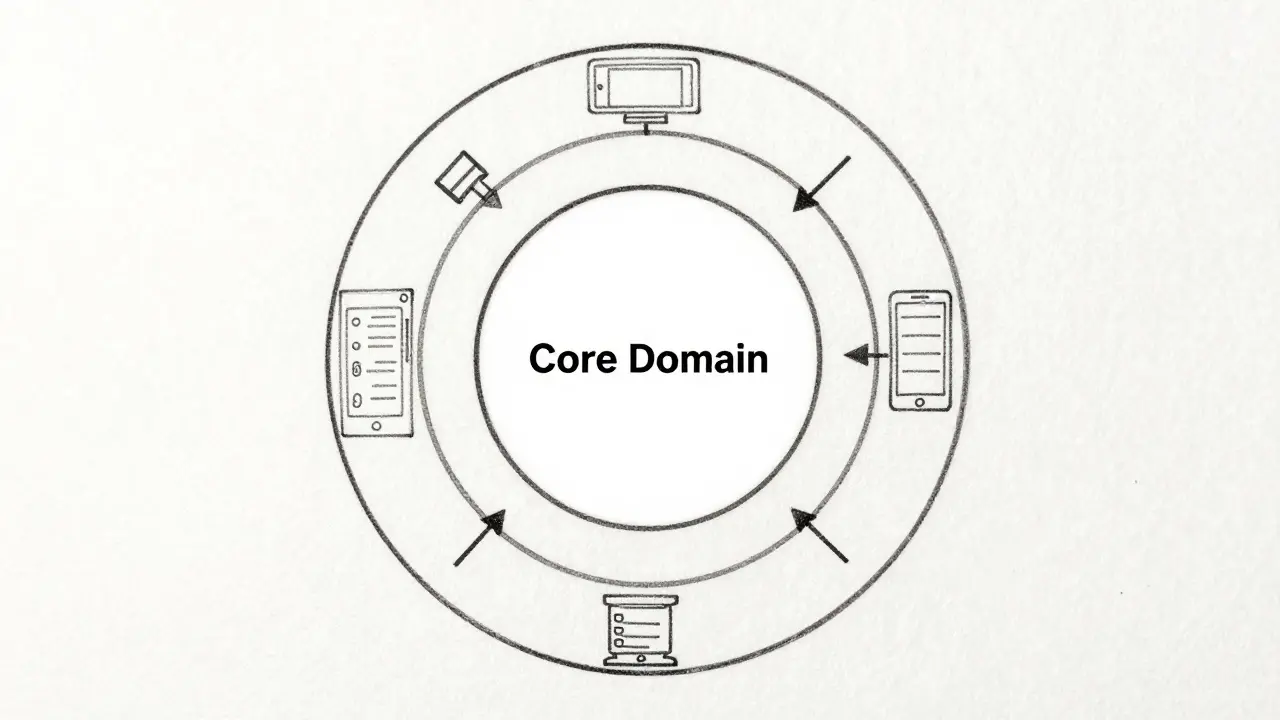
To keep frameworks at the edges, you need to visualize your application as concentric circles:
- Core Domain Layer: The innermost circle. This contains pure business logic. It knows nothing about HTTP requests, JSON formatting, or database drivers. It uses simple data structures and interfaces.
- Application Layer: The middle circle. This handles use cases and orchestrates flow between the core and the outside world. It defines interfaces but doesn’t implement framework-specific details.
- Framework Layer: The outermost circle. This includes your UI (React, Vue), your database (PostgreSQL, Firebase), and your external APIs. This layer adapts the outside world to speak to the core.
The golden rule is direction of dependency. Dependencies must point inward. The framework layer depends on the application layer, which depends on the core. The core must never depend on the framework. If your AI assistant tries to import a UI component into your business logic file, it has violated this rule. You must catch it immediately.
Setting Up Architectural Guardrails Before You Code
You cannot rely on willpower alone to enforce these boundaries, especially when an AI is generating code faster than you can read it. You need automated guardrails. The industry standard for this in 2025-2026 is Sheriff is an open-source module boundary enforcement tool that analyzes code changes against predefined architectural rules.
Sheriff works by scanning your imports and ensuring modules only communicate across allowed boundaries. Here is how you set it up effectively:
- Define Your Layers: Create explicit folders for
domain,application, andinfrastructure(orframework). Do not mix them. - Configure Rules: Write a configuration file (usually
sheriff.yaml) that states: "Files indomaincannot import frominfrastructure." - Integrate with CI/CD: Run Sheriff on every pull request. If the AI generates code that violates the boundary, the build fails. No exceptions.
- Prompt Context: Share these rules with your AI assistant at the start of each session. Paste the Sheriff config into your system prompt so the AI understands the constraints before it generates a single line.
vFunction’s case studies show that teams using these boundary checks reduced framework leakage into core logic by 89%. That’s not a marginal improvement; it’s a structural transformation. The overhead is minimal-only 2-3% added to development time-but the payoff in maintainability is massive.
The Vertical Slice Workflow for AI Development
Traditional waterfall-style architecture often leads developers to build all the database models first, then all the services, then all the views. This is dangerous in vibe coding because the AI tends to create deep, interconnected dependencies as it fills in each layer. Instead, adopt a vertical slice approach.
A vertical slice means implementing a tiny piece of functionality across all layers simultaneously. For example, if you want a "User Registration" feature:
- Create a minimal
Userentity in the core domain (just name and email). - Create a
RegisterUserinterface in the application layer. - Create a dummy implementation in the infrastructure layer that logs to console.
- Create a basic form in the UI layer that calls the interface.
Once this thin slice works, you expand it. Add password hashing to the core. Connect the real database in the infrastructure. Style the form in the UI. By keeping slices thin, you prevent the AI from creating monolithic, tightly-coupled components. You also get working software faster, which keeps the "vibe" positive while maintaining architectural integrity.
Tools and Techniques for Enforcing Boundaries
Beyond Sheriff, several other tools have emerged to support Clean Architecture in AI-driven workflows. Understanding their roles helps you choose the right stack.
| Tool/Framework | Primary Function | Best Use Case | Integration Effort |
|---|---|---|---|
| Sheriff | Module boundary enforcement via static analysis | Enforcing import rules between layers | Low (YAML config) |
| PACT Framework | Contract testing between services | Microservices and distributed systems | Medium (Test setup) |
| AIBD Guidelines | Structured workflow templates for AI prompts | Standardizing team prompt engineering | Low (Documentation) |
| vFunction Platform | AI agent guidance and architectural insights | Enterprise-scale AI development monitoring | High (Platform adoption) |
The PACT Framework, introduced in late 2024, adds another layer of safety by ensuring that contracts between services remain stable even as AI refactors code. Meanwhile, the AIBD (AI-Based Development) guidelines provide standardized prompt templates that explicitly instruct AI assistants to generate framework-agnostic code. Using these tools in combination creates a robust defense against architectural decay.

Common Pitfalls and How to Avoid Them
Even with tools in place, human error persists. Here are the most frequent mistakes developers make when applying Clean Architecture to vibe-coded projects:
- Ignoring the Initial Setup Time: Clean Architecture requires 15-20% more upfront planning. Developers often skip this to save time, only to spend weeks untangling messes later. Accept the initial cost. It pays off after three features.
- Vague Prompts: Asking an AI to "build a user login" without specifying architectural constraints will result in framework-heavy code. Always specify: "Implement a user login use case in the application layer, adhering to the defined interfaces. Do not import any UI or database libraries."
- False Positives in Boundary Checks: Tools like Sheriff may flag legitimate cross-layer communication if interfaces aren’t properly abstracted. Refine your rules iteratively. Don’t disable the tool; adjust the abstraction.
- Mixing Concerns in Entities: AI loves to add validation logic, date formatting, and serialization methods directly into domain entities. Keep entities dumb. Move that logic to value objects or mappers in the application layer.
Dr. Sarah Chen from Google Cloud noted in a 2024 IEEE study that projects enforcing these boundaries had 73% higher maintainability scores after a year. The key is consistency. One violation opens the door for ten more.
When Clean Architecture Might Be Overkill
Not every project needs this level of rigor. If you are building a throwaway prototype, a weekend hackathon entry, or an internal script that will be deleted in three months, unstructured vibe coding is fine. The goal of Clean Architecture is longevity and adaptability. If your project has neither, the overhead isn’t justified.
However, for any product intended for public release, enterprise use, or long-term maintenance, the cost of ignoring architecture far exceeds the cost of implementing it. As Andrew Ng stated in his AI Engineering course, architectural boundary enforcement is the single most impactful practice for sustainable AI-assisted development. Treat it as a non-negotiable requirement, not an optional best practice.
What is the biggest risk of using AI for coding without Clean Architecture?
The biggest risk is rapid accumulation of architectural debt. AI assistants tend to embed framework-specific dependencies (like React or SQLAlchemy) directly into business logic. This makes it extremely difficult to switch technologies or refactor code later, leading to project failure or exorbitant maintenance costs.
How do I stop my AI assistant from importing UI libraries into my backend logic?
Use automated boundary enforcement tools like Sheriff. Configure it to block imports from UI or database packages in your core domain folder. Additionally, include explicit instructions in your AI system prompt to generate framework-agnostic code and adhere to defined layer boundaries.
Is Clean Architecture worth the extra setup time for small projects?
For throwaway prototypes or scripts, no. However, for any project expected to last more than a few months or involve multiple developers, yes. The initial 15-20% time investment prevents months of refactoring later. Data shows structured approaches reduce critical bugs by 62%.
What is a "vertical slice" in the context of vibe coding?
A vertical slice is a development strategy where you implement a small piece of functionality across all architectural layers (UI, Application, Domain, Infrastructure) simultaneously, rather than building each layer completely before moving to the next. This prevents deep, tangled dependencies and provides immediate working feedback.
Which tools are recommended for enforcing architectural boundaries in 2026?
Sheriff is the leading open-source tool for module boundary enforcement. For broader workflow guidance, the PACT Framework and AIBD guidelines are highly recommended. Enterprise teams also use vFunction for advanced AI agent monitoring and architectural insights.