
Have you ever stared at a blinking cursor, waiting for an AI to finish its sentence? That pause isn't just the system "thinking." It is a complex chain of mathematical operations happening in milliseconds. When you send a prompt to a large language model (LLM), you are triggering a process called inference, which is the computational process where a trained model generates predictions or outputs based on new input data. The delay you experience-known as prompt-to-response latency-is not a single event. It is a series of distinct phases, each with its own bottlenecks and optimization opportunities.
Understanding what happens behind the scenes helps you build faster applications. Whether you are building a real-time chatbot or a background data processor, knowing how latency works allows you to make smarter engineering decisions. Let's break down exactly why that delay exists and how you can measure and minimize it.
The Two Phases of Latency: TTFT and ITL
Industry professionals don't just look at total time. They split latency into two critical metrics: Time to First Token (TTFT) and Inter-Token Latency (ITL). These two numbers tell very different stories about your application's performance.
Time to First Token (TTFT) is the time between hitting "send" and seeing the first character appear. This phase is all about preparation. The model must read your entire prompt, convert it into numerical vectors, and build a memory structure called the Key-Value (KV) cache. If TTFT is high, users feel like the app is broken or frozen. For interactive apps like customer service bots, keeping TTFT under 500 milliseconds is often considered the gold standard for a "responsive" feel.
Inter-Token Latency (ITL), also known as Time Per Output Token (TPOT), measures the speed of the text stream after that first token appears. This is the "typing speed" of the AI. If TTFT is fast but ITL is slow, the user sees the start of the answer immediately but then waits awkwardly long for the rest. A smooth, steady stream of tokens creates a better user experience than a burst of text followed by silence.
| Metric | What It Measures | User Perception | Primary Driver |
|---|---|---|---|
| TTFT | Prompt processing + KV cache build | Initial responsiveness | Prompt length, server queue |
| ITL / TPOT | Time between subsequent tokens | Streaming smoothness | Model size, GPU power |
Why Does It Take So Long? The Architecture Bottleneck
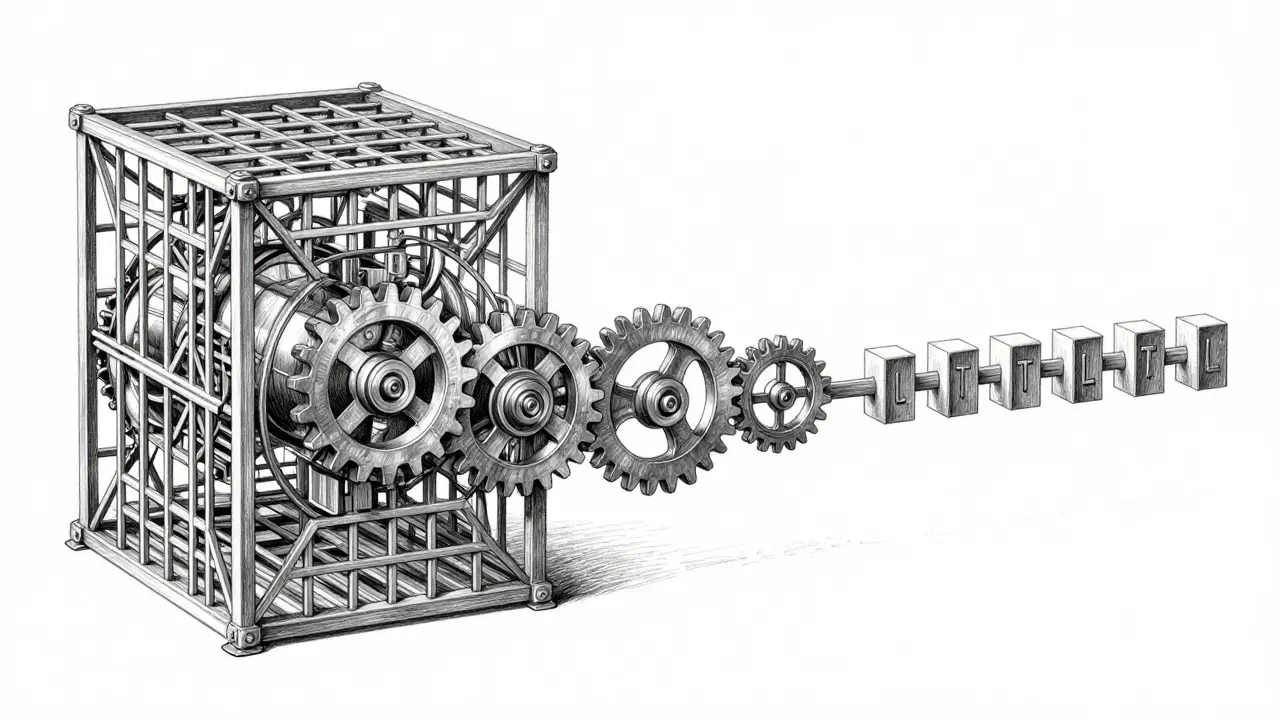
The root cause of LLM latency lies in the transformer architecture itself. Unlike traditional software that might calculate a result in one go, LLMs generate text sequentially. They predict one token at a time. A token can be a word, part of a word, or even punctuation. To write the sentence "Hello world," the model predicts "Hello," then uses "Hello" to predict "world."
This sequential nature means output generation cannot be parallelized. You cannot calculate the fifth word before you have calculated the fourth. This creates a hard ceiling on speed. Research from Proxet shows that processing time correlates directly with token count. For example, processing a 500-token prompt through GPT-3.5-turbo took approximately 1.0 second of normalized processing time. As prompts grow to 4,000 tokens, that median processing time rises to about 1.25 seconds. While this seems small, it adds up quickly in high-volume systems.
During the TTFT phase, the model builds the KV cache. This cache stores the attention scores for every token in the prompt. If your prompt is long, the cache is large, and building it takes more memory bandwidth and compute cycles. Once the cache is ready, the model switches to the decoding phase, generating tokens one by one. Here, the hardware becomes the limiting factor.
Hardware and Infrastructure: The Speed Limits
You can optimize code all day, but if your hardware is weak, latency will suffer. The physical chips running the model dictate the maximum possible speed. Modern LLM inference relies heavily on Graphics Processing Units (GPUs) rather than Central Processing Units (CPUs) because GPUs excel at the matrix multiplications required by neural networks.
NVIDIA's A100 and H100 processors are industry standards for a reason. They offer massive memory bandwidth and specialized tensor cores that accelerate the math behind token prediction. Anyscale’s documentation highlights that moving from older architectures to these newer GPUs can significantly reduce per-token computation time. However, raw chip power isn't everything. How those chips talk to each other matters too.
If a model is too large for one GPU, it gets sharded across multiple devices. This requires high-speed interconnects like NVLink, which enables high-bandwidth communication between NVIDIA GPUs to minimize data transfer overhead. Without NVLink, the time spent moving data between GPUs can outweigh the benefits of having more compute power, spiking your ITL.
System load is another silent killer. If your server is handling 100 requests simultaneously, new requests enter a queue. Even if the model is fast, the wait time in the queue increases TTFT. Strategies like autoscaling and request prioritization help, but they add complexity to your infrastructure.
Optimizing for Speed: Practical Strategies
Since we can't change the fundamental sequential nature of transformers, we have to work around it. Here are specific ways to reduce latency without sacrificing quality.
- Shorten Prompts: Every token in your prompt adds to the TTFT. Remove unnecessary context, instructions, or filler words. If you are using few-shot prompting (providing examples in the prompt), keep those examples concise. Fewer input tokens mean a smaller KV cache and faster initial processing.
- Batching Requests: Inference engines can process multiple requests together in a batch. Increasing the
max_num_seqsparameter allows the system to group more requests, improving overall throughput (Tokens Per Second). However, be careful: overly aggressive batching can increase ITL for individual users because the GPU is juggling more tasks at once. - Use Smaller Models: Not every task needs a massive 70-billion-parameter model. For simple classification or summarization, smaller models like Llama-3-8B or Mistral-7B run much faster and cheaper. They have less weight to load and fewer calculations per token.
- Quantization: This technique reduces the precision of the model's weights (e.g., from 16-bit floating point to 4-bit integer). Quantized models use less memory and move data faster, often resulting in lower latency with minimal loss in accuracy.
The Cost of Waiting: Economic Implications
Latency isn't just a technical problem; it's a financial one. Most cloud providers, including OpenAI, bill by the token. Longer prompts cost more to process. Slower responses mean higher infrastructure costs if you need to keep powerful GPUs idle while waiting for network calls or database queries.
There is a direct trade-off between accuracy and speed. A longer, more detailed prompt might yield a slightly better answer, but it increases both latency and cost. Your goal should be to find the "sweet spot" where the prompt is short enough to be fast and cheap, but detailed enough to be accurate. Techniques like P-tuning (prompt tuning) allow you to encode specific instructions into virtual tokens, reducing the visible prompt length while maintaining control over the model's behavior.
Future Outlook: Breaking the Sequential Barrier
As of 2026, researchers are actively working on methods to bypass the sequential bottleneck. Speculative decoding is one promising approach. In this method, a smaller, faster model predicts several tokens ahead, and the larger model verifies them in parallel. If the small model is correct, the large model accepts the block of tokens instantly, effectively multiplying generation speed. If it's wrong, the large model corrects it, adding only a small penalty.
Another area of innovation is improved caching mechanisms. By reusing KV caches for similar prompts, systems can skip the expensive pre-computation phase entirely for repetitive queries. This is particularly useful for search engines or FAQ bots where users ask similar questions repeatedly.
While hardware continues to improve, the laws of physics and mathematics still apply. We will never see truly instantaneous generation for complex reasoning tasks. However, by understanding the components of latency-TTFT, ITL, hardware constraints, and prompt engineering-you can design systems that feel instant to the user, even if the backend is doing heavy lifting.
What is the difference between TTFT and ITL?
TTFT (Time to First Token) is the delay before any output appears, driven by prompt processing and cache building. ITL (Inter-Token Latency) is the time between each subsequent word, determining how smoothly the text streams.
How does prompt length affect latency?
Longer prompts increase TTFT because the model must process more tokens to build the KV cache. They do not significantly impact ITL, which depends more on model size and hardware.
Can I reduce latency without changing the model?
Yes. Shortening prompts, using quantization, optimizing batching parameters, and ensuring efficient hardware interconnects like NVLink can all reduce latency.
Why is token generation sequential?
Transformers predict the next token based on all previous tokens. Since each prediction depends on the last, the process must happen step-by-step, preventing parallelization of output generation.
What is speculative decoding?
Speculative decoding uses a small, fast model to draft multiple tokens at once. The main model then verifies them in parallel, potentially speeding up generation if the draft is correct.