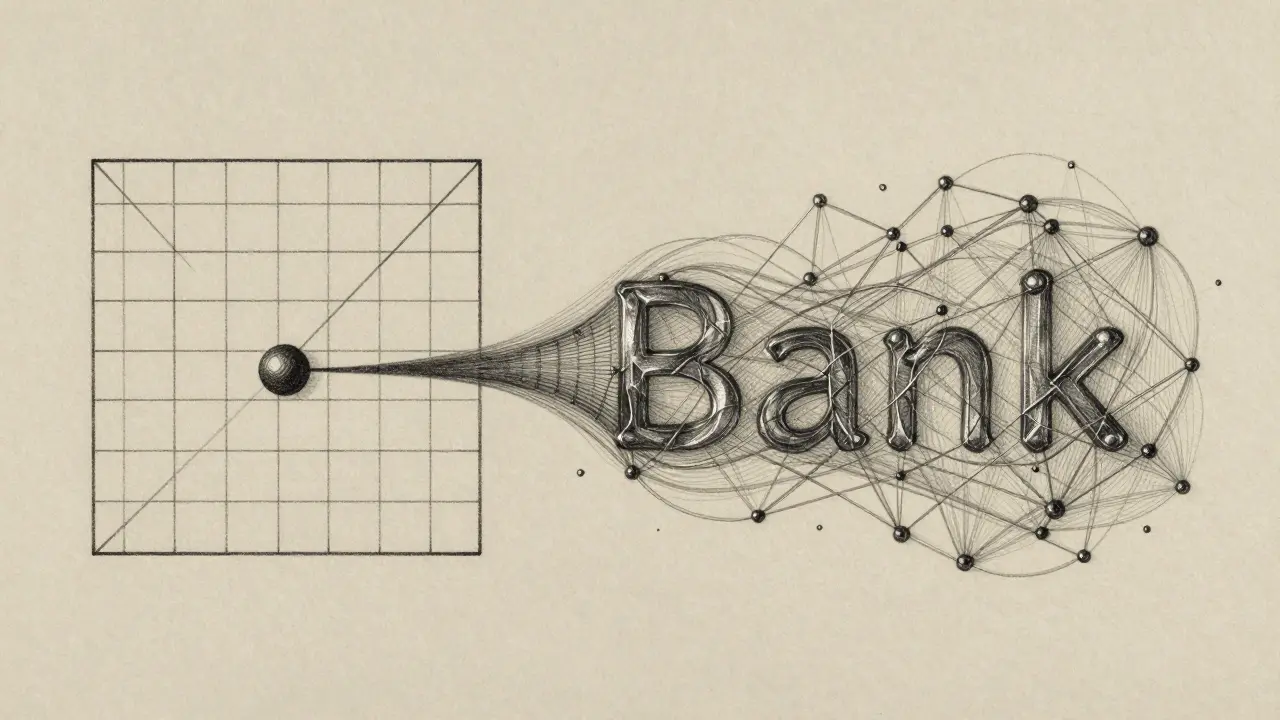
Imagine telling a friend, "I'm headed to the bank." Without any other information, your friend doesn't know if you're withdrawing cash or going for a walk by the river. You know exactly which one you mean because of the situation-the context. For a long time, computers were terrible at this. They saw the word "bank" as a single mathematical point, regardless of whether the sentence mentioned money or fish. But modern Large Language Models (LLMs) have changed that. They don't just look up words in a dictionary; they build a dynamic map of meaning on the fly.
Key Takeaways
- Dynamic Meaning: LLMs use contextual representations to change a word's meaning based on the words around it.
- The Engine: The Transformer architecture and its attention mechanism are what make this possible.
- Memory Limits: The "context window" determines how much information a model can "remember" at once.
- Architecture Matters: Autoregressive models (like GPT) and masked models (like BERT) process context in fundamentally different ways.
Moving Beyond Static Word Lists
Before the current AI boom, we used things called static embeddings, like Word2Vec or GloVe. These were essentially giant spreadsheets where every word had one fixed set of coordinates. If "bank" was at coordinates (X, Y), it stayed there whether you were talking about finance or geography. It was a blunt tool that struggled with polysemy-words with multiple meanings.
Everything changed with the introduction of the Transformer architecture in 2017. Instead of a fixed point, LLMs now create contextual representations. This means the model takes the initial word and transforms it through dozens of layers, adjusting its meaning based on every other word in the sentence. By the time the model "decides" what a word means, it has looked at the entire surrounding linguistic environment. This allows an LLM to handle anaphora resolution-knowing that when you say "it" in the second sentence, you're referring to the "blue car" mentioned in the first.
The Secret Sauce: The Attention Mechanism
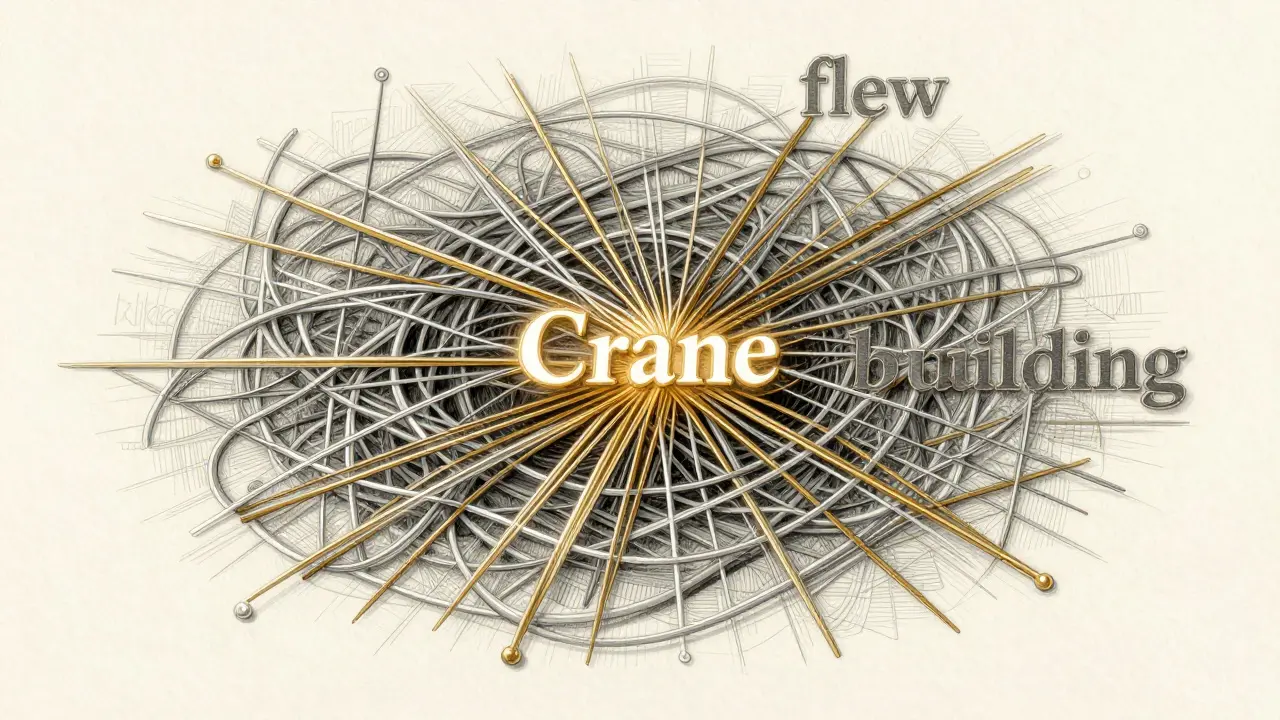
If the Transformer is the engine, the Attention Mechanism is the steering wheel. It allows the model to assign different "weights" to different words. When a model processes the phrase "The crane flew over the building," the attention mechanism tells the model to pay more attention to "flew" and "building" to determine that "crane" refers to a bird, not a piece of construction equipment.
Modern models do this with incredible precision. For instance, GPT-3 uses vectors with 12,288 dimensions. Imagine a 12,000-sided shape; that's how much nuance the model can pack into a single token. This high-dimensional space allows the AI to distinguish between very subtle differences in meaning, such as the difference between "wanting" something (a desire) and "warrants" (a legal document), based on the surrounding syntax.
Understanding the Context Window
You've probably noticed that if you have a very long conversation with an AI, it eventually starts forgetting things you mentioned at the beginning. This is because of the Context Window. Think of this as the model's operational short-term memory. If a piece of information falls outside this window, it effectively ceases to exist for the model.
Different models have vastly different capacities. While older versions like GPT-3.5 were limited to about 4,096 tokens, newer models have pushed these boundaries significantly. Claude 3 can handle up to 200,000 tokens, allowing it to analyze entire books or massive legal contracts in one go. However, more memory isn't always better. Researchers have identified a "lost-in-the-middle" problem, where models are great at remembering the start and end of a prompt but struggle with information buried in the center-sometimes seeing a 23% drop in accuracy for middle-positioned data.
| Model Entity | Context Window (Tokens) | Primary Strength |
|---|---|---|
| GPT-3.5 | 4,096 | Quick, short interactions |
| GPT-4 Turbo | 128,000 | Complex reasoning and coding |
| Claude 3 | 200,000 | Long-document analysis |
| Llama 3 | Varies (up to 8K-128K) | Efficient open-weights performance |
Autoregressive vs. Masked Models
Not all LLMs "look" at context the same way. There are two main philosophies here: autoregressive and masked language models.
Autoregressive models (like the GPT series) are like people who read from left to right. They predict the next word based on everything that came before it. This makes them incredible at generating fluid, coherent text because they are always building on a growing chain of context. If you type "I like to eat," the model uses that context to predict "ice cream."
Masked models (like BERT) are more like puzzle solvers. They look at the words both before and after a gap. For example, in the sentence "I like to [MASK] ice cream," the model looks at both "like to" and "ice cream" to fill in the word "eat." This bidirectional approach makes them much better at tasks like question answering or sentiment analysis, where understanding the full context of a sentence is more important than generating new text.
The Gap Between Statistics and Understanding
Does this mean LLMs actually "understand" meaning the way humans do? This is where experts disagree. Some, like the team at Stanford AI Lab, argue that LLMs perform a kind of Bayesian inference-essentially using a prompt to locate a concept they already learned during training.
On the other side, critics like Dr. Emily Bender argue that this is all a "stochastic parrot" effect. In this view, the AI isn't understanding the concept of a "bank" or "love" or "justice"; it's just calculating the statistical probability that certain tokens appear near other tokens. It has the map, but it's never actually visited the city. While the representations are mathematically sophisticated, they lack grounded real-world experience.

Practical Workarounds for Memory Limits
Since no model has an infinite window, developers have had to get creative. If you're building an app that needs to "remember" a user's history over months, you can't just feed the whole history into the prompt. Instead, they use techniques like Retrieval-Augmented Generation (RAG). RAG works by storing documents in a vector database and only pulling the most relevant snippets into the context window when needed. It's like giving the AI a textbook to look at instead of forcing it to memorize the whole library.
Other common strategies include conversation summarization, where the AI periodically condenses the previous 20 turns of a chat into a short paragraph to save space, or sliding window techniques that only keep the most recent tokens in view. These methods ensure that the AI maintains a sense of coherence without hitting the hard ceiling of its architecture.
What is the difference between a token and a word?
Tokens are the basic units LLMs process. A token isn't always a whole word; it can be a part of a word, a punctuation mark, or even a space. For example, a long word like "unbelievable" might be split into three tokens: "un", "believ", and "able". This helps models handle new words or different tenses more efficiently.
Why does the AI forget things in long conversations?
This happens because of the context window limit. Every model has a maximum number of tokens it can process at once. Once the conversation exceeds that limit, the oldest tokens are "pushed out" to make room for new ones, causing the AI to lose track of earlier details.
Can a larger context window stop hallucinations?
Not necessarily. While a larger window gives the model more information, it doesn't guarantee the model will use that information correctly. In fact, some users report that very large windows (like 200k tokens) can still lead to hallucinations, especially when the model struggles to locate a specific fact in the middle of a massive document.
What is an embedding in simple terms?
An embedding is basically a list of numbers (a vector) that represents a word's meaning. Words with similar meanings are placed close together in this mathematical space. Contextual embeddings take this a step further by shifting those numbers based on the surrounding words.
Is RAG better than just increasing the context window?
It depends on the use case. Increasing the window is great for analyzing a single long document. RAG is superior for managing massive libraries of information because it's more computationally efficient and avoids the "lost-in-the-middle" problem by only providing the most relevant data.
Next Steps for Implementation
If you are a developer trying to optimize contextual understanding in your projects, start by auditing your data. If you're seeing the AI ignore critical instructions, try moving those instructions to the very end of your prompt-this leverages the fact that models often prioritize the most recent tokens.
For those dealing with massive datasets, don't just chase the model with the biggest window. Experiment with chunking strategies-breaking your text into smaller, overlapping pieces-and implement a vector database for RAG. This usually results in higher accuracy and lower costs than relying solely on a 200k token window. As we move toward 2026 and beyond, keep an eye on adaptive context windows, which promise to dynamically allocate memory based on what's actually important in your text.