
Have you ever asked an AI model a complex question, only to get a confident but completely wrong answer? It’s frustrating. The model sounds smart, uses the right words, but the logic is broken. This is where Chain-of-Thought prompting changes the game. It’s not magic, and it doesn’t require you to retrain your model from scratch. Instead, it’s a clever way of asking the AI to show its work before giving you the final answer.
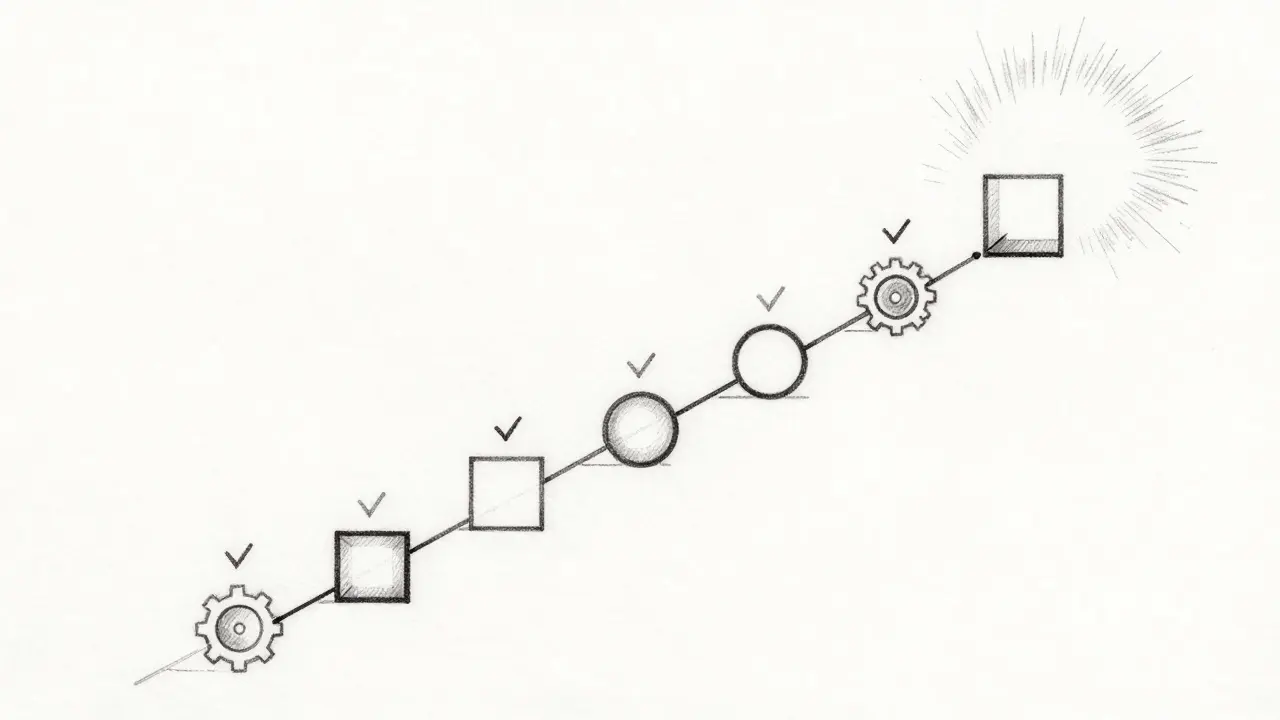
Think about how you solve a tough math problem or a tricky logic puzzle. You don’t just shout out the number. You break it down. You calculate step one, then step two, check if it makes sense, and finally arrive at the solution. Chain-of-Thought (CoT) prompting forces Large Language Models (LLMs) to do exactly that. By guiding the model to generate intermediate reasoning steps, we can dramatically improve accuracy on tasks that require multi-step logic.
What Exactly Is Chain-of-Thought Prompting?
At its core, Chain-of-Thought Prompting is a prompt engineering technique that guides language models to generate intermediate reasoning steps before arriving at a final answer. It was formally introduced in a landmark paper by researchers at Google Research, including Jason Wei and Denny Zhou, published in early 2022. Before this, most people used "standard prompting," which means giving the model a few examples of input and output, like showing it flashcards with questions and answers.
Standard prompting works fine for simple facts. If you ask, "Who wrote Hamlet?" the model knows Shakespeare. But try asking, "If I have 3 apples, eat 1, and buy 5 more, how many do I have?" Standard prompting often fails here because the model tries to jump straight to the answer without doing the mental math. CoT prompting fixes this by including examples that show the *process*. Instead of just "Answer: 7," the example says, "I started with 3, subtracted 1 to get 2, then added 5 to get 7. Answer: 7."
This small change tricks the model into activating its internal reasoning capabilities. It’s like turning on the headlights when driving at night. The road (the data) hasn’t changed, but now you can see where you’re going.
Why Model Size Matters More Than You Think
Here is a hard truth: Chain-of-Thought prompting isn’t a silver bullet for every AI model. It relies on something called "emergent ability." In simple terms, the reasoning skills only kick in when the model is big enough.
The original research showed a stark contrast between small and large models. When they tested a tiny 118-million-parameter model, CoT prompting barely helped. Accuracy on arithmetic tasks went from 3.7% to 4.4%. That’s negligible. But when they scaled up to a massive 540-billion-parameter model (PaLM), the results exploded. On the same task, standard prompting got 17.9% accuracy, while CoT prompting hit 78.7%. That is a massive jump.
This tells us something important. If you are using a small, local model on your laptop, CoT might not do much for you. But if you are working with major models like GPT-4, Claude, or PaLM, CoT is essential. These large models have the latent knowledge; CoT just unlocks it.
| Benchmark Task | Standard Prompting (540B Model) | Chain-of-Thought Prompting (540B Model) | Improvement |
|---|---|---|---|
| GSM8K (Math Word Problems) | 26.4% | 58.1% | +31.7 points |
| MultiArith (Arithmetic) | 17.9% | 78.7% | +60.8 points |
| CommonsenseQA | 66.9% | 76.9% | +10.0 points |
| StrategyQA (Complex Commonsense) | ~55% | ~77% | +22.3 points |
How to Implement Chain-of-Thought Prompts
You don’t need to be a PhD in computer science to use this. You just need to structure your prompts correctly. Here is a practical guide to setting it up.
- Choose Your Examples Carefully: You need 3 to 8 high-quality examples (this is called "few-shot learning"). Don’t just pick random questions. Pick ones that are similar in complexity to the real problems you want the model to solve.
- Show the Work: In each example, write out the reasoning process clearly. Use transition words like "First," "Next," "Therefore," and "Finally." This gives the model a linguistic template to follow.
- Keep It Consistent: Make sure the format of the reasoning matches across all examples. If one example uses bullet points and another uses paragraphs, the model gets confused.
- End with the Answer: Always separate the reasoning from the final answer. A common pattern is to end the reasoning with "So, the answer is [X]."
For instance, if you are building a customer support bot that needs to calculate refunds based on usage days, your example might look like this:
User: I used the service for 10 days, but it costs $1 per day. I paid $15 upfront. How much should I get back?
Assistant: First, calculate the total cost for the days used: 10 days * $1/day = $10. Next, subtract this cost from the upfront payment: $15 - $10 = $5. Therefore, the refund amount is $5.
When you present this to the model, it learns to mimic that specific logical flow for new, unseen questions.
Factuality Control and the Risk of Hallucinations
We mentioned factuality control in the title, and for good reason. While CoT improves reasoning, it does not magically fix bad data. In fact, it can sometimes make hallucinations worse if you aren’t careful.
If the model makes a mistake in step one of its reasoning chain, it will likely carry that error through to the final answer. Because the explanation looks so logical and detailed, you might trust it more than a short, direct answer. This is known as "false confidence." As Dr. Emily Bender, a computational linguist, warned, models might be mimicking the *style* of reasoning without truly understanding the causal relationships.
To mitigate this, you can use a technique called Self-Consistency is a method where the model generates multiple reasoning paths and selects the most frequent answer. Instead of asking for one answer, you ask the model to think through the problem three or five different times. Then, you look at the final answers. If four out of five paths lead to "$5," you can be much more confident that $5 is correct. If the answers vary wildly, you know the model is unsure, and you should flag it for human review.
Zero-Shot CoT: The Quick Fix
What if you don’t have time to craft perfect examples? There is a simpler version called Zero-Shot Chain-of-Thought. You don’t provide any examples at all. Instead, you just add a single phrase to the end of your prompt: "Let's think step by step."
Research by Kojima et al. in 2022 showed that this simple addition can trigger reasoning behaviors in large models. It’s not as powerful as full few-shot CoT, but it’s incredibly easy to implement. For quick tests or simple queries, adding those six words can significantly boost performance without any extra setup.

Costs and Trade-offs
Nothing comes free. The main downside of Chain-of-Thought prompting is latency and cost. Because the model has to generate more tokens (words) to explain its thinking, it takes longer to respond. One data scientist reported a 220ms increase in latency per query when implementing CoT. Additionally, since you are paying for token generation, inference costs can rise by 35-40%.
You also risk "reasoning drift," where the model goes off on tangents, generating irrelevant steps that confuse the final output. To avoid this, keep your examples concise. Don’t let the reasoning ramble. Every step should directly contribute to the solution.
Is Chain-of-Thought Still Relevant in 2026?
Absolutely. Even though newer techniques like Automatic Chain-of-Thought (Auto-CoT) and built-in reasoning modes in models like Llama 3 exist, the fundamental principle remains vital. Auto-CoT automates the creation of examples, saving you time, but it still relies on the same step-by-step logic. As models grow larger and more capable, the demand for reliable, verifiable reasoning increases. CoT provides a transparent window into the model’s decision-making process, which is crucial for enterprise applications where accountability matters.
Whether you are building an educational app, a financial analysis tool, or a customer support chatbot, forcing the AI to show its work is the best way to ensure it’s actually thinking, not just guessing.
Does Chain-of-Thought prompting work on small AI models?
Generally, no. Research shows that CoT is an emergent property that requires large models, typically those with over 100 billion parameters. Small models may struggle to follow the logical structure, resulting in minimal or no improvement in accuracy.
What is the difference between Few-Shot and Zero-Shot CoT?
Few-Shot CoT involves providing several examples of step-by-step reasoning in the prompt to guide the model. Zero-Shot CoT provides no examples but adds a trigger phrase like "Let's think step by step" to encourage the model to reason internally. Few-Shot is usually more accurate but requires more effort to set up.
Can Chain-of-Thought prompting reduce AI hallucinations?
It can help, but it doesn't eliminate them. By breaking down the problem, errors become easier to spot. However, if the model hallucinates a fact in an early step, the rest of the reasoning will likely be flawed. Using Self-Consistency (generating multiple paths) is a better strategy for verifying factual accuracy.
How many examples should I include in a CoT prompt?
Most experts recommend starting with 3 to 8 high-quality examples. Too few may not establish the pattern, while too many can clutter the context window and potentially confuse the model. Quality matters more than quantity.
Why does Chain-of-Thought prompting increase costs?
LLM pricing is often based on the number of tokens generated. Since CoT requires the model to output detailed reasoning steps before the final answer, it produces significantly more text, leading to higher API costs and longer processing times.


