
Imagine asking a large language model to summarize a legal contract. You get a generic overview that misses the critical liability clauses. Now, imagine giving that same model three examples of how you want those contracts summarized-highlighting risks, deadlines, and penalties. Suddenly, the output is precise, consistent, and exactly what you need. This isn't magic; it's few-shot prompting, a technique where you provide 2-8 input-output examples within your prompt to guide the model's behavior without retraining it. For years, developers faced a binary choice: use zero-shot prompting (asking the model to do something with no examples) or spend thousands of dollars and weeks of time fine-tuning a model on custom data. Few-shot prompting sits right in the middle. It leverages the model's existing knowledge but steers it toward specific patterns using context. Recent studies show this simple shift can boost accuracy by 15% to 40% compared to zero-shot methods. But here’s the catch: throwing random examples at an LLM doesn’t always work. In fact, too many examples can actually hurt performance. To get reliable results, you need a strategy.
Why Few-Shot Prompting Works Better Than Zero-Shot
To understand why few-shot prompting is so effective, you have to look at how large language models like GPT-4, Claude, and LLaMA are built. They are pattern recognition engines. When you ask a question in a zero-shot setting, the model guesses the most likely next words based on its entire training dataset. If your task is common-like translating French to English-it usually works fine because it has seen millions of such pairs. But if your task is niche, like extracting specific metadata from medical records in a proprietary format, the model lacks that specific pattern in its general training. That’s where few-shot prompting steps in. By providing examples in the context window, you trigger in-context learning, the ability of an LLM to adapt its behavior temporarily based on recent inputs within the conversation history. Think of it like hiring a new employee. In zero-shot mode, you just hand them a job description and say "get started." In few-shot mode, you sit down with them for ten minutes, walk through three real cases, and show them exactly how you want the files organized. The employee hasn't changed their fundamental skills, but their immediate output aligns perfectly with your expectations. This approach saves computational resources because you aren't updating the model's weights (parameters). You're just guiding its attention.
The Golden Rules of Example Selection
Not all examples are created equal. A poorly chosen example can confuse the model more than help it. The goal is to teach the model the pattern, not just memorize the answer. Here is how to select and structure your examples for maximum impact:
- Representativeness: Choose examples that mirror the complexity and style of your actual test data. If your real inputs are messy and informal, don't give the model clean, textbook-perfect examples. It will fail when it encounters noise.
- Diversity: Avoid repetitive patterns. If you are building a sentiment analysis tool, include positive, negative, and neutral examples. If you only show positive ones, the model might start hallucinating positivity in everything.
- Progression: Order your examples from simple to complex. Start with a basic case that establishes the core rule, then move to edge cases. This helps the model build a logical framework before tackling harder variations.
- Avoid Bias: Check your examples for hidden biases. If you are generating code, ensure your examples don't all use the same library or coding style unless that is the strict requirement. Misleading examples create misleading outputs.
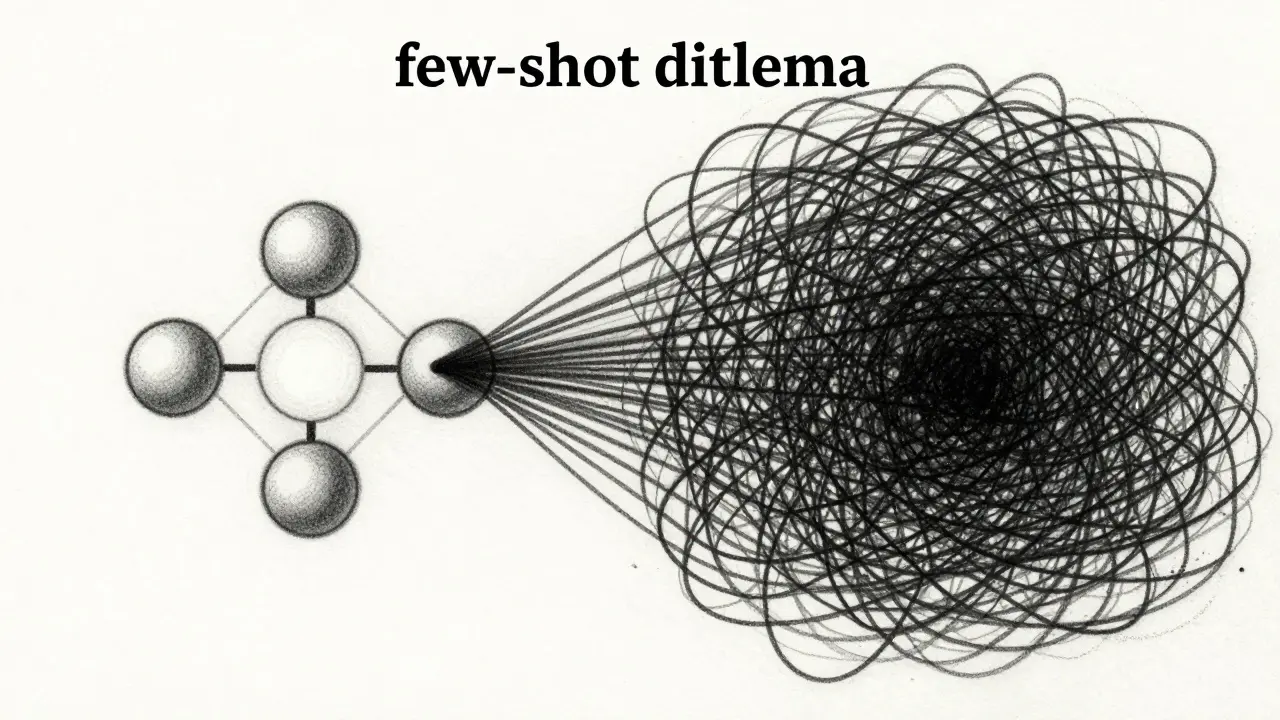
The Few-Shot Dilemma: Why More Isn't Always Better
Here is a counterintuitive finding that trips up many prompt engineers: adding too many examples can degrade performance. This phenomenon is known as the few-shot dilemma, a situation where excessive examples in a prompt lead to diminished LLM performance due to over-prompting. Recent investigations across models like GPT-4o, DeepSeek-V3, and LLaMA-3.1 have shown that performance peaks at a certain number of examples and then declines. Why? Because the model gets overwhelmed. It starts trying to reconcile conflicting nuances between too many examples, or it simply runs out of "attention" capacity to focus on the actual instruction at the end of the prompt. This is called over-prompting. To combat this, you need smarter selection methods rather than brute force. Two methods stand out:
- Semantic Embedding: Select examples that are semantically similar to your current input. If you are classifying a complaint about a delayed flight, pull past examples of travel delays, not product returns.
- TF-IDF Vectors: Research indicates that Term Frequency-Inverse Document Frequency (TF-IDF) often outperforms semantic embedding for filtering relevant examples. TF-IDF identifies keywords unique to your specific query, ensuring the examples share critical terminology with the task at hand.
Combining Few-Shot with Chain-of-Thought
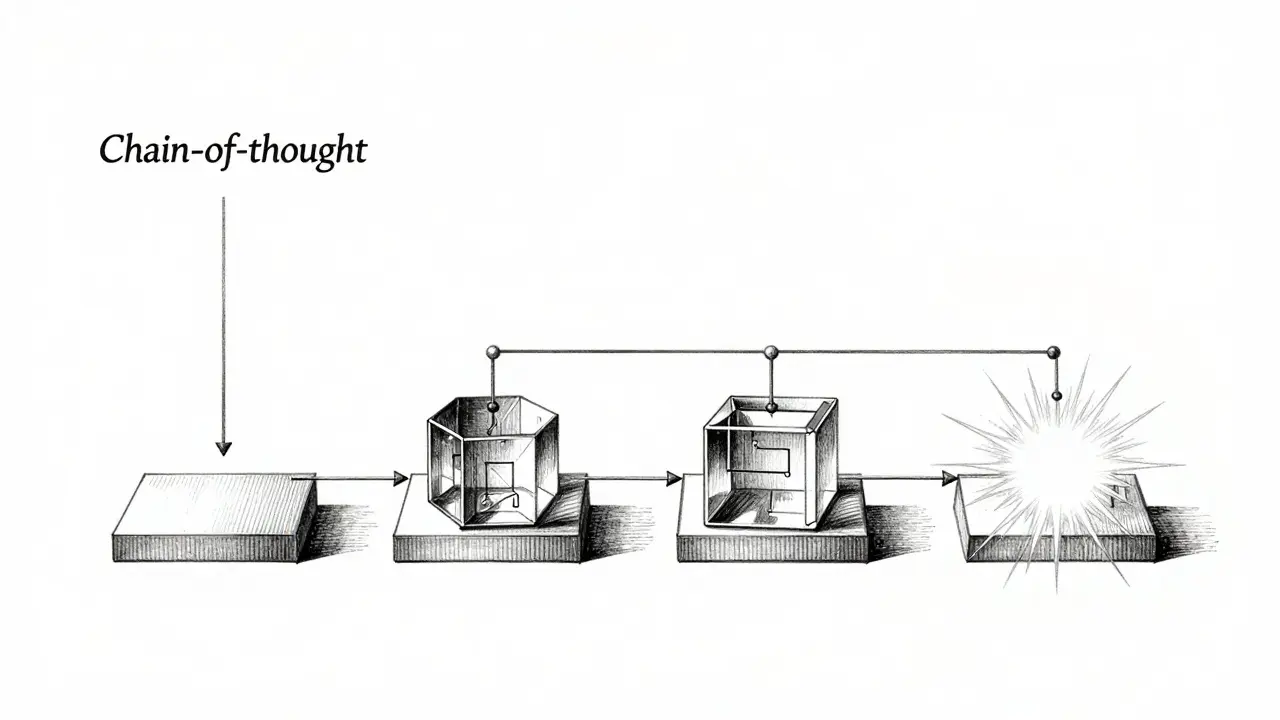
If your task involves complex reasoning-math problems, logical deductions, or multi-step decision making-few-shot prompting alone might not be enough. The model might get the right answer but for the wrong reasons, leading to inconsistency. This is where you combine few-shot prompting with chain-of-thought (CoT), a technique where the model is prompted to generate intermediate reasoning steps before arriving at a final answer. In your examples, don't just show the input and the final output. Show the work. For instance, if you are asking the model to calculate tax deductions:
Input: Income $50,000, Expenses $5,000
Reasoning: First, determine taxable income by subtracting expenses from gross income ($50,000 - $5,000 = $45,000). Then apply the standard tax rate of 15%. $45,000 * 0.15 = $6,750.
Output: $6,750
By explicitly demonstrating the logical progression in your examples, you teach the model how to think, not just what to output. This combination excels in scenarios where transparency and accuracy are both critical. It reduces hallucinations because the model is forced to ground its final answer in visible logic steps.
When to Use Few-Shot vs. Fine-Tuning vs. RAG
Few-shot prompting is powerful, but it isn't the solution for every problem. Knowing when to switch tools is key to efficient AI development. Here is a breakdown of when to use which approach:
| Strategy | Best Used For | Data Requirement | Cost & Effort |
|---|---|---|---|
| Few-Shot Prompting | Task-specific formatting, moderate complexity, rapid prototyping | Low (2-10 examples) | Low (No training needed) |
| Fine-Tuning | High-volume single tasks, maximum accuracy, specialized domain language | High (Hundreds to thousands of labeled pairs) | High (Computational resources + time) |
| RAG (Retrieval-Augmented Generation) | Dynamic information needs, large knowledge bases, factual grounding | Medium (Document corpus) | Medium (Vector database setup) |
Practical Checklist for Implementation
Ready to implement few-shot prompting in your workflow? Follow this checklist to ensure consistency and accuracy:
- Start Small: Begin with 2-3 diverse examples. Test the model's response.
- Iterate on Edge Cases: Identify where the model fails. Add an example that specifically addresses that failure mode.
- Check for Over-Prompting: If performance drops after adding more examples, remove the least relevant ones. Aim for quality over quantity.
- Use Structured Formats: Keep your examples consistent in format (e.g., JSON, XML, or clear text blocks). This helps the model parse the pattern easier.
- Validate with Holdout Data: Don't just test on the examples you gave. Test on completely new inputs to ensure the model is generalizing, not memorizing.
- Combine Techniques: For hard tasks, add chain-of-thought reasoning to your examples.
- Select Smartly: If you have a large pool of potential examples, use TF-IDF or semantic similarity to pick the top 3 most relevant ones for each query.
How many examples should I include in a few-shot prompt?
Generally, 2 to 5 well-chosen examples are sufficient for most tasks. Adding more than 8 examples can lead to the "few-shot dilemma," where performance degrades due to over-prompting. Focus on diversity and relevance rather than quantity.
What is the difference between few-shot prompting and fine-tuning?
Few-shot prompting provides examples within the prompt itself, allowing the model to learn via in-context learning without changing its underlying parameters. Fine-tuning involves retraining the model's weights on a dataset, which is more expensive, time-consuming, but potentially more accurate for highly specialized tasks.
Does few-shot prompting work with all Large Language Models?
Yes, few-shot prompting is effective across major LLMs including GPT-4, Claude, LLaMA, and Mistral. However, the optimal number of examples and the sensitivity to over-prompting may vary slightly depending on the model's architecture and context window size.
How does chain-of-thought improve few-shot prompting?
Chain-of-thought adds explicit reasoning steps to your examples. This teaches the model the logical process behind the answer, significantly improving accuracy on complex tasks like math, logic puzzles, or multi-step classification by reducing hallucinations.
What is the "few-shot dilemma"?
The few-shot dilemma refers to the phenomenon where adding too many examples to a prompt causes the model's performance to drop. This happens because the model becomes confused by conflicting patterns or loses focus on the primary instruction due to cognitive overload in the context window.


