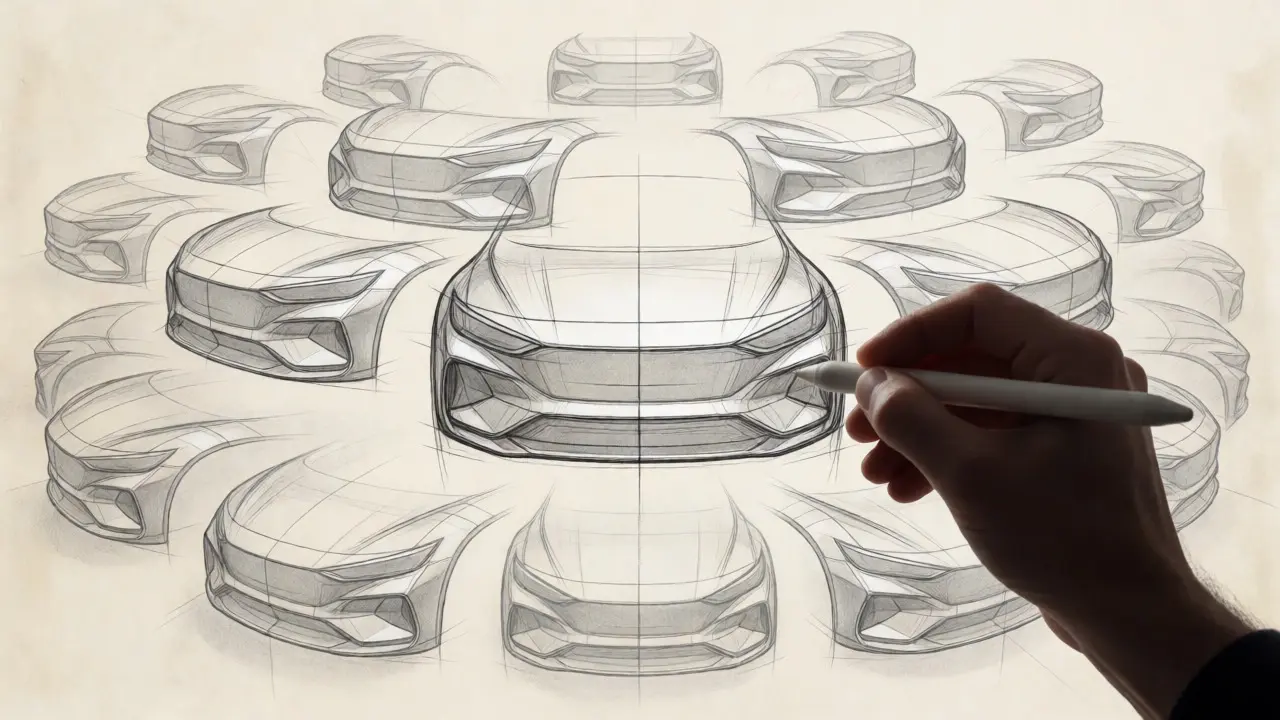
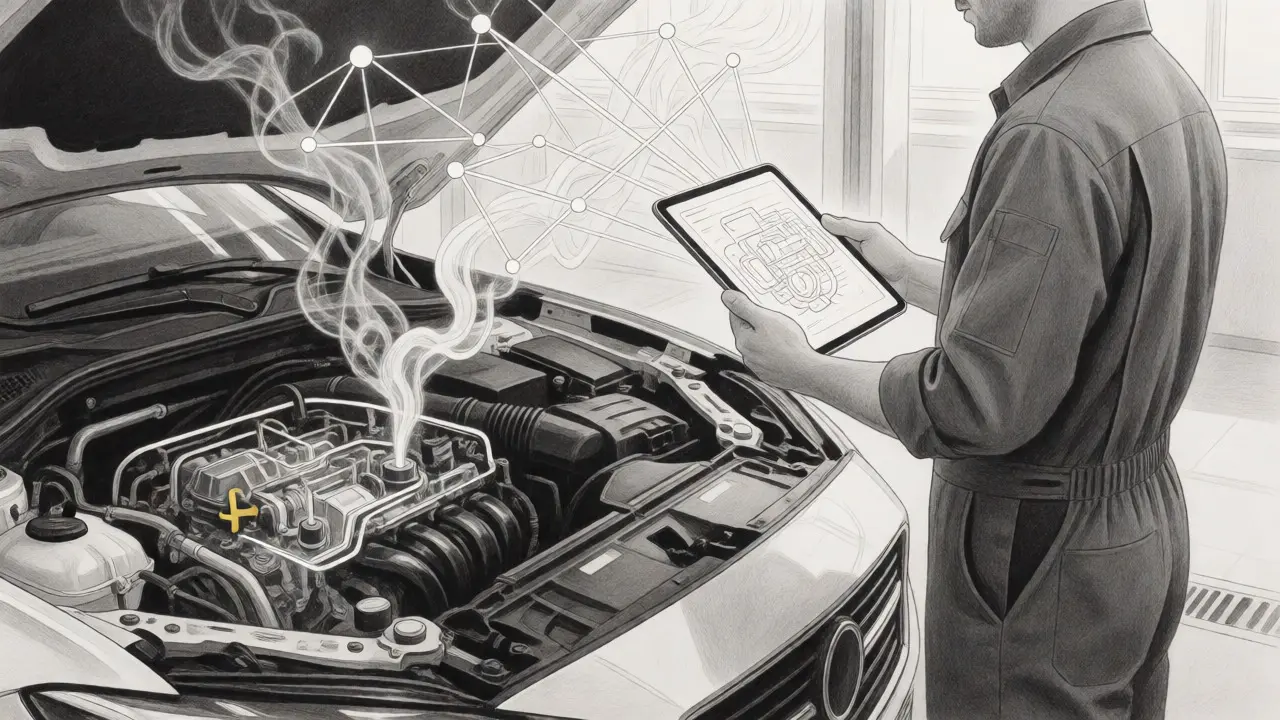
Imagine an engineer sketching a bumper concept with a text prompt, and within seconds, the system generates dozens of 3D variants that already meet crash safety standards. Or picture a mechanic pointing a tablet at a smoking engine, where an AI agent cross-references millions of service records to pinpoint the exact leak in minutes rather than hours. This isn't science fiction; it's the current state of Generative AI in the automotive industry.
We are witnessing a third wave of AI adoption in cars. The first wave was rule-based systems in the 1990s. The second brought machine learning for driver assistance in the 2010s. Now, in the mid-2020s, generative models-specifically Large Language Models (LLMs) and diffusion networks-are reshaping how vehicles are designed, diagnosed, and experienced by drivers. If you're involved in automotive tech, understanding this shift is no longer optional; it's essential for staying competitive.
The Shift from Discriminative to Generative
For decades, automotive AI was mostly discriminative. It looked at data and classified it: "Is this sensor reading normal or faulty?" Generative AI flips the script. It creates new data. It writes code, designs parts, and converses naturally. According to IBM’s 2023 overview, this shift allows manufacturers to generate designs, code, and simulations using foundation models deployed on platforms like watsonx. AWS similarly highlights how cloud-hosted foundation models accelerate innovation, moving model creation from months to days.
Why does this matter? Traditional development cycles for a vehicle platform span 36 to 60 months. Generative AI compresses this timeline. An arXiv survey from 2025 notes that these tools can reduce development time by multiple months and improve diagnostic accuracy by double-digit percentages. For fleets exceeding 100,000 vehicles, this efficiency translates into massive cost savings and faster time-to-market.
Revolutionizing Vehicle Design
Design teams used to evaluate fewer than 10 physical prototypes per cycle. Today, global OEMs use generative AI to explore hundreds of virtual variants simultaneously. L&T Technology Services describes how engineers combine text prompts with CAD constraints to generate diverse design options. Instead of waiting weeks for a team to refine a concept, an engineer can iterate through dozens of aerodynamic shapes in a single day.
This isn't just about aesthetics. Technical mechanisms like text-conditioned diffusion models translate textual specifications-say, "a bumper with high impact resistance and low weight"-into detailed 3D representations. These models integrate with legacy Product Lifecycle Management (PLM) systems, automatically checking each variant against crash performance metrics and manufacturability constraints. It turns design from a linear process into a parallel exploration of possibilities.
| Aspect | Traditional Workflow | Generative AI Workflow |
|---|---|---|
| Prototypes per Cycle | < 10 Physical | Dozens to Hundreds Virtual |
| Ideation Time | Weeks | Hours/Days |
| Constraint Checking | Manual/Sequential | Automated/Parallel Simulation |
| Data Input | CAD Files, Sketches | Natural Language, CAD, Telemetry |
Smarter Diagnostics and Maintenance
Diagnostics have long relied on support vector machines and random forests to classify faults from CAN bus data. While accurate, these systems often lack explainability. Generative AI enhances these pipelines by creating synthetic fault data to train models better and generating textual explanations for technicians.
NVIDIA’s 2024 talk outlines a multi-agent diagnostic pipeline. Imagine a computer vision subsystem detecting smoke in a workshop. A diagnostic AI agent, powered by Retrieval-Augmented Generation (RAG), then reasons over technical documentation and past service records to suggest a cause. A third safety agent ensures the recommended fix complies with protocols. This reduces time-to-diagnose from hours to minutes. KPIT highlights that generative models can also mine knowledge from tens of thousands of pages of technical manuals, answering specific warranty questions instantly.
However, caution is required. The arXiv survey warns that hallucinations remain a risk. Generative recommendations must be treated as suggestions, not autonomous decisions, especially for safety-critical components. Human-in-the-loop verification remains mandatory under standards like ISO 26262.
Connected In-Cabin Experiences
The most visible impact of generative AI is inside the cabin. We are moving away from rigid, intent-based voice commands like "Set temperature to 72 degrees." Companies like Cerence have launched CaLLM, a generative AI assistant integrated with NVIDIA platforms. It offers context-aware dialogue, allowing drivers to say, "I'm cold," and receive a holistic response involving seat heating, climate control, and even music suggestions based on mood.
AWS emphasizes the ecosystem aspect: chatbots for dealer support, mobile apps, and in-car assistants all share the same backend intelligence. This creates a seamless experience where your preferences learned in the app apply immediately when you enter the vehicle. These agents run on embedded SoCs in the car but offload complex reasoning to the cloud when needed, balancing latency and capability.

The Software Engineering Backbone
Modern vehicles contain tens of millions of lines of code. Managing this complexity is a nightmare for traditional teams. Generative AI acts as a copilot for developers. KPIT explains how models take natural language requirements-like "implement a diagnostic trouble code handler"-and produce AUTOSAR-compliant C code snippets. They also generate unit tests, covering hundreds of requirements per ECU.
This accelerates the V-model development process, which typically spans 12 to 18 months. By automating boilerplate code and test generation, engineers can focus on architecture and integration. IBM notes that while this saves significant effort, rigorous validation is still needed to comply with ASPICE and functional safety standards.
Implementation Challenges and Best Practices
Adopting generative AI isn't plug-and-play. Organizations face skill gaps, data quality issues, and computational costs. Training domain-specific models requires vast datasets that individual OEMs might struggle to assemble alone. Furthermore, integrating these tools into legacy environments with hundreds of ECUs takes time.
Start small. IBM suggests beginning with narrow pilots, such as a documentation assistant or warranty claim analyzer. Prove value with limited scope before scaling. Ensure robust governance. As these models touch safety-relevant workflows, you need strict controls over training data and access rights. Build blended teams where AI specialists support domain experts, fostering a culture that values AI-assisted output alongside traditional engineering rigor.
How does generative AI differ from traditional AI in automotive?
Traditional AI (discriminative) analyzes existing data to classify or predict outcomes, such as identifying a fault from sensor readings. Generative AI creates new content, including 3D designs, source code, synthetic data, and natural language responses, enabling creative problem-solving and automation of content-heavy tasks.
Can generative AI replace human mechanics for diagnostics?
Not entirely. While generative AI significantly speeds up diagnosis by analyzing images and documentation, it currently serves as an assistive tool. Hallucinations and rare fault coverage require human verification, especially for safety-critical repairs. It augments technician expertise rather than replacing it.
What are the main risks of deploying generative AI in cars?
Key risks include model hallucination (generating incorrect information), data privacy concerns regarding driver telemetry, high computational costs for training and inference, and regulatory compliance challenges. Safety margins in driving require deterministic behavior, which probabilistic generative models must carefully manage.
Which companies are leading generative AI in automotive?
Major players include NVIDIA (hardware and agentic frameworks), AWS (cloud infrastructure and services), IBM (watsonx platform), and specialized suppliers like Cerence (CaLLM assistant). Engineering firms like KPIT and L&T Technology Services help integrate these technologies into OEM workflows.
How long does it take to implement generative AI in a vehicle program?
Initial pilots can be set up in weeks using pre-trained foundation models. However, full-scale production deployment, including integration with legacy systems, validation, and regulatory approval, typically takes 12 to 36 months depending on the complexity and scope of the application.


