For decades, scientists have relied on their intuition and manual experimentation to uncover new truths about the world. Today, that process is shifting. We are moving past the era where artificial intelligence simply automates tedious tasks or retrieves facts from a database. Instead, we are entering an age where reasoning-enhanced large language models act as active partners in scientific investigation. These advanced systems don't just answer questions; they generate hypotheses, design experiments, and even correct their own mistakes. This shift isn't just about speed-it's about fundamentally changing how we discover new materials, understand biological systems, and solve complex physical problems.
The Evolution: From Tool to Scientist
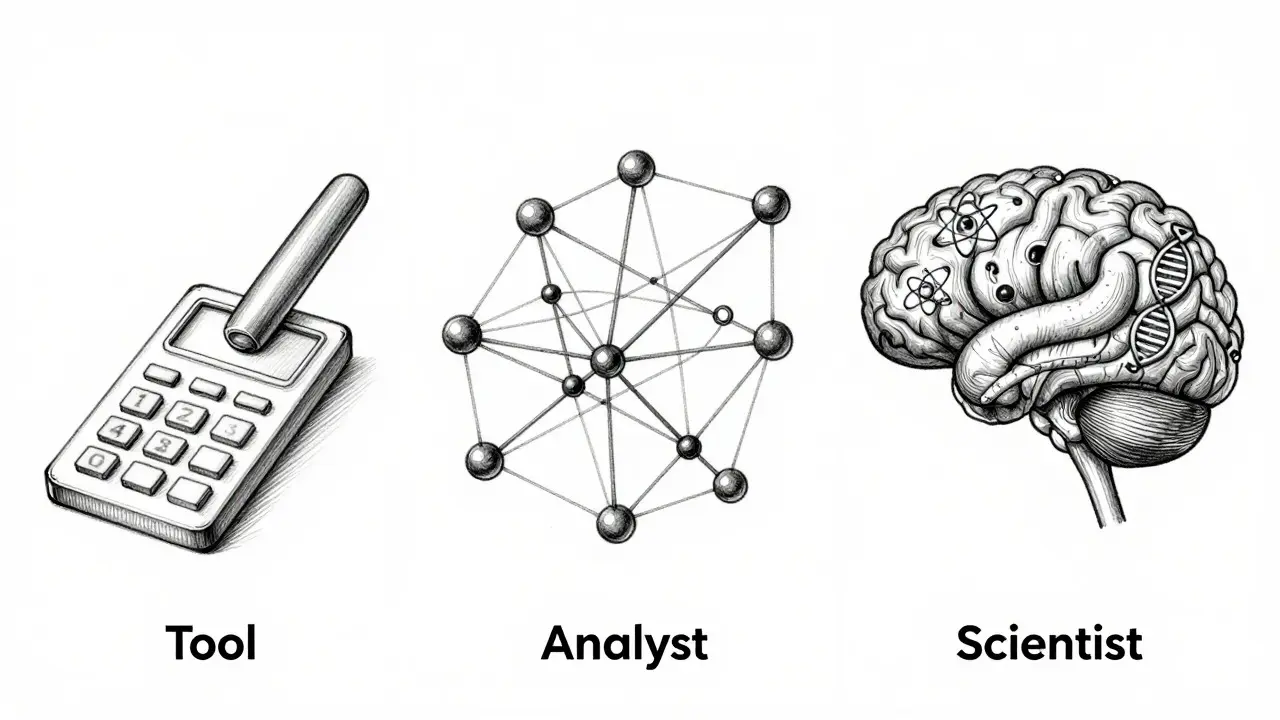
To understand where we stand today, it helps to look at the three distinct levels of AI involvement in science. Think of this as a maturity model for how much trust and autonomy you give your digital assistant.
Level 1: The Tool. In this stage, the LLM is like a very fast intern. It performs specific, well-defined tasks under direct supervision. You ask it to summarize a paper or format some data, and it does exactly that. It doesn't think deeply; it just executes.
Level 2: The Analyst. Here, the model gains more independence. It can process complex information, conduct analyses, and offer insights with less hand-holding. It might spot a trend in a dataset that you missed, but it still needs you to validate its findings.
Level 3: The Scientist. This is the cutting edge. At this level, LLM-based systems can autonomously conduct significant portions of research. They formulate hypotheses, plan experiments, analyze results, and propose next steps. While not yet fully autonomous super-intelligences, these systems drive substantial parts of the discovery loop, acting as collaborative partners rather than passive oracles.
Why Standard LLMs Fall Short in Science
You might wonder why we need special "reasoning" capabilities if general-purpose LLMs are already so smart. The issue is that science requires logical consistency and domain-specific principles that generic models often ignore. A standard LLM might hallucinate a chemical structure because it sounds plausible linguistically, even if it violates basic laws of chemistry.
Traditional molecular property prediction models suffer from poor interpretability. They tell you what the result is, but not why. For a scientist, the "why" is crucial. Without understanding the reasoning path, you can't trust the model enough to base expensive lab experiments on its predictions. This gap between statistical pattern matching and true causal reasoning is what reasoning-enhanced architectures aim to close.
MPPReasoner: Teaching Chemistry Through Logic
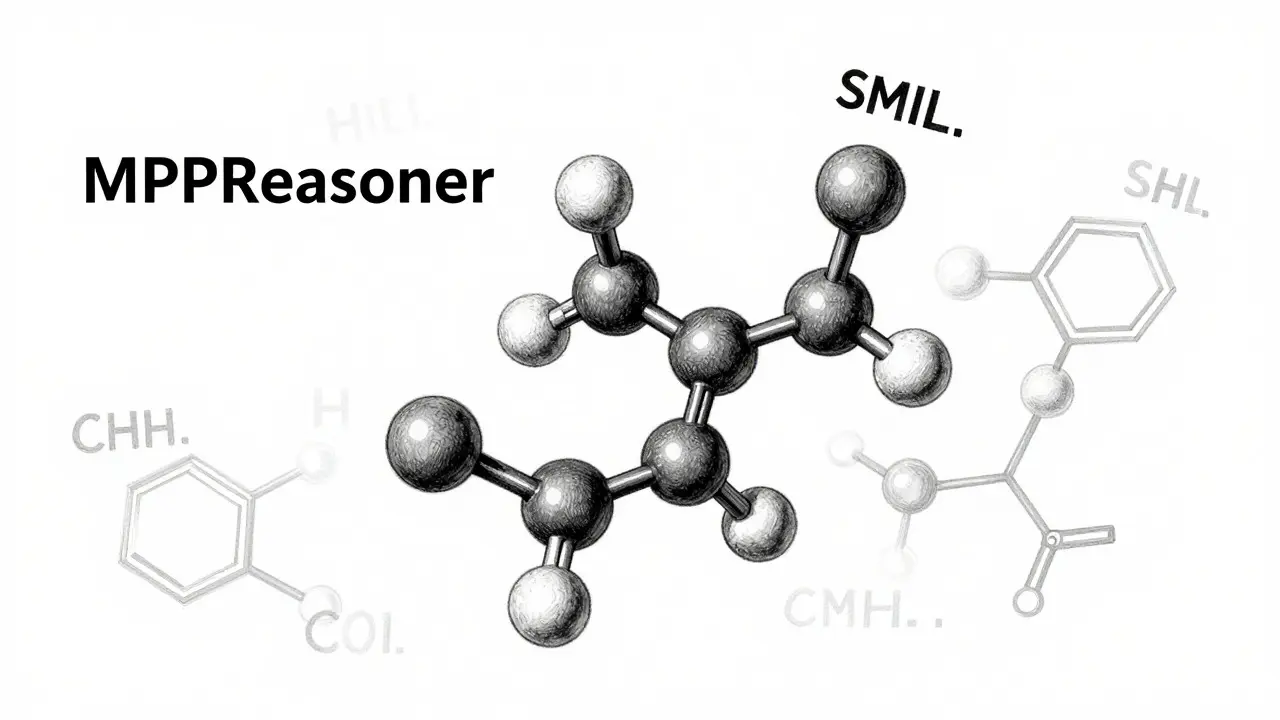
A prime example of this evolution is MPPReasoner, a multimodal large language model built upon Qwen2.5-VL-7B-Instruct. Unlike older models that just looked at text strings representing molecules, MPPReasoner integrates molecular images with SMILES strings (a text-based notation for chemical structures). This allows it to "see" the molecule while reading its code.
The real breakthrough lies in its training strategy. Developers used a two-stage approach:
- Supervised Fine-Tuning: The model was trained on 16,000 high-quality reasoning trajectories. These weren't random outputs; they were generated using expert knowledge and multiple teacher models to ensure logical rigor.
- Reinforcement Learning from Principle-Guided Rewards (RLPGR): This is where the magic happens. Instead of rewarding the model for sounding confident, RLPGR uses verifiable, rule-based rewards. If the model applies a chemical principle incorrectly, it gets penalized. If its logic holds up against computational verification, it gets rewarded.
The results speak for themselves. In extensive experiments across eight datasets, MPPReasoner outperformed the best baseline models by 7.91% on in-distribution tasks and 4.53% on out-of-distribution tasks. That improvement in out-of-distribution performance is critical-it means the model can generalize to new, unseen chemical problems rather than just memorizing known ones.
Battery Innovation and Domain Adaptation
Scientific discovery isn't limited to chemistry. In high-stakes fields like battery innovation, the stakes are higher, and the complexity is greater. SES AI’s Molecular Universe LLM, a 70-billion parameter model, demonstrates how domain adaptation works in practice.
Simply fine-tuning a general LLM on scientific papers isn't enough. You need reasoning alignment. This process teaches the model to logically navigate multi-step processes, such as generating a hypothesis about a new electrode material, simulating its behavior, and self-correcting if the simulation fails. This capability is essential for driving material exploration, where trial-and-error in the lab is costly and time-consuming.
| Capability Level | Primary Function | Autonomy | Example Use Case |
|---|---|---|---|
| LLM as Tool | Task Automation | Low (Direct Supervision) | Summarizing literature reviews |
| LLM as Analyst | Data Interpretation | Medium (Reduced Intervention) | Identifying trends in clinical trial data |
| LLM as Scientist | Hypothesis & Experiment Design | High (Iterative Autonomy) | Proposing new battery materials via simulation |
The Power of Iterative Reasoning
One of the most exciting aspects of reasoning-enhanced LLMs is their ability to engage in iterative refinement. In traditional workflows, a scientist has an idea, tests it, and moves on. With advanced LLMs, the system can explore hundreds of variations of an idea before you ever step into the lab.
Consider the benchmark framework called Scientific Discovery Evaluation (SDE). This framework assesses models on realistic, iterative tasks rather than static quizzes. The results were striking. In biology, when tested on Leinsky's rule assessment, the DeepSeek model’s accuracy jumped from 65% to a perfect 100% simply by enabling its reasoning capabilities. In physics, reasoning-enabled models like DeepSeek R1 and GPT-5 found governing equations for dynamic systems much faster than non-reasoning counterparts. They didn't just guess; they proposed structural changes, realizing, for instance, that an equation needed a sign function rather than just a polynomial.
This highlights a key insight: humans often initiate the broad direction, but advanced systems autonomously explore and refine the specific solutions. This partnership accelerates the feedback loop, allowing researchers to discard bad ideas quickly and focus resources on promising avenues.

Hybrid Frameworks: RAG Meets Case-Based Reasoning
No single technology solves every problem. The future of scientific AI lies in hybrid frameworks. Specifically, combining Retrieval-Augmented Generation (RAG) with Case-Based Reasoning (CBR) creates a robust architecture for discovery.
RAG allows the LLM to access up-to-date scientific literature, ensuring it doesn't rely solely on its pre-training data. CBR, on the other hand, leverages graph databases and vector embeddings to manage knowledge efficiently. By embedding case-based reasoning into a unified platform, these systems promote human-AI collaboration through iterative workflows. The LLM acts as a reasoning engine, pulling relevant past cases (similar experiments or failures) to inform current decisions. This approach emphasizes transparency and ethical accountability, ensuring that the AI’s suggestions are grounded in verifiable historical data.
Limitations and the Road Ahead
Despite these advances, we must remain realistic. Current LLMs are far from achieving general scientific superintelligence. The SDE framework revealed significant performance gaps in certain research scenarios. Shared failure modes persist across top-tier models, indicating that architectural innovation and training methodology improvements are still needed.
Moreover, the gap between performing well on general science exams and actually conducting discovery remains wide. A model might ace a multiple-choice test on quantum mechanics but fail to design a viable experiment to test a new theory. This suggests that while guided exploration and serendipity play a role, true autonomy requires deeper integration of physical constraints and causal logic.
However, the trajectory is clear. As we integrate domain adaptation, instruction tuning, and reasoning alignment more seamlessly, these models will become indispensable. They won't replace scientists, but they will empower them to tackle problems that were previously too complex or time-consuming to address alone.
What is a reasoning-enhanced large language model?
A reasoning-enhanced LLM is an advanced AI model that goes beyond simple text prediction. It integrates logical deduction, chain-of-thought processing, and domain-specific principles (like chemistry or physics rules) to solve complex, multi-step problems. Unlike standard LLMs, these models can explain their decision-making process and self-correct errors based on verifiable criteria.
How does MPPReasoner improve molecular property prediction?
MPPReasoner improves predictions by combining visual molecular images with SMILES text strings and using Reinforcement Learning from Principle-Guided Rewards (RLPGR). This ensures the model adheres to chemical principles during reasoning, resulting in a 7.91% performance boost on in-distribution tasks compared to previous baselines.
What are the three levels of LLM involvement in science?
The three levels are: 1) LLM as Tool, which performs specific tasks under supervision; 2) LLM as Analyst, which offers insights with reduced intervention; and 3) LLM as Scientist, which autonomously generates hypotheses, plans experiments, and analyzes data with considerable independence.
Why is reasoning alignment important for scientific AI?
Reasoning alignment equips models to logically navigate complex processes like hypothesis generation and self-correction. Without it, models may provide plausible-sounding but scientifically invalid answers. Alignment ensures the AI follows logical chains and respects domain-specific constraints, making its outputs trustworthy for research.
Can current LLMs replace human scientists?
Not yet. While LLMs can assist significantly at the "Analyst" and early "Scientist" levels, they still struggle with general scientific superintelligence and nuanced experimental design. They are best viewed as collaborative partners that accelerate discovery rather than full replacements for human expertise.