
You type a sensitive question into your company’s AI assistant. Maybe it involves client financials, proprietary code, or personal employee data. You hit enter. The answer appears instantly. But what happens to that conversation after you close the tab? Does it vanish? Or does it sit in a server somewhere, waiting to be mined, leaked, or subpoenaed?
This is the core problem with Large Language Model (LLM) logs. Without strict rules, every interaction becomes a permanent record. For businesses, this creates a massive liability. If you don’t control how long prompts are kept and how they are deleted, you are likely violating privacy laws like GDPR or exposing yourself to security breaches.
Managing these records isn't just about hitting a 'delete' button. It involves complex workflows, legal holds, and technical delays that many IT teams overlook. Here is how to build a policy that actually works.
The Hidden Complexity of "Delete"
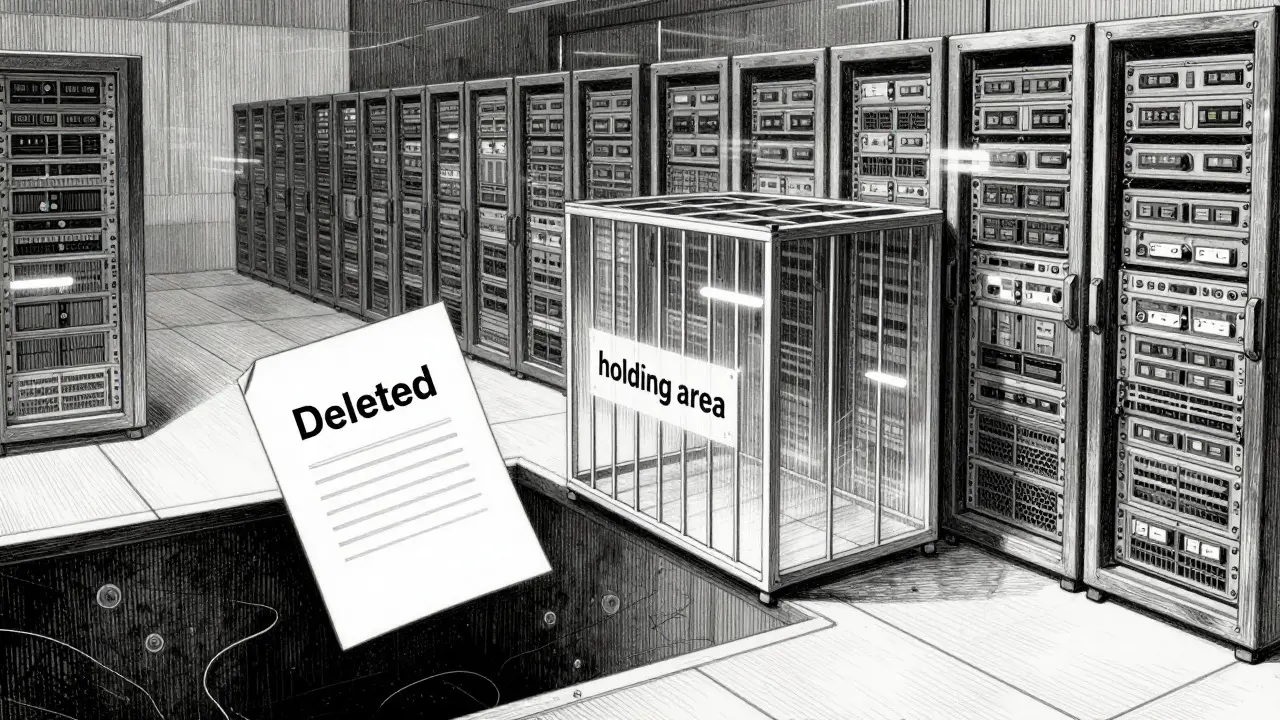
Most people assume that when they delete an AI chat, the data disappears immediately. In reality, enterprise systems often use staged deletion processes to ensure nothing is lost accidentally. This is crucial for legal reasons but dangerous if you think your data is gone right away.
Take Microsoft’s ecosystem as a concrete example. When using tools like Microsoft 365 Copilot, messages aren't nuked instantly. Instead, they follow a specific path:
- Retention Period Expires: Once the set time passes (e.g., 30 days), the message moves to a holding area called
SubstrateHolds. - The Holding Phase: The data sits here for at least one day, sometimes up to seven. This buffer ensures that if a legal hold or litigation request comes in, the data hasn't been permanently erased yet.
- Permanent Deletion: Only after the timer job runs does the system wipe the data. This final step can take another 1 to 7 days.
This means a "delete-only-after-1-day" policy might actually keep your data alive for up to 16 days total. If your compliance officer asks, "Is that customer's SSN gone?" and you say "yes" on day two, you might be wrong. Understanding these latency gaps is the first step in honest reporting.
Defining Your Retention Windows
You cannot apply a one-size-fits-all rule to all AI interactions. A casual joke told to an AI bot has different risk levels than a query containing patient health records. You need to classify your data before setting dates.
| Data Category | Recommended Retention | Deletion Trigger | Compliance Driver |
|---|---|---|---|
| General Chat / Internal Q&A | 30-90 Days | Time-based expiry | Operational efficiency |
| PII (Names, Emails) | Minimum necessary (often < 30 days) | Right to be forgotten request OR Time-based | GDPR, CCPA |
| Financial/Legal Advice | 7 Years | Statutory requirement met | SOC 2, HIPAA, SEC rules |
| Proprietary Code Snippets | Indefinite (Encrypted) | Project closure | Intellectual Property protection |
Work with your legal team to define these buckets. Don't guess. If you keep PII longer than needed, you increase your blast radius in case of a breach. If you delete too soon, you might fail an audit.
Technical Controls: Encryption and Access
Policies are useless without technical enforcement. You need to lock down who can see the logs and how they are stored. The gold standard is encryption everywhere-both in transit and at rest.
For highly sensitive fields, consider format-preserving encryption. This allows the system to validate data formats (like email addresses) without decrypting the actual content. Additionally, implement strict role-based access controls (RBAC). Just because an engineer works on the AI platform doesn't mean they should have read access to user prompts.
Every access event must be logged. Who looked at the logs? When? Why? These immutable audit trails are your proof of due diligence during investigations. If a regulator asks how you protected data, showing a clean, detailed access log is far better than saying "we tried."
The Multi-Cloud Challenge
Many companies use multiple AI providers-perhaps Azure OpenAI for some tasks and a third-party API for others. This fragmentation makes deletion a nightmare. Each provider has its own dashboard, its own API, and its own definition of "deleted."
To manage this, you need a centralized governance layer. Map out where every piece of data lives. When a user requests deletion, your system should trigger calls to all relevant platforms simultaneously. Verify the deletion downstream. Don't just trust the vendor's confirmation; check the logs to ensure the data is truly unrecoverable. Simple file deletion marks files as "free space," which can be recovered. Secure deletion overwrites the data to prevent recovery.

Model Memory and Unlearning
There is a deeper issue beyond logs: model memory. If your organization fine-tunes an LLM on internal documents, those documents become part of the model's weights. Deleting the original file doesn't remove the knowledge from the AI.
If you discover that PII was accidentally used in training, you face a difficult choice. You may need to employ techniques like "knowledge unlearning" or retrain the model on a sanitized dataset. This is computationally expensive and technically complex. The best defense is prevention: sanitize data *before* it ever touches the training pipeline. Use automated tools to scan for PII and redact it before ingestion.
Building Your Policy Checklist
Start with these actionable steps to secure your LLM environment:
- Audit Current Flows: Identify where prompts are sent and stored today.
- Define Categories: Classify data types (PII, Public, Confidential).
- Set Timers: Assign specific retention periods to each category.
- Automate Deletion: Use scripts or platform features to auto-delete expired logs.
- Verify Erasure: Implement checks to confirm data is gone, not just hidden.
- Train Users: Teach employees what is safe to type into AI tools.
Remember, the goal isn't just compliance. It's trust. Your users need to know their conversations are private. By implementing clear, enforced retention and deletion policies, you protect both your company and your customers.
How long do LLM providers typically keep chat logs?
It varies by provider and configuration. Some default to retaining logs indefinitely for service improvement unless disabled. Others offer short-term caching (e.g., 30 days). Always check the specific vendor's privacy policy and enable automatic deletion settings if available.
What is the difference between soft delete and hard delete in AI logs?
Soft delete hides the data from the user interface but keeps it in the database for recovery or legal holds. Hard delete removes the data references and eventually overwrites the storage blocks, making recovery extremely difficult or impossible. Enterprise policies often require hard delete for true privacy compliance.
Can I force an AI model to forget specific information?
Not easily. If data is only in logs, deleting the log works. If data was used to train or fine-tune the model, it is embedded in the model weights. Removing it requires "machine unlearning" techniques or retraining the model from scratch with sanitized data, which is resource-intensive.
Does GDPR apply to AI prompt data?
Yes. If the prompts contain personally identifiable information (PII) of EU citizens, GDPR applies. This includes the "right to be forgotten," requiring you to delete that data upon request. You must also justify why you are storing the data in the first place (purpose limitation).
How can I automate log deletion across multiple AI platforms?
Use a centralized identity and access management (IAM) system combined with API integrations. Create scripts that listen for deletion events and push commands to each AI provider's API. Regularly audit these connections to ensure they remain functional as platforms update their interfaces.