
We are standing at a critical juncture in the evolution of artificial intelligence. On one hand, we have powerful generative models that can write code, diagnose diseases, and create art. On the other, we have data-highly sensitive personal health records, financial histories, and proprietary business logic-that cannot leave the owner’s control without violating trust or law. For years, this was a zero-sum game: you either got the power of AI or you kept your privacy. Not anymore.
The solution lies in a class of technologies known as privacy-preserving generative AI. Specifically, two heavyweights are leading the charge: Homomorphic Encryption (HE), which allows computers to crunch numbers while they remain locked in a cryptographic vault, and Secure Enclaves, hardware-based fortresses within standard processors. These aren't just theoretical concepts from academic papers anymore. As of 2026, they are moving from lab experiments to real-world deployment, fundamentally changing how we build and use AI.
Why Traditional Encryption Fails AI
To understand why these new tools matter, look at how traditional security works. When you send an email via HTTPS or store files on an encrypted drive, the data is protected "in transit" and "at rest." But here is the catch: to do anything useful with that data, it must be decrypted first. If you want an AI model to analyze your medical scan, the hospital server decrypts the image, sends it to the AI processor, gets a result, and then re-encrypts it.
That brief moment when the data is unencrypted is the vulnerability window. In a cloud environment, the provider’s staff, malicious software, or a hacker exploiting a memory leak could see your raw data. It’s like handing over a sealed letter, asking someone to read it aloud, and hoping they don’t memorize the contents. For highly regulated industries like healthcare and finance, this risk is unacceptable.
Homomorphic Encryption changes the rules entirely. It allows computations to be performed directly on ciphertext (the encrypted data). The AI processes the locked information and produces an encrypted output. Only the person holding the private key can unlock the final answer. The AI never sees the actual data, not even for a microsecond.
How Homomorphic Encryption Works in Practice
Homomorphic encryption isn't brand new; the math has been around since the 1970s. However, until recently, it was too slow for practical use. Fully Homomorphic Encryption (FHE) allows unlimited operations, but early versions were thousands of times slower than standard processing. That bottleneck is what kept it out of production.
Recent breakthroughs have changed that landscape. In March 2025, researchers at the Pacific Northwest National Laboratory (PNNL) demonstrated viable FHE deployments on edge devices using the CKKS encryption scheme. This is significant because edge devices-like smartphones or IoT sensors-have limited battery and processing power. The CKKS scheme manages the "noise" that accumulates during calculations, allowing efficient performance without draining resources.
Here is what this looks like in a real scenario:
- The Problem: A bank wants to train a fraud detection AI using transaction data from three different countries. Data privacy laws prevent them from sharing raw customer data across borders.
- The Old Way: They couldn't do it. Or they had to anonymize the data so heavily that the AI became useless.
- The HE Way: Each bank encrypts its data locally. They send the encrypted blobs to a central aggregator. The AI trains on the encrypted data. The resulting model updates are also encrypted. No single party ever sees another party's raw transactions.
This approach was validated by research published in JMR Medical Informatics in 2024, which showed that AI models trained on multi-institutional datasets using homomorphic encryption actually outperformed models trained on single-institution data with standard encryption. The collaborative power outweighed the computational cost.
Secure Enclaves: The Hardware Shield
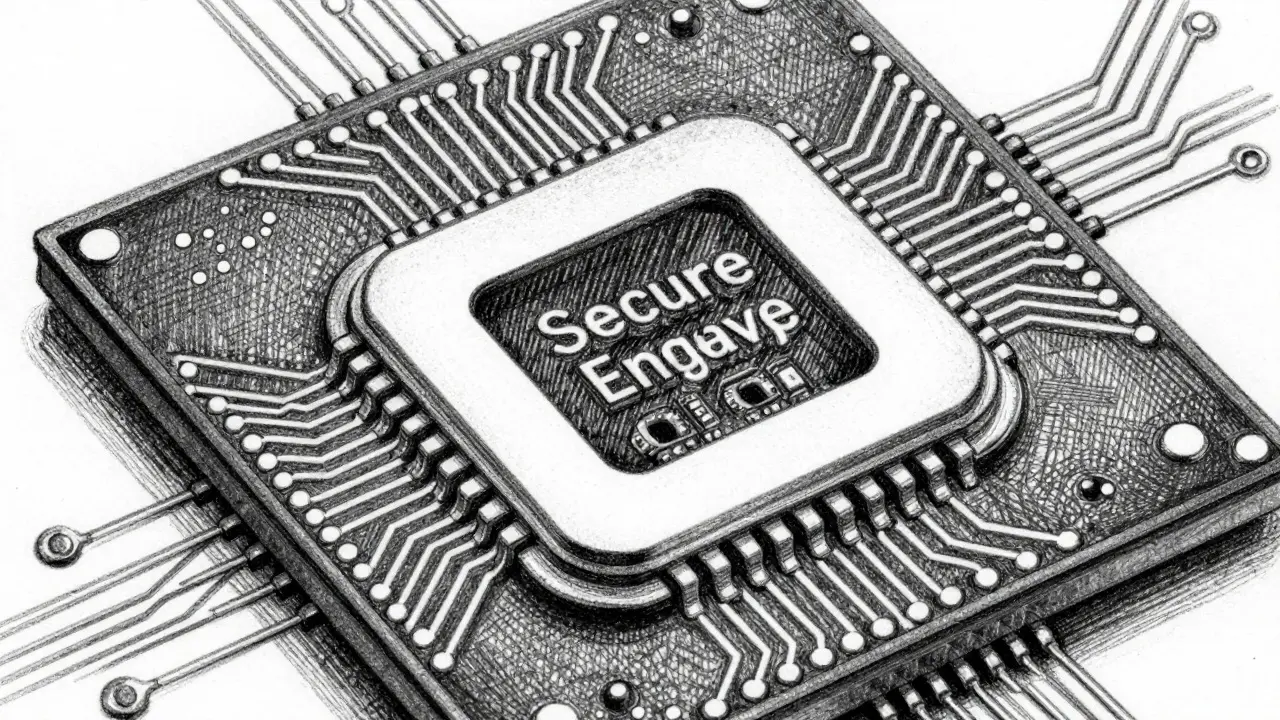
While homomorphic encryption handles the software side, Secure Enclaves provide the hardware foundation. You might know these as Intel SGX (Software Guard Extensions) or AMD SEV (Secure Encrypted Virtualization). These are isolated areas within a CPU that are inaccessible to all other software, including the operating system and hypervisors.
Think of a secure enclave as a safe inside a computer chip. Even if the main server is compromised by root-level malware, the attacker cannot peek into the enclave. The code running inside the enclave is encrypted, and the data processed there is protected by hardware keys that never leave the chip.
For generative AI, this means you can run large language models (LLMs) in the cloud without trusting the cloud provider. You upload your proprietary model weights and user queries into the enclave. The computation happens in isolation. The results come out, but the intermediate states-the "thought process" of the AI-are hidden from the infrastructure owner.
The trade-off here is speed versus security. Secure enclaves offer near-native performance because they use standard arithmetic, unlike the heavy mathematical overhead of homomorphic encryption. However, they rely on trust in the hardware manufacturer. If there is a flaw in the Intel or AMD silicon design, the whole system fails. HE relies on mathematical proofs, which are generally considered more robust against future threats.
Combining Forces: Federated Learning and HE
The most robust architectures today don't pick one tool; they combine them. Federated Learning is a method where AI models are trained across multiple decentralized devices or servers holding local data samples, without exchanging them. Traditionally, federated learning protects data by keeping it local, but the model updates sent back to the central server can still leak information. Researchers have shown that attackers can reconstruct training data from these updates.
By adding homomorphic encryption to federated learning, you close that gap. IBM has already integrated HE into its federated learning frameworks. Here is the workflow:
- Hospitals train a diagnostic AI locally on their patient data.
- They generate model updates (gradients).
- These updates are encrypted using HE before being sent to the central aggregator.
- The aggregator sums up the encrypted updates.
- The global model is returned to hospitals, also encrypted.
This dual layer ensures that neither raw data nor intermediate model insights are exposed. It creates a trust architecture based on mathematics rather than contracts. This is crucial for compliance with regulations like the GDPR, which increasingly demands "state-of-the-art" technical measures rather than just legal assurances.

Challenges and Realistic Expectations
Despite the progress, we need to keep our feet on the ground. The International Association of Privacy Professionals (IAPP) notes that while HE shows unprecedented potential, it is not yet efficient enough for widespread operational use across all applications. There are still significant hurdles:
- Computational Overhead: HE operations are still slower than plaintext operations. While PNNL’s 2025 work improved this, complex deep learning tasks can still take hours instead of minutes.
- Complexity: Implementing HE requires specialized expertise. Developers need to understand noise budgets, polynomial sizes, and key management, which adds friction to standard AI workflows.
- Storage Costs: Encrypted data takes up significantly more space than unencrypted data, increasing storage and bandwidth costs.
Because of these constraints, many organizations are adopting a hybrid strategy. They use secure enclaves for high-performance inference tasks where speed is critical, and reserve homomorphic encryption for highly sensitive batch processing or collaborative training scenarios where privacy is non-negotiable.
The Future Landscape: Blockchain and Beyond
Looking ahead, the convergence of these technologies is opening doors to entirely new architectures. Imagine a decentralized health research platform powered by blockchain. Hospitals contribute encrypted model updates via smart contracts. The blockchain verifies the integrity of the contributions on-chain, ensuring no one cheated the system, while homomorphic encryption keeps the actual patient data hidden. Supply chain networks could similarly train risk-detection models collaboratively, governed by transparent protocols but protected by cryptographic secrecy.
As we move through 2026, the focus is shifting from "can we do it?" to "how do we scale it?" New York University recently unveiled a novel framework bringing FHE to deep learning applications, aiming to solve the efficiency bottlenecks. With continued investment in both hardware acceleration for HE and standardized APIs for secure enclaves, privacy-preserving AI will likely become the default, not the exception, for enterprise-grade generative AI systems.
What is the main difference between Homomorphic Encryption and Secure Enclaves?
Homomorphic Encryption is a software/mathematical technique that allows computation on encrypted data without decrypting it. It provides strong privacy guarantees based on cryptographic proofs but can be computationally slow. Secure Enclaves are hardware-based isolated environments within a CPU (like Intel SGX) that protect data in use from the operating system and other processes. They offer faster performance but rely on trust in the hardware manufacturer.
Is Homomorphic Encryption ready for production use in 2026?
It is ready for specific use cases, particularly in healthcare, finance, and collaborative AI training where privacy is paramount. Recent advancements, such as the CKKS scheme implementations by PNNL in 2025, have made it viable for edge devices and certain AI workloads. However, it is not yet a drop-in replacement for all general-purpose computing due to computational overhead and complexity.
How does Homomorphic Encryption help with GDPR compliance?
GDPR requires organizations to implement appropriate technical measures to protect personal data. Homomorphic Encryption provides mathematical assurance that data remains protected even during processing, satisfying the requirement for "state-of-the-art" security. It reduces liability by ensuring that even if a breach occurs, the stolen data remains unintelligible.
Can I use Homomorphic Encryption with Large Language Models (LLMs)?
Yes, recent research from NeurIPS 2024 demonstrates privacy-preserving inference on LLMs using HE. User queries are encrypted before sending to the cloud, the model processes them homomorphically, and the response is returned encrypted. This prevents cloud providers from accessing user prompts or proprietary model parameters.
What is the role of Federated Learning in this ecosystem?
Federated Learning enables AI training across decentralized data sources without moving the raw data. When combined with Homomorphic Encryption, it protects the model updates exchanged between participants, preventing leakage of sensitive information that can occur in standard federated learning setups.