Remember when building an app meant weeks of staring at a blank text editor? That era is officially over. In 2026, the concept of vibe coding has moved from niche hype to mainstream reality. You describe what you want in plain English, and artificial intelligence builds it for you. But here is the catch: not all AI builders are created equal. Two names are dominating the conversation right now: Base44 is a cloud-based platform that generates full-stack applications from natural language prompts, targeting teams who need structure and speed. On the other side of the ring stands Tempo Labs is a visual development environment focused on accelerating React component design and implementation, appealing to developers who want control without the boilerplate grind.
The market for these tools exploded in 2025, hitting a $42.7 billion valuation with a staggering 23.4% year-over-year growth, according to Gartner’s January 2026 analysis. With so much money and attention flowing into this space, picking the wrong tool can cost you time, flexibility, or even your sanity. So, which one should you choose? It depends entirely on whether you are building a quick internal tool or polishing a customer-facing product.
What Is Vibe Coding Anyway?
Before we dive into the specs, let’s clear up the terminology. "Vibe coding" isn’t just a buzzword; it describes a shift in how we interact with code. Instead of writing every line manually, you act as a director. You provide the intent, the context, and the feedback, while the AI handles the syntax, the architecture, and the deployment.
This approach relies heavily on Large Language Models (LLMs) like GPT-4o and Claude 3.5 Sonnet. However, raw LLMs aren’t enough. They need scaffolding-structure to keep the generated code clean, secure, and functional. This is where platforms like Base44 and Tempo Labs come in. They wrap those powerful models in workflows designed for specific outcomes. One wraps it in a project management layer; the other wraps it in a visual design layer.
Base44: The Structured Builder for Teams
Base44 was founded by former enterprise software developers who were tired of the repetitive setup work that comes with every new project. Launched in 2024, their mission is simple: eliminate traditional coding barriers. Their tagline says it all: "If you can describe it, you can build it."
Base44 operates entirely in the cloud. There is no local setup, no configuring Node environments, and no wrestling with Docker containers. You log in, you type your idea, and Base44 generates the backend infrastructure, authentication systems, database functionality, and role-based permissions automatically. It deploys instantly with built-in hosting.
Here is why teams love it:
- Speed to Value: A user on Reddit reported building a complete customer portal in two hours-a task that would have taken their team two weeks.
- Enterprise Ready: It supports integrations with GitHub, Amazon S3, Supabase, SendGrid, and more. This makes it viable for business-critical apps, not just toys.
- Structured Workflows: Unlike freeform chat interfaces, Base44 guides you through a structured process. This reduces the chance of the AI going off the rails.
However, there is a trade-off. Because Base44 abstracts away so much complexity, it can feel rigid. If you want to implement complex animations or highly customized UI behaviors, the AI might default to basic CSS transitions. As one Capterra reviewer noted, it struggles with advanced frontend polish, often generating generic components rather than bespoke designs.
Tempo Labs: The Visual Editor for React Developers
If Base44 is about automating the entire stack, Tempo Labs is a specialized tool for designers and developers to collaborate on React code visually. Founded in 2023 as part of Y Combinator’s Summer batch, Tempo targets a different pain point: the gap between design mockups and actual implementation.
Tempo doesn’t try to replace your entire development environment. Instead, it integrates tightly with existing React projects. It offers a visual drag-and-drop editor where you can tweak layouts, styles, and components without losing control of the underlying code. Changes sync back to GitHub, allowing for flexible deployment strategies.
Key advantages include:
- React Specificity: It understands React deeply. You can import components from Storybook and iterate on them visually.
- Developer Control: You aren’t locked into a black box. The code remains readable and editable by human developers.
- Collaboration: Real-time collaboration features allow designers and devs to work on the same file simultaneously.
A success story from Chorus AI illustrates its power: using Tempo’s Agent+ plan, they cut front-end development costs in half and increased velocity by 3x. For startups building customer-facing React applications, this level of efficiency is game-changing.
The downside? It’s React-centric. If your stack involves Vue.js or Angular, Tempo is less useful. Currently, it lacks support for non-React frameworks, though Vue.js support is planned for Q3 2026.
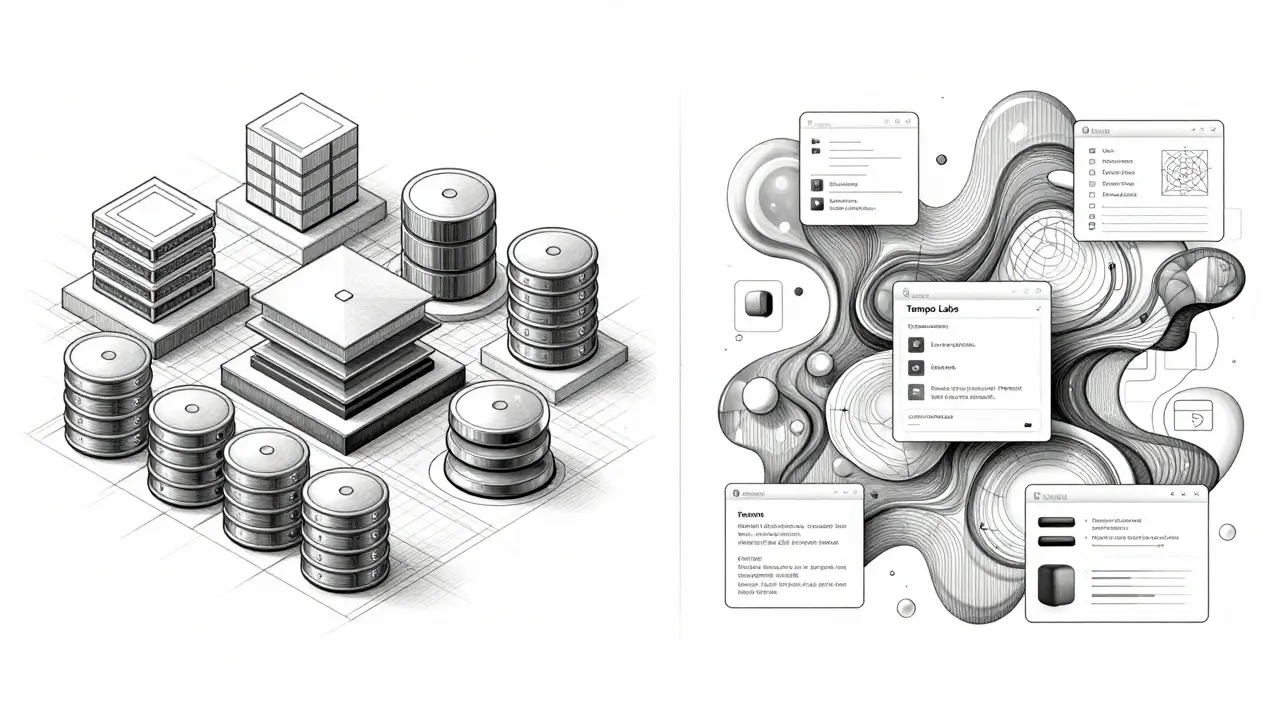
Head-to-Head Comparison
To help you decide, let’s look at the numbers. Both platforms use top-tier LLMs, but their architectures serve different masters.
| Feature | Base44 | Tempo Labs |
|---|---|---|
| Primary Use Case | Full-stack app generation from text | Visual React component editing |
| Deployment | Automatic, built-in hosting | Syncs to GitHub, flexible deployment |
| Framework Support | Multi-framework (React, Vue, Svelte) | React only (Vue coming Q3 2026) |
| Pricing (Paid Tier) | $20/month | $30/month |
| Learning Curve | Moderate (8-12 hours) | Steep for non-React devs (15-20 hours) |
| Market Rating | 4.2/5 (SelectHub) | 4.5/5 (SelectHub) |
Notice the pricing difference. Base44 is cheaper, offering a robust free plan with core features. Tempo Labs charges more, reflecting its specialized nature and higher value for professional React teams. Also, consider the ratings: Tempo Labs edges out Base44 in user satisfaction, largely due to its precision in handling design details.
Who Should Choose Which?
Let’s get practical. Imagine you are a product manager at a mid-sized company. You need an internal dashboard to track employee expenses. You don’t care about pixel-perfect animations; you care about getting it done before Friday. Go with Base44. Its ability to generate auth, databases, and logic in minutes will save you days of work. The slight rigidity in UI customization won’t matter because it’s an internal tool.
Now, imagine you are a lead developer at a startup. Your investors are watching, and your mobile app’s landing page needs to be stunning. You already have a React codebase. You need to iterate on button styles, layout grids, and responsive breakpoints quickly without breaking your build. Go with Tempo Labs. Its visual editor will let you polish the design while keeping your codebase clean and collaborative.
There is also a hybrid approach. Some teams use Base44 to scaffold the initial application structure and then export the code to refine it further using tools like Tempo Labs. However, this requires technical expertise to bridge the gap between the two platforms.
The Reality Check: Do You Still Need to Code?
Marketing claims often suggest these tools make coding obsolete. Let’s be honest: that’s not true yet. A study by the Alan Turing Institute found that 68% of successful Base44 implementations and 72% of Tempo Labs implementations involved users with at least basic programming knowledge.
Why? Because AI needs guidance. You need to understand concepts like state management, API endpoints, and component hierarchy to prompt the AI effectively. If you ask Base44 to "build a social network," it might give you a generic template. If you ask it to "build a social network with real-time WebSocket updates and role-based access control," you’ll get something usable. The better you understand the underlying technology, the better the output.
This doesn’t mean non-technical users can’t benefit. They absolutely can. But they will hit ceilings faster. For them, Base44’s structured workflow is safer than Tempo’s open-ended visual editor, which assumes some familiarity with React concepts.
Future Outlook: Where Are They Heading?
Both platforms are evolving rapidly. Base44 released version 2.3 in January 2026, enhancing data modeling and improving integration with Claude 3.5 Sonnet. They are planning GitHub Copilot integration by Q2 2026, which could bridge the gap between their cloud environment and local developer workflows.
Tempo Labs launched its Agent+ plan in December 2025, adding advanced collaboration features. Their roadmap includes Vue.js support by Q3 2026, signaling an intent to broaden their market beyond just React shops. Analysts project Tempo Labs will reach 6.8% market share by end of 2026, driven by high retention rates (91%) among developers.
Base44 is projected to grow to 4.1% market share, bolstered by strong enterprise adoption. Eighty-two percent of its enterprise users plan to expand usage, citing the reliability of its structured workflows.
The vibe coding market is still young. Established players like Lovable hold the #1 spot with 18.3% market share, but Base44 and Tempo Labs are carving out lucrative niches. As AI models become smarter and more context-aware, the line between "coding" and "directing" will blur even further. But for now, choosing the right tool depends on your specific needs: structure and speed versus control and polish.
Is Base44 free to use?
Yes, Base44 offers a free plan that includes all core features, including built-in integrations, authentication systems, and database functionality. Paid plans start at $20 per month for additional resources and priority support.
Can I use Tempo Labs if I don't know React?
It is possible, but challenging. Tempo Labs is optimized for React development. Non-React developers report a steep learning curve of 15-20 hours. If you are unfamiliar with React concepts like components and props, you may find the visual editor confusing. Base44 might be a better starting point for beginners.
Which platform is better for enterprise teams?
Base44 is generally better suited for enterprise teams. It focuses on structured workflows, team collaboration, and full-stack generation with automatic security features like role-based permissions. 68% of its paying customers are mid-to-large enterprises using it for internal business applications.
Does Tempo Labs support Vue.js or Angular?
Currently, Tempo Labs is React-only. However, Vue.js support is scheduled for release in Q3 2026 according to their public roadmap. Angular support is not yet announced.
How do these platforms compare to traditional no-code tools?
Traditional no-code tools often lock you into proprietary ecosystems with limited customization. Base44 and Tempo Labs leverage AI to generate standard, editable code (HTML, CSS, JavaScript, React). This means you retain ownership and flexibility, avoiding vendor lock-in.
What is the average time to build an app with Base44?
Users report significant time savings. One case study showed a customer portal built in 2 hours that previously took 2 weeks. Generally, simple apps can be prototyped in under an hour, while complex applications may take a few days of iterative refinement.
Do I need to pay for API calls to OpenAI or Anthropic?
Both platforms integrate with models like GPT-4o and Claude 3.5 Sonnet. Typically, the cost of these API calls is bundled into the subscription fee for paid tiers. Free tier users may have limits on the number of generations or complexity of prompts.
Which platform has better documentation?
Tempo Labs scores higher in documentation clarity (4.6/5) compared to Base44 (4.3/5). Tempo’s docs are particularly praised for their React-specific examples and tutorials, making it easier for developers to learn the tool.


