The landscape of large language models has shifted so fast that the rankings from just nine months ago feel like ancient history. If you were picking an AI partner in mid-2025, you likely looked at GPT-4o or Gemini 1.5 and called it a day. But by March 2026, those names are no longer the undisputed kings. We are witnessing a true renaissance in natural language processing, driven not just by bigger models, but by smarter architectures and unprecedented context windows.
This isn't just about who scores higher on a test. It's about how we use these tools. With context windows jumping from thousands to millions of tokens, and open-source models closing the gap with proprietary giants, the decision of which model to deploy is more complex-and more exciting-than ever before. Let’s break down exactly how the top contenders stack up in 2026, what the new benchmarks mean for your workflow, and why "bigger" no longer always means "better."
The New Heavyweights: Closed-Source Leaders
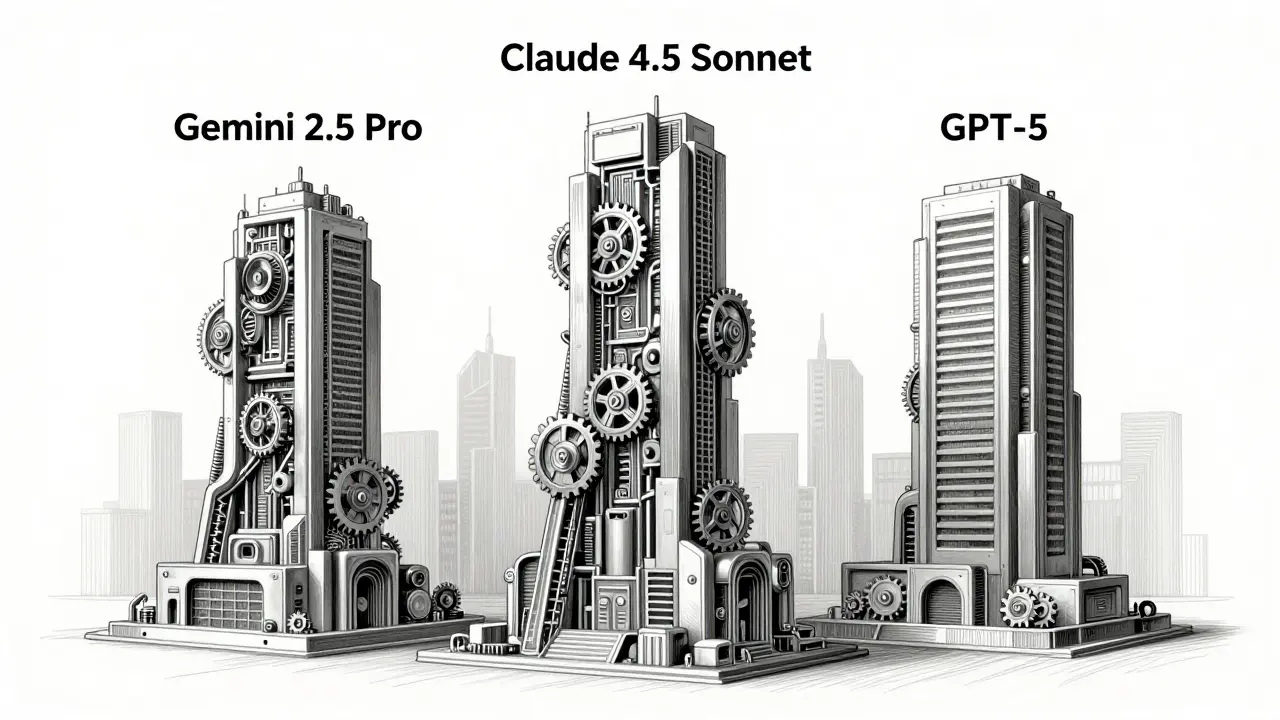
When it comes to raw performance out of the box, the closed-source trio still holds the crown, but the margins have tightened significantly. According to the latest data from the Onyx LLM Leaderboard and Pluralsight’s benchmarking framework, Google Gemini 2.5 Pro currently sits at position one with a comprehensive score of 1452. This translates to approximately 84.6% accuracy across diverse competency areas, including coding, reasoning, and general knowledge.
Right on its heels is Claude 4.5 Sonnet, tied for first place in several categories with a score of 1448. OpenAI’s latest flagship, GPT-5 (in its high configuration), follows closely with a score of 1437. These numbers aren’t just abstract metrics; they represent real-world reliability. For enterprises that need consistent, high-fidelity outputs without fine-tuning, these three remain the gold standard.
However, their dominance comes with trade-offs. These models are API-only services. You don’t get to peek under the hood, and you’re locked into their pricing structures. But the payoff is integration. Gemini’s tight coupling with Google Workspace-Search, Docs, Gmail, and Android-creates a seamless productivity loop that competitors struggle to match. If your team lives in Google’s ecosystem, Gemini 2.5 Pro isn’t just a tool; it’s an extension of your existing workflow.
| Model | Benchmark Score | Accuracy Estimate | Key Advantage |
|---|---|---|---|
| Gemini 2.5 Pro | 1452 | ~84.6% | Google Workspace Integration |
| Claude 4.5 Sonnet | 1448 | ~84.2% | Reasoning & Safety |
| GPT-5 (High Config) | 1437 | ~83.9% | Ecosystem Breadth |
The Open-Source Revolution: Context Windows Explode
If closed-source models are winning on pure accuracy, open-weight models are winning on scale and flexibility. The biggest story in 2026 isn’t just parameter count-it’s context window size. We’ve moved past the era where 128,000 tokens was considered "large." Today, it’s the baseline.
Meta’s Llama 4 Scout has shattered previous records with a staggering 10 million token context window. To put that in perspective, you can feed an entire library of research papers, full codebases, or multi-year conversation histories into Scout without truncation. This changes how we approach deep research and long-term memory tasks. You no longer need to summarize documents before analysis; you can analyze them all at once.
Mistral isn’t far behind. Their Mistral 3 Large offers a 256,000 token window, which is massive for most enterprise applications. Meanwhile, Chinese developers have made significant strides. Z.ai’s GLM-5 utilizes a mixture-of-experts (MoE) architecture with 744 billion total parameters (40 billion active) and supports 128,000 tokens. More impressively, GLM-5 was trained on 28.5 trillion tokens-the largest pretraining dataset seen to date.
Why does this matter? Because open-weight models allow you to deploy locally. You keep your data private, avoid API costs, and customize behavior. For organizations concerned about vendor lock-in or data sovereignty, models like Llama 4, GLM-5, and Mistral 3 Large are game-changers.

Efficiency Over Size: The Rise of Mixture-of-Experts
There’s a common misconception that bigger models are always better. The 2026 landscape proves otherwise. The shift toward mixture-of-experts (MoE) architectures has allowed developers to build models that are both larger and faster than their dense predecessors.
In a traditional dense model, every parameter is activated for every input. In an MoE model, only a subset of experts is activated per token. This dramatically reduces computational load during inference while maintaining the capacity of a much larger model. Take Qwen’s latest release: Qwen3.5-35B-A3B. Despite having only 35 billion parameters (with 3 billion active), it outperforms the significantly larger Qwen3-235B model. This demonstrates that architectural efficiency and training quality now outweigh raw parameter counts.
This trend is evident across the board. Meta’s Llama 4 family uses MoE structures to deliver multimodal capabilities efficiently. Mistral 3 Large activates only 41 billion of its 675 billion parameters. Even OpenAI’s new open-reasoning models, gpt-oss-20b and gpt-oss-120b, leverage MoE to provide reasoning capabilities previously reserved for their proprietary o3 series.
For businesses, this means lower inference costs. You can run powerful models on cheaper hardware or handle higher throughput without breaking the bank. The days of needing a supercomputer to run a state-of-the-art LLM are fading.
Specialized Players: Edge, Mobile, and Finance
Not every task requires a 10-million-token monster. In fact, for many applications, smaller, specialized models are superior. Microsoft’s Phi family continues to dominate the efficiency space. With models ranging from 3 billion to 15 billion parameters, Phi is optimized for constrained environments like mobile devices and edge computing. Some Phi variants even support reasoning and multimodality, proving that small doesn’t mean dumb.
Similarly, Google’s Gemma 3 lineup offers five configurations, from 270 million to 27 billion parameters. A specialized variant, Gemma 3n, targets mobile architectures directly. These models are perfect for apps that need on-device AI processing without sending data to the cloud.
For niche industries, specialized models still hold value. BloombergGPT remains a strong choice for financial analysis, leveraging domain-specific training data. Grok continues to serve specific social media and real-time information use cases. And for multilingual applications, particularly in Asian markets, Chinese models like MiniMax M2.5 and Qwen3.5 offer nuanced understanding that Western-centric models sometimes miss.
How to Choose Your Model in 2026
With so many options, how do you pick? It depends entirely on your primary constraint: cost, privacy, or performance.
- Prioritize Performance & Integration: If you need the highest accuracy and already use Google Workspace, go with Gemini 2.5 Pro. If you need robust reasoning and safety guardrails, choose Claude 4.5 Sonnet.
- Prioritize Privacy & Control: Deploy open-weight models like Llama 4 Scout or GLM-5 locally. You’ll sacrifice some convenience for complete data ownership and customization.
- Prioritize Cost & Speed: Look at MoE models like Mistral 3 Large or Qwen3.5. They offer near-top-tier performance at a fraction of the inference cost of dense models.
- Prioritize Edge/Mobile Deployment: Use Phi or Gemma 3n. These models are designed to run smoothly on consumer hardware without cloud dependency.
Remember, the gap between "best" and "good enough" has narrowed. A model like Qwen3.5-35B might score slightly lower on a benchmark than GPT-5, but if it runs 10x faster and costs 10x less, it’s often the better business decision.
What is the best large language model for general use in 2026?
For general use requiring maximum accuracy and ease of access, Google Gemini 2.5 Pro and Claude 4.5 Sonnet are currently the top performers based on benchmark scores of 1452 and 1448 respectively. However, if you prefer open-source flexibility, Meta's Llama 4 Scout offers exceptional context capabilities.
How do mixture-of-experts (MoE) models improve performance?
MoE architectures activate only a subset of parameters for each input, reducing computational load during inference. This allows models like Mistral 3 Large and Qwen3.5 to maintain high capacity and accuracy while being faster and cheaper to run than dense models of similar size.
Which model has the largest context window in 2026?
Meta's Llama 4 Scout currently holds the record with a 10 million token context window. This enables processing of entire books, large codebases, or extended research collections in a single session without truncation.
Are open-source models as good as proprietary ones?
The gap has narrowed significantly. Models like GLM-5 and Mistral 3 Large compete closely with proprietary leaders in many tasks. While GPT-5 and Gemini 2.5 Pro still lead in raw benchmark scores, open-source models offer advantages in privacy, cost control, and customization.
What is DeepSeek Sparse Attention (DSA)?
DeepSeek Sparse Attention is an architectural innovation used in models like GLM-5. It optimizes attention mechanisms for long-context workloads, significantly reducing compute costs while preserving strong reasoning performance over extended text sequences.