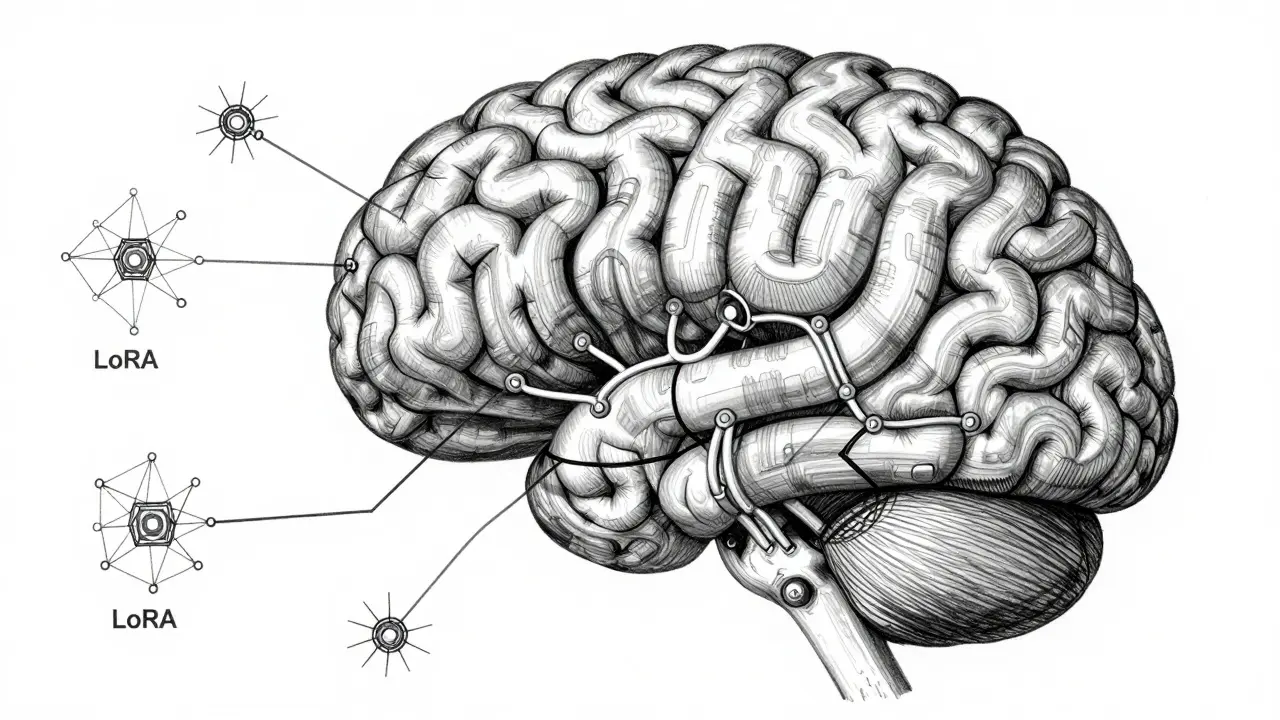
Full fine-tuning of large language models used to be a luxury reserved for tech giants with bottomless compute budgets. If you wanted to customize a 13-billion-parameter model for your specific business task, you needed access to clusters of high-end GPUs and thousands of dollars in electricity costs. That reality has shifted dramatically thanks to Parameter-Efficient Fine-Tuning (PEFT), specifically techniques like Low-Rank Adaptation (LoRA) and adapter modules.
These methods allow you to achieve nearly identical performance to full fine-tuning while using a fraction of the resources. You can now fine-tune massive models on consumer-grade hardware or single cloud instances. This guide breaks down how LoRA and adapters work, when to use which, and how to implement them effectively in 2026.
The Core Problem: Why Full Fine-Tuning Is Broken
Large Language Models (LLMs) like Llama-2, Mistral, or proprietary enterprise models contain billions of parameters. When you perform full fine-tuning, you update every single weight in the network. For a 7B parameter model, this requires storing gradients, optimizer states, and activations for all those parameters simultaneously. The memory footprint explodes.
Consider the math: a 13B parameter model typically requires around 80GB of VRAM for full fine-tuning. Most developers do not have access to an A100 or H100 GPU cluster. Even if they did, the cost is prohibitive. Training multiple task-specific models means maintaining separate copies of the entire base model for each task. Storage costs alone become unsustainable.
PEFT solves this by freezing the pre-trained model weights and only training a small subset of new parameters. Instead of updating the whole brain, you attach a tiny, trainable module that guides the existing knowledge toward your specific task. This reduces storage requirements by up to 99% and cuts computational costs significantly.
How LoRA Works: Low-Rank Adaptation
LoRA was introduced by Microsoft Research in 2021 as a way to decompose weight updates into low-rank matrices. In simple terms, LoRA assumes that the change required to adapt a model to a new task is relatively small and can be represented efficiently.
Technically, for any weight matrix W in the transformer layers, LoRA freezes W and injects two trainable low-rank matrices, A and B. The update ΔW is calculated as A × B. Because the rank r is much smaller than the dimensions of W, the number of trainable parameters drops drastically.
- Rank (r): Typically ranges from 8 to 256. Lower ranks (8-16) are sufficient for simple tasks like sentiment analysis. Higher ranks (64-256) are needed for complex reasoning or domain-specific knowledge injection.
- Alpha (α): A scaling factor that controls the magnitude of the update. The effective update is
ΔW × (α/r). Common practice setsα/rto 1.0 or 2.0.
During inference, these matrices are merged with the original weights. This adds less than 1% to the model size and introduces zero latency overhead because the operations are parallelized within the existing transformer architecture. A 7B model might require only 8MB per LoRA adapter, compared to 14GB for the full model.
Adapter Modules: The Alternative Approach
Adapter modules take a different structural approach. Instead of modifying weight matrices via decomposition, adapters insert small neural networks between the existing transformer layers. These modules usually consist of two linear layers with a bottleneck dimension (typically 64-128 units) and a non-linear activation function.
While adapters also freeze the base model, they increase the depth of the network. This has significant implications for inference speed. Because the adapter layers must be executed sequentially, they add approximately 15-20% latency to each forward pass. For real-time applications where response time is critical, this overhead can be unacceptable.
However, adapters have one advantage: faster convergence during training for certain minimal-update scenarios. Some benchmarks show adapters completing training 15-20% faster than LoRA when the task requires very few parameter adjustments. They are also preferred in multi-task learning scenarios where modular updates allow for easier swapping of task-specific components without retraining the entire adaptation layer.
| Feature | LoRA | Adapter Modules |
|---|---|---|
| Inference Latency | 0% increase (merged weights) | 15-20% increase (sequential execution) |
| Memory Footprint | ~8MB per adapter (7B model) | ~10-15MB per adapter |
| Training Speed | Slightly slower convergence | Faster convergence for simple tasks |
| Multi-Task Support | Excellent (via LoRAX batching) | Good (modular design) |
| Hardware Requirement | Consumer GPU (24GB VRAM) | Consumer GPU (24GB VRAM) |

QLoRA: Pushing Limits Further
If LoRA is efficient, QLoRA is revolutionary. Introduced by Dettmers et al., QLoRA combines LoRA with 4-bit quantization. It allows you to fine-tune models with over 65 billion parameters on a single consumer GPU with 24GB of VRAM, such as an RTX 4090.
QLoRA works by loading the base model in 4-bit precision (using NF4 data type) and then performing the LoRA updates in higher precision (usually 16-bit). This reduces the memory requirement for the base model by half compared to standard 8-bit loading. As of late 2025, QLoRA is the standard for fine-tuning models above 30B parameters in resource-constrained environments.
The trade-off is negligible. Performance metrics show QLoRA achieves 97-99% of full fine-tuning accuracy on standard NLP benchmarks like GLUE. For most practical applications, the slight reduction in precision does not impact output quality.
Implementation Strategy: Choosing Your Tools
The ecosystem for PEFT has matured rapidly. The most widely adopted tool is Hugging Face PEFT library, which provides a unified interface for LoRA, adapters, and other methods. It integrates seamlessly with the Transformers library and supports major frameworks like PyTorch.
For enterprise deployments managing hundreds of adapters, specialized systems like LoRAX (by Predibase) or FlexLLM are essential. LoRAX enables multi-adapter batching, allowing you to serve 100+ task-specific adapters with sub-linear latency increases. Adding a second adapter might increase latency by 3-5%, rather than the linear 10-15% seen in naive implementations.
Here is a typical workflow for implementing LoRA:
- Select Base Model: Choose a model appropriate for your domain (e.g., Llama-2-7B for general text, Meditron for healthcare).
- Define Configuration: Set rank
r=16orr=64depending on task complexity. Setalpha=32. - Prepare Data: Format your dataset into instruction-response pairs.
- Train: Use the PEFT library to wrap the model. Train only the LoRA modules.
- Merge & Deploy: Use
merge_and_unload()to combine adapters with base weights for production inference.
Common Pitfalls and Solutions
Despite its advantages, PEFT is not magic. Developers often encounter specific challenges:
Rank Selection: 83% of practitioners use trial-and-error to select the rank value. A good heuristic is starting with r=8 for classification tasks and increasing to r=64 or r=128 for generation tasks requiring complex reasoning. If performance plateaus, increase the rank before adding more data.
Adapter Conflicts: Loading multiple LoRA weights simultaneously can cause performance degradation (up to 12%) if not configured correctly. Always use unique adapter names and ensure proper scheduler configuration. The adapter_source parameter helps resolve conflicts when loading multiple adapters.
Merging Artifacts: Merging adapters post-training can sometimes cause a small accuracy drop (0.5-0.8%) due to numerical precision issues. To mitigate this, merge weights at high precision (FP32) before converting to lower precision for deployment.
Continued Pretraining: PEFT methods are less effective for continued pretraining on massive datasets. If you need to teach the model entirely new languages or vast amounts of raw text, full fine-tuning maintains a 3-5% accuracy advantage. Use PEFT for task-specific customization, not for expanding the fundamental knowledge base.
The Future of PEFT
The industry is moving toward standardization. Fragmentation of adapter formats is a growing concern, with critics warning that incompatible versions could undermine reproducibility. Initiatives led by MLCommons and Hugging Face aim to establish a universal adapter format by mid-2026.
Hardware vendors are also adapting. NVIDIA’s upcoming Blackwell architecture includes dedicated tensor cores optimized for LoRA operations, promising a 2.3x speedup for adapter-based inference. As PEFT becomes the default method for LLM customization, expect it to integrate deeply into MLOps platforms, becoming a standard layer in AI infrastructure rather than a niche technique.
What is the difference between LoRA and Adapters?
LoRA modifies weight matrices using low-rank decomposition, resulting in zero inference latency overhead when merged. Adapters insert new neural network layers between transformer blocks, which adds 15-20% inference latency but may converge faster for simple tasks.
Can I fine-tune a 70B model on a consumer GPU?
Yes, using QLoRA. By combining 4-bit quantization with LoRA, you can fine-tune models up to 65B parameters on a single 24GB GPU like an RTX 4090. Standard LoRA would require significantly more VRAM.
What is the best rank value for LoRA?
There is no single best value. Start with r=8 for simple classification tasks. For complex generation or reasoning tasks, use r=64 or r=128. Higher ranks provide more capacity but increase training time and memory usage.
Does LoRA reduce the accuracy of the model?
No. LoRA typically achieves 97-99% of the accuracy of full fine-tuning on standard benchmarks. The performance gap is negligible for most practical applications.
How do I deploy multiple LoRA adapters simultaneously?
Use specialized serving systems like LoRAX or FlexLLM. These tools enable multi-adapter batching, allowing you to serve hundreds of task-specific adapters with minimal latency increase. Avoid loading multiple adapters naively, as this causes significant performance degradation.


