
Remember the early days of generative AI? You’d type a vague request into a chat window, hope for the best, and get a result that was... okay. Maybe. If you were lucky. Fast forward to mid-2026, and that approach is costing companies money. In fact, a staggering 78% of businesses scaling AI in late 2024 reported massive productivity jumps once they stopped treating prompts like casual text messages and started documenting them like critical business assets.
We are no longer just 'chatting' with Large Language Models (LLMs). We are building systems. And just like any software system, if you don't document how it works, who uses it, and what it's supposed to do, it will eventually break. This shift has birthed a new discipline: documentation standards for prompts, templates, and LLM playbooks. It’s not about bureaucracy; it’s about reliability. When you standardize your instructions, you reduce errors by nearly half and make your AI outputs predictable enough to trust in high-stakes environments.
The Core Components of Modern Prompt Documentation
So, what actually goes into a 'standard' prompt document today? It’s far more than just the question you ask the AI. Think of it as a recipe card that includes not just the ingredients, but the chef’s notes, the kitchen equipment required, and the exact temperature the oven needs to be at.
Most effective frameworks now include these essential elements:
- Context & Audience: Who is the AI pretending to be? Who is reading the output? A legal brief for a judge requires a different tone than a marketing email for a teenager.
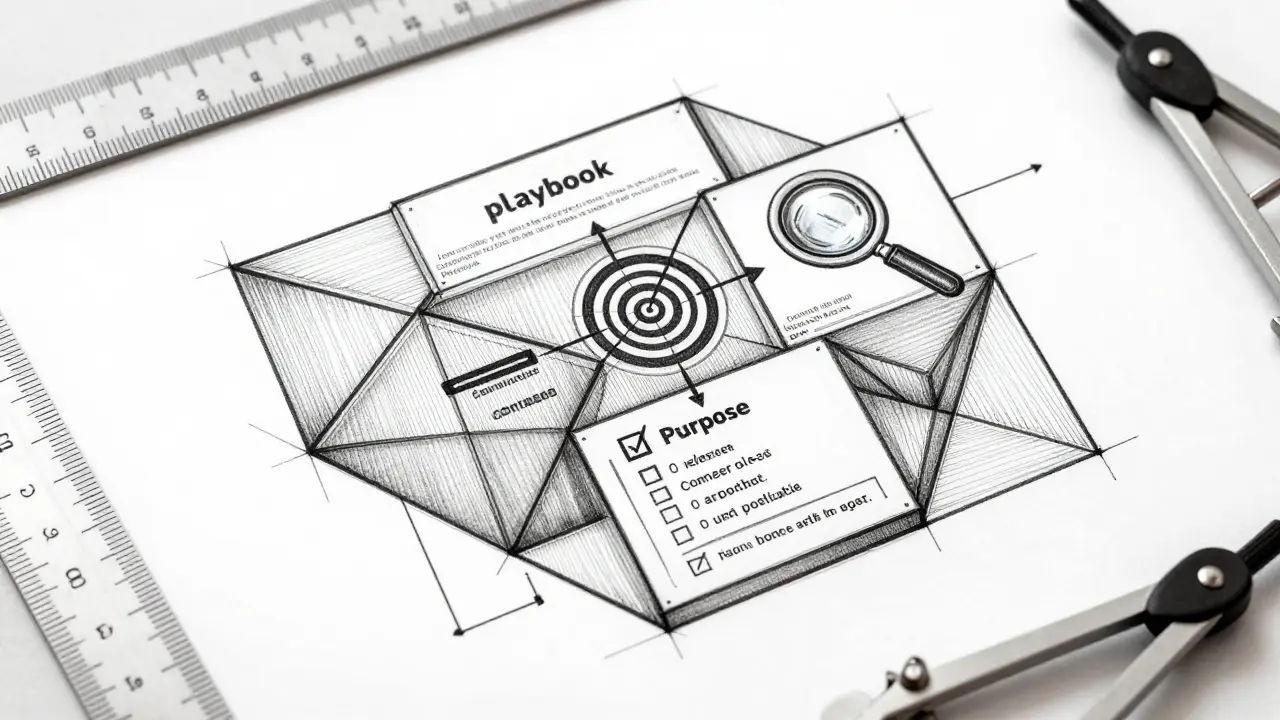
- Purpose: What is the specific goal? Are we summarizing, coding, or analyzing sentiment?
- Procedure: Step-by-step instructions. Most robust playbooks require a minimum of three steps: setup, execution, and delivery.
- Specifications (Success Criteria): How do we know the job is done right? This defines the post-conditions. For example, 'Output must be under 500 words and include two citations.'
- Advice & Constraints: Corrections to the AI’s default assumptions. This is where you tell the model what *not* to do, which is often more important than telling it what to do.
- Required User Inputs: Clear placeholders for data the human must provide before the prompt runs. This reduces input errors significantly.
Dr. Jane Chen from Stanford AI Lab noted in her 2024 keynote that these documents have evolved from simple instruction sets into comprehensive knowledge artifacts. They need to balance specificity with adaptability. If it’s too rigid, it fails on edge cases. If it’s too loose, the AI hallucinates. The sweet spot lies in structured flexibility.
Comparing the Dominant Frameworks: CAP, Role+Task, and Devin
You won’t find one single 'correct' way to document prompts, but there are three dominant patterns emerging in the industry. Choosing the right one depends on your team’s technical comfort and the complexity of the task.
| Framework | Best For | Key Strength | Main Weakness | Adoption Rate (2024) |
|---|---|---|---|---|
| CAP Method | Simple tasks, education, quick drafts | Extremely easy to learn and implement | Lacks structure for complex, multi-step workflows | 63% (Higher Ed) |
| Role + Task + Constraint | Business operations, marketing, sales | Precise role definition improves tone consistency | Requires significant customization per use case | 52% (Fortune 500) |
| Devin AI Playbook Structure | Engineering, technical implementations, compliance | Comprehensive sections including success metrics and forbidden actions | Steeper learning curve; higher initial time investment | 71% (Engineering Teams) |
The CAP method (Context, Audience, Purpose), popularized by UCSD Extension, is great for getting started because it’s simple. But if you’re asking an LLM to write code or analyze financial reports, CAP often falls short. That’s where the Role+Task+Constraint pattern shines for general business apps. However, for true repeatability and error reduction, technical teams are increasingly adopting structures like those from Devin AI, which explicitly define 'Forbidden Actions' and 'Required from User' fields. These additions alone have been shown to cut input errors by nearly half.
Tools of the Trade: Waybook, Playbooks.com, and Custom Solutions
You can document prompts in a Google Doc, but dedicated tools offer version control, sharing, and integration capabilities that static files lack. The market has consolidated around a few key players.
Waybook has captured roughly 38% of the enterprise market share. Its main selling point is the 'Centralized Knowledge Repository.' If you have hundreds of prompts across different departments, Waybook helps you organize them. Their enterprise plans start around $24 per user per month. Users love the version control features that track how a prompt evolves over time, though some complain about limited customization in their standard templates.
Playbooks.com holds about 29% of the market. They focus on a library approach, offering ready-to-use templates for various business functions. Their cross-model compatibility is a huge plus-they support 12 major AI models as of late 2024. Pricing is accessible, with a free library and premium tiers at $99/month. However, users note difficulty adapting marketing-focused prompts for highly technical use cases.
Then there’s Devin AI, favored by developers (19% market share). Their tool integrates deeply with GitHub Actions, allowing for automated playbook testing within CI/CD pipelines. This is crucial for engineering teams who treat prompts as code. The trade-off is that it requires a deeper understanding of conditional logic and success metrics.
The Business Case: Why Documentation Pays Off
If you’re still skeptical about spending time on documentation, look at the numbers. A study by DataGrail in Q3 2024 analyzed 2,300 business use cases and found that documented prompts reduced revision cycles by 62%. Think about that: instead of rewriting an AI response three times, you get it right the first time more than half the time.
Furthermore, first-response accuracy jumped by 58% when using standardized documentation. For customer-facing roles like support or sales, this means faster resolution times and happier clients. A healthcare compliance team, for instance, used structured breach response playbooks to cut notification drafting time from eight hours down to 45 minutes per incident. That’s not just efficiency; that’s risk mitigation.
Gartner analysts emphasize that organizations with mature prompt documentation standards achieve AI adoption cycles that are 3.7 times faster. Why? Because new employees don’t have to reinvent the wheel. They inherit tested, proven instructions rather than guessing what worked last week.

Implementation Challenges and Pitfalls
It’s not all smooth sailing. Implementing these standards comes with friction. The average onboarding time for a team adopting formal documentation is 15 to 20 hours. That’s a significant investment. Many teams report that non-technical staff, particularly in marketing and HR, struggle to adopt these rigorous standards initially.
A major pitfall is 'over-documentation.' MIT Technology Review warned in late 2024 that overly rigid prompts can reduce flexibility by 31% in dynamic scenarios. If you specify every single detail, the AI may fail when faced with unexpected inputs. Dr. Marcus Johnson from Carnegie Mellon cautioned that this rigidity can create false confidence in outputs, especially when edge cases aren’t addressed.
Another common failure mode is outdated documentation. In a fast-moving AI landscape, a prompt that works perfectly in January might produce mediocre results in June due to model updates. About 57% of respondents in a late 2024 developer poll cited keeping docs current as a major headache. Successful teams combat this by establishing 'prompt review committees' that meet bi-weekly to audit and refine their libraries.
Future Trends: Standardization and Governance
As we move through 2026, prompt documentation is becoming a core component of AI governance. The EU AI Act’s implementation in July 2024 mandated sufficient documentation for high-risk AI applications, forcing many European enterprises to formalize their processes. This regulatory pressure is driving global adoption.
We are seeing a convergence toward three pillars: metadata standards for tracking performance, interoperability protocols for sharing prompts across platforms, and validation frameworks for measuring effectiveness. The AI Prompt Standards Consortium released a draft specification (v0.8) in late 2024 aiming for ISO-like standards. While fragmentation remains a risk, the trajectory is clear: prompt documentation will become as fundamental to business operations as spreadsheet templates are today.
What is the difference between a prompt template and an LLM playbook?
A prompt template is usually a simple fill-in-the-blank structure for a single task. An LLM playbook is a comprehensive document that includes the template plus context, success criteria, forbidden actions, user input requirements, and procedural steps. Playbooks are designed for repeatable, complex business processes, while templates are often used for ad-hoc tasks.
How much time does it take to train a team on prompt documentation standards?
On average, teams require 15 to 20 hours of initial training to become comfortable with formal documentation standards. Proficiency typically develops within 3 to 4 weeks of active use. Technical teams using complex structures like Devin AI’s may need additional time to understand conditional logic and success metrics.
Which framework is best for non-technical teams?
The CAP method (Context, Audience, Purpose) is generally the easiest for non-technical teams to adopt due to its simplicity. However, for business-critical tasks requiring high consistency, the Role+Task+Constraint pattern offers a good balance of structure and usability without the steep learning curve of engineering-focused playbooks.
Do I need specialized software like Waybook to document prompts?
No, you can start with simple documents like Word files or Notion pages. However, as your organization scales, dedicated tools like Waybook or Playbooks.com provide valuable features such as version control, centralized repositories, and cross-model compatibility, which help maintain consistency and reduce errors across large teams.
How does prompt documentation help with AI regulation compliance?
Regulations like the EU AI Act require transparent documentation of AI system instructions, especially for high-risk applications. Structured prompt documentation provides an audit trail of what the AI was instructed to do, how it was constrained, and what success criteria were defined, helping organizations demonstrate compliance and mitigate liability.