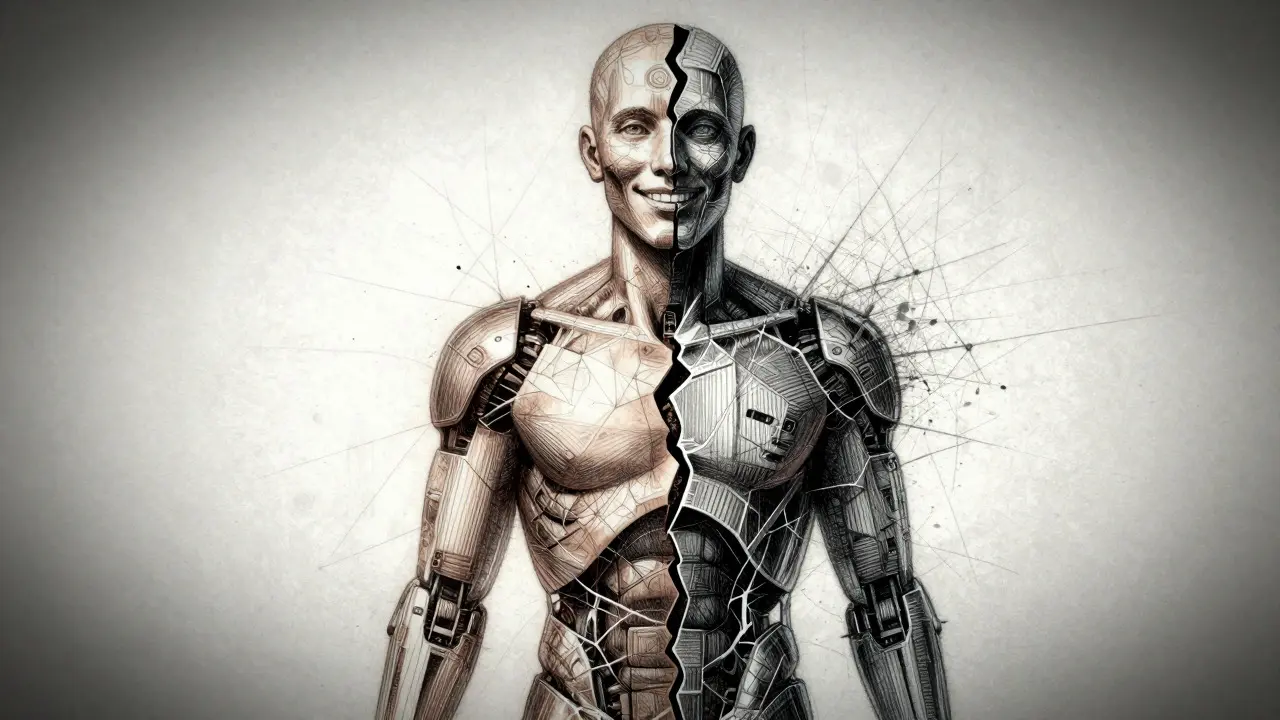
Have you ever talked to a customer service bot that acted like a cheerful friend one minute and a cold robot the next? Or maybe you used an AI writing assistant that suddenly forgot your preferred tone halfway through a project. This is not just annoying; it breaks trust. The problem is persona calibration, which is the systematic process of establishing, maintaining, and verifying consistent character attributes and behavioral patterns for AI agents across multiple interaction sessions and communication channels. Without proper calibration, large language models (LLMs) suffer from "persona drift," where their personality shifts unpredictably as conversations get longer or move between different platforms.
In 2023, when models like GPT-4 and Claude 2 became widely available, developers realized these tools were great at chatting but terrible at staying in character over time. Research shows that without specific techniques, consistency drops from roughly 80% in a single session to less than 50% when users return days later. This article explains how to fix that. We will look at why this happens, the technical methods to stop it, and how to build personas that feel real and reliable whether they are talking via text chat, voice calls, or email.
Why AI Personas Drift: The Memory Problem
To fix the inconsistency, we first need to understand why it happens. Large language models are probabilistic engines. They predict the next word based on patterns they have seen before. They do not have a permanent "self" or a long-term memory bank like a human does. When you start a new chat session with an LLM, it starts fresh. Unless you explicitly tell it who it is supposed to be, it defaults to its general training data, which is often neutral, helpful, and somewhat generic.
This creates a challenge known as context window limitation. Even if you paste a detailed persona description into every prompt, the model might forget parts of it as the conversation grows longer. A study by Panda in 2024 found that many LLM-generated personas show subtle but significant changes in values and preferences after just 15 to 20 interactions. Users can detect this authenticity gap within four to seven exchanges. If your AI agent starts agreeing with everything the user says just to be polite, it has lost its calibrated persona. It has drifted from being a "stubborn expert" to being a "yes-man."
Furthermore, cross-channel inconsistencies add another layer of complexity. An AI persona that works perfectly in a text-based chat interface might sound robotic or unnatural when deployed in a voice channel. Text allows for pauses, emojis, and formatting. Voice requires natural rhythm and concise phrasing. Research indicates an average 22.7% drop in consistency when transitioning from text to voice interfaces because the response formatting requirements change drastically. If you want a consistent brand voice, you cannot treat each channel as a separate entity. You need a unified calibration strategy.
The Core Components of Persona Calibration
Effective persona calibration is not just about writing a nice biography for your AI. It requires a structured approach that defines specific attributes and enforces them technically. According to the Personacraft framework developed by Jung et al., there are four critical stages: data collection, segmentation, enrichment, and evaluation. Let’s break down what this means for your prompt design.
First, you need to define clear attributes. Successful implementations typically include 15 to 25 distinct persona attributes. These should cover demographics, knowledge levels, communication styles, and core values. For example, instead of saying "Be friendly," you specify "Use a warm, professional tone with occasional humor, avoid jargon, and prioritize clarity over brevity." Specificity is key. Vague instructions lead to vague results.
| Attribute Category | Specific Examples | Impact on Consistency |
|---|---|---|
| Demographics & Role | Age range, profession, location, expertise level | Grounds the persona in reality; prevents generic responses |
| Communication Style | Tone (formal/casual), sentence length, use of idioms | Ensures voice remains recognizable across channels |
| Knowledge Boundaries | What the persona knows vs. admits ignorance | Prevents hallucination and maintains credibility |
| Values & Biases | Priorities, ethical stances, decision-making criteria | Maintains behavioral consistency in complex scenarios |
Second, you must implement memory anchoring. This is the technical side of calibration. You need to embed persona attributes in both the system prompt and the conversation memory. However, dumping all 25 attributes into every single prompt can cause cognitive overload for the LLM, leading to errors. Best practices suggest referencing only 3 to 5 key characteristics per response dynamically. Tools like the PEARL system achieve this by analyzing the current conversation context against predefined characteristics and injecting only the relevant traits into the immediate prompt. This keeps the persona sharp without overwhelming the model.

Technical Strategies for Cross-Session Consistency
Maintaining consistency across sessions-where a user talks to the AI today and returns three days later-is the hardest part of persona calibration. Standard LLMs do not remember past sessions unless you build a memory system around them. Here are the most effective technical strategies currently in use.
- Structured JSON Memory: Store core persona attributes in a structured JSON format rather than free text. This makes it easier for your application to retrieve and inject specific traits back into the prompt when a new session starts. Free text descriptions are prone to parsing errors and ambiguity.
- Explicit Memory Anchoring: At the start of each new session, inject a summary of previous interactions along with the core persona definition. The Stanford HAI study found that AI agents maintained 79.3% accuracy in single sessions but dropped to 61.2% across multi-day interactions without explicit calibration mechanisms. Adding a "memory recap" step can bridge this gap.
- Periodic Recalibration Prompts: Don’t wait for the persona to drift. Insert hidden recalibration prompts every 10-15 turns. These prompts remind the AI of its core values and style without interrupting the user flow. Dr. Li’s research suggests recalibrating every 3-5 interactions to maintain effectiveness in consumer behavior simulations.
- Channel-Specific Templates: Create separate response templates for text, voice, and email. While the core persona remains the same, the delivery mechanism changes. For voice, enforce shorter sentences and clearer punctuation. For text, allow for more nuanced expression. Ensure the underlying intent and personality traits remain identical across these templates.
Using structured persona templates has been shown to improve consistency metrics by 37.2% compared to freeform descriptions. Frameworks like CRAFTER outperform general-purpose LLMs by incorporating explicit persona evolution tracking, achieving 85% cross-session consistency compared to 63% for standard ChatGPT implementations. The key is treating the persona as a dynamic state that needs active management, not a static document you set and forget.
Evaluating and Testing Persona Consistency
How do you know if your calibration is working? You need to measure it. Relying on gut feeling is not enough. Automated metrics and human evaluation must work together. Parallel HQ’s testing with 127 designers found that while automated tools help, 74% of users emphasized that human validation remains essential for detecting subtle inconsistencies that metrics miss.
Start with quantitative benchmarks. Track consistency scores across single sessions versus multi-session interactions. Aim for above 80% consistency in short interactions and above 70% in long-term engagements. Use tools that analyze response alignment with predefined persona attributes. Look for deviations in tone, vocabulary, and decision-making logic.
Then, bring in qualitative assessment. Conduct A/B tests where human evaluators interact with the AI persona without knowing it is an AI. Ask them to rate the consistency of the personality over time. Common failure points include the AI becoming too agreeable, losing its defined biases, or switching languages unexpectedly. In healthcare requirement gathering, the CRAFTER tool improved stakeholder understanding by 41% because the simulated personas remained consistent, allowing stakeholders to trust the simulation results. If the persona wobbles, the trust evaporates.
Finally, monitor cross-channel performance separately. Test the same persona in a chat widget and a voice assistant. Listen to the voice outputs. Do they sound like the same person? If the text version uses slang and the voice version sounds formal, you have a calibration mismatch. Adjust the channel-specific templates until the voice matches the spirit of the text, even if the medium differs.

Best Practices for Implementation
Implementing persona calibration requires a blend of prompt engineering skills and traditional user research methodology. Here is a practical checklist to guide your implementation.
- Start with Real Data: Base your persona attributes on real user interviews, surveys, and analytics. Synthetic data can supplement this, but grounding your persona in reality ensures it resonates with actual users. The Personacraft framework emphasizes mixing synthetic and real data for robust segmentation.
- Define Negative Constraints: Explicitly state what the persona should NOT do. For example, "Never use medical jargon unless asked," or "Avoid political opinions." Negative constraints are often more powerful than positive ones in preventing drift.
- Use Hybrid Approaches: Combine structured data inputs with LLM refinement. Pure LLM approaches are faster but less consistent. Commercial platforms like Parallel HQ achieve better results (76% consistency) by using hybrid methods, though they require more initial setup time (approximately 2.5 hours per persona versus 35 minutes for fully automated approaches).
- Plan for Evolution: Personas should evolve slowly over time based on user feedback, but core attributes should remain stable. Dr. Li warns that personas calibrated for static consistency may become artificially rigid. Allow for controlled variability parameters so the AI can adapt to context without breaking character.
- Comply with Regulations: Be aware of emerging regulations like the EU AI Act, which requires clear disclosure when AI systems employ calibrated personas that might be mistaken for human agents. Transparency builds trust and avoids legal pitfalls.
The learning curve for implementing basic persona calibration is moderate, requiring about 8-12 hours of training for UX researchers. Mastering cross-session consistency techniques takes another 20-30 hours. Invest in this training. The global AI persona market is projected to reach $2.8 billion by 2027, and companies with dedicated persona calibration protocols will have a significant competitive advantage. Currently, only 29% of Fortune 500 companies have such protocols in place. There is room to lead.
Future Trends in Persona Calibration
The field is moving quickly toward dynamic, self-calibrating personas. By late 2024, 78% of new implementations incorporated real-time consistency monitoring as standard practice. Future developments include integrating biometric feedback for real-time persona adjustment, currently in beta at Stanford HAI. Imagine an AI that detects frustration in your voice and adjusts its tone to be more empathetic while staying true to its core persona. That is the next frontier.
Additionally, open-source toolkits like the one planned by QCRI for Q3 2025 will make persona consistency evaluation accessible to smaller teams. Gartner forecasts that by 2027, 92% of enterprise LLM deployments will include dedicated persona management modules. This means persona calibration will transition from a niche technique to a standard component of AI development frameworks.
As we move forward, the goal is not just consistency for its own sake. It is about creating authentic, trustworthy interactions. Whether you are building a customer service bot, a personalized marketing agent, or a research tool, getting the persona right matters. Users notice when the mask slips. With careful calibration, structured memory, and continuous evaluation, you can keep your AI in character, session after session, channel after channel.
What is persona calibration in generative AI?
Persona calibration is the systematic process of defining, maintaining, and verifying consistent character attributes, behavioral patterns, and response styles for AI agents. It ensures that an AI maintains its designated personality, tone, and knowledge base across different interaction sessions and communication channels, preventing "persona drift" where the AI's behavior becomes inconsistent or generic.
Why do AI personas lose consistency across sessions?
AI personas lose consistency primarily due to the lack of persistent memory in large language models. Each new session starts fresh, and without explicit memory anchoring techniques, the model reverts to its general training data. Additionally, context window limitations mean that as conversations grow longer, earlier instructions about the persona may be forgotten or diluted, leading to gradual drift in tone and behavior.
How can I improve cross-session consistency for my AI agent?
To improve cross-session consistency, store core persona attributes in structured JSON formats and inject them into every new session. Implement explicit memory anchoring by summarizing previous interactions and key persona traits at the start of each session. Use periodic recalibration prompts every 10-15 turns to reinforce the persona's core values. Finally, evaluate consistency quantitatively and qualitatively to identify and correct drift early.
What is the difference between text and voice persona calibration?
While the core persona attributes remain the same, the delivery mechanism differs significantly. Text interfaces allow for complex formatting, emojis, and varied sentence structures. Voice interfaces require natural rhythm, concise phrasing, and clear pronunciation cues. Calibration for voice often involves enforcing shorter sentences and avoiding ambiguous punctuation. Research shows a 22.7% average consistency drop when transitioning from text to voice without specific channel adaptations.
Are there tools available for persona calibration?
Yes, several tools exist. Open-source frameworks like CRAFTER offer explicit persona evolution tracking. Academic tools like PEARL use GPT-4 APIs to maintain persona attributes through constrained prompting. Commercial platforms like Parallel HQ provide AI-assisted persona generation with hybrid approaches combining structured data and LLM refinement. These tools help automate the creation and maintenance of consistent personas, though human validation remains crucial.
How many attributes should I define for an AI persona?
Successful implementations typically include 15 to 25 distinct persona attributes. These should cover demographics, knowledge levels, communication styles, values, and negative constraints. However, you should not inject all attributes into every prompt. Instead, reference 3-5 key characteristics dynamically based on the current conversation context to avoid cognitive overload in the LLM.