
Running a business that uses generative AI feels less like tech innovation and more like navigating a minefield of legal requirements. You have the European Union's strict risk-based rules, the United States' pro-innovation pivot, and China's heavy content controls. If you are building or deploying AI models today, you cannot just follow one rulebook. The landscape has shifted dramatically since 2023, and by mid-2026, the divergence between these major powers is clearer than ever.
This isn't about abstract ethics anymore. It is about whether your company can operate legally in three different markets simultaneously. With global adoption of generative AI hitting 54.6% in late 2025, the pressure to comply is real. Let’s break down exactly what these regulations mean for your operations, where they clash, and how you can actually manage them without burning out your legal team.
The Three Pillars of Global AI Control
To understand where we stand in 2026, we need to look at the three dominant regulatory frameworks. They represent three completely different philosophies on how society should handle artificial intelligence.
The European Union: Risk-Based Precision
The EU AI Act is the gold standard for comprehensive regulation. Fully effective by August 2025, it treats AI like pharmaceuticals: higher risk means stricter rules. For general-purpose AI (GPAI) models that pose systemic risks, providers must implement rigorous risk mitigation measures, ensure transparency, and respect copyright standards.
What does this mean for you? If your model falls into the high-risk category, you face mandatory documentation, human oversight requirements, and post-market monitoring. The EU doesn’t ban most AI, but it makes compliance expensive and complex. This approach appeals to privacy advocates but frustrates developers who feel bogged down by bureaucracy.
The United States: Innovation First
In a sharp turn from previous years, the U.S. government under Executive Order 14179 (issued January 2025) revoked earlier restrictions. The goal is clear: remove federal barriers to keep the U.S. ahead in the global AI race. Instead of top-down bans, the focus is on voluntary guidelines, industry self-regulation, and targeted enforcement only when public safety is directly threatened.
This creates a "wild west" environment compared to Europe. Companies love the freedom to experiment, but consumers worry about accountability. The U.S. strategy assumes market forces and existing laws (like copyright and consumer protection) are enough to keep AI in check. So far, federal agencies introduced 59 AI-related regulations in 2024, showing that while the tone is pro-innovation, the activity level remains high.
China: Sovereignty and Security
China’s Interim Measures for Generative AI, active since August 2023, takes a hardline stance on control. The rules mandate lawful data use, visible watermarks for all AI-generated content, and strict alignment with "socialist core values." More importantly, there is a heavy emphasis on data localization-keeping training data and compute resources within national borders.
For global companies, this is a nightmare scenario. You essentially need a separate, walled-off version of your service for China. The Cyberspace Administration of China enforces these rules aggressively, meaning non-compliance isn't just a fine; it’s a total market exit.
| Feature | EU AI Act | US EO 14179 | China Interim Measures |
|---|---|---|---|
| Primary Goal | Risk mitigation & rights protection | Innovation acceleration & competitiveness | National security & social stability |
| Transparency | Mandatory disclosure for GPAI | Voluntary best practices | Mandatory watermarks/metadata |
| Data Rules | GDPR-aligned, cross-border allowed | Flexible, sector-specific | Strict data localization required |
| Enforcement | Fines up to 6% of global revenue | Litigation & agency guidance | Service suspension & criminal liability |
Where the Rules Converge: Transparency and Risk
Despite the philosophical differences, there are two areas where almost every jurisdiction agrees: transparency and risk management. These are your safe harbors if you are trying to build a globally compliant product.
Transparency is universal. Whether it’s the EU’s labeling requirements, China’s watermarking mandates, or emerging U.S. state-level laws, everyone wants users to know when they are interacting with AI. In 2025, 100% of major regulatory frameworks included some form of disclosure mandate. Implementing robust metadata tagging and visible labels is no longer optional-it’s baseline hygiene.
Risk management is maturing. Organizations now manage an average of four AI-related risks (privacy, explainability, reputation, compliance), up from two in 2022. The World Bank’s 2025 Digital Progress and Trends Report highlights that governments worldwide are moving from vague principles to specific interventions against market failures. Even in the pro-innovation U.S., companies are adopting voluntary standards because investors and customers demand proof of safety.

The Real-World Pain Points for Businesses
You might think you can just hire a lawyer and solve this. But the operational reality is messier. According to McKinsey’s 2025 State of AI survey, 60% of organizations cite risk and compliance as primary barriers to adopting agentic AI. Here is why:
- Legacy System Integration: 58% of respondents struggle to plug new AI tools into old IT infrastructure that wasn’t built for audit trails or real-time compliance checks.
- Skill Gaps: 78% of organizations now require dedicated AI compliance officers, up from 32% in 2023. Finding people who understand both code and law is incredibly difficult.
- Documentation Burden: The EU AI Act requires extensive technical documentation. Developers report spending months creating these files, which often sit unused until an audit happens.
A common complaint from engineers on platforms like Reddit is the difficulty of reconciling EU transparency rules with China’s data localization. You can’t easily share model updates across borders if the data never leaves Chinese servers. This forces companies to maintain duplicate development pipelines, doubling costs.
Sovereign AI: The New Battleground
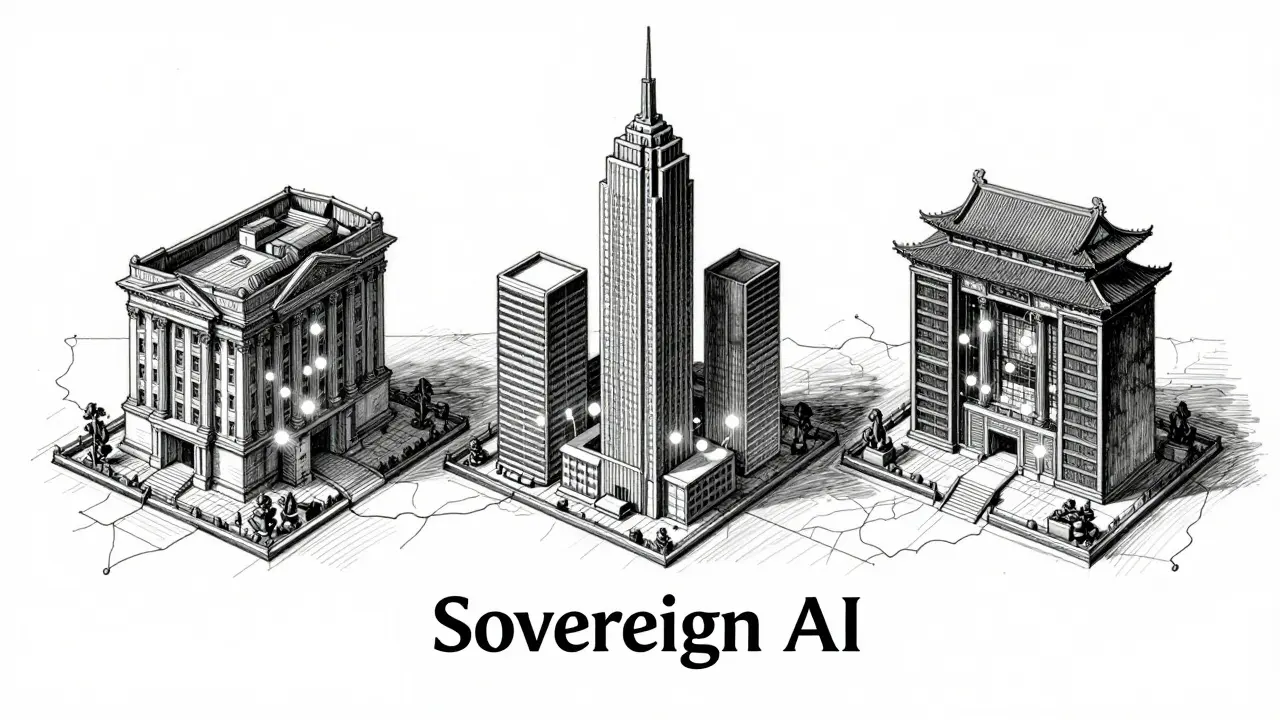
A critical concept emerging in 2025-2026 is Sovereign AI. This refers to ensuring that data, models, and compute resources remain under controlled national or organizational boundaries. More than 50% of AI leaders identify regulatory monitoring and infrastructure control as significant challenges here.
Countries are investing heavily in this space. Canada pledged $2.4 billion, France committed €109 billion, and Saudi Arabia launched Project Transcendence ($100 billion). Why? Because relying on foreign cloud providers for AI training poses a security risk. For businesses, this means you may need to host different versions of your AI services in different regions, not just for legal reasons, but because the physical infrastructure itself is becoming politically charged.
How to Build a Compliant Strategy in 2026
So, what do you actually do? Here is a practical checklist based on current expert recommendations:
- Start with the Highest Standard: Design your system to meet the strictest requirements (usually the EU AI Act) from day one. It is easier to relax rules for other markets than to add them later.
- Implement Automated Labeling: Use tools that automatically inject metadata and watermarks into all AI-generated output. Do not rely on manual processes.
- Map Your Data Flow: Know exactly where your training data lives and moves. If you operate in China, assume that data stays in China. Build isolated architectures for such regions.
- Hire Dedicated Compliance Talent: Generalist lawyers won’t cut it. You need specialists who understand the technical nuances of machine learning and the legal nuances of each jurisdiction.
- Monitor Continuously: Regulations change fast. Use community resources like the GitHub 'Global-AI-Regulation-Tracker' (which had over 2,450 stars by late 2025) to stay updated on new local laws.
Looking Ahead: Enforcement and Harmonization
Dr. Yoshua Bengio, Scientific Director of Mila Quebec AI Institute, predicted in September 2025 that by 2027, we will see the first major cross-jurisdictional enforcement actions. This means a company could be fined in Europe for actions taken in Asia if the global impact violates EU norms.
The trend is moving toward harmonization of transparency rules, even if risk definitions remain divergent. International bodies like the OECD and UN are pushing for core Responsible AI principles. While full global uniformity is unlikely, expect more cooperation on issues like deepfake detection and algorithmic bias.
The bottom line? AI regulation is no longer a future problem. It is a present-day operational constraint. By treating compliance as a core engineering requirement rather than a legal afterthought, you can navigate this complex landscape and still innovate.
What is the biggest difference between EU and US AI regulation?
The EU AI Act uses a prescriptive, risk-based approach with heavy fines for non-compliance, focusing on citizen rights. The US, under Executive Order 14179, favors a voluntary, innovation-first approach, relying on industry self-regulation and existing laws rather than new comprehensive statutes.
Do I need to watermark my AI-generated content?
Yes. Almost all major jurisdictions, including the EU, China, and increasingly US states, require some form of transparency. Visible watermarks or hidden metadata tags are the standard way to prove content was AI-generated, helping avoid legal issues related to misinformation or copyright.
What is Sovereign AI and why does it matter?
Sovereign AI refers to keeping AI data, models, and computing power within national borders. It matters because countries like China and members of the EU are enforcing data residency laws. This forces global companies to build separate, localized AI infrastructures, increasing complexity and cost.
How long does it take to establish an AI compliance framework?
According to McKinsey’s 2025 survey, organizations report an average of 6.2 months to establish effective AI governance frameworks. This includes hiring staff, auditing systems, and creating documentation. Start early, as delays can block product launches.
Will AI regulations become global in the future?
Full global uniformity is unlikely due to differing political values. However, experts predict increased harmonization around transparency and basic safety standards by 2027. Cross-jurisdictional enforcement actions are expected to rise, making global consistency beneficial even if not strictly required everywhere.