Imagine being able to build a key that fits a lock no one has ever seen before. For decades, biologists were stuck trying to find natural proteins that might work for specific diseases. Now, with generative AI, we are building those proteins from scratch. This isn't just faster research; it is a fundamental shift in how we understand biology. In 2026, tools like MIT's BoltzGen and diffusion models are turning protein design into a programmable engineering task rather than a guessing game.
The days of relying solely on evolutionary patterns are over. We have moved into an era where we can specify a function-like binding to a specific cancer cell or breaking down plastic-and let the AI generate a structure that meets those exact needs. This article breaks down how these systems work, which tools are leading the pack, and what this means for drug discovery and biosecurity.
The Shift From Discovery to Creation
To understand why this matters, you have to look at the scale of the problem. The space of possible protein sequences is estimated at 10300. That number is so large it dwarfs the number of atoms in the observable universe. Traditional methods relied on finding proteins that nature had already evolved. If a disease target was "undruggable" because no natural protein fit it, researchers hit a wall.
Generative AI changes the rules by treating protein sequences like language. Models learn the "grammar" of proteins from Earth's entire known sequence database. They don't just memorize existing structures; they understand the physical and chemical principles that make a protein fold correctly and function effectively.
Dr. Noelia Ferruz from the CRG explains it simply: these models learn the internal language of proteins and can speak it perfectly. They generate completely new proteins that maintain structural meaning but have never existed in nature. This allows us to address targets that previously seemed impossible to reach.
Key Architectures Powering Protein Design
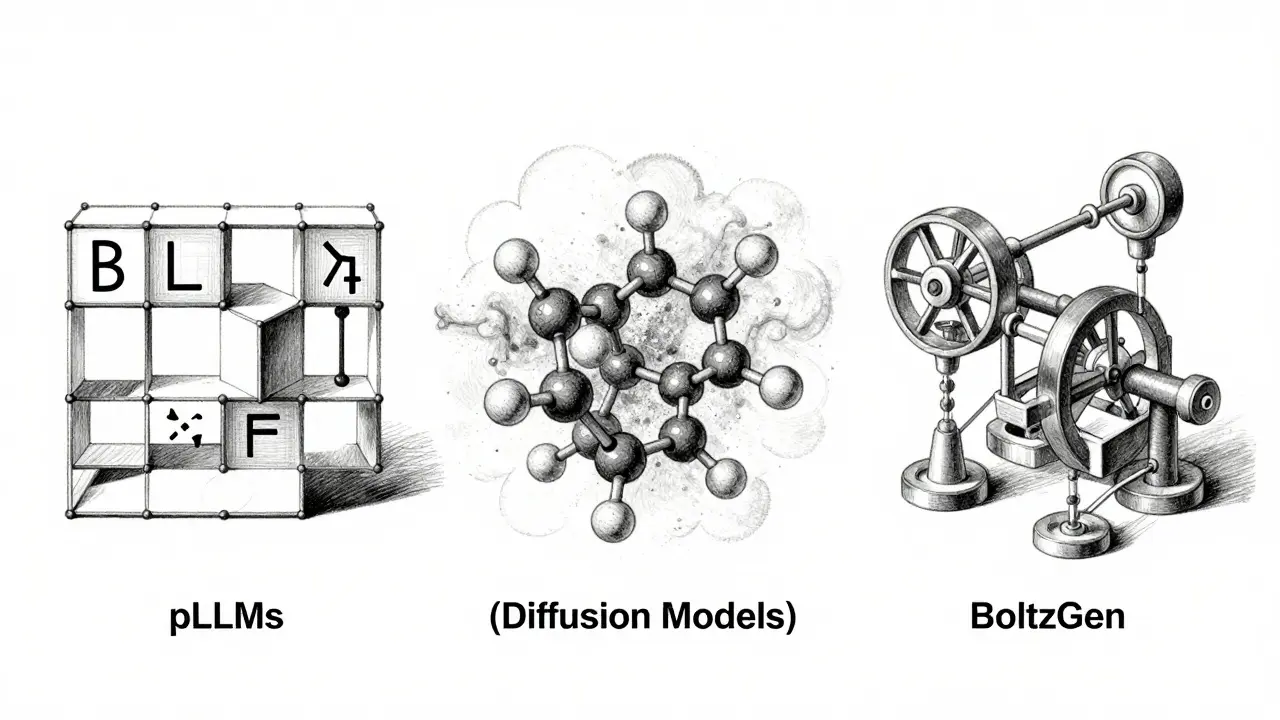
Not all generative models work the same way. In 2025 and 2026, three main architectural approaches emerged as the industry standards. Knowing which one to use depends on your specific research goals.
| Approach | Key Tool Example | Best Use Case | Limitation |
|---|---|---|---|
| Protein LLMs (pLLMs) | Integra Therapeutics Platform | Discovering new variants of known families (e.g., transposases) | Requires large datasets of related sequences |
| Diffusion Models | RFdiffusion3 (Baker Lab) | Atomic-level design of protein-molecule complexes | Computationally intensive; complex setup |
| Unified Frameworks | BoltzGen (MIT) | De novo binder design for undruggable targets | Steep learning curve for integration |
Protein Large Language Models (pLLMs)
These models treat amino acid sequences similarly to how ChatGPT treats words. Integra Therapeutics used this approach to analyze 13,000 newly discovered PiggyBac transposase sequences. The result? Novel proteins that maintained functional coherence while offering improved versatility for genome editing. One variant showed high activity in human primary T cells, a critical step for cancer therapies.
Diffusion Models
Think of diffusion models like un-noising an image. They start with random noise and gradually refine it into a structured output. RFdiffusion3, released by the Baker lab in September 2025, operates at atomic resolution. It designs both the protein and its interacting molecules simultaneously. This avoids common pitfalls like misfit pockets or unrealistic chemistry, ensuring the designed complex actually works in the real world.
Unified Frameworks
MIT's BoltzGen represents a hybrid approach. It unifies structure prediction and protein design. By incorporating feedback from wetlab collaborators, it builds physical constraints directly into the generation process. This makes the outputs more likely to be experimentally viable without endless trial-and-error cycles.
Real-World Applications Beyond Theory
The hype around AI often outpaces reality, but in protein design, the validation data is stacking up fast. Here is where the technology is delivering tangible results:
- Gene Therapy: AI-designed transposases are enabling more precise "find and cut-and-transfer" mechanisms. This reduces off-target effects and improves safety profiles for genetic treatments.
- Enzyme Engineering: The Graz team's Riff-Diff implementation generated enzymes for retro-aldol and Morita-Baylis-Hillman reactions. A large fraction produced detectable products in vitro, working faster than other generated enzymes.
- Biopharma Manufacturing: Companies are using these tools to reduce dependence on naturally occurring proteins that are difficult to optimize for industrial-scale production. This lowers costs and increases supply chain stability.
For instance, designing antibodies that bind to unstable viral epitopes was nearly impossible before. Now, researchers can specify the binding geometry and stability bounds, and the AI generates candidates ready for testing.
The Controllability Barrier and Biosecurity Risks
It is not all smooth sailing. The biggest technical hurdle remains the "controllability barrier." While models can generate plausible proteins, precisely steering them toward a specific function-like catalyzing a unique reaction-still requires significant tuning. You cannot always guarantee the first output will work perfectly.
Then there is the darker side. As Singularity Hub warned in October 2025, dangerous AI-designed proteins could evade current biosecurity software. Because these tools expand the "protein universe" to include sequences never seen in nature, traditional screening methods may fail to flag malicious designs. Researchers at Georgia Tech emphasize the need for practical guardrails within their frameworks to ensure generated proteins remain safe and experimentally viable.
Getting Started With Generative Protein Tools
If you are a researcher looking to adopt these tools, here is a realistic path forward:
- Define Your Functional Goal: Are you looking for a binder, a catalyst, or a structural scaffold? Be specific about constraints like stability temperature or pH tolerance.
- Choose the Right Architecture: Use pLLMs if you have a family of related sequences. Use diffusion models for atomic-level precision in complexes. Use unified frameworks like BoltzGen for de novo binders.
- Leverage Open-Source Foundations: MIT's Boltz-2 is open-source, providing a solid base for academic teams. Start here to understand the workflow before moving to proprietary platforms.
- Plan for Wetlab Validation: Computational success does not equal biological success. Budget for iterative experimental feedback. The loop between AI design and lab testing is where true optimization happens.
The barrier to entry is lowering, but expertise in structural biology and machine learning remains valuable. Collaboration between data scientists and biologists is no longer optional-it is essential.
What Comes Next in 2026 and Beyond
We are seeing a move toward multi-modal frameworks. Future tools will allow researchers to input high-level intent-such as "bind to Target X with high affinity"-and receive optimized designs automatically. The integration of real-time experimental data back into the training loop will further close the gap between digital design and physical reality.
As these technologies mature, expect to see broader applications in environmental science, such as enzymes that recycle plastics or capture carbon. The societal impact could be profound, addressing challenges that extend far beyond healthcare.
What is the difference between AlphaFold and generative AI for protein design?
AlphaFold is primarily a predictive tool; it predicts the 3D structure of a protein given its sequence. Generative AI tools like BoltzGen or RFdiffusion go further: they create new sequences and structures from scratch based on functional requirements. AlphaFold tells you what a protein looks like; generative AI helps you build a new one that doesn't exist yet.
Is BoltzGen available for public use?
Yes, the foundation model Boltz-2 is open-source, allowing academic researchers to access and utilize the underlying technology. However, some advanced features or integrated pipelines may require specific licensing or collaboration agreements depending on the institution.
How do diffusion models improve protein design accuracy?
Diffusion models operate at atomic resolution, considering the precise positioning of every atom rather than just general residue placement. This allows them to design protein-molecule complexes that avoid steric clashes and ensure realistic chemical interactions, leading to higher success rates in wetlab validation.
What are the biosecurity concerns with AI-generated proteins?
Because generative AI can create novel proteins that have never existed in nature, they may bypass traditional biosecurity screening tools that rely on matching against known databases. There is a risk that malicious actors could design harmful biological agents that current software fails to detect, necessitating new security frameworks.
Can I use these tools if I am not a machine learning expert?
While deep ML expertise helps, the field is becoming more accessible. Open-source platforms like Boltz-2 provide user-friendly interfaces and documentation. Many research teams now consist of biologists who define the functional goals and data scientists who handle the model parameters, making collaboration easier than ever.