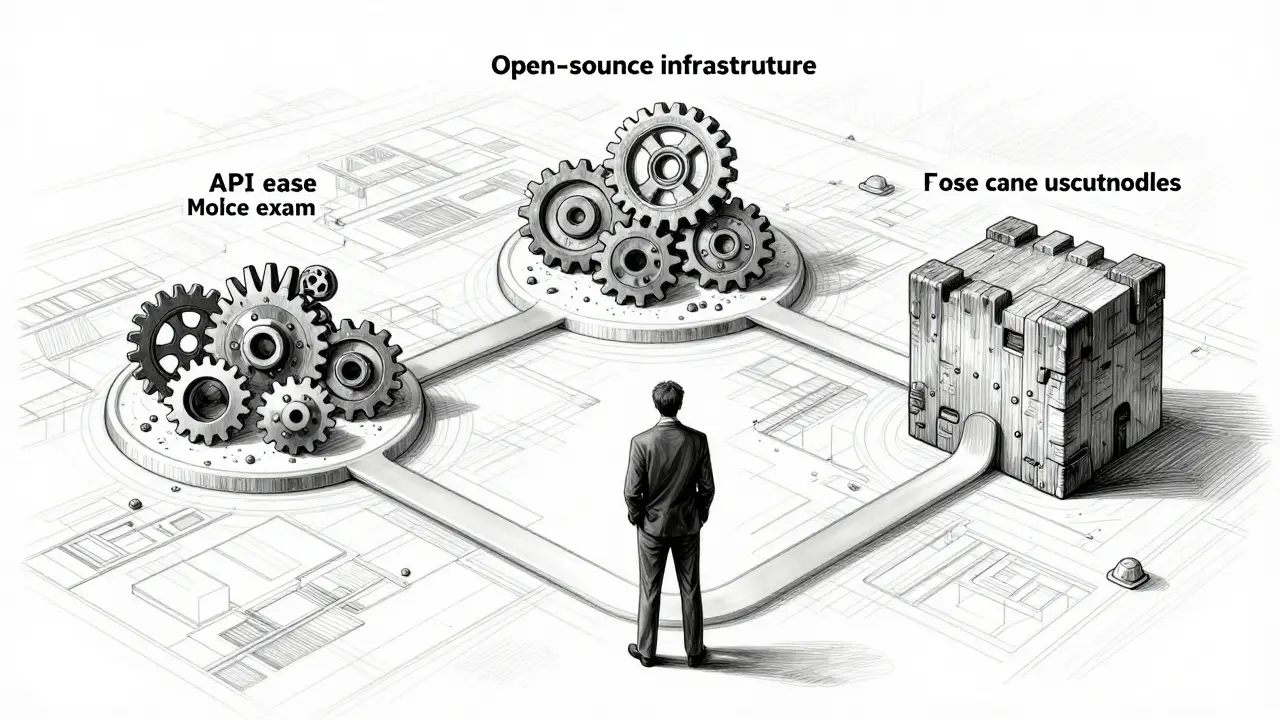
Stop treating your large language model (LLM) strategy like a single-choice exam. If you are still betting everything on one provider or sticking rigidly to one architecture, you are likely overpaying and underperforming. In 2026, the smartest enterprises don't just 'use AI.' They manage a diverse portfolio of models, mixing commercial APIs, open-source foundations, and custom-built systems to hit the sweet spot between cost, control, and accuracy.
This approach, known as LLM Portfolio Management, has moved from a nice-to-have concept to a mandatory discipline. According to Lumenalta's 2026 CIO survey, 87% of technology executives now maintain a formal strategy for this, up from just 42% two years ago. The result? A staggering 38-62% reduction in operational costs while keeping performance high. But how do you actually build this portfolio without creating a maintenance nightmare?
The Three Tiers of Your LLM Portfolio
To manage complexity, you need a clear taxonomy. Leading organizations typically split their models into three distinct tiers based on risk, cost, and control requirements. This isn't about picking the 'best' model; it's about picking the right tool for the job.
- Tier 1: Mission-Critical & High Control (Custom Models). These are for proprietary research, highly regulated industries, or tasks where data privacy is non-negotiable. You build these in-house or fine-tune them heavily. They offer the highest domain accuracy but come with the highest price tag-averaging $417,000 per model with 6-9 month development cycles, according to MIT's 2026 LLM Cost Study.
- Tier 2: Regulated but Less Critical (Domain-Specific Fine-Tuned). Think healthcare triage or financial underwriting. Here, you might use an open-source base like Llama 4 or Falcon 2 and fine-tune it on your specific data. This balances control with speed to market.
- Tier 3: General Tasks (API-Based Models). Customer service chatbots, content generation, and general summarization. For these, you leverage the power of giants like GPT-5, Gemini 3, or Claude 4. They are easy to integrate and excel at general knowledge, but they lack customization and pose data privacy risks.
The Real Cost Trade-Offs: API vs. Open-Source vs. Custom
Let's talk numbers, because that's usually where the debate gets heated. Many leaders assume open-source is always cheaper. It’s not. It depends entirely on your scale and infrastructure maturity.
| Model Type | Avg. Cost / 1k Tokens | Data Privacy Control | Accuracy on Specialized Tasks | Maintenance Effort |
|---|---|---|---|---|
| API-Based (e.g., GPT-5) | $0.015 | Low (78% report compliance issues) | Baseline (Generic) | Very Low |
| Open-Source (e.g., Llama 4 70B) | ~$0.0085 (at scale) | High (94% full governance) | +18.7% vs Generic API | High (40% more engineering resources) |
| Custom/Fine-Tuned | $0.018 - $0.025 | Maximum | +12.3% above baseline | Medium-High |
Here is the catch: Deploying a massive open-source model like Llama 4 70B requires significant hardware investment. Running equivalent throughput to GPT-5 API usage can cost around $28,500 monthly in infrastructure, compared to $18,200 for the API. However, if your token volume is high enough, the per-token cost of open-source drops significantly, making it cheaper in the long run. As one Reddit user noted, switching to a hybrid of Llama 4 13B and GPT-5 cut their monthly bill from $42k to $27k while improving accuracy.
Why You Can't Rely on Just One Model
Dr. Andrew Ng warned in his January 2026 TED Talk that companies sticking to a single-model strategy face 30% higher operational costs and compliance risks. His team found that 63% of those single-model companies failed to achieve ROI within 18 months. Why? Because no single model excels at everything.
API models like GPT-5 score an impressive 82.1% on general benchmarks like MMLU-Pro. But when it comes to specialized industry tasks, they often hallucinate or miss nuance. Custom models, however, can outperform them by nearly 13% on those specific tasks. Meanwhile, open-source models give you the freedom to inspect every layer of the code, which is critical for meeting regulations like the EU AI Act and US Executive Order 14110, both of which demand rigorous model inventory and risk categorization.
Gartner’s Arputham Rajkumar emphasizes that mature enterprises implement 14-17 specific controls for model selection and retirement. Without a portfolio approach, you can't apply these controls effectively. You end up either over-engineering simple tasks (using a custom model for email drafting) or under-securing critical ones (sending patient data to a public API).

Building Your Evaluation Framework
You can't manage what you don't measure. A robust LLM portfolio requires a standardized evaluation framework. SAP’s 2026 Enterprise AI Maturity Report suggests measuring 12 key metrics, but here are the four that matter most:
- Accuracy Thresholds: Don't just look at general benchmarks. Use task-specific tests. For example, set a minimum threshold of 78.4% on MMLU-Pro for general tasks, but create custom evaluators for your specific business logic. Maxim AI’s 2026 Observability Report notes that 89% of successful deployments use custom evaluators beyond basic accuracy.
- Latency Targets: User-facing applications need responses under 2.3 seconds. If your open-source model takes 5 seconds to generate a response, users will bounce, regardless of its accuracy.
- Cost Per Token: Set targets for each tier. Aim for $0.0085 for Tier 3 (general), $0.012 for Tier 2, and accept higher costs for Tier 1 if the value justifies it.
- Compliance Risk Score: Rate each model on a 100-point scale for data leakage risk. Keep mission-critical models below a score of 15.
Tools like LangSmith (holding 31% market share in evaluation frameworks) and Vellum (24% in orchestration) help automate this monitoring. But tools alone aren't enough. You need a process.
A 6-Phase Implementation Plan
Lumenalta’s January 2026 "Enterprise LLM Adoption Framework" outlines a practical path forward. Here is how to execute it:
Phase 1: Assessment (Weeks 1-4)
Identify high-value use cases. Focus on repetitive language tasks that represent at least 15% of departmental effort. Don't boil the ocean. Pick 3-5 high-impact areas first.
Phase 2: Piloting (Weeks 5-12)
Run parallel pilots for different model types. Collect 300-500 high-quality exemplars with clear inputs and outputs for each use case. Test an API model against an open-source alternative. Measure real-world performance, not just benchmark scores.
Phase 3: Evaluation & Selection
Apply your 12-metric framework. Did the open-source model save money but require too much engineering time? Did the API model fail compliance checks? Make data-driven decisions.
Phase 4: Architecture Integration
Implement Retrieval-Augmented Generation (RAG) architectures. AssemblyAI’s 2026 study shows 92% of enterprises use RAG to ground models in their own data. Ensure your system can route queries dynamically. New tools like LangChain’s "Model Router 2.0" allow you to send simple questions to cheap API models and complex reasoning tasks to powerful custom models automatically.
Phase 5: Governance & Security
Establish data clean rooms to join consented sources while keeping raw identifiers out of prompts. Address the 68% of enterprises reporting inconsistent security practices across model types. Create a center of excellence to share knowledge and standardize practices.
Phase 6: Continuous Optimization
Monitor for model drift. Forrester’s Mike Gualtieri found that continuous evaluation frameworks reduced model drift by 47%. Retire models that no longer meet cost or performance criteria.
Pitfalls to Avoid
Even with a plan, things can go wrong. Be wary of these common traps:
- Hidden Technical Debt: AI researcher Emily Bender warns that over-relying on open-source models without proper evaluation creates hidden debt. 38% of enterprises reported significant rework after initial open-source deployments due to inadequate documentation or integration challenges.
- Ignoring Infrastructure Costs: Remember, open-source models are free to download but expensive to run. Factor in GPU costs, cooling, and electricity before declaring victory on savings.
- Skill Gaps**>: You need ML engineers with 4+ years of experience, prompt engineers, and domain specialists. If your team lacks these skills, start with API models and gradually build internal capability.
Looking Ahead: The 2026 Roadmap
The landscape is shifting fast. By late 2026, Gartner predicts LLM portfolio management will move from the "Peak of Inflated Expectations" to the "Plateau of Productivity." We are seeing the rise of AI-powered portfolio assistants that automatically optimize cost-performance tradeoffs. Standardized model interchange formats are expected in Q3 2026, making it easier to swap models without rewriting code.
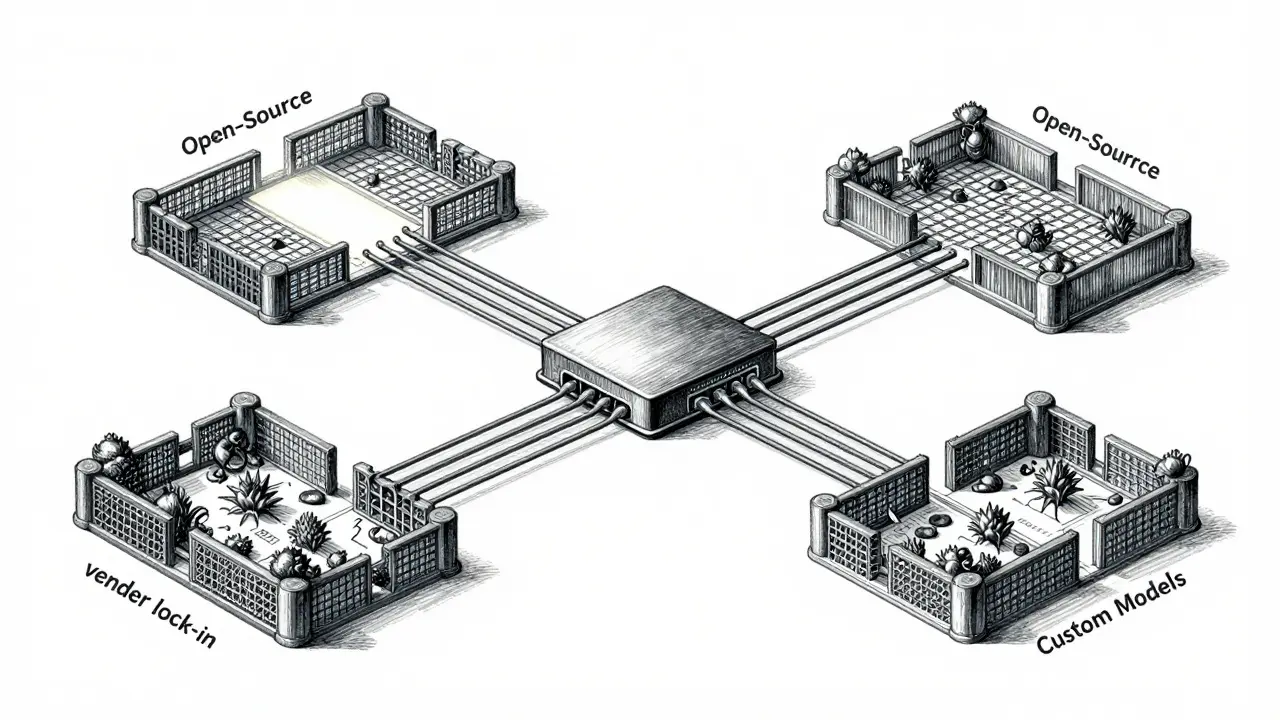
The goal isn't perfection. It's balance. By diversifying your LLM investments, you protect yourself from vendor lock-in, reduce costs, and ensure that every application uses the most appropriate level of intelligence and security. Start small, measure rigorously, and scale wisely.
What is LLM Portfolio Management?
LLM Portfolio Management is the strategic practice of balancing investments across multiple types of large language models-specifically API-based commercial models, open-source foundation models, and custom-built or fine-tuned models. The goal is to optimize for cost, control, accuracy, and compliance by using the right model for each specific business use case rather than relying on a single solution.
When should I use an API model versus an open-source model?
Use API models (like GPT-5 or Claude 4) for general tasks, low-risk applications, and when you need rapid deployment with minimal engineering overhead. They excel at general knowledge and content generation. Use open-source models (like Llama 4 or Mistral) when you need full data governance, have high token volumes that make self-hosting cost-effective, or require deep customization for specialized industry tasks like healthcare triage or financial underwriting.
How much does it cost to deploy a custom LLM?
According to MIT's 2026 LLM Cost Study, developing a custom model averages $417,000 per model with a development cycle of 6-9 months. Additionally, running large open-source models can cost approximately $28,500 monthly in infrastructure for equivalent throughput to premium APIs, though costs vary based on hardware efficiency and token volume.
What are the key metrics for evaluating LLM performance?
Key metrics include accuracy (measured via task-specific benchmarks like MMLU-Pro), latency (under 2.3 seconds for user-facing apps), cost per 1,000 tokens, and compliance risk score. Successful enterprises also use custom evaluators to measure performance on specific business logic rather than relying solely on general benchmarks.
How does the EU AI Act affect LLM portfolio strategy?
The EU AI Act and similar regulations like US Executive Order 14110 require rigorous model inventory documentation and risk-based categorization. This drives enterprises to adopt portfolio management to ensure they can track which models are processing sensitive data, maintain audit trails, and demonstrate compliance through transparent governance frameworks.
What tools help manage an LLM portfolio?
Popular tools include observability platforms like Maxim AI, evaluation frameworks like LangSmith, and orchestration tools like Vellum. Newer solutions like LangChain’s Model Router 2.0 enable dynamic routing of queries to different models based on complexity and cost constraints, automating parts of the portfolio management process.


