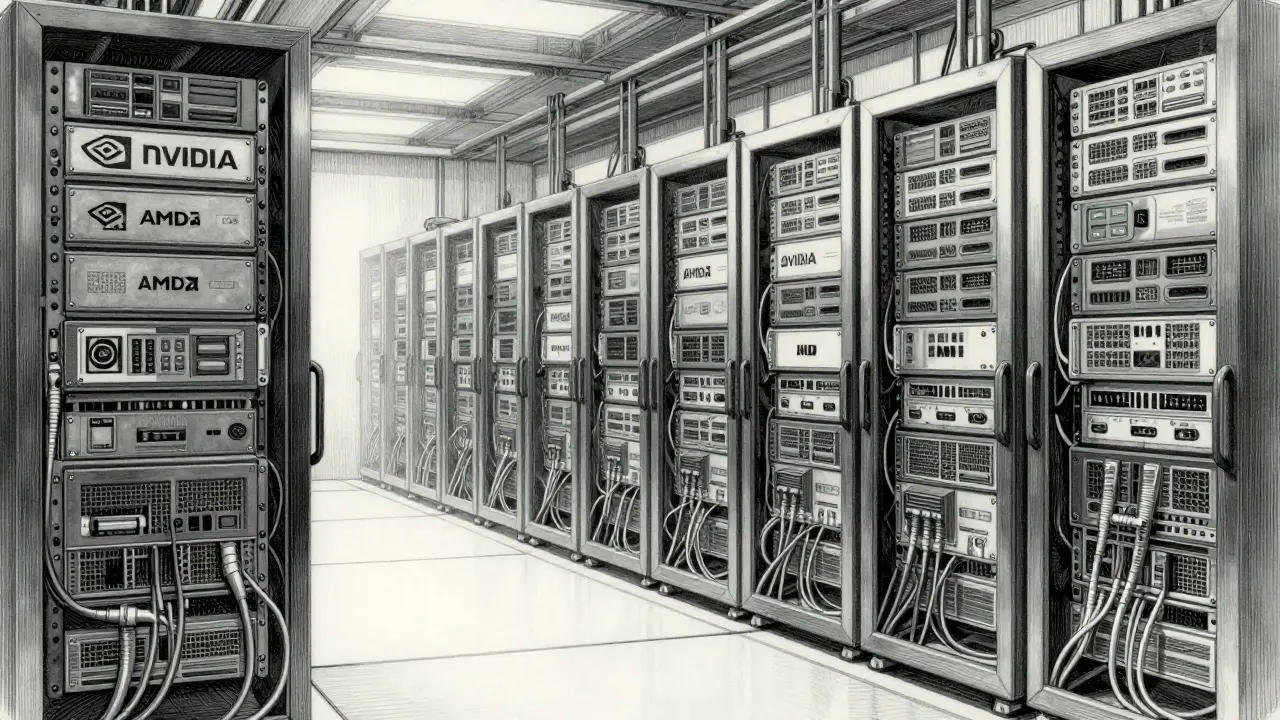
Back in 2023, if you wanted to run a serious large language model, you pretty much had one choice: buy an NVIDIA GPU. Today, in mid-2026, that monopoly is cracking. The hardware landscape for generative AI has exploded into a complex ecosystem of specialized accelerators, high-bandwidth memory wars, and networking architectures that are reshaping how we build intelligence.
We are no longer just talking about faster chips. We are talking about a fundamental shift in computational infrastructure. As models grow larger and more complex, the old ways of moving data around simply don't work anymore. This is what industry leaders call "computation inflation." To keep up, companies like NVIDIA, AMD, Microsoft, and AWS are deploying entirely new classes of silicon designed specifically for the unique demands of training and inference.
The End of the Single-Vendor Era
NVIDIA still holds the crown, but it’s fighting harder than ever. Their dominance was built on CUDA, a software ecosystem that made their GPUs easy to use. But hardware alone doesn’t win wars anymore; efficiency and cost do. In 2026, the market is defined by three main players pushing different strategies: NVIDIA’s incremental power boosts, AMD’s aggressive value proposition, and hyperscalers like Microsoft and AWS building their own proprietary chips to cut costs.
If you are planning your infrastructure for the next two years, you need to understand these distinct approaches. Are you paying for raw performance at any cost? Or are you optimizing for token generation economics? The answer depends entirely on which accelerator family you choose.
NVIDIA’s Response to Computation Inflation
NVIDIA is the leading provider of AI accelerators, known for its GPU architecture and CUDA software ecosystem. Having dominated the market with the A100 and H100 series, NVIDIA faces pressure to maintain its lead as competitors close the gap.
The H100 Tensor Core GPU was a beast when it launched, processing large language models 30 times faster than previous generations. But in 2026, the spotlight is on the upcoming Rubin platform. This isn't just a minor upgrade. It represents NVIDIA's direct response to the exploding complexity of AI models. CEO Jensen Huang has been vocal about "computation inflation"-the idea that model sizes are growing so fast that hardware must evolve annually just to stay relevant.
The Rubin platform will rely heavily on HBM4 (High Bandwidth Memory generation 4). This is critical because memory bandwidth, not compute power, is often the bottleneck in modern AI workloads. By integrating HBM4, NVIDIA aims to keep data flowing to its cores without stalling. Meanwhile, OpenAI has committed to deploying at least 10 gigawatts of NVIDIA systems for its next-generation infrastructure, showing that despite competition, NVIDIA remains the go-to for massive-scale training jobs.
AMD’s Aggressive Push with Helios
AMD is a semiconductor company competing directly with NVIDIA in the AI accelerator market through its CDNA architecture. While NVIDIA plays the long game with software lock-in, AMD is attacking from the side with speed and price. Their strategy is simple: offer comparable performance at a lower total cost of ownership.
In late 2024, AMD released the MI325X, followed quickly by the MI350 series based on the CDNA 4 architecture. These chips promised 35 times faster AI inference compared to the older MI300 series. But the real headline for 2026 is the Helios systems, specifically the MI400 and MI450 variants.
These Helios systems are designed to address the memory bottleneck head-on. They feature HBM4 memory with a staggering bandwidth specification of 19.6 TB/s. For enterprise deployments that are cost-sensitive but still need high throughput, this is a compelling alternative to NVIDIA. AMD is also expanding beyond just accelerators. With the Zen 5 CPU microarchitecture and the Ryzen AI Embedded P100 and X100 Series, they are targeting autonomous systems and robotics, proving they aren't just focused on data centers.
| Manufacturer | Key Product (2026) | Memory Type | Bandwidth | Primary Advantage |
|---|---|---|---|---|
| NVIDIA | Rubin Platform | HBM4 | Proprietary High-Bandwidth | Ecosystem maturity & Scale |
| AMD | MI400/MI450 (Helios) | HBM4 | 19.6 TB/s | Cost-performance ratio |
| Microsoft | Maia 200 | HBM3e | 7 TB/s | Inference economics & Ethernet networking |
| AWS | Trainium3 | Advanced HBM | Optimized for TSMC 3nm | Energy efficiency & Cloud integration |
Microsoft’s Disruptive Move: Maia 200
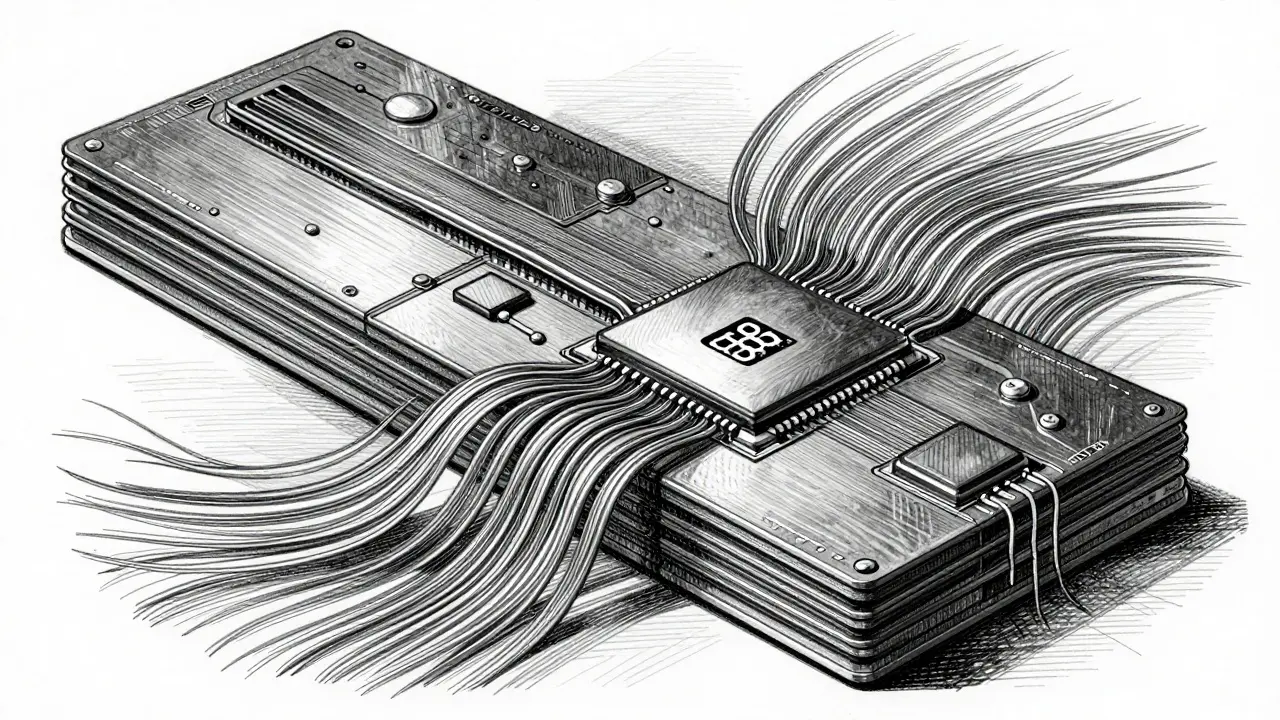
Microsoft is a technology giant developing proprietary AI inference accelerators to reduce dependency on third-party hardware. Here is where things get interesting. Microsoft didn’t just buy chips; they built their own. Enter Maia 200, an inference accelerator engineered to dramatically improve the economics of AI token generation.
Why does this matter? Because training models is expensive, but running them (inference) is where the daily costs add up. Maia 200 uses TSMC’s 3nm process and features native FP8/FP4 tensor cores. It packs 216GB of HBM3e memory operating at 7 TB/s bandwidth. According to Microsoft, it delivers three times the FP4 performance of Amazon’s Trainium3 and beats Google’s TPU v7 in FP8 performance.
But the real innovation isn’t just the chip; it’s the networking. Traditional AI clusters use proprietary, expensive fabrics to connect thousands of chips. Microsoft introduced a two-tier scale-up network design built on standard Ethernet. This exposes 2.8 TB/s of bidirectional dedicated scale-up bandwidth. By using standard Ethernet, they reduce costs while maintaining reliability across clusters of up to 6,144 accelerators. They even licensed OpenAI’s chip design IP, potentially accelerating their development timeline by 12-18 months.
The Memory Bottleneck: HBM4 vs. HBM3e
You can have the fastest processor in the world, but if it has to wait for data, it’s useless. This is why memory technology is the silent battleground of 2026. The central entity here is HBM4, the latest generation of High Bandwidth Memory.
SK Hynix currently dominates HBM production, and demand is so high that their leader products were largely sold out through 2025. Both NVIDIA’s Rubin and AMD’s Helios systems are designed around HBM4 adoption. However, HBM4 availability is tight. This is why Microsoft’s Maia 200 opts for HBM3e. It’s slightly older technology, but it’s available now and still offers impressive 7 TB/s bandwidth. For many enterprises, waiting for HBM4 isn’t an option. You need capacity today.
The relationship between memory bandwidth and AI performance is linear. If your memory bandwidth doubles, your ability to feed data to the GPU or NPU doubles. That’s why specs like "19.6 TB/s" for AMD’s Helios are such big deals. It means less idle time for the compute cores.
Manufacturing Power: TSMC’s Role
TSMC is Taiwan Semiconductor Manufacturing Company, the primary foundry producing advanced AI chips for NVIDIA, AMD, Apple, and others. Behind every major AI player is TSMC. They drive the AI revolution from behind the scenes. In 2026, TSMC is rolling out its A16 technology (1.6nm-class). This process features nanosheet transistors with innovative backside power rail solutions.
The A16 process is a significant leap over the previous N2P node. It delivers 8-10% better speed at the same voltage and reduces power by 15-20% at the same speed. For datacenter products, this means up to a 1.10X improvement in chip density. AWS’s Trainium3 chip utilizes TSMC’s 3nm process to achieve double the performance of Trainium2 with 40% better energy efficiency. Without TSMC’s manufacturing prowess, none of these 2026 roadmaps would be possible.

Networking: Beyond Proprietary Fabrics
As clusters grow to tens of thousands of chips, networking becomes the limiting factor. NVIDIA’s MGX program allows server customization for partners like HPE and Dell, but it still relies on NVIDIA’s proprietary networking stack. Microsoft’s move to standard Ethernet with Maia 200 challenges this status quo.
Standard Ethernet is cheaper and easier to maintain. If you can build a reliable cluster using off-the-shelf network switches instead of custom ASICs, your capital expenditure drops significantly. This is a key trend to watch: the democratization of AI infrastructure through standardized networking components.
Other Key Players: Intel, Qualcomm, and Cerebras
The market isn’t just about the big three. Intel is leveraging its x86 dominance with Xeon 6 processors, delivering 50% higher AI performance with fewer cores. Every core includes built-in AI acceleration. For edge computing, Qualcomm dominates with Snapdragon processors featuring the Hexagon NPU. Their upcoming AI200 and AI250 accelerators target datacenters with rack-scale performance and near-memory computing, promising 10x higher memory bandwidth by 2027.
Then there’s Cerebras Systems, which takes a completely different approach with its Wafer-Scale Engine (WSE). Instead of packing small chips onto a board, Cerebras builds a single massive processor on an entire wafer. This eliminates the communication latency between chips, offering a unique alternative for specific large-model training tasks.
How to Choose Your Hardware Strategy
So, what should you do? If you are training foundational models from scratch, NVIDIA’s Rubin platform remains the safest bet due to its ecosystem and scale. If you are focused on inference and want to optimize costs, look closely at Microsoft’s Maia 200 or AMD’s Helios systems. The shift in 2026 is clear: specialization wins. There is no longer one-size-fits-all hardware for AI.
Remember to evaluate not just peak TFLOPS, but memory bandwidth, energy efficiency, and networking scalability. The companies that succeed in 2026 will be those that align their hardware choices with their specific workload economics.
What is HBM4 and why is it important for AI in 2026?
HBM4 (High Bandwidth Memory generation 4) is the latest standard for high-speed memory used in AI accelerators. It is crucial because modern large language models require massive amounts of data to be moved to the processor quickly. HBM4 provides significantly higher bandwidth than previous generations, reducing bottlenecks and allowing chips like NVIDIA’s Rubin and AMD’s Helios to operate at full speed.
Is Microsoft’s Maia 200 better than NVIDIA’s GPUs?
It depends on your workload. Maia 200 is optimized specifically for inference (running models) rather than training. It offers superior cost-efficiency for token generation and uses standard Ethernet for networking, which lowers infrastructure costs. However, NVIDIA’s GPUs remain the industry standard for training large models due to their mature CUDA software ecosystem and broader compatibility.
What is AMD’s strategy against NVIDIA in 2026?
AMD is competing on performance-per-dollar. With its Helios systems (MI400/MI450), AMD offers HBM4 memory with 19.6 TB/s bandwidth, aiming to provide competitive inference performance at a lower total cost of ownership. They are also expanding into embedded AI and robotics with their Ryzen AI series, diversifying beyond just data center GPUs.
Why is TSMC so critical to the AI hardware market?
TSMC manufactures the advanced silicon chips for almost every major AI player, including NVIDIA, AMD, Apple, and AWS. Their transition to 1.6nm-class (A16) and 3nm processes enables the higher speeds and lower power consumption required for next-gen AI accelerators. Without TSMC’s manufacturing capacity, companies could not produce the high-density chips needed for modern AI workloads.
How does networking impact AI cluster performance?
In large AI clusters, thousands of chips must communicate constantly. Slow networking creates delays, causing expensive compute resources to sit idle. Innovations like Microsoft’s use of standard Ethernet for high-bandwidth scale-up networks reduce costs and simplify maintenance while maintaining the high throughput needed for efficient distributed computing.