
By 2025, if you're still choosing between NLP pipelines and end-to-end LLMs as if they're competitors, you're already behind. They're not rivals. They're teammates. The real question isn't NLP pipelines or LLMs-it's when to use each one, and how to stitch them together so they work better than either could alone.
What You’re Actually Trying to Solve
Most teams don’t start with a tech preference. They start with a problem. Maybe it’s filtering 10,000 customer support tickets a day for abusive language. Or extracting product features from 500,000 product descriptions. Or understanding medical notes written in messy handwriting and slang. Each of these has different needs: speed, cost, accuracy, consistency, auditability. If your job is to make a decision that affects your bottom line, your users, or your compliance team, you need to know where each tool shines-and where it fails. This isn’t about hype. It’s about what happens when the system goes live at 3 a.m. with 20,000 requests queued up.NLP Pipelines: The Precision Tools
Think of NLP pipelines like a Swiss Army knife with exactly the right blade for each cut. You take a sentence. Run it through tokenization. Then part-of-speech tagging. Then named entity recognition. Then sentiment scoring. Each step is a small, focused model-or even a rule. They’re fast. They’re cheap. And they’re predictable. A typical pipeline built with spaCy or NLTK can process 5,000 tokens per second on a single CPU. It costs about $0.0001 per 1,000 tokens. Response times? Under 10 milliseconds. That’s why companies like GetStream still use them for live chat moderation. If you’re blocking hate speech in real time, you can’t wait a second for a response. Users leave. Revenue drops. These systems are also easy to audit. If a false positive happens, you can trace it: “Ah, the sentiment model flagged ‘I hate this product’-but it also missed ‘I’m disappointed’ because the rule didn’t cover that phrase.” You fix the rule. Retrain the model. Deploy. Done. But here’s the catch: they break when things get messy. If you need to understand sarcasm, implied meaning, or cultural context, pipelines fall apart. They’re great at spotting “iPhone” and “battery life,” but terrible at figuring out if someone said “This phone is a miracle… if you like spending $1,000 on a brick.”End-to-End LLMs: The Generalists
LLMs are the opposite. They’re not built to do one thing well. They’re built to do anything-if you ask them right. GPT-4, Claude 3.5, Llama-3-they take a prompt and spit out a response that sounds human. They can summarize, translate, reason, write code, even pretend to be a customer service rep. But they’re expensive. And slow. Running GPT-4 costs between $0.002 and $0.12 per 1,000 tokens. On average, each request takes 100ms to 2 seconds. That’s 10 to 200 times slower than a pipeline. And you need a GPU. Or a cloud API. Or both. The bigger problem? They’re not reliable. Ask the same question twice, and you might get two different answers. They hallucinate. They overconfidently invent facts. In a financial compliance scenario, that’s dangerous. In a medical coding system, it’s catastrophic. A 2024 study by GeeksforGeeks found LLMs hallucinate in 15-25% of complex reasoning tasks. That means for every 100 insurance claims they process, 15-25 could contain made-up diagnoses or incorrect codes. No compliance officer in their right mind would let that fly without a human check.When to Use NLP Pipelines
Use NLP pipelines when you need:- Speed under 50ms
- Cost under $0.001 per 1,000 tokens
- Deterministic output (same input = same output every time)
- Regulatory compliance (GDPR, HIPAA, EU AI Act)
- High-volume, repetitive tasks (e.g., tagging product categories, filtering spam)
When to Use End-to-End LLMs
Use LLMs when you need:- Understanding nuance, tone, or context
- Generating creative or open-ended text (emails, summaries, reports)
- Handling multilingual, unstructured input without predefined rules
- Tasks where you can’t write enough rules to cover all cases
The Hybrid Approach: The Smart Middle Ground
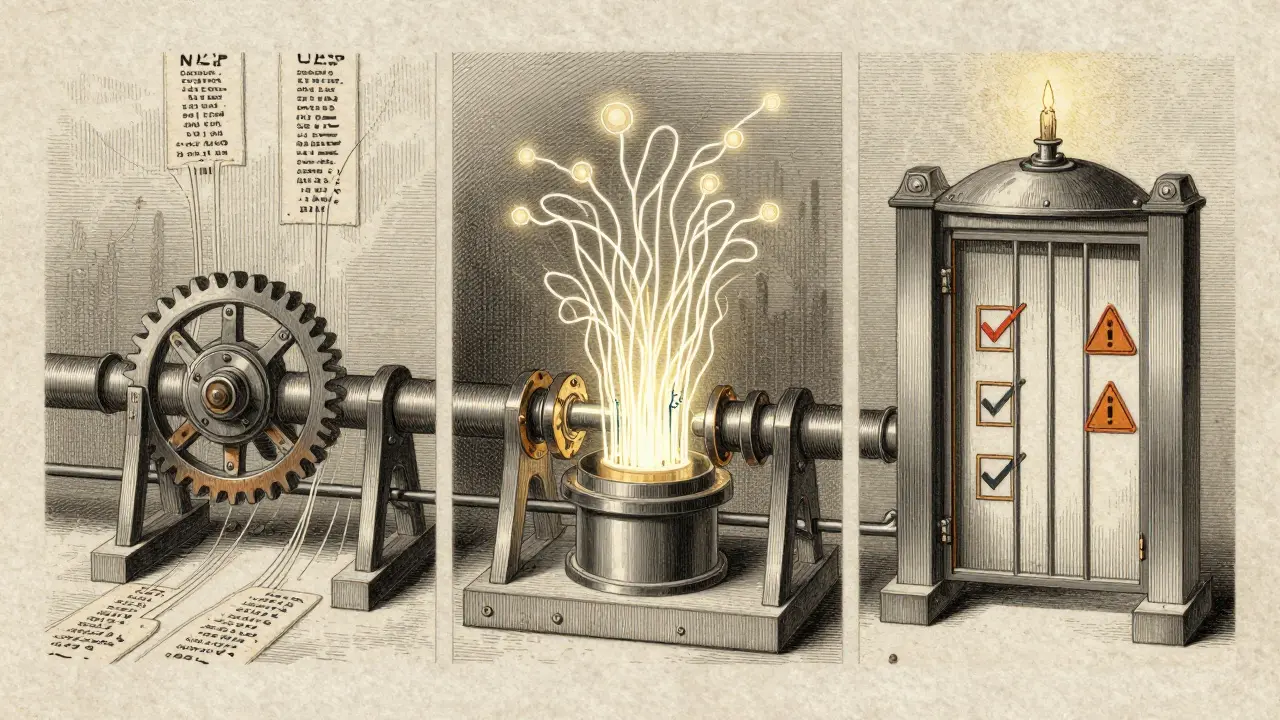
The best systems don’t pick one. They combine both. Here’s how it works in practice:- Use an NLP pipeline to clean and structure the input. Extract entities. Remove noise. Identify key phrases.
- Feed that clean, structured data into the LLM as a prompt. Now the LLM isn’t guessing-it’s reasoning.
- Use another NLP pipeline to validate the LLM’s output. Check for hallucinations. Flag inconsistencies.
- Fallback: NLP handles 85-90% of requests. LLM only kicks in when confidence is low. Cost reduction: 80-90%.
- Primary: LLM runs first for high-risk tasks (e.g., financial compliance). NLP validates. Accuracy over cost.
- Hybrid: Both run in parallel. Output scores are averaged. Used in audit-critical systems.
What’s Holding You Back?
Most teams don’t fail because the tech is bad. They fail because they don’t understand the trade-offs. If you’re using LLMs for everything, you’re probably paying too much, moving too slow, and risking compliance violations. If you’re using pipelines for everything, you’re missing out on the power of contextual understanding. The biggest mistake? Thinking LLMs replace NLP. They don’t. Just like calculators didn’t replace abacuses-they made arithmetic faster. NLP pipelines are still the abacus for structured tasks. LLMs are the calculator for messy, open-ended ones.
How to Start Building a Hybrid System
Start small. Pick one high-volume, low-risk task. Something you’re already handling with rules or manual review. Step 1: Map your current pipeline. What are the steps? Where do errors happen? Step 2: Pick one bottleneck. Maybe it’s sentiment analysis. Or entity extraction. Step 3: Try feeding the output of that step into an LLM with a clear prompt. Example: “Given these extracted entities: [list], what is the overall sentiment toward the product?” Step 4: Compare accuracy and cost. Did it improve? Did it cost more? By how much? Step 5: Add validation. Run the LLM’s output through a simple rule-based checker. If it says “positive sentiment” but the word “terrible” appears twice, flag it. Step 6: Monitor. Track cost per request. Accuracy over time. Latency. Error types. Within 4 weeks, you’ll know if hybrid is right for you.Future-Proofing Your System
By 2027, Gartner predicts 90% of enterprise language systems will be hybrid. The EU AI Act already requires deterministic outputs for high-risk applications. That means pure LLMs are becoming legally risky in finance, healthcare, and public services. Meanwhile, LLM providers are adapting. Anthropic’s Claude 3.5 now has a “deterministic mode” that cuts output variance by 78%. But it’s 30% slower. That’s not a fix-it’s a trade-off. And you still need to audit it. The real winners will be teams that treat NLP and LLMs as complementary tools-not competing technologies. Build systems that use the right tool for the right job. And always, always validate.What’s Next?
If you’re using LLMs without NLP preprocessing, you’re leaving money on the table-and risking errors. If you’re still using only pipelines, you’re missing out on understanding language the way humans do. The future isn’t pipelines or LLMs. It’s pipelines with LLMs. And the sooner you start building that, the sooner your system will be faster, cheaper, and smarter.Are NLP pipelines outdated now that LLMs exist?
No. NLP pipelines are more relevant than ever. They’re fast, cheap, and predictable-perfect for high-volume, rule-based tasks like spam filtering, product tagging, or compliance checks. LLMs can’t match their speed or cost-efficiency. The best systems use both: NLP for structure, LLMs for understanding.
Can I just use an LLM for everything and skip NLP pipelines?
You can, but you shouldn’t. LLMs are slow, expensive, and unreliable for simple tasks. A single request can cost 100x more than a pipeline. Response times can exceed 1 second-too slow for real-time chat or moderation. And hallucinations can cause compliance violations. Use LLMs only where you need context, creativity, or reasoning.
How do I know if my task needs an LLM or just a pipeline?
Ask yourself: Can I write rules or train a model to handle this with 90%+ accuracy? If yes, use a pipeline. If the task involves sarcasm, implied meaning, multi-step reasoning, or open-ended generation (like writing emails or summaries), then an LLM is worth the cost. If you’re unsure, start with a pipeline and test adding an LLM on edge cases.
What’s the biggest mistake teams make with LLMs?
Treating LLMs like magic boxes. They’re not. They hallucinate, drift over time, and give different answers to the same question. Without validation, monitoring, or NLP preprocessing, they’re a liability-not an asset. Always add a rule-based check after the LLM output. Always track cost per request. Always version your prompts.
Is hybrid NLP + LLM the future?
Yes. By 2027, Gartner predicts 90% of enterprise systems will use hybrid architectures. The EU AI Act already requires deterministic outputs for high-risk applications, making pure LLMs risky in finance and healthcare. Hybrid systems give you the speed and auditability of pipelines with the intelligence of LLMs. The companies winning right now are the ones stitching them together-not choosing one over the other.


