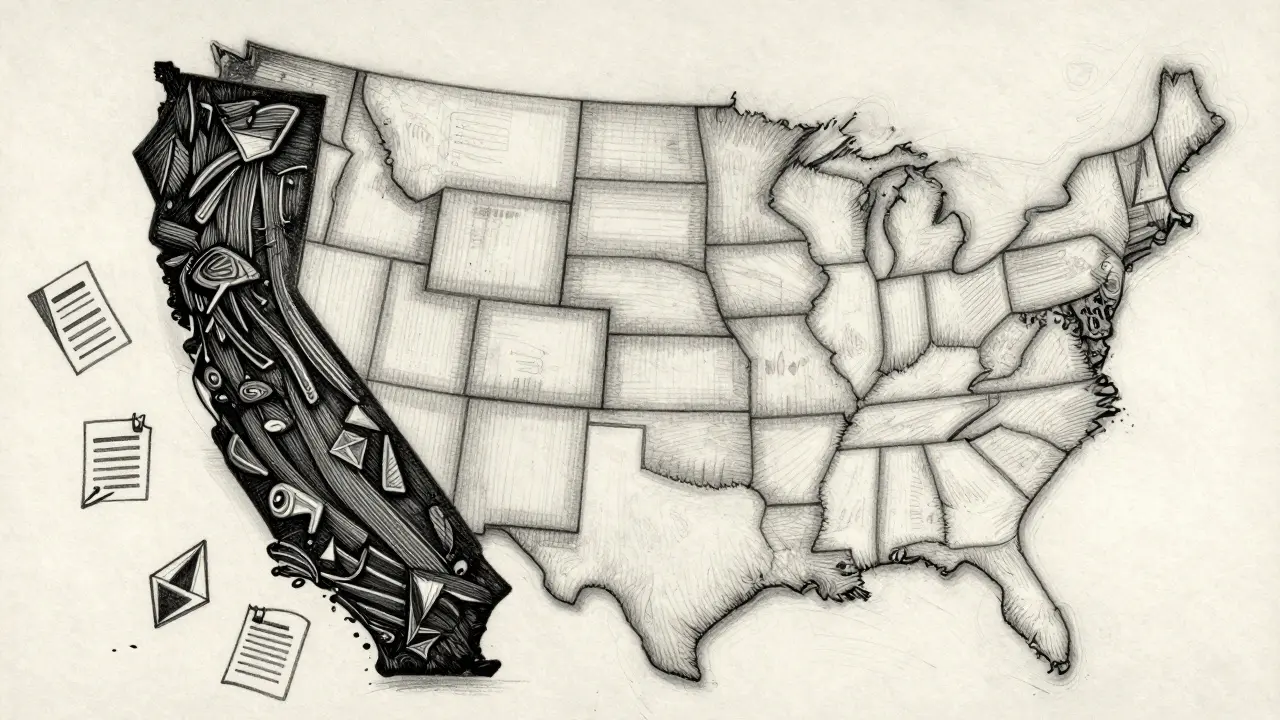
It is June 2026, and if you are building or deploying generative artificial intelligence in the United States, you are likely feeling a mix of confusion and urgency. The federal government has not passed a comprehensive national AI law, leaving a patchwork of state regulations that vary wildly in scope and severity. For businesses, this means one-size-fits-all compliance strategies are dead. You need to know exactly where your users are located and what specific rules apply to them.
California has emerged as the undisputed heavyweight in this regulatory landscape, enacting some of the strictest laws on the planet. Meanwhile, states like Colorado, Illinois, and Utah have taken much narrower approaches, focusing on specific industries or waiting for clearer federal guidance. This guide breaks down the current legal reality in these four key states so you can protect your business and avoid costly fines.
California: The De Facto National Standard
If you operate anywhere near California’s economy, you need to pay attention. With Governor Gavin Newsom signing a flurry of bills in late 2024 and 2025, California has established itself as the lead regulator for AI in the US. Industry analysts predict that California’s framework will become the de facto standard for the entire country, similar to how the GDPR influenced global privacy laws. As of early 2026, several major pieces of legislation are now in effect or about to take effect.
The California AI Transparency Act (AB853) is arguably the most impactful new rule. Signed in September 2025, this law requires large online platforms, system-hosting platforms, and capture device manufacturers to disclose when content is AI-generated. It mandates two types of disclosures:
- Manifest disclosures: Visible labels that users can see directly on the content.
- Latent disclosures: Behind-the-scenes metadata tags that allow detection tools to identify AI usage.
The implementation deadline was recently pushed back from January 1, 2026, to August 2, 2026. This gives companies a few more months to build the necessary technical infrastructure, but the clock is ticking. Violations can result in daily penalties enforced by the California Attorney General.
Another critical piece is the Generative Artificial Intelligence Training Data Transparency Act (AB 2013). This law requires developers to disclose detailed information about their training datasets, including provenance, composition, and potential biases. Crucially, it applies retroactively to systems released or substantially modified on or after January 1, 2022. If you updated your model last year, you already have compliance obligations starting January 1, 2026. Non-compliance can lead to penalties of up to $5,000 per violation under California’s Business and Professions Code.
For healthcare providers, the stakes are equally high. The Physicians Make Decisions Act (SB 1120), effective January 1, 2025, mandates that licensed physicians must supervise any AI tool used to approve, modify, or deny provider requests. Health insurers cannot let algorithms make final decisions without human oversight. Additionally, AB 489 prohibits AI developers from falsely claiming to hold healthcare licenses, ensuring patients always know they are interacting with software, not a doctor.
Finally, the Transparency in Frontier Artificial Intelligence Act (SB53) targets the biggest players. Developers of frontier AI models must publicly publish frameworks describing how they incorporate national and international standards into their development processes. The state is also working on CalCompute, a state-backed cloud computing cluster for AI research, with proposals due by January 1, 2027.
Colorado: Narrow Focus on Insurance
In contrast to California’s broad sweep, Colorado has taken a highly targeted approach. The state’s primary AI legislation, House Bill 24-1262, took effect on July 1, 2024, and focuses exclusively on the insurance industry. This law prohibits insurers from using AI to engage in unfair discrimination and requires disclosure when AI systems are used to make underwriting decisions.
For tech companies outside the insurance sector, this means relatively little direct regulation. However, legal experts warn that this narrow focus creates uncertainty. If you are building an AI tool for non-insurance businesses in Colorado, there are no comprehensive state-level guardrails. The Center for Democracy & Technology has criticized this approach, noting that it leaves significant gaps in consumer protection for general-purpose AI applications.
That said, Colorado is watching closely. In the 2025 legislative session, lawmakers considered HB 25-1047 (Consumer Generative AI Transparency Act), which would have required broader disclosure of AI-generated content in commercial contexts, similar to California’s approach. While this bill did not pass immediately, its introduction signals that Colorado may expand its regulatory scope in the future. Businesses should monitor this trend, as the Denver Business Journal reported that 78% of local insurers found the current insurance-focused rules manageable, suggesting openness to more structured guidelines.
Illinois: Biometrics and Deepfakes
Illinois has long been known for its strict data privacy laws, particularly the Biometric Information Privacy Act (BIPA). While BIPA was amended in 2023 to address AI-related biometric collection issues, the state’s recent generative AI efforts have focused heavily on political integrity and deepfake prevention rather than broad developer accountability.
The most notable recent law is Senate Bill 3197 (Artificial Intelligence Video Recording Act), which took effect on January 1, 2025. This statute prohibits the use of AI to create deepfakes of political candidates within 60 days of an election. This is a reactive measure designed to protect democratic processes, but it does not provide a comprehensive framework for other types of generative AI content.
For businesses, the main risk in Illinois remains BIPA. A Chicago Tribune case study from October 2025 highlighted a marketing firm fined $250,000 for using AI to analyze facial recognition data without proper consent. If your generative AI application processes biometric data-such as voice prints, facial scans, or fingerprints-you must treat Illinois as a high-risk jurisdiction. Ensure you have explicit consent protocols in place before collecting or processing any biometric information through AI tools.
Lawmakers have introduced SB 2891 (Generative AI Disclosure Act) in January 2025, which aims to broaden disclosure requirements. However, as of late 2025, this bill remains in committee. Until it passes, Illinois lacks the comprehensive generative AI legislation seen in California, leaving many businesses confused about their obligations beyond biometrics and elections.
Utah: Minimal Regulation and Data Privacy
Utah represents the opposite end of the spectrum. The state has implemented minimal AI-specific legislation, preferring to rely on its broader data privacy framework. The Utah Consumer Privacy Act (UCPA), which took effect on December 31, 2023, governs data handling practices but does not contain specific provisions addressing generative AI.
This "wait-and-see" approach has drawn mixed reactions. On one hand, tech companies appreciate the lack of heavy-handed regulation. A Salt Lake Tribune poll from November 2025 showed that 63% of local tech firms preferred regulatory clarity over the current ambiguity, but many still favored less intervention than California offers. On the other hand, the Salt Lake City Technology Council warned that Utah risks falling behind in the AI economy without clearer guardrails.
In January 2025, lawmakers introduced Senate Bill 232 (Artificial Intelligence Policy Act), which would establish a task force to study AI governance. However, this bill lacks concrete regulatory requirements and has been delayed until the 2026 legislative session. For now, if you are operating in Utah, your primary compliance focus should be on general data privacy under the UCPA. Ensure you are transparent about data collection, provide opt-out mechanisms for sensitive data processing, and respect user rights regarding personal information.
Compliance Costs and Implementation Challenges
Meeting these diverse state requirements is not cheap. According to a Davis Wright Tremaine report from September 2025, businesses typically need 3-6 months to implement compliance measures for California’s AI laws. Average costs range from $250,000 for small businesses to $2.5 million for enterprise platforms.
One Reddit user, identified as "CaliforniaComplianceOfficer," noted that implementing manifest and latent disclosure requirements across their content platform required six months of engineering work and $1.2 million in development costs. Another user, "AIStartupCEO," complained that the retroactive application of AB 2013 to systems modified after January 2022 caused massive documentation headaches.
To manage these costs, consider adopting California’s standards as your global baseline. The International Association of Privacy Professionals reported in November 2025 that 67% of multinational companies are doing exactly this. By building robust disclosure systems, maintaining detailed training data records, and implementing strong biometric consent protocols, you can satisfy California’s strict rules while also covering the narrower requirements of Colorado, Illinois, and Utah.
| State | Primary Focus | Key Legislation | Effective Date | Penalties/Risks |
|---|---|---|---|---|
| California | Transparency, Training Data, Healthcare | AB853, AB 2013, SB 1120 | Jan 2025 - Aug 2026 | Daily fines, $5k/violation |
| Colorado | Insurance Underwriting | HB 24-1262 | July 1, 2024 | Unfair discrimination claims |
| Illinois | Biometrics, Political Deepfakes | BIPA, SB 3197 | Jan 1, 2025 | $250k+ fines for BIPA |
| Utah | General Data Privacy | UCPA | Dec 31, 2023 | Privacy violations |
Frequently Asked Questions
Does California's AI Transparency Act apply to my small business?
Yes, if you meet the definition of a "covered provider." The law expanded its scope to include large online platforms, system-hosting platforms, and capture device manufacturers. Originally, it only applied to generative AI systems serving over one million monthly users, but the expansion in AB853 broadens who needs to comply. Check if your platform hosts or distributes AI-generated content to determine if you fall under these categories.
What is the deadline for complying with California's AB853?
The implementation deadline for the California AI Transparency Act (AB853) is August 2, 2026. This date was delayed from the original January 1, 2026, target to give companies more time to develop the necessary technical infrastructure for manifest and latent disclosures.
Do I need to disclose training data for AI models built before 2022?
Under California's AB 2013, you do not need to disclose training data for models created before January 1, 2022, unless they were substantially modified on or after that date. The law applies retroactively to systems released or significantly changed since January 1, 2022, creating immediate compliance obligations for many existing models.
Is there any federal AI law that overrides these state regulations?
As of mid-2026, there is no comprehensive federal AI legislation in the United States. This absence has led to a regulatory patchwork where states like California set their own rules. Without federal preemption, state laws remain fully enforceable, meaning you must comply with each state's specific requirements based on where your users are located.
How does Illinois' BIPA affect generative AI developers?
If your generative AI application collects, stores, or analyzes biometric data-such as facial features, voice patterns, or fingerprints-you must comply with Illinois' Biometric Information Privacy Act (BIPA). This requires obtaining written consent from individuals before collecting their biometric data and following strict retention and destruction policies. Failure to comply can result in significant fines, as seen in recent cases involving marketing firms.
Should I adopt California's standards globally?
Many experts recommend this strategy. Since California's regulations are among the strictest and its market is the largest, adopting its standards as your global baseline ensures compliance in the most demanding jurisdiction. This approach also prepares you for similar laws that may emerge in other states, reducing the need for multiple, fragmented compliance systems.
What are "latent disclosures" in AI content?
Latent disclosures are hidden metadata tags embedded within AI-generated content. Unlike manifest disclosures, which are visible labels users can see, latent disclosures are designed to be read by automated detection tools. California's AB853 requires these tags to ensure that AI usage can be verified even if visible labels are removed or obscured.
Does Utah have any specific laws for generative AI?
No, Utah currently lacks specific legislation targeting generative AI. Its regulatory framework relies on the broader Utah Consumer Privacy Act (UCPA), which governs general data privacy practices. While Senate Bill 232 proposes studying AI governance, it has not yet passed, leaving Utah with minimal direct AI regulation compared to states like California.