
You type a prompt into an AI chatbot. It replies instantly. But behind that seamless interaction lies a complex translation process. The AI doesn't read your words the way you do. It reads numbers. Before any intelligence happens, your text must be broken down into chunks called tokens, which are the fundamental units of text processing for large language models. This process is known as tokenization.
If you’ve ever wondered why some prompts cost more to run than others, or why an AI might struggle with a rare technical term, the answer usually lies in how it tokenizes data. Tokenization isn’t just a preprocessing step; it’s the lens through which the model sees reality. Get it wrong, and the model misunderstands context. Get it right, and you unlock speed, accuracy, and lower costs.
The Core Problem: Why Computers Need Tokens
Neural networks operate on mathematics, not linguistics. They cannot process the string "hello" directly. They need vectors-arrays of numbers that represent meaning. Tokenization bridges this gap by converting raw text into these numerical IDs.
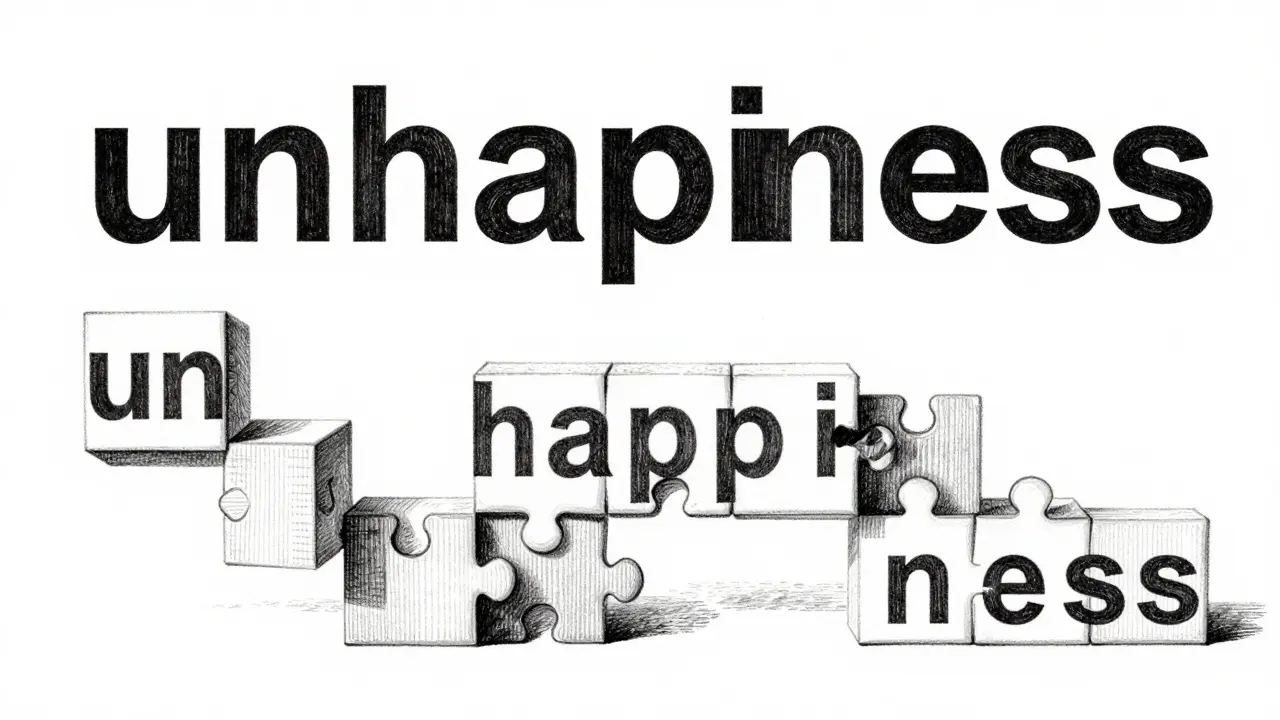
Imagine trying to explain the concept of "unhappiness" to someone who only knows basic building blocks. You could teach them the whole word as one unit. Or, you could break it down: "un" (not), "happy" (joyful), and "ness" (state of being). If they know those parts, they understand the whole, even if they’ve never heard the specific combination before.
This analogy mirrors the central challenge in Generative AI, which is a class of artificial intelligence capable of creating new content such as text, images, or code.. Early systems tried to treat every word as a unique token. This created massive vocabularies. More importantly, it failed when encountering out-of-vocabulary (OOV) words-rare terms, typos, or new slang. The model would hit a wall, returning a special "unknown" symbol and losing all semantic nuance.
To solve this, researchers developed subword tokenization. Instead of whole words or single characters, these methods split text into meaningful sub-parts. This approach balances vocabulary size with the ability to handle rare words. Two dominant methods emerged: Byte Pair Encoding (BPE) and WordPiece.
Byte Pair Encoding (BPE): The Frequency-Based Approach
Byte Pair Encoding (BPE) is a compression algorithm adapted for NLP that merges frequent character pairs iteratively. Originally designed for data compression, BPE became the backbone for many modern large language models, including the GPT series from OpenAI.
Here is how BPE works in practice:
- Start with characters: Every word is initially broken down into individual letters. "playing" becomes [p, l, a, y, i, n, g].
- Count frequencies: The algorithm scans the entire training dataset to find which adjacent character pairs appear most often. For example, "ing" might appear millions of times across thousands of verbs.
- Merge the best pair: The most frequent pair is merged into a new token. Now, "ing" is treated as a single unit.
- Repeat: This process repeats until the vocabulary reaches a predefined size limit (e.g., 50,000 tokens).
The result is a vocabulary where common subwords like "-tion", "-ing", or "pre-" exist as standalone tokens. When the model encounters "unhappiness," it might tokenize it as ["un", "happi", "ness"]. Because "un" and "ness" are high-frequency affixes, the model understands their grammatical function even if it hasn’t seen "unhappiness" specifically during training.
BPE is popular because it is deterministic and efficient. However, it has a blind spot: it relies strictly on frequency. It doesn’t consider the probability of a split occurring in a linguistic context, which can sometimes lead to suboptimal splits for certain languages.
WordPiece: The Probabilistic Alternative
WordPiece is a tokenization algorithm that uses likelihood scores rather than raw frequency to merge subwords. Developed by Google and popularized by the BERT model, WordPiece shares similarities with BPE but optimizes differently.
While BPE asks, "Which pair appears most often?", WordPiece asks, "Which pair is most likely to belong together based on statistical likelihood?" It calculates the probability of two tokens appearing adjacent to each other relative to their individual frequencies.
This probabilistic approach often results in different token boundaries. For instance, where BPE might split a compound German word based on sheer repetition, WordPiece might preserve a longer segment if the statistical evidence suggests those characters form a cohesive unit more often than not.
WordPiece excels in masked language modeling tasks. Since BERT trains by predicting missing words, understanding the subtle probabilities of subword combinations helps the model fill in gaps more accurately. This makes WordPiece particularly strong for search engines and retrieval-augmented generation (RAG) systems where precise semantic matching is critical.
| Feature | Byte Pair Encoding (BPE) | WordPiece |
|---|---|---|
| Primary Metric | Raw frequency of adjacent pairs | Likelihood score of token pairs |
| Best Known Use Case | Autoregressive generation (GPT models) | Masked language modeling (BERT/RoBERTa) |
| Vocabulary Growth | Iterative merging until fixed size | Similar iterative process, but optimized for likelihood |
| Handling Rare Words | Splits into known subwords + unknown chars | Splits into probable subword units |
| Computational Cost | Low during inference | Low during inference |
Beyond Text: Multimodal and Dynamic Tokenization
Text is no longer the only input for generative AI. Models like DALL·E and Stable Diffusion use tokenization for images too. In these systems, an image is divided into patches, which are then encoded into tokens similar to how text is processed. This allows the model to learn relationships between visual features and textual descriptions.
However, static tokenizers have limits. A fixed vocabulary trained on English news articles might struggle with code, medical jargon, or low-resource languages. This has led to the rise of dynamic tokenization. Unlike traditional methods that apply the same rules to every input, dynamic approaches adapt based on the context of the specific text being processed.
For example, a system detecting programming code might prioritize keeping variable names intact, while a legal document processor might preserve case law citations. Advanced techniques like Masked Vector-Quantized Tokenization (MQ-Tokenizer) are being explored for recommendation systems, where user-item interactions are quantized into discrete tokens to improve generalization.
The Hidden Costs: Computational Bottlenecks
Tokenization is not free. Converting text to tokens and back again (detokenization) consumes CPU cycles and memory. In real-time applications, this overhead can add latency. More critically, the number of tokens directly impacts cost.
Most commercial AI APIs charge per token. If your tokenizer breaks a simple sentence into 50 tokens instead of 30, your bills increase by 40% for the same information. Efficient tokenization strategies can therefore save enterprises significant money at scale.
Long-context models face another challenge: attention mechanism complexity. Transformers calculate relationships between all tokens in a sequence. As token count grows, computational requirements grow quadratically. Techniques like Sparse Transformers aim to reduce this burden by focusing only on relevant token interactions, but the initial tokenization strategy sets the ceiling for efficiency.
Practical Tips for Developers and Users
Understanding tokenization helps you work better with AI. Here are actionable insights:
- Watch your punctuation: Many tokenizers separate punctuation marks as distinct tokens. Excessive commas or periods increase token count without adding semantic value.
- Be wary of spaces: Some tokenizers treat spaces as part of the preceding or following word. Inconsistent spacing can change how a word is split, potentially altering meaning.
- Test rare terms: If you’re working with specialized domains (e.g., genetics or engineering), check how your tokenizer handles key terminology. If it breaks critical terms into meaningless fragments, consider fine-tuning the tokenizer or using a domain-specific model.
- Optimize prompts: Remove filler words. "Please provide a detailed explanation of..." can often be shortened to "Explain..." saving tokens and reducing noise.
The Future: Semantic and Quantum Horizons
Research is moving toward semantics-driven tokenization. Instead of relying solely on surface-level character patterns, future tokenizers may incorporate contextual meaning during the splitting process. Imagine a tokenizer that knows "bank" refers to finance in one sentence and geography in another, and adjusts its representation accordingly.
Quantum computing also holds theoretical promise. Quantum algorithms could potentially process complex tokenization tasks more efficiently, enabling real-time analysis of massive datasets. While still largely experimental, this represents a potential leap forward in handling the combinatorial explosion of natural language.
As models evolve, so will the ways we feed them data. Tokenization remains the gatekeeper of AI comprehension. Mastering its nuances isn’t just for engineers-it’s essential for anyone looking to leverage generative AI effectively, economically, and accurately.
What is the difference between BPE and WordPiece?
Both are subword tokenization methods, but they optimize differently. BPE merges the most frequently occurring adjacent character pairs. WordPiece merges pairs based on their statistical likelihood of appearing together. BPE is common in GPT models, while WordPiece is standard for BERT-based models.
Why does tokenization matter for API costs?
Most AI services charge per token. Different tokenizers produce different token counts for the same text. An inefficient tokenizer might split words unnecessarily, increasing the token count and thus the cost. Optimizing your input to align with the model's tokenizer can reduce expenses significantly.
How do AI models handle unknown words?
Modern models use subword tokenization. If a word is not in the vocabulary, it is broken down into smaller, known subword units (like prefixes, roots, and suffixes). This allows the model to infer meaning from parts it recognizes, rather than failing completely.
Can tokenization affect AI accuracy?
Yes. Poor tokenization can split semantically important units incorrectly, leading to misunderstandings. For example, if a medical term is split randomly, the model may miss its clinical significance. Choosing the right tokenizer for your domain is crucial for performance.
What is dynamic tokenization?
Dynamic tokenization adapts the tokenization process based on the input text's characteristics, rather than using a fixed vocabulary. It aims to improve handling of diverse, unseen, or specialized text by determining optimal splits in real-time based on context.