
Why Your Standard IT Contract Is Broken for AI
If you signed a contract with an Large Language Model (LLM) provider in 2024 using your standard software-as-a-service (SaaS) template, you are likely exposed to significant legal and operational risk. The days of treating AI vendors like traditional cloud providers are over. Unlike static software that does exactly what it was coded to do, LLMs are probabilistic. They change. They hallucinate. And they can degrade in quality without any code being touched.
This isn't just theoretical. In early 2025, procurement managers reported unexpected costs from model drift, averaging 22% of initial contract value in the first year alone. One enterprise signed a three-year deal without proper performance thresholds. By month ten, accuracy on their critical use case dropped from 92% to 78%. The vendor refused to compensate because the Service Level Agreement (SLA) only specified uptime, not output quality. That is a gap most legal teams didn't know existed until it cost them millions.
The landscape shifted dramatically following the Office of Management and Budget's (OMB) March 2025 memo. Federal agencies were required to implement specific contractual requirements for LLM procurement. This mandate forced the private sector to pay attention. Today, effective AI vendor management is no longer optional; it is a core component of enterprise governance. You need contracts that address dynamic performance, data ownership, and the unique liabilities of generative AI.
The Five Dimensions of Modern AI Contracts
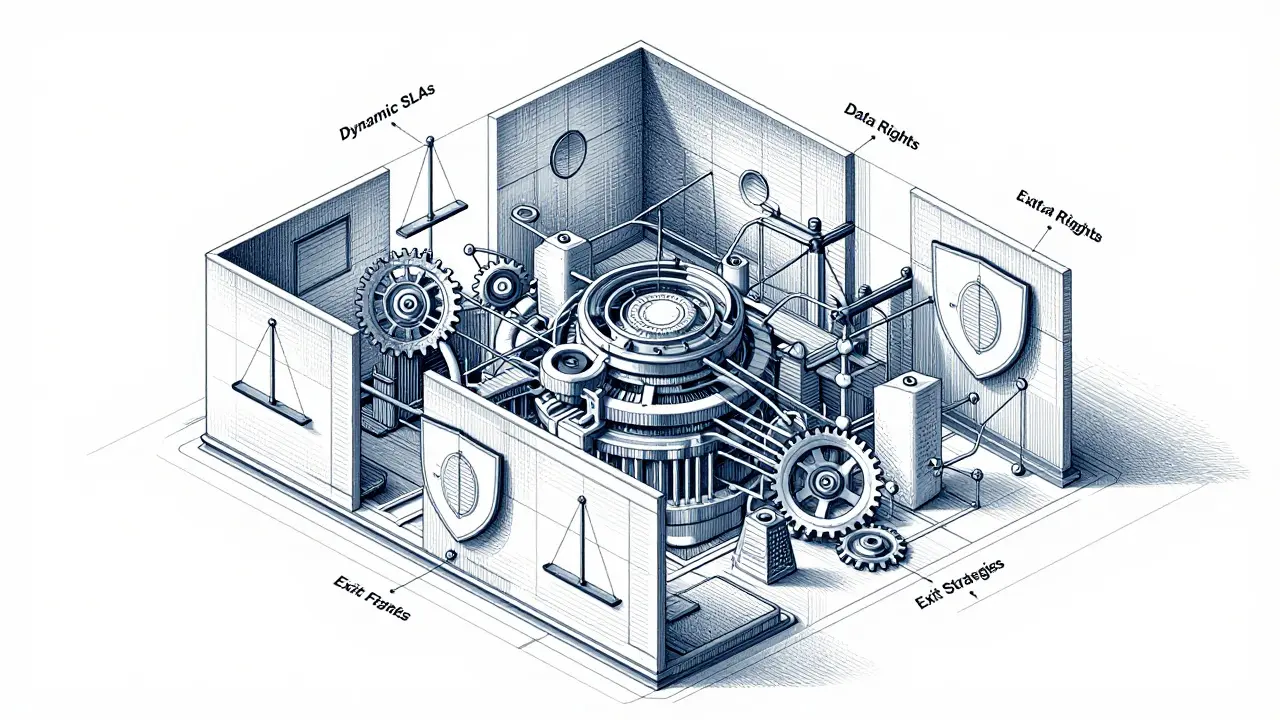
Traditional IT contracts focus on static deliverables, uptime guarantees, and clear-cut liability limits. LLM contracts require a fundamentally different approach. Based on industry standards emerging in 2024 and 2025, here are the five critical dimensions where your contract must evolve.
- Dynamic SLAs Over Static Uptime: Traditional contracts guarantee 99.9% uptime. For AI, uptime means nothing if the model outputs nonsense. Your contract needs AI-Specific SLAs. These should specify performance KPIs like model accuracy (typically 85-95% depending on the use case), drift thresholds (limiting monthly degradation to 0.5-2%), and explainability metrics (ensuring at least 80% of decisions are interpretable).
- Expanded Liability Clauses: Standard indemnification clauses are obsolete. You need explicit terms addressing liability for AI-generated outcomes. This includes damages from biased outputs, misinformation, or unforeseen failures. Effective LLM contracts now establish tiered liability structures, often requiring 3-5x annual fees for bias-related damages and uncapped liability for security breaches.
- Data Rights and Output Ownership: In traditional SaaS agreements, data rights might take 5-10% of negotiation time. In LLM contracts, this requires 30-40% focus. You must define who owns the training data, who owns the fine-tuned models, and who owns the generated outputs. Ambiguity here leads to intellectual property disputes down the line.
- Regulatory Compliance Integration: With the EU AI Act taking full effect for high-risk systems by February 2026, your contract must address compliance responsibilities. Does the vendor provide the necessary transparency reports? Do they handle the human-in-the-loop requirements for automated decision-making? The burden of proof must be clearly allocated.
- Exit Strategies and Interoperability: Vendor lock-in is a major risk in AI. Your contract must include clauses for interoperability to ease transitions to other vendors or in-house solutions. This includes a pre-negotiated exit strategy covering secure data retrieval and a timeline for transitioning workloads.
Comparing Traditional vs. LLM Vendor Management
To understand the shift, look at how the metrics differ. Traditional contract lifecycle management (CLM) focuses on speed and cost reduction. AI vendor management focuses on risk mitigation and continuous value delivery.
| Feature | Traditional SaaS Contract | LLM Provider Contract |
|---|---|---|
| Primary SLA Metric | Uptime (99.5-99.9%) | Model Accuracy & Drift Thresholds |
| Liability Cap | Contract Value or 1-2x Annual Fees | Tiered: 3-5x for Bias, Uncapped for Security Breaches |
| Data Focus | Privacy & Storage Security | Training Data Rights, Output IP, Fine-Tuning Ownership |
| Update Protocol | Scheduled Patches | Canary Deployments & Continuous Monitoring |
| Relationship Type | Transactional / Periodic Review | Partnership / Shared Accountability |
| Compliance Driver | GDPR, SOC 2 | EU AI Act, NIST AI RMF, OMB Memos |
Notice the shift in relationship type. Bamboo Data Consulting describes modern AI vendor management as an "organic, end-to-end discipline." It requires ongoing collaboration, not just a signature at the start. If your legal team treats the contract as a one-time event, you will fail to manage the risks of model evolution.
Navigating Regulatory Requirements in 2026
The regulatory environment for AI has hardened significantly. The OMB's March 2025 deadline triggered widespread contract revisions across federal agencies, achieving a 92% compliance rate by late 2024. But the pressure doesn't stop there. Forty-seven U.S. states introduced AI procurement legislation between 2024 and 2025. Meanwhile, the EU AI Act establishes mandatory requirements for high-risk AI systems.
Your contracts must explicitly address these frameworks. For example, the OMB guidelines mandate that agencies request specific documentation from vendors, including:
- Acceptable use policies
- Model cards and system cards detailing architecture and limitations
- End-user resources and feedback mechanisms
- Transparency regarding pre-training and post-training activities
- Evidence of third-party modifications and enterprise-level controls
Additionally, President Trump's July 2024 executive order required AI vendors to measure their models' political bias. While enforcement varies, savvy enterprises are including bias auditing requirements in their contracts to protect against reputational damage. Ignoring these mandates isn't just a compliance issue; it's a business continuity risk.
Implementation Strategy: Building Your Team
You cannot manage LLM vendors with just a procurement officer and a general counsel. The learning curve is steep. Procurement teams require 120-160 hours of specialized training to become effective in this space. Here is how to structure your internal team for success.
First, assemble a cross-functional squad. According to Bamboo Data Consulting's implementation guide, you need:
- Legal Counsel with AI Expertise: 2-3 attorneys who understand AI-specific liabilities and data rights. General corporate lawyers often miss the nuances of model drift and algorithmic bias.
- Data Scientists: 3-5 full-time equivalents (FTEs) dedicated to model validation. They need to define the technical SLAs and verify that the vendor is meeting accuracy and fairness benchmarks.
- Procurement Specialists: 2-3 FTEs focused on commercial terms and market intelligence.
Second, adopt the right tools. Specialized AI contract management platforms like Sirion AI and Icertis are capturing 22% of the $4.3 billion enterprise CLM market in 2025. These platforms use small data models alongside LLMs to provide precision in contract analysis. As Rajesh Gupta, CTO of Sirion AI, noted, "LLMs alone are insufficient - Small Data Models add precision" for critical tasks like clause extraction and risk scoring.
Third, establish monitoring protocols. Sarah Chen of Baker McKenzie warned that 68% of early adopters failed to allocate sufficient personnel for continuous contract compliance verification. You need a process for quarterly contract reviews and real-time monitoring of model performance metrics. If the model drifts beyond your agreed threshold, your contract should trigger automatic remediation steps or financial penalties.

Avoiding Common Pitfalls
Even experienced organizations stumble when entering the AI vendor market. Here are the most common traps and how to avoid them.
Pitfall 1: Underestimating Model Drift Costs. Many contracts assume the model will perform consistently. In reality, models degrade as language evolves and new data enters the ecosystem. Always include drift detection limits in your SLA. Define what happens when accuracy drops below a certain percentage. Who pays for retraining? Who bears the cost of downtime during updates?
Pitfall 2: Vague Data Ownership Terms. If you fine-tune a base model with your proprietary data, who owns the resulting weights? Some vendors claim ownership of all derivatives. Push back hard. Ensure your contract grants you exclusive rights to your fine-tuned models and clarifies that your input data remains confidential and is not used to train other customers' models.
Pitfall 3: Lack of Exit Flexibility. AI technology moves fast. A model that is state-of-the-art today may be obsolete in six months. Your contract should allow for easy termination or migration if the vendor fails to keep pace with innovation. Include interoperability clauses that ensure you can export your data and configurations without penalty.
Pitfall 4: Ignoring Explainability. For regulated industries, black-box AI is unacceptable. Require the vendor to provide explainability metrics. Can they show why the model made a specific decision? If not, you may face regulatory hurdles under the EU AI Act or sector-specific regulations.
Future Trends: Self-Updating Contracts
The field is evolving rapidly. By 2027, 81% of industry experts predict the rise of "self-updating contracts." These agreements will automatically adjust terms based on real-time model performance metrics. Imagine a contract that dynamically adjusts pricing or service levels if the model's accuracy fluctuates. This level of automation requires robust integration between your CLM platform and the vendor's API.
Standardization is also accelerating. The International Association for Contract and Commercial Management (IACCM) launched a working group in January 2025 to create the first industry-wide LLM vendor contract framework. This could reduce negotiation times and increase consistency across the market. Keep an eye on these developments, as they will shape best practices for years to come.
Organizations with mature LLM vendor management practices are already seeing results. McKinsey's 2025 AI Procurement Outlook projects that these companies will achieve 28-35% higher ROI from AI investments compared to those using traditional contracting approaches. Conversely, failure to adapt carries a heavy price: a 42% higher risk of AI project failure due to vendor misalignment.
The message is clear. Treat your AI vendors differently. Update your contracts. Build the right team. And monitor performance continuously. The future of AI procurement belongs to those who govern effectively.
What is model drift in the context of LLM contracts?
Model drift refers to the gradual degradation of an AI model's performance over time as the underlying data distribution changes or the model becomes outdated. In contracts, this is addressed through SLAs that define acceptable accuracy thresholds and drift limits (e.g., no more than 2% monthly degradation). If drift exceeds these limits, the vendor may be obligated to retrain the model or face penalties.
How does the OMB March 2025 memo affect private sector contracts?
While the OMB memo directly applies to federal agencies, it sets a de facto standard for the entire industry. Private vendors supplying government clients must comply, and many enterprises adopt these rigorous standards (such as requiring model cards and bias audits) to ensure consistency and mitigate risk across their supply chain.
Who owns the output generated by an LLM?
Ownership depends entirely on the contract. Some vendors retain rights to all generated content, while others grant exclusive ownership to the customer. It is critical to negotiate this clause explicitly, especially if the output involves proprietary information or is intended for commercial use. Ambiguity here can lead to intellectual property disputes.
What are AI-Specific SLAs?
AI-Specific SLAs go beyond traditional uptime metrics to include performance indicators relevant to AI systems. These may include model accuracy rates, precision/recall scores, bias metrics, explainability percentages, and response latency for complex queries. They ensure the AI delivers value, not just availability.
Why is vendor lock-in a bigger risk with LLMs than traditional software?
LLM ecosystems often involve proprietary formats for fine-tuned models, custom embeddings, and integrated toolchains. Switching vendors can mean losing access to your trained models or facing significant re-engineering costs. Contracts must include interoperability clauses and data portability rights to mitigate this risk.
How much training does a procurement team need for AI vendor management?
According to benchmark reports, procurement teams require 120-160 hours of specialized training. This covers AI literacy, understanding model evaluation metrics (like F1 scores and accuracy), and knowledge of emerging regulations such as the EU AI Act and NIST AI Risk Management Framework.
What is the role of small data models in contract management?
While LLMs provide broad contextual understanding, small data models offer precision for specific tasks. In contract management, they are used for exact clause matching, entity extraction, and risk scoring, providing more reliable outputs for critical legal decisions than general-purpose LLMs alone.
Are self-updating contracts a reality yet?
They are emerging. By 2027, most experts predict widespread adoption. These contracts use APIs to automatically adjust terms based on real-time performance data. Currently, early adopters are experimenting with dynamic pricing and service level adjustments tied to model accuracy metrics.


