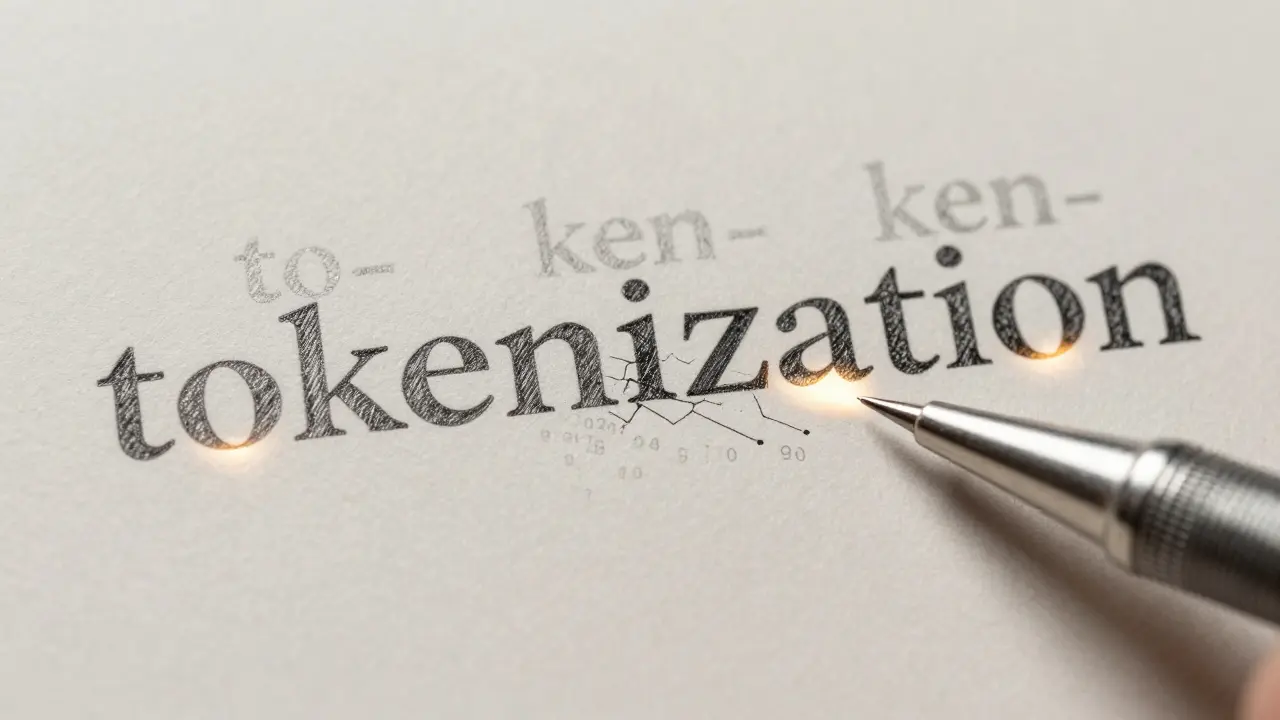
When you type a sentence into a chatbot, it doesn’t see words like you do. It sees numbers. And before those numbers get fed into a massive AI model, something subtle but crucial happens: the text gets chopped up. This is tokenization. And despite all the hype around trillion-parameter models, tokenization isn’t going away - it’s more important than ever.
What Tokenization Actually Does
Tokenization is the process of breaking text into smaller pieces - called tokens - that a neural network can understand. It’s not just about splitting words. Think of it like translating a novel into a code made of symbols. The model doesn’t care about letters or grammar. It only cares about how many tokens it has to process.
Early systems tried two extremes: word-based tokenization and character-based tokenization. Word-based meant every word got its own token. That sounds clean, until you realize English has over half a million words. Training a model on that meant storing a massive dictionary - and even then, it couldn’t handle new words like "neuralnet" or "LLM". Character-based was the opposite: split every letter. That meant "tokenization" became 13 separate tokens. The model had to piece it together from scratch, using way more memory and time.
Enter subword tokenization. Around 2016, Google’s Byte Pair Encoding (BPE) changed everything. Instead of choosing between words or letters, it found common patterns. "Tokenization" becomes "to-", "ken-", and "ization". That’s three tokens instead of one giant one or 13 tiny ones. It strikes a balance: enough flexibility to handle new words, without drowning the model in data.
Why Vocabulary Size Isn’t Just a Number
Not all tokenizers use the same number of tokens. GPT-3 uses 50,257. BERT uses 30,522. Llama 3, released in March 2024, uses 128,256. That’s not random. Each number is a trade-off.
Larger vocabularies mean fewer tokens per sentence. That’s good because models have limits. GPT-4 can handle 128,000 tokens - roughly 96,000 words. But if your tokenizer splits every word into three pieces, you hit that limit faster. A 128K vocabulary reduces sequence length by 22-35% compared to a 3K one, according to a 2024 benchmarking study. Shorter sequences = faster processing = lower costs.
But bigger vocabularies also mean more memory. Each token needs a vector in the model’s brain. More tokens = more memory used. That’s why some companies stick with 30K-50K. It’s cheaper to run. The sweet spot? Most models land between 30K and 128K. It’s not about being the biggest. It’s about being just right for the job.
Costs You Can’t Ignore
Tokenization isn’t just a preprocessing step. It’s a cost center.
At inference time - when the model is answering your question - 60-75% of the total cost comes from token processing, not the model itself. That’s right: most of the money you spend on AI isn’t for thinking. It’s for chopping up text.
One developer on Reddit cut their legal document processing costs by 37% just by switching tokenizers. Another found their financial entity recognition was failing 22% of the time because "Apple Inc." was split into "Apple" and "Inc.", and the model lost the connection. Fixing the tokenizer fixed the errors.
Enterprise data shows the numbers clearly: optimized tokenization can reduce cost per 1,000 tokens from $0.0038 to $0.0023. That’s a 39.5% drop. At scale, that’s millions saved.
Domain-Specific Tokenization Is a Game-Changer
One-size-fits-all doesn’t work in medicine, law, or finance.
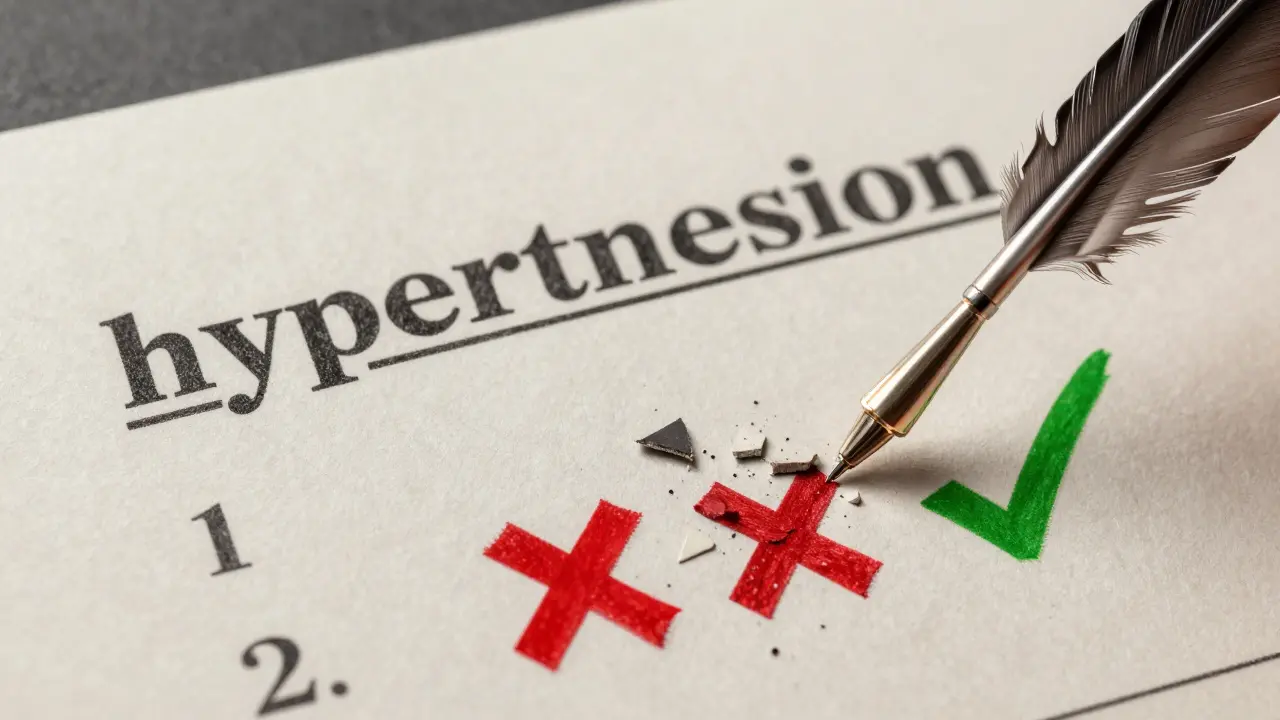
"hypertension" might be one token in a general tokenizer. But in a medical model, it’s better to keep it whole. Splitting it into "hyper-", "tens-", "ion" loses meaning. A 2024 study showed a 14.6% improvement in medical text understanding when using a custom tokenizer trained on clinical notes.
Same with legal documents. "pro bono", "writ of certiorari", "res judicata" - these phrases are single concepts. Tokenizers trained on general text will break them apart. Custom tokenizers preserve them. That’s why 68% of enterprises now customize their tokenizers. Finance leads at 73%, healthcare at 69%, legal at 65%.
Hugging Face’s tokenizer library lets you fine-tune on your own data. All you need is 500-1,000 labeled examples. Two hours of training on a regular GPU, and suddenly your model understands "FDA-2024-0123" as one unit, not six.
What Happens When Tokenization Goes Wrong
It’s not just about efficiency. Bad tokenization breaks meaning.
MIT’s 2024 study found that 37.6% of multi-token words - like "machine-learning" or "New York" - lost semantic coherence. The model couldn’t tell if "New" and "York" belonged together. That led to 22% drop in accuracy on named entity tasks.
Even the biggest models aren’t immune. Dr. Elena Rodriguez from Stanford suggested that models with 100B+ parameters can learn character patterns anyway, making tokenization obsolete. But MIT’s data contradicts that. Even with trillions of parameters, token fragmentation still distorts meaning. The model doesn’t "understand" the context - it just guesses based on patterns. If the pattern is broken, the guess is wrong.
And then there’s the variability problem. Sean Trott at UC San Diego found that letting tokenization vary slightly - say, sometimes splitting "unhappy" as "un-" and "happy", other times as "unh-" and "appy" - actually improved the model’s ability to generalize. Why? Because it forced the model to learn what "happy" means, not just how it’s spelled in one specific token form.
What’s New in 2025
Tokenization isn’t static. It’s evolving.
NVIDIA’s Adaptive Tokenization Framework (ATF), released in late 2024, changes the tokenizer on the fly. If you’re typing a medical report, it switches to a medical vocabulary. If you’re asking about coding, it uses a tech-optimized one. During testing, it boosted accuracy by 14.2% in specialized tasks.
Google’s Gemini 2.5 uses context-aware tokenization. It looks at surrounding words before deciding how to split. That cut rare-word errors by 19.3%.
And researchers are now training models to be "tokenization-aware." Instead of treating tokenization as a fixed step, they train the model to expect variability. Early results show 8.5-12.3% gains in accuracy. This isn’t just optimization. It’s a paradigm shift.
The Bottom Line
Large language models get all the attention. But tokenization is the unsung hero. It’s the gatekeeper. It decides what the model sees, how fast it sees it, and how accurately it understands.
Forget the myth that bigger models make tokenization irrelevant. The data says otherwise. Optimized tokenization delivers 7-15% gains in accuracy, cost, and speed. It’s one of the highest ROI tweaks you can make in an NLP pipeline. For less than a week of work, you can cut costs, reduce errors, and improve performance.
Tokenization isn’t dying. It’s becoming smarter. And if you’re building or using LLMs in 2026, ignoring it isn’t an option. It’s the difference between a model that works - and one that works well.
Is tokenization still needed if the model is huge?
Yes. Even trillion-parameter models still rely on tokenization. While larger models can learn patterns from raw characters, studies show that poor tokenization still causes meaning distortion - especially with compound terms, names, and domain-specific jargon. Tokenization reduces sequence length, which cuts processing costs and memory use. It’s not about the model’s size - it’s about efficiency and clarity.
What’s the difference between BPE, WordPiece, and SentencePiece?
All three are subword tokenizers, but they work differently. BPE (Byte Pair Encoding) merges the most frequent pairs of characters or tokens iteratively. WordPiece, used in BERT, uses a probabilistic model to decide which subwords to create. SentencePiece, developed by Google, works directly on raw text without pre-tokenization - it’s language-agnostic and handles spaces as regular characters. SentencePiece is more flexible for non-English languages and is widely used in multilingual models like Llama 3.
How do I know if my tokenizer is causing errors?
Check for unexpected splits in key terms. If "iPhone" becomes "i" and "Phone", or "COVID-19" turns into three tokens, your tokenizer isn’t domain-aware. Run a simple test: feed in 100 domain-specific phrases and count how many are split incorrectly. If more than 5% are broken, it’s worth customizing. Tools like Hugging Face’s Tokenizer Inspector can visualize splits and highlight problematic words.
Can I use the same tokenizer for every project?
You can, but you shouldn’t. A general-purpose tokenizer trained on web text will struggle with legal contracts, medical reports, or code comments. Customizing your tokenizer for your domain - even with just 500 examples - often cuts errors by 20% or more. It’s not extra work. It’s essential tuning.
How long does it take to optimize tokenization?
For most teams, it takes 2-3 weeks to fully optimize. The first week is learning the tools. The second is testing different vocab sizes and algorithms. The third is fine-tuning on your data. If you’re using Hugging Face, you can get started in a day. But real gains - the kind that cut costs or fix errors - come from 500-1,000 labeled examples and 2-4 hours of training. That’s not a lot compared to training a whole model.


