Key Takeaways
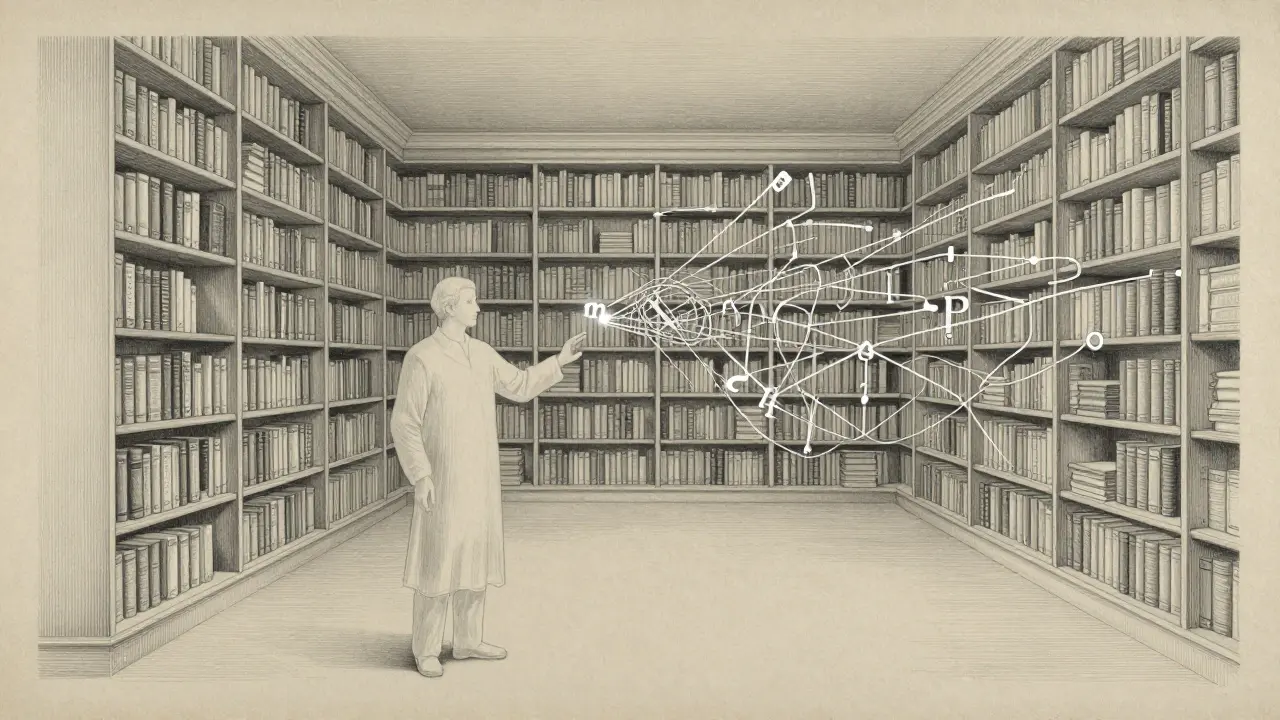
- The FFN acts as a token-wise processing unit that follows the attention mechanism.
- A two-layer structure provides the necessary non-linearity to transform data without crushing computational efficiency.
- FFNs typically account for 60-70% of a model's total parameters, acting as the primary "knowledge store."
- While three layers can improve performance, the two-layer setup is the industry standard for stability and hardware compatibility.
The Engine Under the Hood: What is an FFN?
In the world of Transformer architecture is a deep learning design that relies on self-attention to process sequential data in parallel ], the FFN is a position-wise neural network. This means it looks at every single token in your sentence independently. After the Multi-Head Attention (MHA) phase-where the model figures out that "it" in a sentence refers to "the robot"-the FFN takes over to refine that representation. Technically, this isn't just one big pile of math. It is a sequence of two linear transformations with a non-linear "trigger" in the middle. Most modern models use a GELU (Gaussian Error Linear Unit) or ReLU activation function. Without this middle step, the two layers would just collapse into a single linear operation, and the model would lose its ability to learn complex patterns. It would be like trying to paint a masterpiece using only a straight edge; you can make lines, but you can't make curves.Why Two Layers? The Magic of Expansion and Contraction
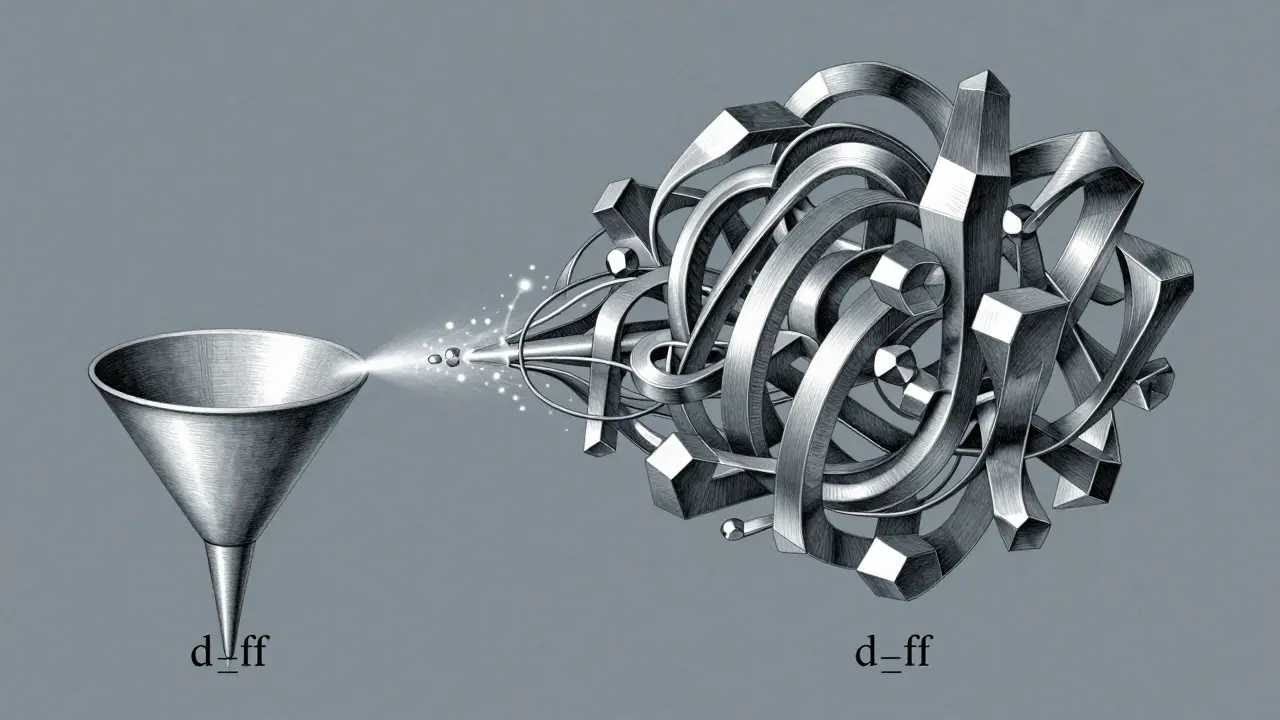
If one layer is too simple and ten layers are too slow, why did the industry settle on two? The secret lies in the "expand-and-contract" strategy. First, the model projects the token representation from a smaller dimension (d_model) to a much larger one (d_ff), typically four times the original size. For example, in a model where d_model is 1024, the FFN bumps this up to 4096. This expansion gives the model a massive "workspace" to analyze the token's features in high detail. Then, the second layer projects it back down to the original size so it can be passed to the next transformer block. This specific two-step dance creates a balance between representational power and speed. According to research from the University of Washington, FFN computations take up roughly 50-60% of the total inference time. If we added more layers, the latency would spike, making the AI feel sluggish. If we used only one layer, we'd lose the non-linear transformation entirely, leading to a significant drop in reasoning capabilities.| Configuration | Performance (Cross-Entropy Loss) | Training Speed | Best Use Case |
|---|---|---|---|
| Single-Layer | High (~3.09) | Fastest | Simple translation tasks |
| Two-Layer (Standard) | Moderate (~2.92) | Balanced | General LLMs (GPT-3, Llama) |
| Three-Layer | Lowest (~2.85) | Slower (per block) | High-accuracy reasoning |
The Parameters Game: Where Knowledge Lives
One of the most surprising facts about Large Language Models is that the "intelligence" isn't evenly spread. In many setups, the FFN contains about 68% of the total parameters. In a model like GPT-3, the FFN is essentially a massive lookup table. While the attention mechanism handles the *grammar* and *context*, the FFN stores the *facts*. When you ask an LLM about the capital of France, the attention mechanism links the words "capital" and "France," but the FFN is where the association between those concepts and the word "Paris" is actually stored. This is why reducing the FFN size often leads to "hallucinations" or a loss of factual accuracy. You aren't just making the model smaller; you are effectively deleting pages from its encyclopedia.Pushing the Limits: Can We Do Better Than Two Layers?
Recent research suggests we might be hitting a ceiling with the two-layer standard. A 2025 study (arXiv:2505.06633v1) found that three-layer FFNs actually outperform the standard setup if you keep the total parameter count the same. By using fewer transformer blocks overall but making each FFN deeper (three layers instead of two), they saw a 2.4% improvement in language modeling performance and an 18% reduction in total training time. However, this isn't a free lunch. Developers on Hugging Face have reported that moving to three layers often causes training instability. In some cases, you have to drop your learning rate by about 15% just to keep the model from crashing. This is why most companies stick to two layers; it is the "safe" engineering choice. It works on almost every hardware configuration and rarely causes the gradients to explode during training.
Practical Challenges and Modern Optimizations
Running these massive FFNs is expensive. For a high-end model, the FFN component alone can generate hundreds of millions of floating-point operations (FLOPs) per token. This creates a massive memory bottleneck, especially during training where FFN layers can eat up 40-50GB of VRAM. To fight this, we are seeing a shift toward more efficient implementations. Meta introduced FlashFFN with Llama 3, which cuts memory usage by 35% without changing the actual math of the two-layer structure. We are also seeing the rise of Mixture of Experts (MoE), where the model doesn't use one giant FFN, but instead has a collection of smaller "expert" FFNs. It only activates the few that are relevant to the current token, drastically reducing the computational cost while keeping the parameter count high.Choosing the Right Path: Trade-offs for Developers
If you are building your own model or fine-tuning an existing one, you have to decide if the standard two-layer FFN is enough. For most tasks, the answer is yes. The two-layer setup is the industry sweet spot because it balances non-linearity with stability. But if you are targeting specific, high-reasoning tasks and have the compute budget to handle longer training cycles, experimenting with a three-layer depth might be worth it. Just remember to adjust your gradient clipping thresholds-usually between 0.8 and 1.0-to prevent the instability that often plagues deeper networks. If you're working on a device with limited RAM, look into MoE or FlashFFN implementations rather than just cutting the layer count, as a single-layer FFN often degrades performance on complex reasoning tasks by over 5%.Why can't we just use one layer in the FFN?
A single linear layer cannot introduce non-linearity. Without a non-linear activation function (like GELU) between two layers, the network cannot learn complex, non-linear relationships in data. This leads to a significant drop in the model's ability to perform complex reasoning and factual recall.
Does adding more FFN layers always improve the model?
Not necessarily. While three layers can improve performance (as seen in recent arXiv studies), it increases memory requirements and can lead to training instability. The two-layer design is generally preferred for its reliability and balance of speed and power.
What is the relationship between d_model and d_ff?
In most standard transformers, d_ff (the hidden layer dimension) is set to 4 times the d_model. This expansion allows the model to project the token into a higher-dimensional space to extract more complex features before compressing it back down.
How do Feedforward Networks differ from Attention mechanisms?
Attention is about context-it determines how tokens in a sequence relate to one another. Feedforward Networks are about processing-they operate on each token individually to transform its representation based on the knowledge stored in the model's weights.
Is the FFN the most expensive part of a Transformer?
In terms of parameters, yes; it often accounts for 60-70% of the model. In terms of inference time, it accounts for about 50-60% of the total computation, making it a primary target for optimization efforts like FlashFFN.


