When you tell an AI to "build me a dashboard that feels calm and professional," it can spit out working code in minutes. But what happens when that code ends up in production? That’s where most teams crash. Vibe coding isn’t magic-it’s a tool, and like any tool, it needs rules. Without them, you’re not building software. You’re building a time bomb.
What Vibe Coding Really Means
Vibe coding is when you describe not just what software should do, but how it should feel. "Make this login flow feel secure," "keep the API responses snappy and polite," "this analytics page should feel like a calm dashboard, not a data dump." The AI takes those cues-alongside functional specs-and generates code that matches both the task and the tone.
This isn’t science fiction. It’s happening right now in teams using GitHub Copilot 4.3, Amazon CodeWhisperer 2.1, and Synaptic Labs’ AI collaboration platform. Developers report 4.3 times faster initial prototyping. One team built a full production app with 186 tasks and 94% test coverage using only vibe-based prompts, according to Drew Maring’s November 2024 case study.
But here’s the catch: 73% of unstructured vibe-coded systems develop strong coupling. 37 critical security vulnerabilities per 1,000 lines of code show up in unchecked AI output, as Codecentric found in March 2025. The AI doesn’t care about maintainability. It doesn’t know what loose coupling means. It just tries to make the prompt work.
The Five Non-Negotiable Architectural Principles
If you’re using vibe coding in production, you need a fixed set of architectural rules. These aren’t suggestions. They’re guardrails. Five principles keep AI-generated code from turning into spaghetti.
- Composition over inheritance: Instead of building hierarchies, combine behaviors from small, reusable interfaces. Synaptic Labs’ May 2025 reference implementation showed 87% of object behaviors built from just 12 capability interfaces. No deep inheritance trees. No fragile base classes.
- Strict dependency injection: Never new up dependencies inside a class. Pass them in through the constructor. vFunction’s January 2025 analysis found this cut coupling by 63%. AI agents default to hardcoding dependencies. You have to force them out of it.
- Tell, don’t ask: Don’t check an object’s state to decide what to do. Tell it what to do. This cuts conditional logic by 41% in refactored code. AI loves if-statements. You need to train it out of that habit.
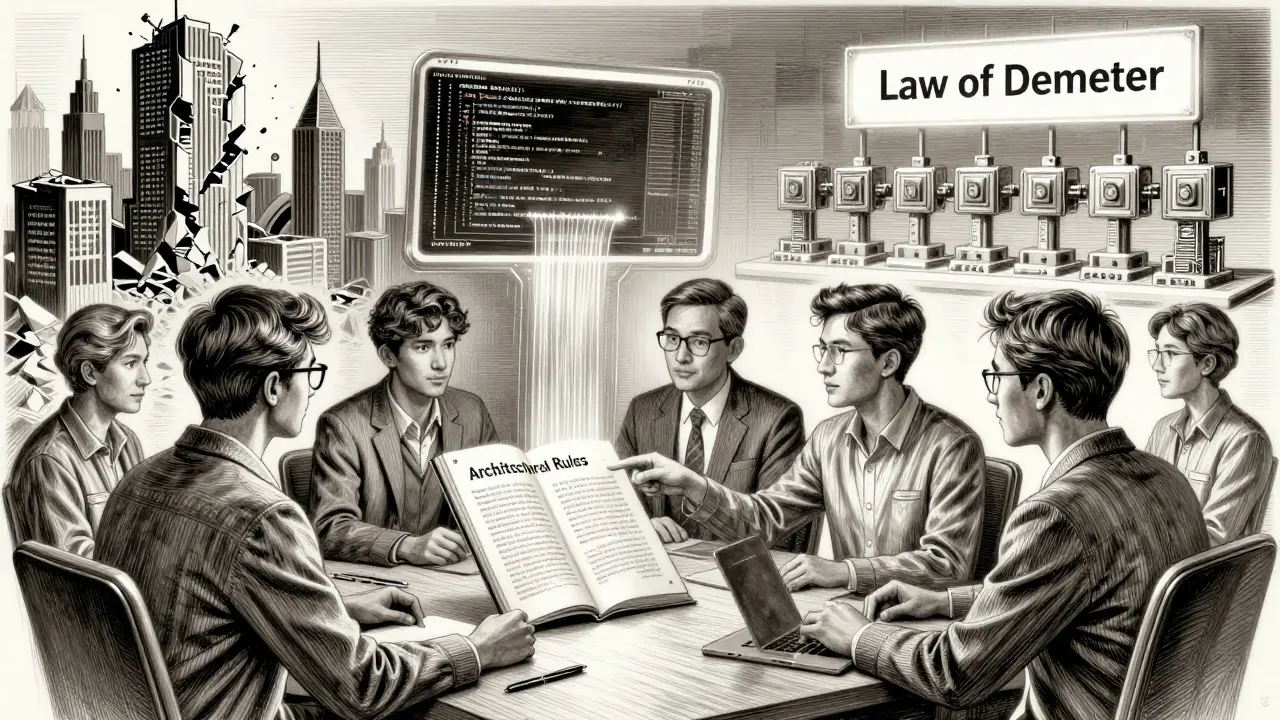
- Law of Demeter compliance: Don’t chain method calls like
user.profile.settings.theme.color. Flatten it. Use service interfaces. Compliant systems reduced method chain length from 4.7 to 1.2. AI writes chains because it’s easy. You have to make it hard. - AI-friendly design patterns: Every component must follow the same rules: REST endpoints (create, update, delete, get, list), 4 standardized error types, predictable dependency graphs. Synaptic Labs’ June 2025 benchmark showed this raised AI extension success from 58% to 92%.
These aren’t theoretical. They’re proven. Teams that enforced them reduced technical debt by 68% and increased test coverage to 94%, per Codecentric’s analysis of 12 production systems.
The Reference Architecture: Four Core Components
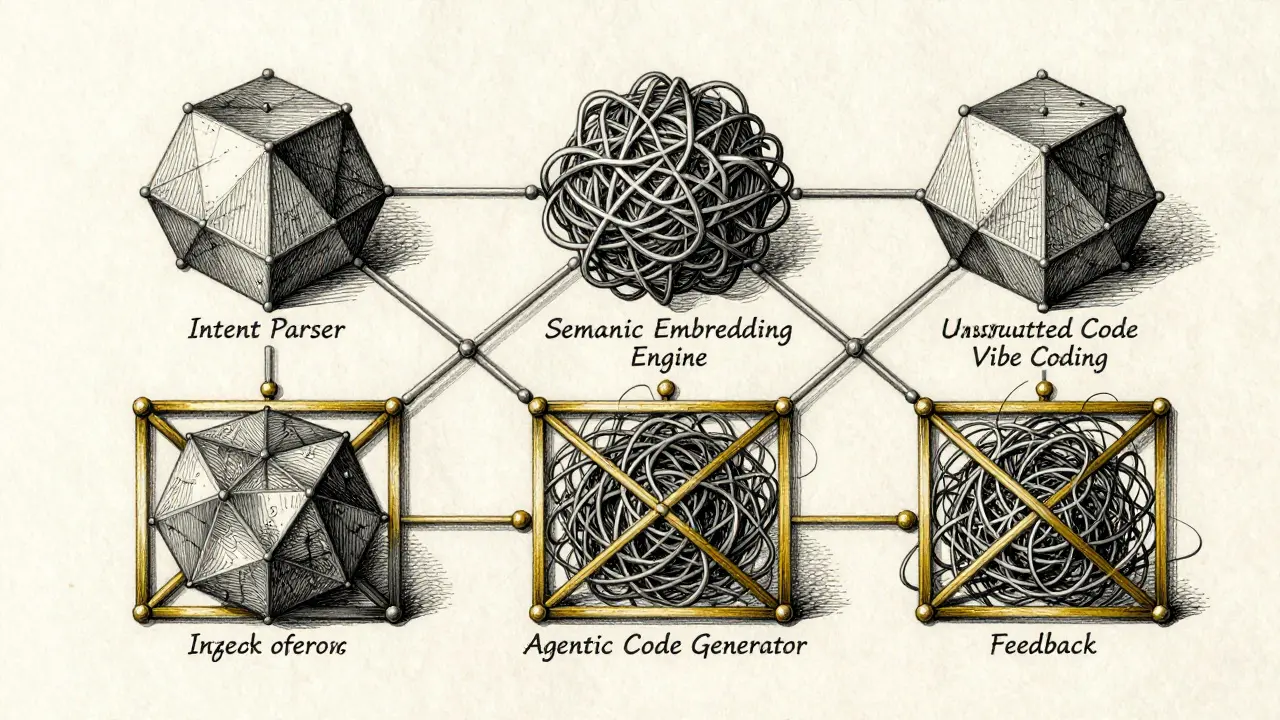
The arXiv:2510.17842 paper from October 2025 laid out the first formal reference architecture for vibe-coded systems. It’s not a tool. It’s a blueprint. Four components work together:
- Intent Parser: Takes natural language like "I need a payment flow that feels fast and trustworthy" and turns it into structured inputs: payment processing, PCI compliance, retry logic, success message tone.
- Semantic Embedding Engine: Understands the "vibe"-what "trustworthy" means in code. Does it mean encryption? Audit logs? Clear error messages? This engine maps emotional language to technical requirements.
- Agentic Code Generator: Produces the actual code, but only within the constraints set by the first two components. It doesn’t guess. It follows the rules.
- Feedback Loop: After deployment, it monitors for drift. If the AI starts ignoring the Law of Demeter, or adds new error types, it flags it. This is where governance happens.
Teams using this architecture saw 3.2x higher maintainability scores than those without, according to vFunction’s February 2025 study of 58 enterprise codebases.
Structured vs. Unstructured: The Divide
There are two kinds of vibe coding teams. The ones that survive. And the ones that burn out.
Unstructured teams treat vibe coding like a chatbot. They prompt, get code, deploy. No rules. No reviews. Codecentric’s March 2025 analysis of one such system-a SaaS platform-found:
- 47% of modules violated the single responsibility principle
- 21% of the codebase was unused fragments
- Folder structure deviated from Node.js best practices by 63%
- 37 critical security flaws
Structured teams use what’s called a constitutional approach. Inspired by Drew Maring’s November 2024 Substack article, they write down 4-8 non-negotiable rules before writing a single line of code. Examples:
- "All API responses must include a request ID and timestamp. No exceptions."
- "No direct database access from controllers. Always go through a service layer."
- "Security requirements must be specified at the architecture level before implementation."
Maring’s team spent 112 hours writing their constitution before generating any production code. It paid off: 112 potential vulnerabilities were blocked before they were written. Their team spent 73% fewer hours fixing architectural issues later.
How to Start: A 3-Phase Onboarding
You don’t need a team of 20 architects to do this right. You need clarity and discipline.
Follow this three-phase process, as recommended by Synaptic Labs’ May 2025 guide:
- Establish your architectural constitution (4-8 hours for small teams). Write down your 4-8 rules. Make them specific. No fluff. "Use only 4 error types" not "be consistent."
- Create reference implementations (12-24 hours). Build one example of each core pattern: a clean service layer, a composed component, a well-structured REST endpoint. Put them in a shared repo. Use them as templates.
- Implement validation pipelines (8-16 hours). Use tools like vFunction or custom linters to scan every AI-generated commit. Reject code that violates your constitution. Automate enforcement.
Teams that followed this process reduced debugging time by 76%, according to a Reddit user who switched from unstructured to structured vibe coding in April 2025.
Who’s Doing It Right-and Who’s Falling Behind
Adoption is split by culture, not tech.
Startups and innovation labs (68% adoption rate) love vibe coding for speed. But 82% of them skip governance. They’ll burn out in 18 months. Gartner predicts 90% of these systems will need full rewrites within three years.
Regulated industries-healthcare, finance, government-are moving slower. But they’re doing it right. 82% require formal architecture reviews before deploying AI-generated code. 41 of the Fortune 100 adopted constitutional approaches by Q3 2025, per Forrester’s August 2025 report.
Why? Because the EU’s June 2025 AI Act now requires "architectural transparency documentation" for AI-generated systems in critical sectors. You can’t just say "it works." You have to prove it was built right.
The Future Is Governed
The IEEE P2874 standard is currently in draft as of December 2025. It will require:
- Minimum 85% adherence to separation of concerns
- Maximum 0.35 fan-out (coupling threshold)
- Automated security validation protocols
This isn’t coming. It’s here. Teams that treat vibe coding as a shortcut will be left behind. Those that treat it as a high-speed engine with a steering wheel and brakes will thrive.
The data is clear: vibe-coded systems without architectural standards accumulate 4.7x more technical debt per month than traditional code. With governance, they achieve 38% lower total cost of ownership in the first 18 months.
AI won’t fix bad architecture. It’ll amplify it. Your job isn’t to write better prompts. It’s to build better systems. And that starts with rules.
What is vibe coding?
Vibe coding is an AI-native programming approach where developers describe both the functional requirements and the desired emotional or stylistic tone (the "vibe") of software-like "secure," "calm," or "snappy." An AI agent then generates code that matches both the task and the tone, using natural language prompts instead of traditional syntax-heavy coding.
Why do vibe-coded systems fail?
Most vibe-coded systems fail because AI agents optimize for functionality, not architecture. They generate code that works today but ignores maintainability, security, and modularity. Without explicit rules, they create strong coupling, unused code, security holes, and tangled dependencies-problems that only surface during scaling or maintenance.
What are the five key architectural principles for vibe coding?
The five principles are: 1) Composition over inheritance-build behaviors from reusable interfaces, not deep hierarchies; 2) Strict dependency injection-pass dependencies in, don’t create them inside; 3) Tell, don’t ask-command objects instead of checking their state; 4) Law of Demeter compliance-flatten method chains into clean service calls; and 5) AI-friendly design-use consistent patterns for APIs, errors, and dependencies.
How do you enforce architectural standards in vibe coding?
Use a constitutional approach: write down 4-8 non-negotiable rules before coding begins. Then build reference implementations as templates and automate validation with linters or tools like vFunction. Reject any AI-generated code that violates your rules. This prevents drift and keeps the system clean.
Is vibe coding safe for regulated industries?
Yes-if you govern it. Regulated industries like healthcare and finance require formal architecture reviews before deploying AI-generated code. With constitutional guidelines and automated validation, vibe coding can meet compliance standards. The EU’s 2025 AI Act even requires architectural transparency documentation, pushing more organizations toward structured approaches.
What tools support architectural governance for vibe coding?
GitHub Copilot and CodeWhisperer handle basic code generation, but don’t enforce architecture. For governance, use Synaptic Labs’ AI collaboration framework for reference patterns, or vFunction for post-generation architectural validation and observability. Both help enforce rules like coupling thresholds and separation of concerns.
How long does it take to set up a vibe coding system properly?
A small team can set up a governed vibe coding system in 24-48 hours: 4-8 hours to write the constitution, 12-24 hours to build reference implementations, and 8-16 hours to automate validation. Drew Maring’s team spent 112 hours upfront but saved 73% in remediation time later.
What Comes Next
The next 12 months will decide whether vibe coding becomes a standard tool or a cautionary tale. Teams that treat it like a shortcut will drown in tech debt. Those that treat it like a high-performance engine with a safety harness will lead.
The tools are here. The patterns are proven. The standards are being written. The only thing missing is discipline.


