
Governance Committees for Generative AI are cross-functional teams that oversee ethical development and deployment of AI systems. Governance Committees for Generative AI are structured teams that ensure AI aligns with regulations, ethics, and business goals. They became critical as tools like ChatGPT spread rapidly. Without them, companies face serious compliance and security risks. According to Privacera’s 2023 analysis, these committees reduce implementation risks by up to 63% while speeding up time-to-value by 41%. Today, 78% of Fortune 500 companies have them, driven by regulations like the EU AI Act and rising public scrutiny.
Why Governance Committees for Generative AI Are Non-Negotiable Now
Generative AI tools like ChatGPT or Midjourney can create text, images, or code in seconds. But without oversight, they might leak sensitive data, spread biased content, or violate laws. For example, a retail company using AI for customer service once accidentally shared customer credit card details. Governance committees prevent this by setting clear rules before deployment. They act as a safety net, ensuring AI stays within ethical and legal boundaries. The U.S. Executive Order 14110 and EU AI Act now legally require such oversight for high-risk applications. Skipping this step isn’t just risky-it’s illegal.
Core Roles and Responsibilities Using RACI
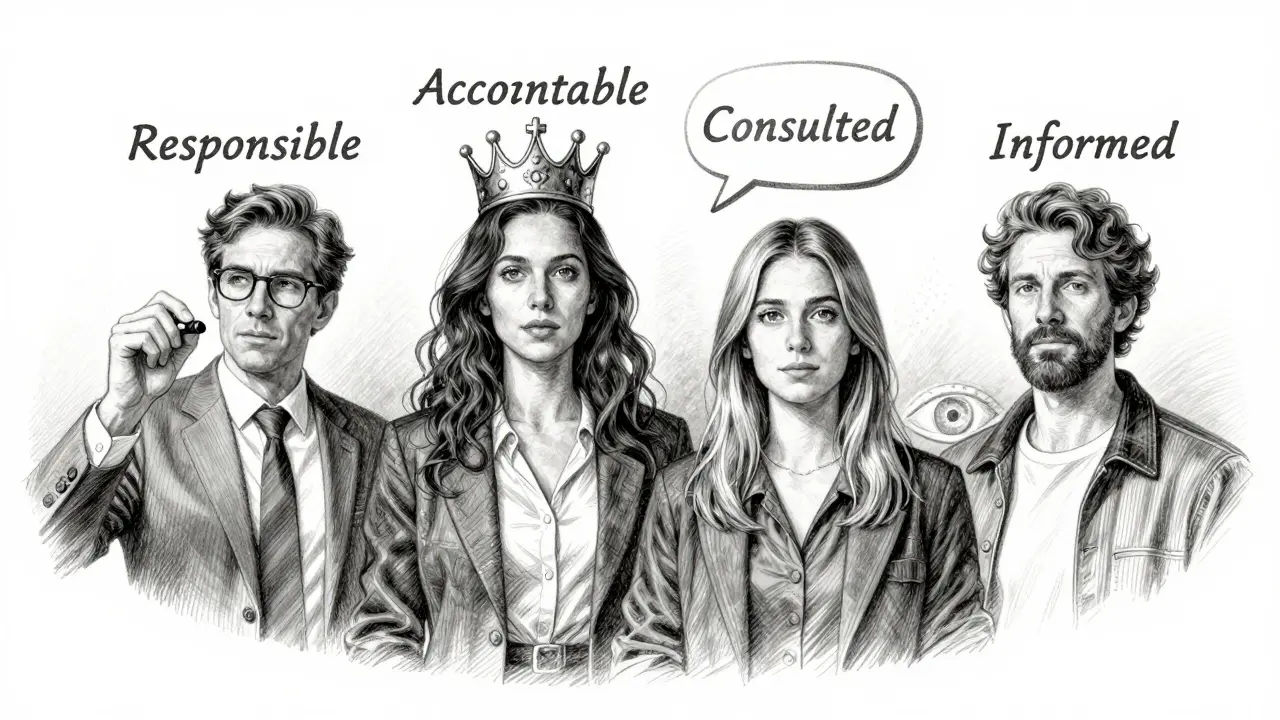
The RACI framework is a project management tool that defines roles as Responsible, Accountable, Consulted, and Informed is essential for clear governance. Here’s how it works for generative AI:
| Role | Responsible | Accountable | Consulted | Informed |
|---|---|---|---|---|
| Legal Compliance | Legal Team | Legal Team | Privacy Officer | Business Units |
| Data Privacy | Privacy Officer | Privacy Officer | Security Team | Executive Leadership |
| Technical Oversight | AI Engineers | CTO | Product Managers | Compliance Team |
| Ethics Review | Ethics Committee | Chief Ethics Officer | Legal Team | Marketing Department |
For example, when deploying a new chatbot, the Legal Team is Responsible for checking compliance with data laws. The Chief Ethics Officer is Accountable for final ethical approval. The Security Team is Consulted on vulnerabilities, while Marketing is Informed of the decision. This prevents confusion and ensures every step has clear ownership.
Meeting Cadence: When Committees Should Meet
Meeting schedules must balance speed and thoroughness. OneTrust is a governance platform that provides risk management tools for AI recommends tiered cadence:
- Executive Committee (Quarterly): Reviews high-level strategy, policy updates, and risk metrics. For instance, IBM’s AI Ethics Council meets every three months to evaluate new products against ethical principles.
- Operational Working Group (Bi-weekly): Handles specific use cases like approving a customer service AI tool. They use electronic voting for urgent decisions within 72 hours.
- Ad-hoc Reviews: For high-risk applications (e.g., healthcare AI), meetings happen immediately after deployment.
Without this structure, approvals can drag on for months or skip critical checks. JPMorgan Chase’s committee reviews 287 use cases yearly with only 12 rejections-thanks to clear meeting schedules and defined workflows.
Choosing the Right Governance Model for Your Organization
Not all committees work the same. Three models dominate:
| Model Type | Adoption Rate | Pros | Cons |
|---|---|---|---|
| Centralized | 42% | 92% fewer regulatory incidents; clear accountability | 30% more executive time required |
| Federated | 38% | 44% faster deployments; balances control and flexibility | Requires strong coordination between subcommittees |
| Decentralized | 20% | 68% higher efficiency for low-risk apps | 57% higher compliance violations |
Centralized models (like IBM’s) work best for highly regulated industries. Federated models (used by Microsoft) suit large enterprises with multiple departments. Decentralized models only fit low-risk uses like internal tools. A financial services company using a decentralized model saw 57% more compliance issues-proving this model fails for high-stakes applications.
Implementing Your Committee: Practical Steps and Pitfalls
Setting up a committee takes 8-12 weeks. Start with stakeholder mapping: include Legal, Privacy, Security, and business leaders. Draft a charter defining authority and decision rules. Train members-non-technical staff need 20-25 hours to understand AI risks. Common mistakes include:
- Skipping technical expertise: A Microsoft Azure engineer reported a committee rejected a $1.2M marketing tool because they didn’t understand fine-tuning vs. prompt engineering.
- Ignoring risk tiering: Clear risk levels (e.g., high/medium/low) cut approval time from 45 days to 12.
- Not integrating with existing workflows: Committees that link to HR or IT systems see 79% higher success rates.
Successful implementations, like The ODP Corporation’s, found 14 compliance gaps in customer service tools within six months by involving the Chief Audit Executive. Always build escalation paths and update policies quarterly.
Real-World Success Stories and Lessons Learned
JPMorgan Chase’s committee approved 275 out of 287 AI use cases in 2024-just 12 rejections. Their secret? Standardized workflows for risk tiering and privacy reviews. The EU AI Act requires similar rigor for high-risk systems. Meanwhile, healthcare organizations formed the Healthcare AI Governance Alliance in March 2025 to standardize committee practices across the sector. These examples show that governance isn’t about slowing innovation-it’s about making it sustainable.
Frequently Asked Questions
How often should governance committees meet?
Executive committees meet quarterly to review strategy and policy. Operational groups meet bi-weekly for specific use cases. Urgent decisions use electronic voting within 72 hours. For example, IBM’s council reviews new products every three months, while JPMorgan’s team handles daily requests through structured workflows.
Who should be on a generative AI governance committee?
Include Legal, Privacy, Security, Ethics, Product Management, and Executive Leadership. Technical experts like AI engineers are critical for understanding model risks. The Chief Audit Executive (CAE) ensures compliance with financial regulations. Without diverse expertise, committees miss blind spots-like rejecting a marketing tool due to technical misunderstandings.
What’s the difference between centralized and federated governance?
Centralized models have one enterprise-wide committee with full approval authority (used by 42% of companies). Federated models combine a central body with business-unit subcommittees (38% adoption). Centralized works best for strict industries like finance, while federated suits large companies needing flexibility. Microsoft uses federated governance to speed deployments by 44% while maintaining compliance.
How does RACI apply to AI governance roles?
RACI defines who does what: Responsible (does the task), Accountable (final decision), Consulted (provides input), Informed (notified of outcomes). For example, the Legal Team is Responsible for compliance checks, while the Chief Ethics Officer is Accountable for final approval. Privacy officers are Consulted on data issues, and business units are Informed of decisions. This prevents overlap and delays.
What are common pitfalls when setting up these committees?
The biggest mistakes include lacking technical expertise (leading to costly rejections), not tiering risks (causing slow approvals), and ignoring existing workflows. Committees that don’t integrate with HR or IT systems see 79% lower success rates. Also, 61% of organizations report approval delays exceeding 30 days without standardized processes. Always build clear escalation paths and update policies quarterly.