Have you ever wondered how an AI writes a poem, answers a question, or even writes an email that sounds like it came from a real person? It’s not magic. It’s math. Specifically, it’s probabilities.
Large Language Models (LLMs) don’t "know" things the way humans do. They don’t understand meaning, context, or intent in the way you or I do. Instead, they’re incredibly sophisticated pattern detectors. They look at what words usually come after other words - billions of times - and then use those patterns to guess what comes next. That’s it. And the way they make those guesses? Through probability distributions.
What Does "Probability" Mean in an LLM?
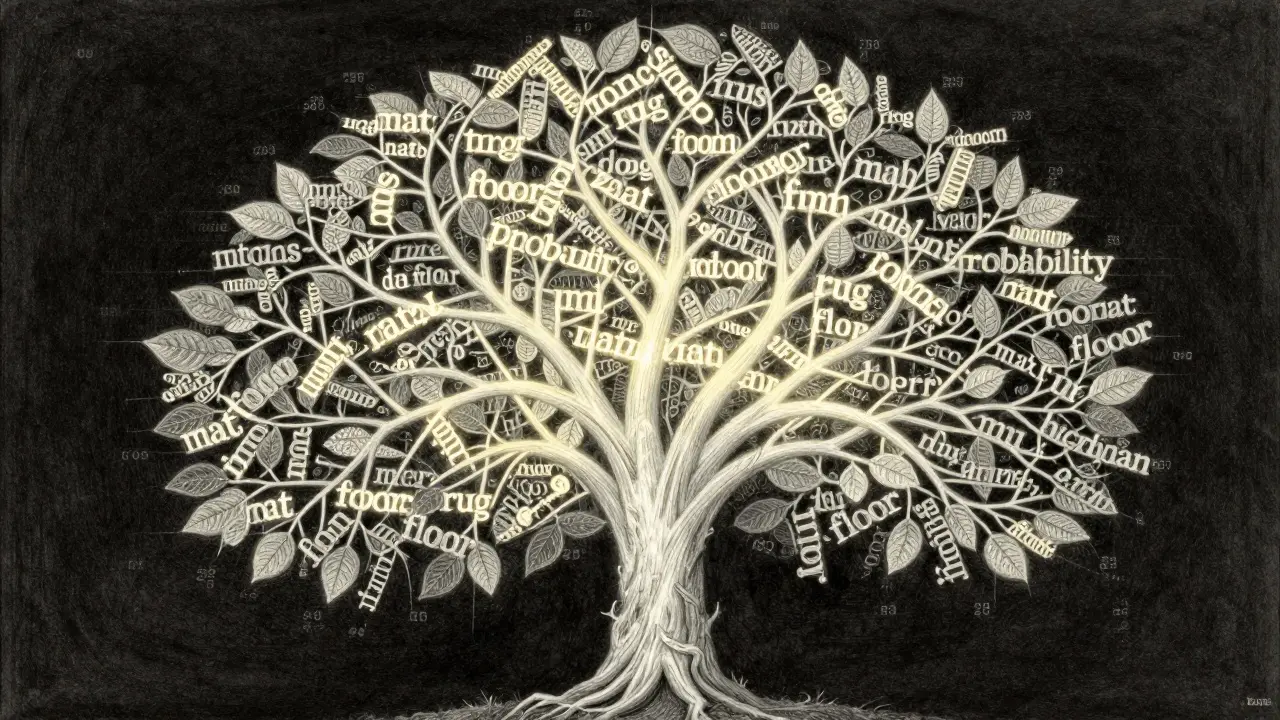
Think of an LLM as a supercharged autocomplete. You type "The cat sat on the," and your phone suggests "mat." But an LLM doesn’t just look at the last word. It looks at the whole sentence - maybe hundreds of words before it - and calculates: "Given everything I’ve seen so far, what’s the most likely next word?"
This isn’t random. It’s based on what the model learned during training. If it saw "The cat sat on the" followed by "mat" 12,000 times, and "rug" 800 times, and "floor" 300 times, it assigns probabilities: mat (85%), rug (10%), floor (3%). Then it picks one - not always the highest, but usually.
The math behind this uses something called softmax. The model spits out raw scores - called logits - for every possible word in its vocabulary (which can be over 100,000 words). Softmax turns those scores into probabilities that add up to 100%. So even if "mat" has the highest score, "rug" still has a shot. That’s where creativity (and sometimes weirdness) comes in.
How Do LLMs Actually Pick the Next Word?
There are several ways models choose from those probabilities. The simplest is called greedy decoding. It just picks the word with the highest probability every time. Sounds smart, right? But it often leads to boring, repetitive text. Imagine a story where every sentence ends the same way. That’s greedy decoding.
Then there’s random sampling. Here, the model rolls a virtual dice based on the probabilities. Even if "mat" is 85% likely, there’s still a 15% chance it picks something else - maybe "sofa" or "window." This creates more variety, but sometimes it’s too wild.
Most modern models use smarter tricks. One popular method is top-k sampling. It ignores all words except the top 40 or 50 most likely ones. Then it randomly picks from just those. This balances creativity and coherence. Another is top-p (or nucleus sampling). Instead of picking a fixed number of words, it picks the smallest group of words whose combined probability adds up to, say, 90%. So if the top 3 words make up 92% of the probability, it only considers those. If the distribution is spread out - say, 15 words each have 6% chance - it picks from all 15. This adapts to the situation.
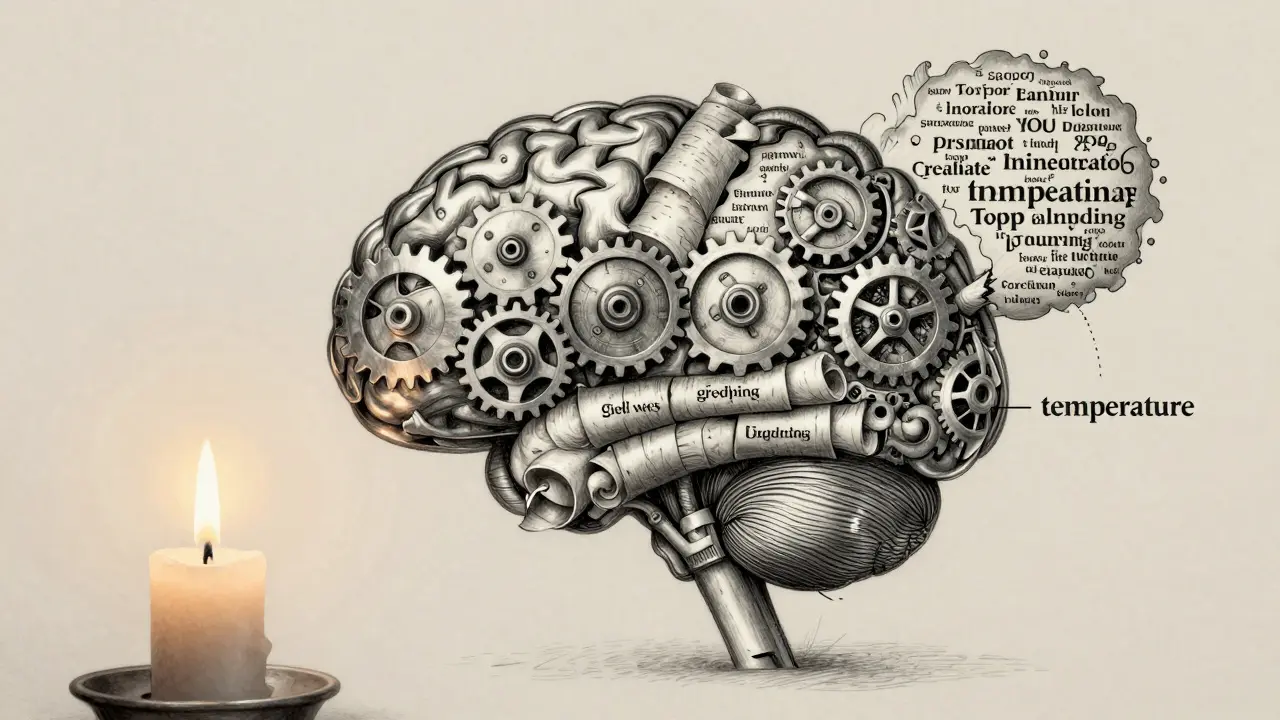
Temperature is another knob you can turn. Low temperature (like 0.2) makes the model more confident - it picks the top choices almost always. High temperature (like 1.0) flattens the probabilities, making less likely words more competitive. Think of temperature like creativity: low = precise, high = wild.

Why Does Context Matter So Much?
Older language models only looked at the last 3 or 5 words. That’s why they’d write things like: "I love dogs. Dogs are great. Dogs bark."
Modern LLMs use something called self-attention. It lets them see the whole context - all 128,000 tokens (words or parts of words) at once. So if you write: "I bought a new laptop. The battery life is terrible. I returned it because," the model doesn’t just see "because." It remembers the whole story: you bought something, it failed, and now you’re explaining why.
This lets it pick "I returned it because the battery life was terrible" instead of just "I returned it because it was broken." It connects distant ideas. That’s why today’s models feel more human.
But They Still Get Things Wrong - Why?
Here’s the catch: LLMs don’t know truth. They know patterns. If the training data had a lot of articles saying "The capital of Australia is Sydney," the model will confidently say that - even though it’s wrong. It’s not lying. It’s just following the most probable path.
Studies show LLMs generate factually incorrect statements 18.3% more often than correct ones in knowledge-heavy tasks. Why? Because false but common phrases appear more often in training data than rare truths. A medical fact mentioned once in a textbook? The model might never learn it. A myth repeated on 10,000 blogs? It’ll sound right.
Another problem? Bias in word choices. Some models show a 23.7% preference for option "A" in multiple-choice questions - even when "A" is wrong. Why? Because in training data, "A" was often the correct answer. The model learned a pattern, not logic.
And then there’s repetition. If you ask an LLM to write a 1,000-word essay, it often loops back to the same phrases. This happens in over 22% of long generations. The fix? Add a "repetition penalty" - a tweak that lowers the probability of words that were just used.
How Do Real-World Apps Use This?
Companies aren’t just using LLMs blindly. They tune these probabilities for specific jobs.
Customer service chatbots? They use low temperature (0.3) and top-p=0.85. Why? To stick to facts, avoid surprises, and sound reliable. No one wants a chatbot saying, "I think maybe the refund is $47.23?"
Storytelling or poetry tools? They crank temperature up to 0.8 and top-p to 0.95. Now the model takes risks. It might invent a new metaphor. It might surprise you. That’s the goal.
Code generation? It’s somewhere in the middle. Top-k=40, temperature=0.6. You want accuracy, but also flexibility - maybe a different way to write a loop.
Hugging Face, the main platform for developers, reports that 72% of users tweak temperature and top-p settings within their first hour of use. That’s how important these settings are.
What’s Next?
The field is moving fast. Google’s new "Adaptive Probability Thresholding" adjusts top-p on the fly - if the text gets fuzzy, it narrows the choices. OpenAI’s upcoming GPT-5 will automatically switch decoding strategies depending on whether you’re writing a poem or debugging code.
And some researchers are blending probability with logic. IBM’s Neuro-Symbolic AI, released in early 2025, checks LLM guesses against real-world knowledge graphs. If the model says "Paris is the capital of Japan," it checks a database, says "no," and corrects itself. This cuts factual errors by nearly 38%.
But here’s the truth: no matter how advanced it gets, LLMs still rely on probability. They don’t reason. They predict. They don’t understand. They calculate.
And for now, that’s enough. Because if you can predict the next word with 90% accuracy across millions of sentences - you can write like a human.
Do large language models understand what they’re saying?
No. LLMs don’t understand meaning, context, or intent. They predict the next word based on patterns they’ve seen in training data. They’re excellent at mimicking human language, but they don’t have beliefs, knowledge, or consciousness. What feels like understanding is just high-probability word sequencing.
Why do LLMs sometimes make up facts?
LLMs generate text based on statistical likelihood, not truth. If a false statement appears frequently in training data - like "The capital of Australia is Sydney" - the model learns to associate it with high probability. It doesn’t know it’s wrong. It just knows it’s common. This is called "hallucination," and it happens because the model prioritizes fluency over accuracy.
What’s the difference between top-k and top-p sampling?
Top-k sampling picks from the top K most likely words, no matter how different their probabilities are. Top-p (nucleus) sampling picks from the smallest group of words whose combined probability adds up to a threshold (like 90%). Top-p adapts: if one word is clearly the best, it picks only a few. If many words are equally likely, it picks more. Top-k is fixed; top-p is dynamic.
Can I control how creative an LLM’s responses are?
Yes, through temperature and sampling settings. Lower temperature (0.2-0.5) makes responses more predictable and focused. Higher temperature (0.7-1.0) makes them more varied and surprising. Combine that with top-p=0.9 for balanced creativity, and you can fine-tune output for anything from legal documents to poetry.
Why do LLMs repeat themselves in long texts?
Repetition happens because the model loses track of context over long sequences. Even with large context windows, probability distributions become less reliable after 50% of the window. Adding a repetition penalty (like 1.2) reduces the chance of reusing recent words. Most developers use this fix - it cuts repetition by over 60% in long-form generation.
Are there any real-world limits to how well LLMs predict words?
Yes. LLMs struggle with rare or technical terms - like medical jargon or obscure legal phrases - because they appear too infrequently in training data. Stanford’s 2025 report found a 41.2% error rate in predicting such terms. They also struggle with logic-heavy tasks: GPT-4 scores only 42.7% on math word problems, while humans and symbolic systems score above 90%. Probability works well for language, not for reasoning.
Understanding how LLMs choose words isn’t about mastering AI. It’s about understanding human language - and how machines learn to copy it. The next time an AI writes something that feels real, remember: it’s not thinking. It’s just guessing - very, very well.


