Imagine asking an AI to interpret a complex medical coding guideline or flag a suspicious financial transaction. A generic large language model might give you a confident answer, but it could also hallucinate facts, ignore critical regulatory nuances, or fail to cite the specific law that matters. In high-stakes sectors like healthcare, finance, and legal services, that margin of error is unacceptable. This is where domain-specific RAG (Retrieval-Augmented Generation) steps in.
Unlike general-purpose AI models trained on the broad internet, domain-specific RAG systems are engineered to pull answers strictly from verified, industry-specific knowledge bases. They don't just guess; they retrieve evidence, ground their responses in fact, and provide audit trails. For organizations operating under strict frameworks like HIPAA, GDPR, or SOX, this isn't just a tech upgrade-it's a compliance necessity.
The Core Problem with Generic AI in Regulated Sectors
General-purpose LLMs are impressive conversationalists, but they are terrible compliance officers. They were trained on public data, which means they lack access to proprietary internal policies, recent regulatory updates, or sensitive patient records. More importantly, they are designed to be creative, not precise. In a regulated environment, creativity leads to liability.
Consider the UK Government’s AI Insights report from 2025, which highlighted that general-purpose models often struggle to provide reliable answers in specialized fields like law or medicine due to limited exposure to expert knowledge. When a bank uses a generic model for Anti-Money Laundering (AML) checks, the model might miss subtle patterns defined in the latest FATF recommendations because those documents weren't part of its training set-or worse, it might invent a rule that sounds plausible but doesn't exist.
Domain-specific RAG solves this by decoupling knowledge from reasoning. The model handles the language processing, but the 'knowledge' comes from a curated, up-to-date database you control. If the regulation changes tomorrow, you update the database, not the model. This separation ensures accuracy, reduces hallucinations, and keeps your system aligned with current laws.
Anatomy of a Domain-Specific RAG System
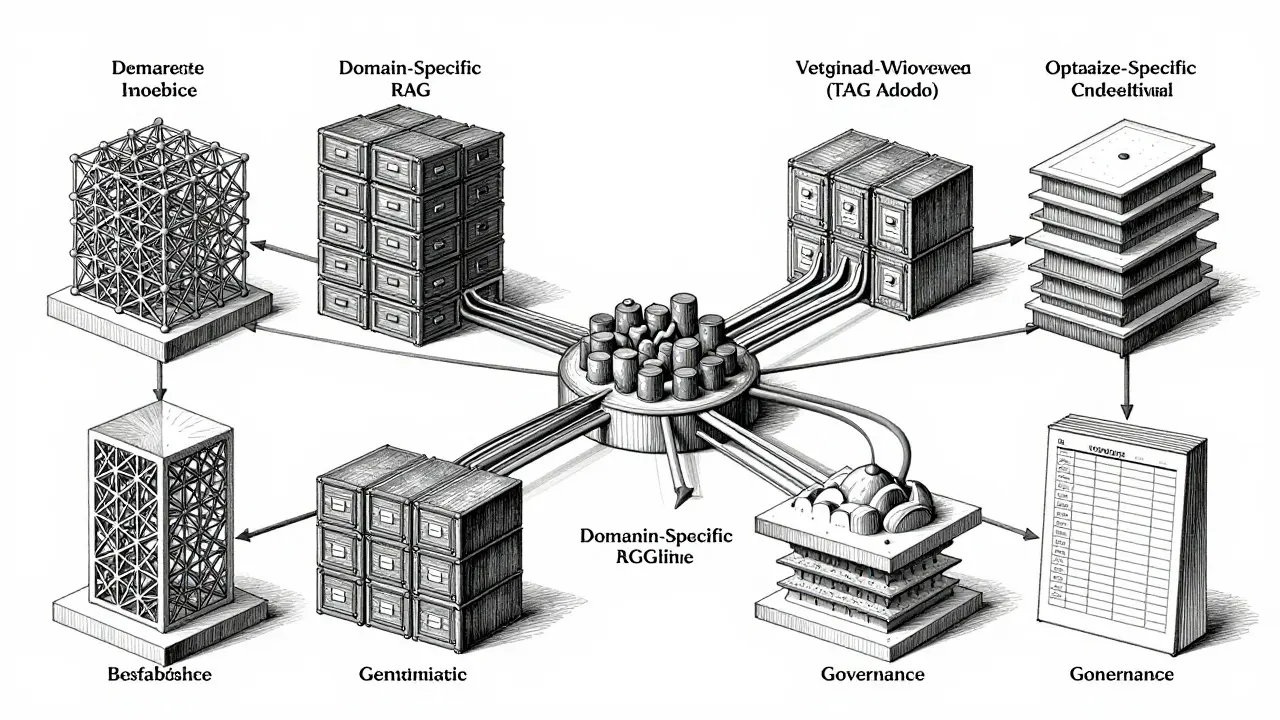
Building a compliant RAG system isn't just about plugging a chatbot into a PDF reader. It requires a robust architecture with five core components working in harmony. According to recent technical specifications, these include:
- Specialized Embedding Models: These convert text into numerical vectors. Unlike generic embeddings, these are fine-tuned on industry corpora (e.g., medical journals or legal statutes) to understand domain-specific semantics. Research indicates this is the pivotal component for retrieval accuracy.
- Vetted Knowledge Bases: Populated with verified regulatory documents, internal policies, and historical case data. Quality here is paramount-garbage in, garbage out.
- Optimized Retrieval Mechanisms: Algorithms that search the knowledge base using domain-aware queries, ensuring relevant chunks of information are pulled back.
- Constrained Generation Layers: The LLM layer is restricted by compliance rules, preventing it from deviating from the retrieved context.
- Governance Frameworks: Systems that enable full audit trails, logging every query, retrieved document, and generated response for regulatory scrutiny.
The embedding model deserves special attention. As noted in arXiv research from 2025, the quality of the embedding directly influences generation quality. If your embeddings can't distinguish between 'negligence' in a tort case versus 'negligence' in a contract dispute, your retrieval will fail. Successful implementations typically use custom embeddings trained on at least 50,000 industry documents to capture these nuances.
Performance Benchmarks: Why RAG Beats Fine-Tuning
You might wonder why companies choose RAG over simply fine-tuning a large language model on regulatory texts. While fine-tuning adjusts the model's weights to better understand a topic, it doesn't easily allow for updating knowledge without retraining. RAG offers dynamic access to new information.
| Metric | Domain-Specific RAG | Fine-Tuned LLM | Traditional Rule-Based |
|---|---|---|---|
| Regulatory Interpretation Accuracy | 31% higher than fine-tuned LLMs | Baseline | N/A |
| Computational Resources | 63% less than fine-tuned LLMs | High | Low |
| False Positive Rate | 47% lower than rule-based | Variable | Baseline |
| Query Processing Speed | 8.3x faster than rule-based | Fast | Slow |
| Audit Trail Capability | Native & Detailed | Limited | Basic |
Data from the UK Government’s AI Insights report (2025) confirms that RAG systems show significantly better accuracy in regulatory interpretation tasks while requiring far fewer computational resources for deployment. Additionally, Leanware’s 2025 guide notes that while RAG adds 250-350ms of latency due to the retrieval step, it achieves 38-42% higher precision in regulatory queries compared to generic LLMs. That trade-off is worth it when the cost of an error is millions in fines.
Real-World Applications: Healthcare and Finance
The theory is solid, but how does it perform in practice? Let’s look at two major sectors driving adoption.
Healthcare: Dr. Elena Rodriguez, Chief AI Officer at Mayo Clinic, reported in 2025 that RAG-enabled systems reduced medical coding errors by 58%. Crucially, these systems maintained full audit trails required by CMS (Centers for Medicare & Medicaid Services). Generic LLMs cannot provide this level of traceability. However, implementation isn't smooth sailing. Binariks’ 2025 case studies show that while 92% of clinical staff are satisfied with diagnostic support apps, 41% of nurses initially resisted due to a 23-hour average training requirement. The complexity of integrating with Electronic Health Records (EHR) systems remains a hurdle.
Finance: In the financial sector, speed and compliance are king. A senior compliance officer at JPMorgan Chase shared on Reddit (r/AIFinance, November 2025) that their RAG system cut AML investigation time from 45 minutes to 7 minutes per case while maintaining 100% audit trail compliance. However, this success came after 14 months of domain-specific tuning. The system had to learn the subtle distinctions in transaction patterns defined by local and international banking laws.

Implementation Challenges and Pitfalls
Don’t let the benchmarks fool you into thinking this is a plug-and-play solution. Implementing domain-specific RAG is hard. Here are the most common traps:
- Document Segmentation Errors: Reported in 53% of initial deployments, cutting documents incorrectly can break context. A legal paragraph split mid-sentence loses its meaning.
- Entity Resolution Failures: Occurring in 37% of cases, the system may fail to link 'Apple Inc.' in one document to 'AAPL' in another, leading to fragmented knowledge.
- Outdated Regulation Handling: 29% of issues stem from the system retrieving superseded laws. Your knowledge base must have rigorous version control.
- Integration Complexity: Cited in 63% of negative G2 reviews, connecting RAG to legacy compliance systems is technically demanding. 78% of financial institutions deploy within VPC environments to meet security standards, adding infrastructure overhead.
Professor Michael Chen of MIT’s AI Lab warns against over-reliance on automation. He points to a 2024 SEC enforcement action against a fintech company that used improperly parsed regulation text. "Over-reliance on RAG without human-in-the-loop verification creates single-point failure risks," Chen states. Even with Amazon Bedrock Guardrails achieving up to 99% verification accuracy, that remaining 1% error rate can be catastrophic in high-stakes decisions.
The Road Ahead: Governance and Standardization
As we move through 2026, the market for domain-specific RAG is exploding, reaching $2.8 billion in 2025 with a projected jump to $8.7 billion by 2028. But growth brings scrutiny. Regulatory bodies are catching up. The EU AI Act mandates "traceable decision-making" for high-risk applications, and the SEC now demands "explainable AI outputs" for investment advice.
Technology providers are responding. Microsoft’s January 2026 update to Azure AI Studio introduced "Compliance Chain Tracking," automatically generating audit documentation for 17 major regulatory frameworks. Amazon released "Regulatory Knowledge Graphs" in late 2025, reducing hallucinations by 32% in FDA-regulated environments by integrating ontology-free knowledge representation.
However, a warning from the UK Financial Conduct Authority in 2025 suggests caution: without international harmonization of AI validation standards, we risk creating "compliance silos." Companies building global operations must ensure their RAG systems can handle cross-jurisdictional conflicts-a area where current systems still struggle, with error rates as high as 37% in multinational tax scenarios.
What is the difference between RAG and fine-tuning?
Fine-tuning adjusts the internal weights of a model to change its behavior or style, but it bakes knowledge into the model, making it hard to update. RAG (Retrieval-Augmented Generation) keeps the model static and retrieves external, up-to-date information at runtime. This makes RAG more accurate for factual, regulated domains where data changes frequently.
Is domain-specific RAG secure enough for healthcare data?
Yes, if implemented correctly. Most healthcare RAG systems are deployed within HIPAA-compliant environments with end-to-end encryption meeting NIST SP 800-53 controls. The key is ensuring that patient data never leaves the secure knowledge base and that the retrieval process logs all access for audit purposes.
How long does it take to implement a domain-specific RAG system?
Technical teams typically need 8-12 weeks to master deployment. However, full integration in complex sectors like healthcare can take longer due to stricter data handling requirements. Expect significant time spent on tuning embeddings and validating retrieval accuracy before going live.
What are the biggest risks of using RAG in regulated industries?
The primary risks include retrieving outdated regulations, segmentation errors breaking context, and hallucinations if the retrieval fails to find relevant info. Additionally, relying solely on AI without human oversight can lead to compliance failures if source documents contain ambiguities.
Do I need custom embeddings for my RAG system?
For regulated industries, yes. Generic embeddings often miss industry-specific nuances. Successful implementations use custom embeddings trained on thousands of domain-specific documents to ensure high precision in retrieval, which directly impacts the accuracy of the final answer.