Imagine your users asking a question and staring at a spinning wheel for four seconds. In the world of Large Language Models (LLMs), that pause is an eternity. For customer support bots or voice assistants, it’s enough to make them hang up. This is the core problem with Retrieval-Augmented Generation (RAG) in production: it adds friction. You are fetching data from external sources just to help the AI answer correctly, but that fetch time kills the conversation flow.
We aren't talking about theoretical delays here. According to Adaline Labs' 2024 analysis, standard RAG pipelines add between 200 and 500 milliseconds just for embedding and vector search operations. When you stack on the LLM generation time, complex queries often take 2 to 5 seconds to return a full answer. If you want real-time interaction-especially for voice applications-you need total latency under 1.5 seconds. That is a tight window. But with the right architecture choices, you can shrink those response times dramatically without sacrificing accuracy.
The Hidden Cost of Traditional RAG
To fix latency, you first have to understand where it hides. Most teams start with a "traditional" RAG setup. The logic is simple: user asks a question, system retrieves documents, system sends everything to the LLM. It works, but it’s inefficient. Every single query triggers a retrieval step, even if the question is something trivial like "What is your name?" or "Hello."
This blind retrieval adds consistent overhead. Adaline Labs documented this in July 2025, showing that traditional RAG adds 200-500ms regardless of whether the retrieved context was actually needed. Furthermore, production pipelines rarely hit just one database. They often query vector databases for semantic search, keyword indexes for exact matches, and sometimes relational databases for structured data. Each network round trip costs you 20 to 50 milliseconds. If you’re hitting three different stores per request, you’ve already lost 150ms before the AI has even started thinking.
There is also the issue of "hidden latency" in context assembly. Adaline Labs found that assembling the final prompt-merging retrieved chunks with the user's query-adds another 100 to 300 milliseconds. This step accounts for 15-25% of total latency in many systems. Engineers often overlook this because they focus heavily on the vector search speed, missing the bottleneck right next door.
Switching to Agentic RAG Architecture
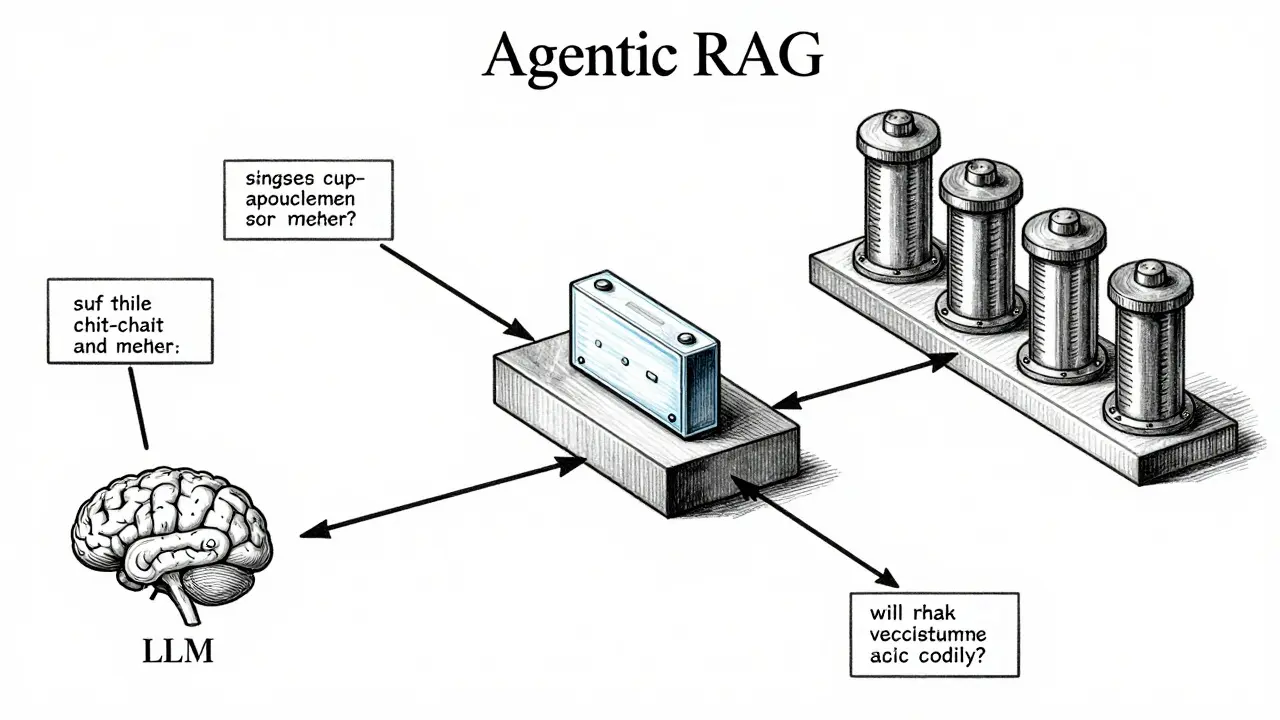
The most impactful change you can make is shifting from a passive pipeline to an active decision-maker. This is called Agentic RAG, which is an architecture that classifies user intent before deciding whether to retrieve external data. Instead of blindly searching for every input, the agent analyzes the query first. Is this a factual question requiring knowledge base lookup? Or is it a chit-chat message that the LLM can handle alone?
The results are striking. Adaline’s production benchmarks showed that Agentic RAG reduces average latency by 35%, dropping response times from 2.5 seconds to 1.6 seconds. More importantly, it cuts costs by 40%. Why? Because the system skips unnecessary retrievals for 35-40% of queries. Gartner predicted in August 2025 that by 2026, 70% of enterprise RAG implementations would adopt this intent classification strategy. It’s no longer optional if you care about speed and budget.
Implementing this requires a lightweight classifier model sitting at the entry point of your pipeline. This model routes queries: simple ones go straight to the LLM; complex ones trigger the retrieval chain. It adds a tiny bit of processing time upfront but saves massive amounts of downstream waiting. Think of it as a triage nurse in a hospital-not every patient needs surgery immediately.
Optimizing Vector Search Performance
If retrieval is necessary, how fast you find the relevant documents matters immensely. Your choice of vector database and indexing strategy defines the baseline speed of your semantic search. Not all vector databases are created equal when it comes to raw latency.
| Database | Avg Query Latency | Recall Rate | Cost Model |
|---|---|---|---|
| Qdrant | 45ms | 95% | Self-hosted ($1,200-$2,500/mo infra) |
| Pinecone | 65ms | 95% | SaaS ($0.25 per 1k queries) |
| MongoDB Atlas | ~300ms | Variable | Included in DB tier |
As shown above, open-source solutions like Qdrant can deliver significantly lower latency than managed services like Pinecone, provided you have the infrastructure to host them. However, raw hardware isn't the only factor. The index type you choose plays a huge role. Approximate Nearest Neighbor (ANN) algorithms like HNSW (Hierarchical Navigable Small World) and IVFPQ (Inverted File with Product Quantization) are industry standards for a reason. Qdrant’s 2025 benchmarking data confirms these indexes reduce query latency by 60-70% compared to brute-force search, with only a minimal 2-5% drop in precision.
Dr. Elena Rodriguez from Stanford University noted in May 2025 that the latency-accuracy curve flattens significantly beyond 95% recall. Pushing for 99% recall might double your search time, but users won’t notice the difference in relevance. Aggressive approximate search is economically justified for most production use cases. Don't chase perfect recall if it means slower responses.
Leveraging Streaming and Batching
Even with fast retrieval, the LLM generation phase can feel sluggish. Users hate waiting for the entire paragraph to appear at once. The solution is streaming. By sending tokens to the client as soon as the LLM generates them, you drastically improve the perceived performance. Vonage’s testing showed that streaming responses reduce Time to First Token (TTFT) from 2,000ms down to 200-500ms. For voice apps using Eleven Labs TTS, this brings the time to first audio below 200ms, making conversations feel natural rather than robotic.
Behind the scenes, you should also be batching queries. Nilesh Bhandarwar, a Senior Software Engineer at Microsoft, stated in October 2025 that asynchronous batched inference is non-negotiable for scale. By grouping multiple prompts into a single GPU forward pass, you leverage parallelism to reduce average latency per request by 30-40%. Tools like LangChain v0.3.0 (released October 2025) now have native support for this, making implementation easier than ever.
Connection pooling is another low-hanging fruit. Artech Digital’s monitoring report from December 2024 highlighted that poor connection management can add 50-100ms per request. Implementing proper pooling cuts this overhead by 80-90%. It’s a small configuration change that yields immediate gains.
Monitoring and Debugging Bottlenecks
You cannot optimize what you do not measure. Many teams assume their vector database is slow, only to discover later that the bottleneck was in the API gateway or context assembly. Maria Chen, Chief Architect at Artech Digital, emphasized that distributed tracing using OpenTelemetry is the single most effective monitoring practice. Her team found that implementing tracing identified 70% of latency bottlenecks within 24 hours.
When setting up your observability stack, track these specific metrics:
- Time to First Token (TTFT): Measures how quickly the user sees any output.
- Retrieval Duration: Time spent in vector search and keyword lookup.
- Context Assembly Time: How long it takes to merge chunks into the final prompt.
- LLM Generation Throughput: Tokens per second generated by the model.
Tools like Datadog and New Relic dominate the market, but they come with high costs at scale. For many engineering teams, combining Prometheus with Grafana offers a robust, cost-effective alternative. Remember, inconsistent latency during peak hours is a common complaint. As one engineer noted on HackerNews in November 2025, unoptimized database connections cause unpredictable spikes from 2 to 8 seconds during traffic surges. Load testing your pipeline under realistic conditions is essential before going live.
Balancing Speed and Accuracy
Finally, keep in mind that latency optimization is a trade-off. AWS Solutions Architect David Chen warned at re:Invent 2024 that over-optimizing for speed can degrade quality. Making vector searches 20% faster might sacrifice 8-12% in precision. Your goal shouldn't be the absolute fastest possible response, but the fastest response that still meets your accuracy requirements.
For finance and healthcare sectors, where accuracy is paramount, targeting 95%+ recall is worth the extra milliseconds. For e-commerce or casual chatbots, sub-1.5-second responses matter more than perfect precision. Define your success metrics early. As Forrester indicates, RAG with optimized latency management will remain essential through 2030, but the winners will be those who balance speed and quality intelligently.
What is the acceptable latency for a production RAG system?
For general text-based chatbots, a total response time under 2 seconds is considered good. For voice applications or real-time conversational interfaces, total latency must stay below 1.5 seconds to maintain natural flow. This includes retrieval, context assembly, and LLM generation time.
How does Agentic RAG reduce latency compared to traditional RAG?
Agentic RAG uses an intent classifier to determine if retrieval is necessary. By skipping the retrieval step for simple queries (like greetings or basic facts), it avoids the 200-500ms overhead associated with vector search and context assembly, reducing average latency by up to 35%.
Which vector database offers the lowest latency?
Based on May 2025 benchmarks, self-hosted Qdrant delivers approximately 45ms query latency at 95% recall, outperforming managed solutions like Pinecone (65ms). However, MongoDB Atlas may add ~300ms due to its integrated architecture. The best choice depends on your infrastructure capabilities and budget.
Can streaming really improve user experience in RAG systems?
Yes. Streaming reduces the Time to First Token (TTFT) from around 2,000ms to 200-500ms. While the total generation time remains similar, users perceive the system as faster because they see content appearing immediately, allowing them to start reading while the rest of the answer is being generated.
What tools should I use to monitor RAG pipeline latency?
OpenTelemetry is the standard for distributed tracing across RAG components. For visualization and alerting, Datadog and New Relic are popular commercial options, while Prometheus and Grafana provide powerful open-source alternatives. Key metrics to track include TTFT, retrieval duration, and context assembly time.