
Deploying a large language model isn't just about GPUs and quantization; it's about making sure you don't wake up to a multi-million dollar lawsuit. Many companies jump into open-source LLM licensing and assume "open source" means "do whatever you want." That's a dangerous gamble. Between 2023 and 2025, enterprise adoption of these models jumped from 15% to 45%, but so did the legal headaches. If you misinterpret a license, you're not just looking at a slap on the wrist-legal assessments suggest infringement penalties can range from $500,000 to $5 million.
The Real Cost of License Ignorance
Why bother with open-source models when you can just use an API? For most, it's the money. Switching from a proprietary API to a properly licensed model can save a company over $1 million annually. However, that saving vanishes if you ignore the fine print. A cautionary tale from the developer community involves a startup that used a "research-only" model in a live product, resulting in a $375,000 settlement that nearly bankrupted the company.
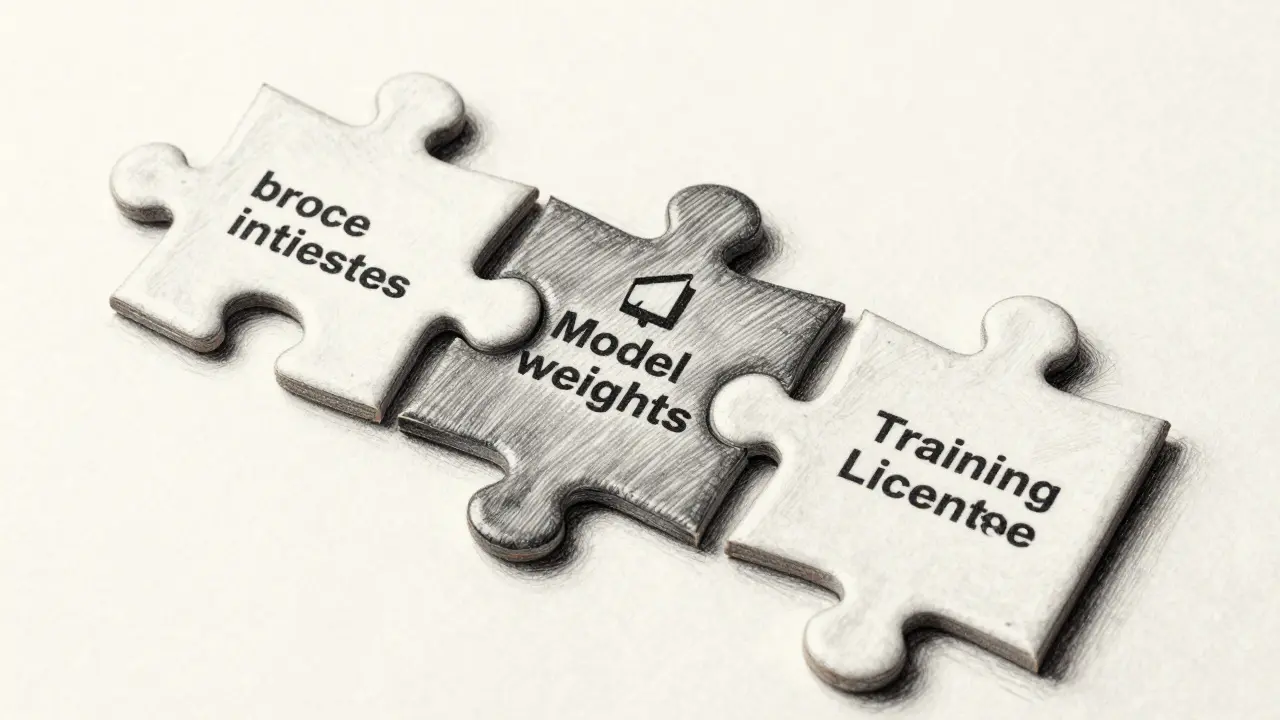
The risk isn't just in the model weights. You have to look at three distinct layers: the model code, the weights, and the training data. Shockingly, about 68% of models have mismatched licenses across these three components. You might find a model with an MIT license for the code, but the weights themselves could be under a restrictive custom agreement. If you don't audit all three, you're leaving your flank open to litigation.
Breaking Down the License Types
Not all open-source licenses are created equal. They generally fall into three buckets, and choosing the wrong one can either be a minor inconvenience or a commercial death sentence.
Permissive Licenses is a category of software licenses that allow the software to be used, modified, and redistributed with very few restrictions. This group includes MIT and Apache 2.0. These are the gold standard for businesses. According to 2025 surveys, 92% of enterprises successfully deploy these commercially because the overhead is tiny-usually just keeping the original copyright notice intact.
Copyleft Licenses is a type of license that requires any derivative work to be released under the same license as the original. The most common example is GPL 3.0. For a business, this is a red flag. If you fine-tune a GPL-licensed model and distribute it, you might be legally obligated to open-source your entire proprietary codebase. Because of this, only about 8% of enterprises use these models commercially.
Then there are the "Weak Copyleft" options, like LGPL or MPL. These are a middle ground; they only force you to open-source the specific parts of the model you modified, not your entire application. While better than full copyleft, they still require more legal scrutiny than a simple Apache 2.0 setup.
| License Type | Commercial Adoption | Legal Review Time | Primary Constraint |
|---|---|---|---|
| Permissive (MIT, Apache 2.0) | ~92% | 2-5 Hours | Basic Attribution |
| Weak Copyleft (LGPL, MPL) | ~34% | 20-40 Hours | Modified Component Disclosure |
| Strong Copyleft (GPL) | ~8% | 40-80 Hours | Full Derivative Disclosure |
The Trap of Custom and Hybrid Licenses
Lately, we've seen a rise in "Open-ish" models. These use custom licenses that look open but have strings attached. A prime example is Meta's Llama 3, which uses the Llama Community License. It allows commercial use, but only until you hit 700 million monthly active users. For a small startup, this is a non-issue. For a global enterprise, it's a hard ceiling that requires a separate commercial contract.
These hybrid models create a fragmented landscape. In fact, custom licenses have jumped from 12% to 34% of all open-source LLMs between 2023 and 2025. This makes automated compliance harder because you can't just rely on a standard checklist; you need a lawyer to read the specific terms of each model. One developer shared a story of receiving a cease-and-desist from Meta after accidentally distributing a fine-tuned Llama 2 model under an MIT license instead of the required custom terms.
Copyright and the "Fair Use" Debate
Even if the license is clean, the data used to train the model might not be. This is the "grey zone" of AI law. Many models were trained on copyrighted books and articles without explicit permission. While some professors argue this is "non-expressive data mining" (essentially fair use), courts aren't all in agreement. There are currently dozens of active lawsuits challenging this.
If you're deploying a model in a high-risk environment, be aware of the EU AI Act. Starting in August 2026, Article 52 will require detailed documentation of training data sources and licensing for high-risk systems. If you can't prove where the data came from or that it was legally sourced, you might be barred from the European market entirely.

Practical Compliance Framework
You don't need a law degree to stay safe, but you do need a process. Following a structured verification flow can reduce your compliance time by up to 35%.
- Component Audit: List every piece of the puzzle. Is the code MIT? Are the weights Apache? Is the training dataset public domain or proprietary?
- Obligation Mapping: Determine exactly what the license asks for. Do you need to provide a copy of the license in your "About" menu? Do you need to disclose changes to the model architecture?
- Attribution Implementation: This is where most people fail. Over 50% of license violations are simply due to missing attributions in the final product, especially in mobile apps.
- CI/CD Integration: Use automated tools like FOSSA or Mend.io to scan for license changes in your pipeline so a rogue update doesn't introduce GPL code into your project.
- Quarterly Reviews: Licenses change and new case law emerges. Set a calendar reminder to review your model stack every three months.
Avoiding Common Pitfalls
One of the most frequent mistakes is the "AI tool leak." Developers using tools like GitHub Copilot have occasionally found GPL-licensed code being suggested and inserted into MIT-licensed projects. If that code is critical to your model's function, you've just contaminated your project with copyleft requirements.
Another common error is ignoring the output. While most licenses focus on the model itself, some users struggle with how to attribute the actual text generated by the AI. While there is no industry standard yet, the safest bet is to maintain a clear record of which model version produced which output, especially for commercial content creation.
Does "Open Source" always mean I can use it for business?
No. Many models use "research-only" or "non-commercial" licenses. Even "open weight" models like Llama 3 have user limits (e.g., 700 million monthly active users) before requiring a paid agreement. Always check for a "Commercial Use" clause.
What is the safest license for a corporate deployment?
Apache 2.0 and MIT are the safest. They allow you to modify and sell the software without forcing you to open-source your own proprietary code. Apache 2.0 is slightly better for large companies because it includes an explicit patent grant.
What happens if I violate a GPL license in my LLM?
The most severe outcome is a "copyleft trigger," where you may be legally required to release your entire proprietary software source code to the public. You could also face significant financial penalties and cease-and-desist orders.
Do I need to worry about the training data if the model license is permissive?
Yes. The model license covers the software/weights, but the training data might be subject to separate copyright claims. This is a major area of ongoing litigation, and regulations like the EU AI Act are beginning to mandate transparency about data sources.
How do I implement attribution for a model embedded in an app?
The best practice is to include a "Legal Notices" or "Open Source Licenses" section in your app's settings or about menu, listing each model and its corresponding license text and copyright notice.


