
AI Coding as a Service Is Now a Federal Procurement Reality
Five years ago, the idea of a government agency buying AI tools to write code was science fiction. Today, it’s standard practice. Since August 2025, the General Services Administration (GSA) has officially added OpenAI, Google, and Anthropic to its Multiple Award Schedule, making it easier than ever for federal agencies to contract AI coding services. This isn’t just about speeding up software development-it’s about fixing broken processes. Federal teams used to spend weeks drafting contract clauses, debugging legacy code, and manually checking compliance. Now, AI tools generate those clauses in minutes, fix bugs before they reach production, and flag regulatory gaps before a contract even goes out the door.
What Exactly Is AI Coding as a Service?
AI Coding as a Service (AI CaaS) means using cloud-based tools that write, review, and optimize code for you. Think GitHub Copilot, but built for government. These tools don’t just suggest lines of code-they understand context. If you’re writing a system to process tax returns or manage veterans’ benefits, the AI adapts to the rules, standards, and security layers that apply. Unlike consumer tools that run on your laptop, government AI CaaS runs in FedRAMP Moderate environments, encrypts every line of code, and can’t train on your agency’s data without written permission. It’s not magic. It’s a secure, auditable, and measurable service.
How Government Contracts Differ from Commercial Ones
Commercial AI coding tools like GitHub Copilot charge $10 per user per month. Amazon CodeWhisperer runs at $8.40. Simple. But government contracts? They’re not about subscriptions. They’re about outcomes. Agencies don’t buy licenses-they buy performance. A typical federal AI CaaS contract includes:
- Minimum 92% code accuracy verified by third-party testing
- Maximum 2.5-second response time for 95% of requests
- 99.85% uptime-with a 0.5% penalty for every 0.1% below that
- Quarterly penetration testing by certified labs
- Integration with Code.gov, GitHub Enterprise, and GitLab
And here’s the kicker: vendors can’t just say they meet these standards. They have to prove it. The GSA’s AI Vendor Assessment Toolkit requires vendors to generate code across 10 government-relevant languages and hit that 92% accuracy mark under real-world conditions. No fluff. No demos. Real results.
SLAs Are the New Contract Language
Forget vague promises like “best effort.” Government SLAs are strict, measurable, and enforceable. If the AI tool takes longer than 2.5 seconds to generate a function, you get a credit. If it drops below 99.85% uptime, you get paid. If it generates code that violates NIST AI Risk Management Framework standards, you can terminate the contract. These aren’t theoretical clauses. The Department of Defense’s CDAO has already used SLA penalties to force vendors to improve their models. One vendor lost $1.2 million in quarterly payments after their tool misapplied FISMA compliance rules in 18% of outputs during a pilot.
SLAs also cover support. Vendors must provide 24/7 technical help with a 15-minute response time for critical issues. Their staff must hold Security+ and AI-900 certifications. This isn’t a help desk in India-it’s certified U.S.-based personnel trained on federal coding standards.

What Agencies Are Actually Using It For
AI CaaS isn’t just for writing new apps. It’s being used to fix old ones. The IRS uses it to scan 30-year-old tax processing scripts and auto-generate updated versions that comply with current IRS coding standards. The Department of Veterans Affairs cut contract drafting time from 40 hours to 6 hours using AI to auto-populate FAR clauses. HHS uses AI to monitor contracts in real time, flagging deviations before they become violations. Even NASA, known for its strict software assurance rules, now uses AI to check code against NASA-STD-8739.8-though early versions failed 38% of tests until they were fine-tuned with real mission code.
Successful implementations share one trait: they start small. No agency is replacing all coders with AI. They’re using it for repetitive, rule-based tasks: generating documentation, checking compliance, refactoring legacy COBOL, or writing unit tests. The human team still reviews everything. But now they’re reviewing better code, faster.
Why Some AI CaaS Projects Fail
Not every pilot works. The Government Accountability Office found that 43% of early AI CaaS deployments hit integration walls. Why? Because agencies tried to plug AI tools into 20-year-old contract management systems that weren’t built for APIs. Others trained the AI on generic code, not government-specific patterns. One agency’s AI kept suggesting code that worked in Python but ignored the mandatory input validation rules in federal financial systems. It took three months of retraining with real IRS code to fix it.
Another common failure? Ignoring intellectual property. The Congressional Budget Office warns that AI-generated code ownership is still legally murky. If the AI writes a function using your agency’s data, who owns it? The vendor? The agency? The open-source library it learned from? Contracts now include explicit clauses: “All AI-generated code derived from government data is government property.” Vendors who don’t agree don’t get the contract.
Market Trends and What’s Coming Next
The federal AI CaaS market hit $3.2 billion in FY2025 and is growing at 16% a year. The DoD leads adoption at 68% of software contracts. HHS and IRS aren’t far behind. But the biggest shift is coming from the GSA’s “OneGov” strategy. By 2027, 78% of agencies plan to buy AI CaaS through GSA channels instead of managing dozens of individual contracts. That means standardization. It also means less room for vendors who can’t meet the baseline.
What’s next? By Q2 2026, the GSA will release standardized SLA templates for AI CaaS. By Q4 2026, all vendors must pass mandatory bias testing-checking if their AI generates different code for different user roles or agencies. And by FY2027, the GSA expects $5.8 billion in AI CaaS contracts. That’s not speculation. It’s based on current adoption curves and the DoD’s new pilot to embed AI directly into contract review workflows.
How to Get Started
If you’re a contracting officer or IT lead in a federal agency, here’s how to begin:
- Review the GSA’s AI Contracting Playbook (updated November 30, 2025)
- Complete the AI Vendor Assessment Toolkit-vendors must pass this to be eligible
- Identify one high-volume, low-risk task to pilot: contract drafting, code documentation, or compliance checks
- Require vendors to demonstrate accuracy on your agency’s specific coding standards
- Build SLAs around uptime, accuracy, and response time-not features
- Train your team. The average learning curve is 8.2 weeks. Don’t skip this.
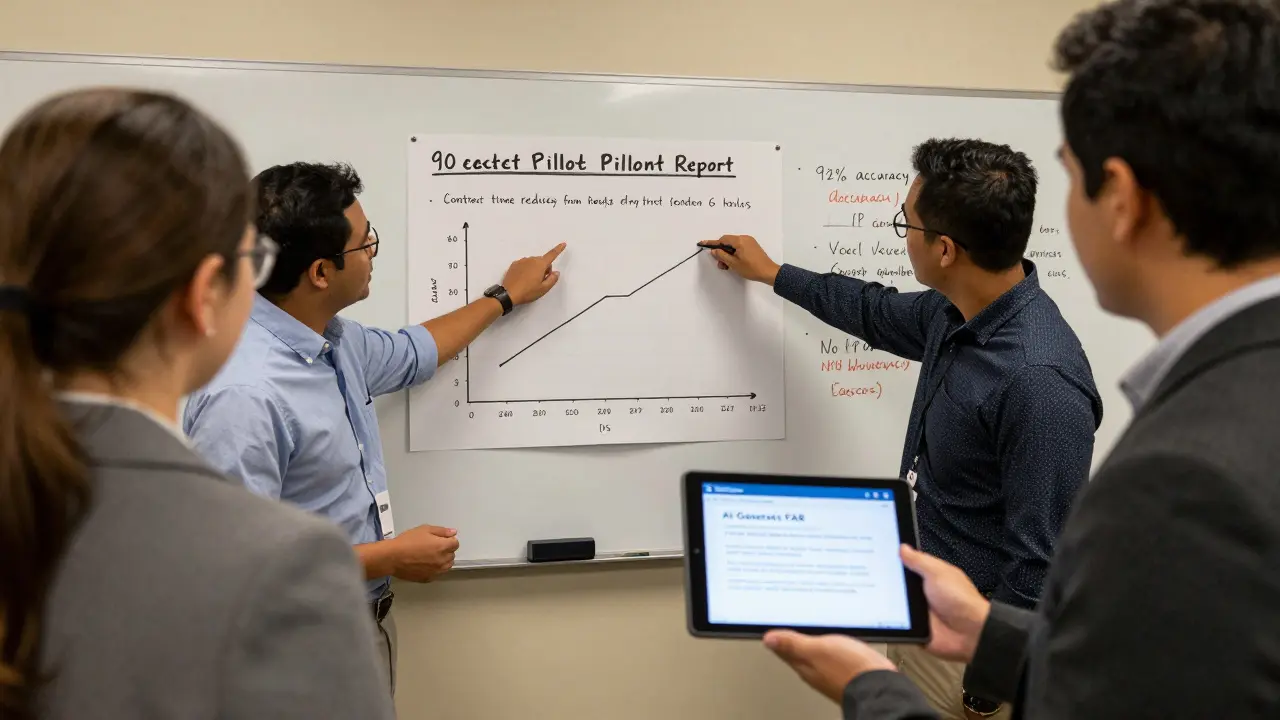
Start with a 90-day pilot. Measure time saved. Measure errors caught. Measure compliance improvements. If the numbers look good, scale it. If not, walk away. The goal isn’t to use AI-it’s to use it well.
Who’s Winning and Who’s Falling Behind
Booz Allen Hamilton leads with 22% market share, thanks to deep ties with DoD and GSA. Anthropic holds 15% by focusing on safety and transparency. But the real winners? Small businesses. They hold 31% of contracts through teaming arrangements with larger firms. Why? Because they’re faster. They build for one use case-like automating FISMA documentation-and do it better than giants trying to sell a full suite.
Vendors who think compliance is enough are losing. The Partnership for Public Service says contractors who only check boxes are getting outpaced by those who show real results: “Here’s how we cut your contract review time from six hours to six minutes.” That’s the new standard.
Final Reality Check
AI CaaS isn’t replacing human coders. It’s replacing the tedious, repetitive parts of their jobs. It’s not going to write a secure missile guidance system on its own. But it can write the 500 lines of boilerplate code that used to take a week-so the human team can focus on the hard problems.
The real risk isn’t AI failing. It’s agencies buying the wrong tool, skipping training, or ignoring SLAs. The ones succeeding are the ones treating AI like a contractor-not a magic wand. They set clear goals. They measure everything. They hold vendors accountable. And they never stop learning.


