
Scientists are no longer just reading papers-they’re asking AI to read them, connect ideas, and even design experiments. Scientific Large Language Models (Sci-LLMs) are changing how research gets done. These aren’t your average chatbots. They’re specialized AI systems trained on decades of scientific literature, chemical structures, genetic sequences, and lab protocols. Their job? To cut through the noise and help researchers move faster-without replacing them.
What Sci-LLMs Actually Do
Most people think of LLMs as tools for writing emails or answering trivia. But Sci-LLMs are built for something harder: understanding the language of science. They can parse SMILES notation for molecules, interpret graphs from microscopy images, and extract data from tables in PDFs that would take a human hours to clean up. A 2023 study found these models reduce literature review time by 63%. That’s not a small win-it’s the difference between spending a week searching and having a clear path in a single afternoon.
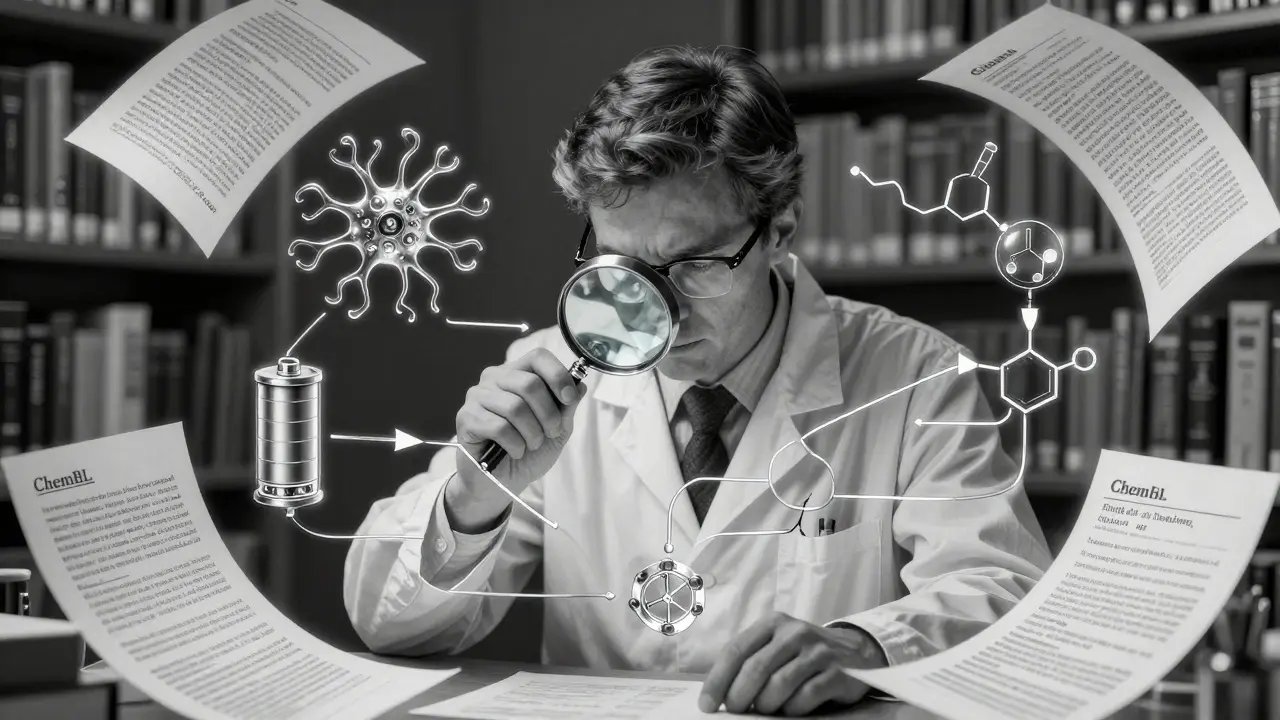
Take a chemist trying to find a new catalyst for a Suzuki coupling. Instead of scanning 50 papers manually, they type in: "What are the most effective palladium catalysts for aryl-aryl coupling under mild conditions?" The model pulls relevant studies from PubMed and ChemBL, summarizes key findings, and even flags conflicting results. It doesn’t just answer-it connects dots across fields. One researcher at Stanford used this to link a forgotten 2019 paper on nickel catalysts to a recent clinical trial on anti-inflammatory drugs, leading to a new hypothesis that later became a patent.
How They’re Built
Sci-LLMs aren’t just GPT-4 with a lab coat. They’re engineered differently. Models like Google’s CURIE and MIT’s KG-CoI use specialized tokenizers that understand DNA base pairs, crystallographic data, and chemical reaction arrows. Their attention mechanisms handle sequences up to 32,768 tokens-far longer than standard models. This lets them read entire papers in one go instead of chunking them into fragments.
They also plug into real scientific databases. When you ask about drug interactions, the model doesn’t guess from training data. It pulls live entries from PubChem or ClinicalTrials.gov. This retrieval-augmented approach cuts hallucination rates by over 40%. One system, tested on 1,200 chemistry questions, got 89.7% accuracy predicting molecular properties by cross-checking with experimental datasets.
Behind the scenes, they use modular "Planner-Controller" architectures. Think of it like a lab assistant breaking down a complex task: "Synthesize compound X using reagent Y" becomes a step-by-step workflow-measure, mix, heat, purify, analyze. In tests, this approach succeeded in 78.4% of 500 simulated workflows. That’s not perfect, but it’s faster than most grad students.
Where They Shine
Sci-LLMs are best at synthesis, not execution. They’re incredible at summarizing trends across thousands of papers. One model analyzed 10,000+ papers on Alzheimer’s biomarkers and identified three emerging patterns human reviewers had missed. That kind of insight can spark entire new research directions.
They’re also great at cross-discipline linking. A materials scientist studying battery degradation might not know to look at electrochemical studies from neuroscience labs. But a Sci-LLM can spot the similarity in ion mobility patterns and surface corrosion mechanisms between lithium-ion cells and neural synapses. In controlled tests, these models made connections with 63.8% accuracy-compared to 42.1% for human researchers.
For repetitive tasks, they’re a game-changer. Automating protocol documentation in labs used to take 2-3 hours per experiment. Now, with integrated LIMS systems, Sci-LLMs generate draft reports in under 10 minutes. Pfizer’s lab in Groton reported a 35% boost in documentation efficiency. That’s not just saving time-it’s reducing human error in record-keeping.
Where They Fail
Here’s the catch: Sci-LLMs don’t understand context the way a seasoned researcher does. They can’t tell if a solvent is too reactive, if a control group is flawed, or if a temperature setting is dangerously high. A 2025 survey found 78% of users encountered at least one critical error in generated protocols. One Reddit user, @ChemPhD2023, lost two days of lab work when the model suggested using acetone in a Grignard reaction-a basic mistake that causes explosions.
Hallucinations are still a problem. In novel scenarios, error rates jump from 12.4% to 37.9%. If you ask a model to design a new quantum chemistry experiment with no prior data, it’ll fabricate plausible-sounding steps that are physically impossible. Experts estimate that 17.4% of generated scientific facts are wrong in these edge cases.
They also struggle with precision. In robotics-assisted labs, Sci-LLMs achieved only 62.3% success in guiding automated pipetting and sample handling. Human technicians hit 98.7%. Why? Because real labs are messy. A slightly clogged tip, a temperature fluctuation, a mislabeled vial-these things break automated workflows. Sci-LLMs don’t sense them.
Real-World Adoption
Adoption is growing fast but uneven. In 2025, 42.7% of major pharmaceutical companies used Sci-LLMs in early drug discovery. That’s up from just 18.2% two years earlier. But smaller labs? Only 15.3% have them. Why? Cost. Training a model requires 128+ GPUs. Running it takes 8-16 A100s. Most academic labs can’t afford that.
There’s also a learning curve. Researchers need 8-12 weeks to get comfortable with prompt engineering for scientific tasks. And if you don’t know your field well? You’ll make 3.7 times more mistakes. One MIT study found that non-specialists often trust outputs blindly because the language sounds authoritative.
Regulators are catching up. The FDA released draft guidelines in September 2025 requiring human verification of all AI-generated clinical trial protocols. The European Medicines Agency is doing the same. That means Sci-LLMs won’t be running trials anytime soon-they’re assistants, not decision-makers.
The Future
By 2027, the Sci-LLM market is expected to hit $2.8 billion. Google’s new CURIE-2 model, released in January 2026, improves geospatial analysis by 22.3%, helping researchers link environmental data to biological outcomes. IBM’s Watson Sci-LLM now includes formal verification layers that cut hallucinations by 31.7%.
But the real shift is coming in how we train scientists. Future researchers won’t just learn how to run a PCR-they’ll learn how to interrogate an AI. How to spot a hallucination. How to validate a hypothesis it generates. How to combine human intuition with machine speed.
The goal isn’t to replace scientists. It’s to free them from the grind. Reading papers, formatting citations, checking references-these tasks are being automated. That leaves more time for the hard part: asking the right questions.
Can Sci-LLMs replace human researchers?
No. Sci-LLMs are tools, not substitutes. They excel at processing data, spotting patterns, and automating repetitive tasks-but they can’t replicate human intuition, ethical judgment, or experimental creativity. Experts like Dr. Emily Chen at MIT emphasize that these models require "significant human oversight for critical experimental decisions." The best outcomes come from collaboration: AI handles scale and speed; humans bring context and control.
Are Sci-LLMs reliable for generating hypotheses?
Yes, but with caution. Sci-LLMs are excellent at proposing hypotheses by connecting distant ideas across literature-63.8% accurate in controlled studies. However, their hallucination rate rises to 17.4% when dealing with novel or poorly documented areas. Always validate generated hypotheses against experimental data and peer-reviewed sources. Use them as idea starters, not final answers.
How do Sci-LLMs differ from general-purpose LLMs like GPT-4?
General LLMs are trained on broad internet text and lack domain-specific knowledge. Sci-LLMs are fine-tuned on scientific corpora like PubMed, ChemBL, and arXiv, using specialized tokenizers for chemical formulas, DNA sequences, and lab notation. They integrate with live databases, use retrieval-augmented generation to reduce errors, and are optimized for scientific reasoning tasks-outperforming general models by 34.7% on benchmarks like CURIE.
What’s the biggest risk of using Sci-LLMs in research?
The biggest risk is blind trust. Researchers may accept AI-generated protocols or citations without verification, leading to wasted time, failed experiments, or even published errors. A 2025 Nature editorial warned that unchecked use could increase scientific retractions by 15-20%. Always double-check outputs, especially in safety-critical areas like chemistry, biology, or clinical design.
Can I use Sci-LLMs if I’m not a programmer?
Yes, but with limits. Many platforms now offer web interfaces for non-coders-like DeepScience.ai or Google’s CURIE portal. You can upload a paper, ask questions, or generate summaries without writing code. But to get the most value-like integrating with lab systems or fine-tuning models-you’ll need some technical help. Start with literature review tasks, then build up skills over time.
What skills do I need to use Sci-LLMs effectively?
You need three things: basic familiarity with your scientific field, intermediate Python skills for API integration, and experience with prompt engineering. Understanding transformer architecture isn’t required, but knowing how to structure queries (e.g., "Summarize the mechanism of action for compounds X and Y, citing studies from 2020-2025") makes a big difference. The Stanford 2025 Sci-AI Adoption Report found that researchers who mastered prompt design saw a 50% improvement in output quality.
Final Thoughts
Sci-LLMs aren’t magic. They’re powerful, flawed, and rapidly evolving. They won’t make you a better scientist overnight. But if you learn to use them right-questioning outputs, verifying results, and focusing on their strengths-they’ll make you a faster, more connected one. The future of science isn’t human vs. machine. It’s human with machine.


