You have a powerful Large Language Model (LLM) that works great on your high-end server, but it chokes the moment you try to run it on a laptop or a smartphone. The culprit is memory and compute overhead. A model like LLaMA-30B requires roughly 60GB of GPU memory just for inference, which is impossible for most edge devices. This isn't just an inconvenience; it's a barrier to deploying AI everywhere. The solution often lies in model compression, specifically through two competing strategies: structured pruning and unstructured pruning.
These aren't just academic concepts. They are practical tools used by engineers at companies ranging from Meta to startups building mobile apps. But choosing between them is tricky. One removes individual weights, creating a messy sparse matrix that standard hardware hates. The other cuts out entire chunks, keeping things tidy but potentially hurting accuracy more. Let's break down how they work, when to use each, and what the latest research says about their efficiency.
The Core Difference: What Are You Actually Cutting?
To understand the trade-offs, you need to visualize what happens inside the neural network during pruning. In simple terms, pruning removes parts of the model that contribute least to its output.
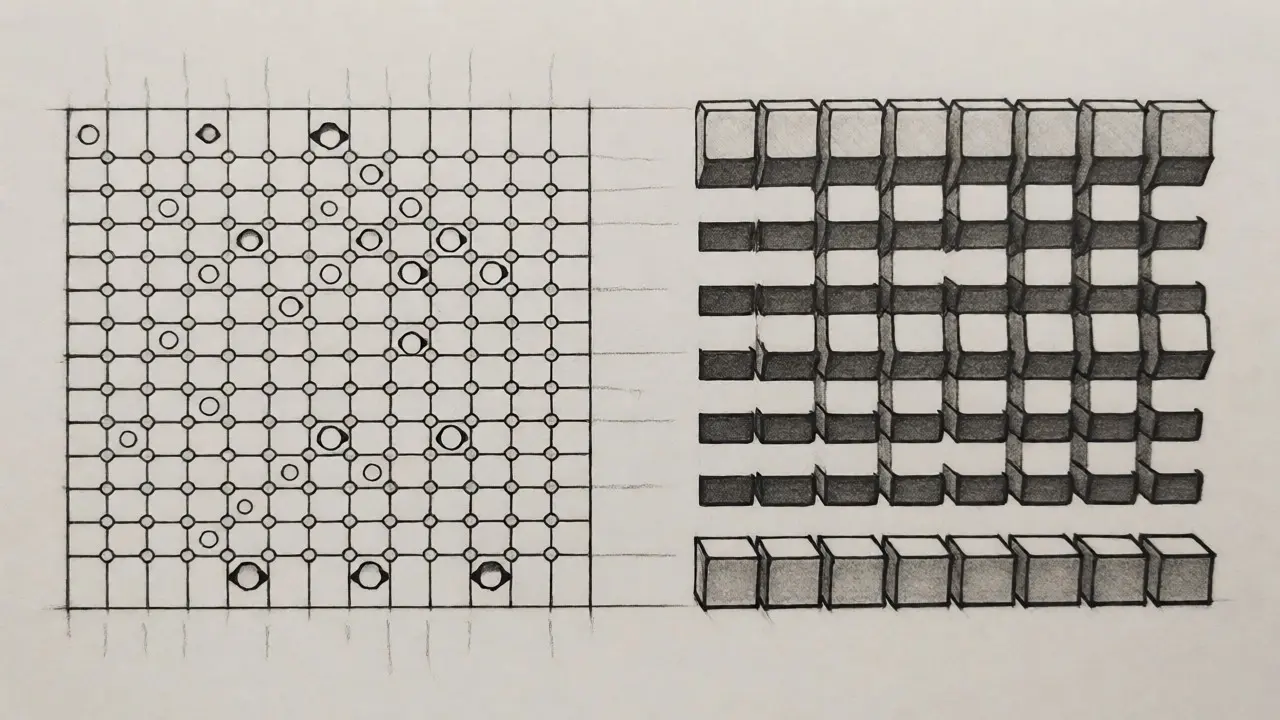
Unstructured pruning targets individual parameters-single numbers in the weight matrices. It’s like picking out specific bad apples from a barrel. You can remove up to 50% or even 90% of the weights if you're aggressive. The result is a highly sparse matrix where many values are zero. The catch? Standard GPUs (like those using NVIDIA Ampere architecture) are optimized for dense, regular calculations. To get speedups from unstructured pruning, you need specialized sparse tensor cores that can skip over the zeros efficiently. Without this hardware support, you might actually see slower performance because of the overhead in managing the irregular data structure.
Structured pruning takes a bigger axe. Instead of removing single weights, it deletes entire structural components: neurons, attention heads, channels, or even whole layers. Think of it as removing entire rows or columns from the matrix. Because the remaining structure remains regular and rectangular, it plays nicely with standard hardware. You don't need special chips. Your existing CPU or GPU can handle the math directly. This makes structured pruning the go-to choice for deployment on diverse hardware, including mobile phones and embedded systems.
| Feature | Unstructured Pruning | Structured Pruning |
|---|---|---|
| Granularity | Individual weights | Neurons, channels, layers |
| Hardware Compatibility | Requires sparse tensor cores (e.g., NVIDIA Ampere) | Works on standard CPUs/GPUs |
| Compression Ratio | High (up to 90% sparsity possible) | Moderate (typically 40-60%) |
| Accuracy Impact | Lower loss at extreme sparsity | Higher risk of accuracy drop above 60% |
| Deployment Complexity | High (needs specialized libraries) | Low (standard frameworks) |
| Best For | Cloud servers with modern GPUs | Edge devices, mobile, legacy hardware |
Unstructured Pruning: The High-Compression Playbook
If you have access to cutting-edge cloud infrastructure, unstructured pruning offers incredible compression rates. The current state-of-the-art here is dominated by methods like Wanda (Weights and Activations), introduced by researchers at Carnegie Mellon University and published at ICLR 2024. Unlike older magnitude-based methods that just looked at the size of the weights, Wanda considers both the weight magnitude and the input activation. Why does this matter? Because a large weight connected to an input that rarely fires is less important than a smaller weight connected to a frequently active input.
The beauty of Wanda is its simplicity. It doesn't require retraining. You feed it a small calibration dataset-often just 128 sequences-and it calculates importance scores on the fly. For LLaMA-7B, Wanda can achieve 40% sparsity while maintaining 98.7% of the original model's accuracy on benchmarks like WikiText-2. That’s perplexity 7.8 versus 7.6 for the dense model. Pretty impressive for a method that takes minutes, not days.
However, there’s a hidden cost. While the pruning process itself is fast, the inference engine needs to be smart enough to exploit the sparsity. If you run a Wanda-pruned model on a standard GPU without sparse support, you won't see the speedup. You’re carrying around all that metadata for zeros that the hardware still processes. So, unless you are running on NVIDIA H100s or similar cards with dedicated sparse engines, unstructured pruning might look good on paper but fail in practice.
Structured Pruning: The Deployment Champion
For most real-world applications, especially those targeting mobile or edge devices, structured pruning wins on practicality. Recent advancements have closed the gap on accuracy significantly. Take FASP (Fast and Accurate Structured Pruning), submitted to ICLR 2025. FASP introduces a clever technique called "interlinking sequential layers." Instead of pruning each layer in isolation, which can cause mismatches in dimensions, FASP coordinates the removal of columns in one layer with corresponding rows in the previous layer. This maintains the flow of information and reduces the performance hit usually associated with structured approaches.
The results are compelling. FASP can prune LLaMA-30B in just 20 minutes on a single RTX 4090 GPU. Compare that to earlier structured methods that took hours or required complex fine-tuning. Moreover, FASP achieves lower perplexity scores than previous baselines. At 50% compression, it hits 5.2 perplexity on WikiText-2, compared to 5.8 for older techniques. This efficiency makes it viable for rapid prototyping and production updates.
Another key player is the foundational work by Wang et al. (EMNLP 2020), which demonstrated that parameterizing weight matrices using low-rank factorization allows for adaptive removal of rank-1 components. Their method showed that BERT-base could be deployed on a Raspberry Pi 4 with minimal degradation. This historical context matters because it proved that structured pruning wasn't just a brute-force hack-it was a principled way to compress models while respecting their mathematical structure.
Real-World Performance Benchmarks
Let's look at the hard numbers. When comparing these methods, we focus on two metrics: compression ratio (how much space/memory we save) and quality retention (perplexity or task-specific accuracy).
- Wanda (Unstructured): On LLaMA-7B, achieving 40% sparsity results in a perplexity of 7.8 (dense is 7.6). Speedup depends heavily on hardware. On supported sparse cores, expect 1.3x-1.8x acceleration. On standard GPUs, speedup may be negligible or negative due to overhead.
- FASP (Structured): On LLaMA-30B, 50% compression yields a perplexity of 5.2. Crucially, this translates to predictable latency reductions on standard hardware. Tests on iPhone 13 showed a 2.1x inference speed increase. This predictability is gold for user-facing apps.
- Wang et al. (Structured): On BERT-base, 40% compression led to only a 0.8% accuracy drop on MNLI tasks. At 60% compression, it maintained 58.2 perplexity on Wikitext-103, outperforming magnitude-based unstructured baselines by 2.3 points.
A critical insight from recent studies is the "accuracy-compression tradeoff plateau." Dr. Sebastian Raschka notes that beyond 60% sparsity, structured methods often suffer from catastrophic forgetting, where the model loses general capabilities rapidly. Unstructured methods can push further-sometimes to 90% sparsity-but the resulting models become brittle and highly dependent on specific hardware accelerators to be useful.
Implementation Pitfalls and How to Avoid Them
Integrating pruning into your pipeline isn't always plug-and-play. Here are common traps developers fall into:
- Memory Overhead in Calibration: Wanda requires caching activations for the calibration set. For LLaMA-7B, this can add 25-35GB of memory usage during the pruning phase. If you're running this on a consumer GPU, you might run out of VRAM before you even start. Solution: Use smaller batch sizes or offload activations to CPU RAM.
- Layer Dimension Mismatches: Structured pruning often breaks if you remove a neuron in Layer N but forget to adjust the input dimension of Layer N+1. Tools like FASP handle this automatically via interlinking, but custom implementations frequently fail here. Always validate tensor shapes after pruning.
- Language Bias: Research shows that pruning impacts low-resource languages disproportionately. Wang et al. found a 5.2% performance drop on Swahili Wikipedia compared to 1.8% on English. If your app serves global users, test your pruned model on non-English datasets.
- Retraining Needs: Some older structured methods required extensive fine-tuning post-pruning. Modern methods like FASP and Wanda claim "no retraining" or minimal tuning. Verify this for your specific task. Zero-shot classification might hold up well, but complex reasoning tasks may degrade without a short fine-tuning pass.

Which Method Should You Choose?
Your decision should hinge on your deployment environment and resource constraints.
Choose Unstructured Pruning (e.g., Wanda) if: * You are deploying to cloud environments with modern NVIDIA GPUs (Ampere, Hopper). * You need maximum compression ratios (>50%). * You have access to specialized inference libraries like TensorRT or ONNX Runtime with sparse support. * You prioritize peak accuracy at high sparsity levels over hardware flexibility.
Choose Structured Pruning (e.g., FASP) if: * You are targeting mobile devices, edge computing, or older hardware. * You need predictable latency and compatibility with standard frameworks (PyTorch, TensorFlow Lite). * You want faster pruning cycles (minutes instead of hours/days). * You are willing to accept slightly lower compression ratios (40-60%) for easier deployment.
Interestingly, the industry is moving toward hybrid approaches. NVIDIA’s TensorRT 9.2 now supports combined pruning and quantization workflows, achieving 4.7x model size reduction. By pairing structured pruning (for hardware compatibility) with quantization (for memory reduction), you can get the best of both worlds. This trend suggests that pure unstructured pruning might remain a niche for high-end cloud clusters, while structured methods dominate the broader market.
Frequently Asked Questions
Does unstructured pruning always make models faster?
No. Unstructured pruning creates irregular sparsity patterns. Standard GPUs are optimized for dense matrix multiplication. If your hardware lacks specialized sparse tensor cores (like NVIDIA Ampere), the overhead of managing the sparse structure can actually slow down inference compared to a dense model. You only see speedups if your software stack and hardware explicitly support sparse operations.
Can I combine structured pruning with quantization?
Yes, and it is highly recommended. Structured pruning reduces the number of operations (FLOPs), while quantization reduces the memory footprint of the remaining weights. Tools like NVIDIA TensorRT support both simultaneously, allowing for significant model size reduction (up to 4.7x) and improved throughput on compatible hardware.
How much accuracy do I lose with 50% compression?
It depends on the method and model size. For state-of-the-art methods like Wanda (unstructured) or FASP (structured), accuracy loss at 50% compression is typically minimal-often less than 1-2% on standard benchmarks like GLUE or WikiText-2. However, for very small models or complex reasoning tasks, the drop can be higher. Always evaluate on your specific downstream task rather than relying solely on perplexity.
Is retraining required after pruning?
Modern methods like Wanda and FASP are designed to work without full retraining. They rely on efficient importance scoring (using activations or interlinked layers) to preserve performance. However, for extreme compression ratios or sensitive tasks, a brief period of fine-tuning (few epochs) can recover lost accuracy. Older methods often required extensive retraining, which added significant time and computational cost.
Which pruning method is better for mobile apps?
Structured pruning is generally better for mobile apps. Mobile processors (CPUs/NPUs) struggle with the irregular memory access patterns of unstructured sparsity. Structured pruning maintains regular tensor shapes, which aligns with the vectorized instructions used by mobile hardware. Additionally, frameworks like Apple's Core ML and Android's NNAPI have native support for structured optimizations, making deployment smoother.