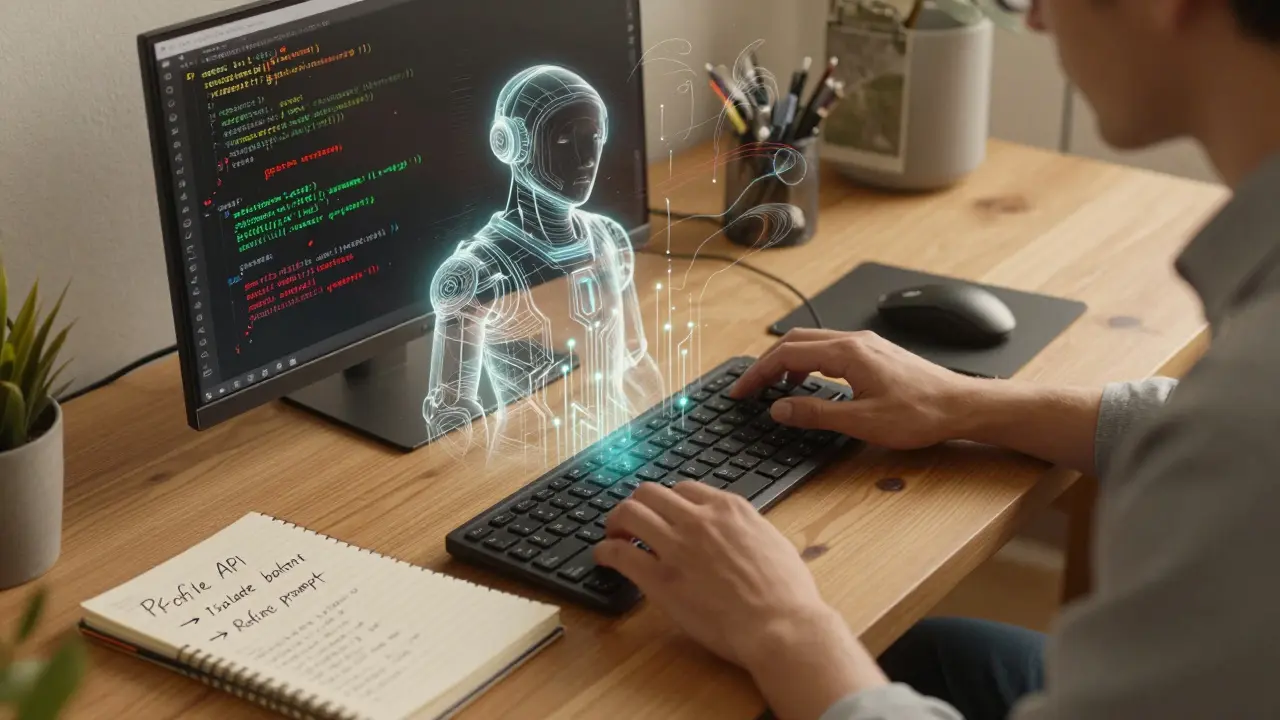
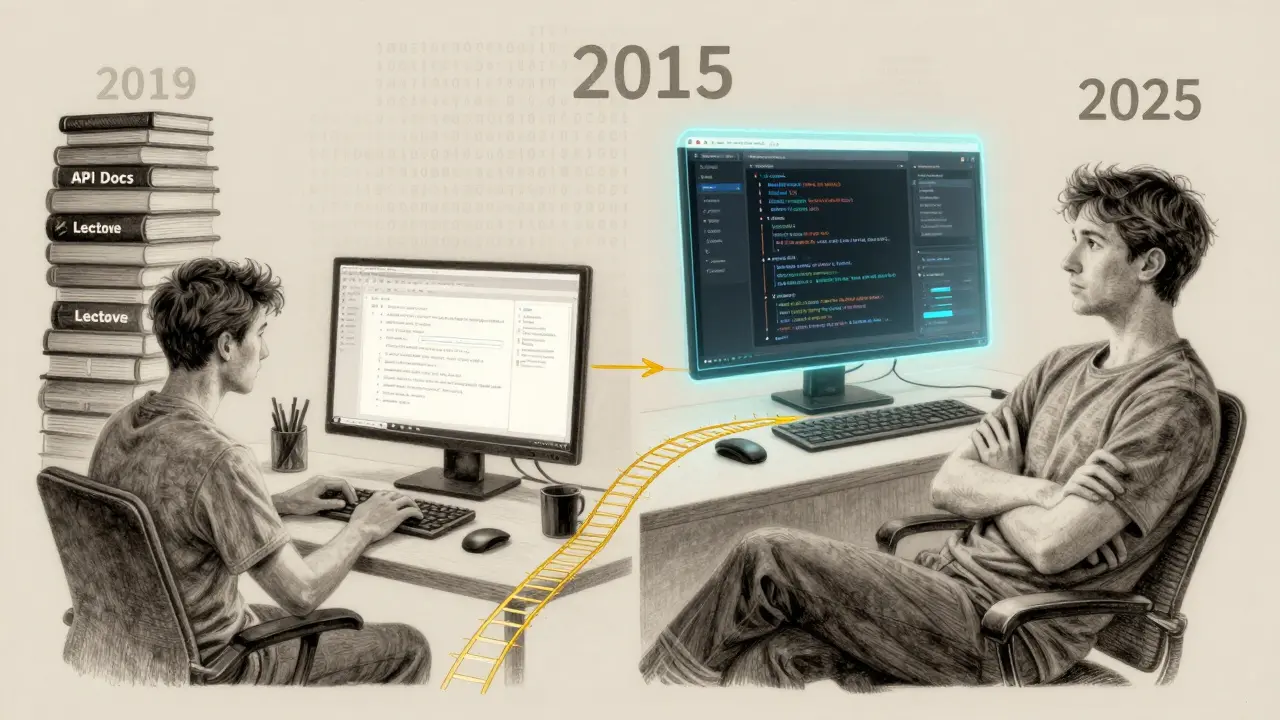
Five years ago, hiring a developer meant checking their GitHub, asking about their favorite framework, and testing their ability to debug a recursive function. Today? Companies don’t care if you can write a for-loop from memory. They care if you can vibe code - that is, if you can work side-by-side with AI tools to build real software, faster and smarter, without getting lost in the noise.
Vibe coding isn’t a buzzword. It’s the new normal. Tools like Cursor, Replit AI, and v0 by Vercel aren’t just assistants - they’re co-pilots. And the developers who thrive aren’t the ones who memorized every API. They’re the ones who ask the right questions, spot when the AI is hallucinating, and know how to steer the tool toward real results.
What Vibe Coding Really Means
Vibe coding is the practice of using AI-powered development tools to co-create software. It’s not about typing less. It’s about thinking differently. Instead of writing every line, you describe what you want - "build a login form with email validation and social auth" - and the AI generates it. Then you refine, test, and guide it. You don’t just run code. You conduct it.
This shift changes everything. Employers aren’t hiring for syntax mastery anymore. They’re hiring for contextual intelligence. The person who can look at 12 AI-generated lines and instantly say, "This won’t scale under load," or "This security pattern is outdated," is worth more than someone who can write a perfect bubble sort from scratch.
Skills Employers Are Rewarding Right Now
Based on hiring patterns from 2024 to early 2026, here are the top five skills that actually move the needle in vibe coding roles:
- Problem decomposition - Can you break a vague request like "make the app faster" into testable, AI-actionable tasks? Top performers don’t say "I need a better algorithm." They say, "Let’s profile the API response time, isolate the bottleneck, and ask the AI to optimize the query layer."
- AI prompt fluency - It’s not about fancy prompts. It’s about precision. The best vibe coders use context windows like a surgeon uses a scalpel: "Generate a React component that handles form validation with Zod, uses Tailwind, and includes error states for mobile. No comments. No extra dependencies."
- Debugging with AI - You don’t need to know why a bug exists. You need to know how to make the AI find it. That means knowing how to ask: "What’s the most likely cause of this crash when the user submits on iOS?" or "Compare this output to the spec - where did we drift?"
- Toolchain fluency - Vibe coders don’t just use one tool. They switch between Cursor, Replit, Windsurf, and v0 based on the task. Knowing when to use AI for scaffolding vs. when to use it for refactoring is a real skill. One engineer told me she spends 70% of her time in Replit for rapid prototyping and 30% in Cursor for deep codebase edits. She’s not a tool junkie - she’s a workflow architect.
- Domain-to-code translation - The biggest gap in junior hires? They can’t turn business needs into AI prompts. If a product manager says, "Users drop off after the third step," a vibe coder doesn’t just build a UI fix. They ask the AI: "Analyze our analytics logs. What’s the most common user behavior before churn? Then suggest a UI change that reduces friction by at least 30%."
These aren’t theoretical. Companies like Notion, Figma, and even mid-sized SaaS teams in Austin and Denver are hiring for these exact traits. Salaries for vibe-savvy developers are up 22% since 2023, according to data from levels.fyi. The top 10% of hires in this space now earn $185,000+ in the U.S., even at non-FAANG companies.
What’s Not Important Anymore
Let’s be clear: some traditional skills are fading fast.
- Memorizing API documentation - AI does it better and faster.
- Writing boilerplate code - Why type it when the AI can generate it in 3 seconds?
- Perfecting syntax under pressure - No one cares if you can recite JavaScript hoisting rules. They care if you can fix a production bug in 10 minutes using AI-assisted diagnostics.
- Working in isolation - The best vibe coders don’t code alone. They collaborate with AI, with teammates, and with product teams. Solo hackers are becoming relics.
One hiring manager at a Series B startup in Portland told me: "We stopped asking about LeetCode. We started asking, ‘Show me how you’d use AI to rebuild our checkout flow in two days.’ The answer told us everything we needed to know."
The Hidden Edge: Emotional Intelligence in Coding
Here’s the twist no one talks about: vibe coding demands emotional intelligence.
You can’t just be smart. You have to be self-aware. You need to know when the AI is giving you a lazy answer. You need to push back. You need to say, "This feels off," even if the code runs. You need to ask, "Why did the AI suggest this pattern? Is it because it’s efficient - or because it’s popular in training data?"
One developer in Seattle shared how she caught an AI-generated security flaw that slipped past three senior engineers. The AI had used a deprecated auth library because it was common in the training set. She didn’t know the library was deprecated - she just trusted her gut. She dug into the changelogs. Turned out, it had a zero-day exploit patched six months ago. The AI didn’t know. She did.
That’s the new edge: critical thinking + intuition + AI fluency.
Who’s Getting Left Behind
Developers who cling to old models are getting squeezed. Three groups are especially at risk:
- Legacy tool purists - Those who refuse to use AI because "it’s cheating" or "I need to understand everything." The truth? You don’t need to understand every line. You need to understand the system.
- Task-focused coders - People who treat coding like a factory job: "Give me a ticket, I’ll write the code." They’re being replaced by AI agents that can handle routine tickets faster.
- Isolated learners - Those who only learn from books and tutorials, never from live AI collaboration. They’re missing the real classroom: the editor where the AI responds in real time.
It’s not about skill loss. It’s about mindset loss. The future belongs to those who see AI not as a replacement, but as an extension of their thinking.
How to Get Ready - Right Now
If you’re a developer, here’s what to do in the next 30 days:
- Switch one daily task to AI-first. If you usually write a React component by hand, try describing it to Cursor and then edit the output. Notice where you had to correct it.
- Learn one new AI tool deeply. Replit, Windsurf, or v0. Spend 10 minutes a day using it to build something small.
- Ask a colleague: "What’s the last thing you used AI to fix?" Then try to replicate it.
- Start documenting your AI workflows. Not code - process. How do you vet AI output? How do you know when to trust it? Write it down.
- Stop practicing algorithms on LeetCode. Start practicing problem framing. Write 3 prompts for real-world tasks: "Fix this performance issue," "Improve this UI accessibility," "Refactor this for scalability."
This isn’t about learning to code better. It’s about learning to think better - with AI as your partner.
What’s Next
By 2027, we’ll see job titles like "AI Collaboration Engineer" and "Vibe Coding Specialist" in job boards. Companies will start requiring proof of AI fluency - not certifications, but work samples: a video of you using Cursor to rebuild a feature, or a log of your prompt iterations.
The best developers won’t be the fastest typists. They’ll be the best listeners. The ones who can hear what the AI is trying to say - and know when to say, "No, that’s not it. Try again."
Is vibe coding just using AI to write code?
No. Vibe coding is about collaboration. It’s not just letting AI generate code - it’s guiding it, questioning it, refining it, and knowing when to override it. Think of it like a jazz duo: the AI plays the notes, but you decide the rhythm, the feel, and when to take the solo.
Do I need to learn new programming languages to thrive in vibe coding?
Not necessarily. Most vibe coders still use JavaScript, Python, or TypeScript. What changes is how you use them. Instead of memorizing syntax, you focus on structure, intent, and system behavior. Your language skills matter less than your ability to communicate your intent to the AI.
Can non-developers become vibe coders?
Yes - and they’re already doing it. Product managers using v0 to build mockups, designers using Replit to prototype interactions, even marketers using AI to generate landing page code - these are all vibe coders. The barrier isn’t technical skill. It’s willingness to experiment and think in systems.
Are vibe coding jobs only for startups?
No. While startups lead the way, big companies like Adobe, Shopify, and even banks are hiring vibe coders. Why? Because they need to ship faster. The same tools that help a two-person team build an MVP now help a 50-person team reduce release cycles from weeks to hours.
How do I prove I’m a vibe coder in a job interview?
Bring a short video or screen recording of you using an AI tool to build something - even if it’s small. Show your prompts, your edits, your corrections. Explain why you made each change. That’s your portfolio now. Code samples alone won’t cut it anymore.


