You’ve got a large language model. It’s smart, it’s fast, and it costs money to run. Now you need it to do your specific job-whether that’s summarizing legal contracts or chatting with customers. The big question isn’t just "how do we make it work?" but "which training path should we take?"
In 2026, the industry has settled into a clear pattern. You have two main roads: instruction tuning, which teaches the model to follow general commands across many tasks, and task-specific fine-tuning, which drills the model on one narrow skill until it’s perfect at that one thing. Choosing wrong can cost you months of development time and leave you with a model that forgets how to speak human.
The Core Difference: Generalist vs. Specialist
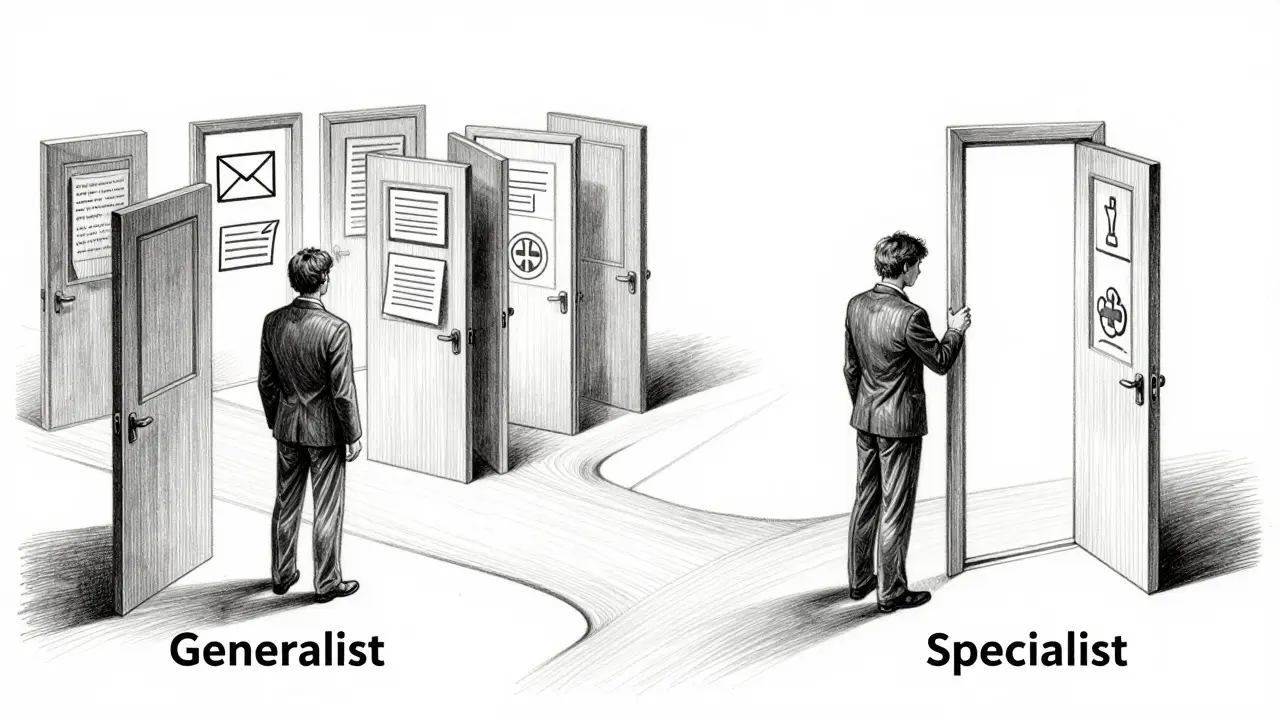
Think of Instruction Tuninga process where an LLM is trained on diverse instruction-response pairs to improve its ability to follow user commands across multiple domains as hiring a versatile consultant. You teach them how to read emails, write reports, and answer questions. They might not be the world’s best accountant, but they won’t crash if you ask them to draft a birthday card instead of a quarterly review.
On the other hand, Task-Specific Fine-Tuninga method where an LLM is trained on a small dataset focused on a single, narrow task to maximize performance in that specific area is like hiring a specialist surgeon. You train them only on heart surgery. They will be incredible at heart surgery. But if you ask them to fix a broken leg, they might freeze-or worse, give dangerous advice because their brain has been rewired for only one type of procedure.
This distinction matters because base models (like early versions of Meta's Llama 3) are good at predicting the next word, but bad at following orders. Without instruction tuning, a model might ignore your prompt entirely and just continue writing whatever story it was halfway through.
When to Choose Task-Specific Fine-Tuning
Don’t dismiss task-specific fine-tuning just because it sounds old-school. It still wins in high-stakes, narrow domains. If you are building a system to classify medical codes using ICD-10 standards, you don’t want creativity. You want precision.
Here is when this approach makes sense:
- High Regulatory Risk: In healthcare or finance, you need the model to adhere strictly to specific formatting rules. Mistral Healthcare’s 2024 specialized model achieved 98.7% accuracy on medical coding by focusing exclusively on that task.
- Narrow Data Availability: If you only have 500-1,000 labeled examples of a very specific output format, task-specific tuning extracts maximum value from that small dataset.
- Performance Sensitivity: Studies show task-specific fine-tuning can deliver up to 5.8% higher accuracy on its primary task compared to general instruction tuning.
However, there is a catch. This method suffers from Catastrophic Forgettinga phenomenon where a neural network loses previously learned information after being trained on new data. Research by Youssef Hussein in late 2024 showed that fine-tuning a base model on a single task can degrade its unrelated capabilities by up to 38%. Your model becomes a genius at one thing and an idiot at everything else.
Why Instruction Tuning Is the Industry Standard
If you look at the major players-ChatGPT, Claude, Gemini-they all rely heavily on instruction tuning. By Q4 2025, Gartner reported that 87% of commercial LLM deployments incorporated some form of instruction tuning. Why?
Because users hate rigid systems. A customer support bot shouldn’t break if a user asks a vague question or switches topics mid-conversation. Instruction tuning creates robustness. Google’s FLAN-T5 model demonstrated back in 2022 that training on diverse instructions improves zero-shot capabilities-the model’s ability to handle tasks it has never seen before.
The trade-off is data complexity. You need thousands of high-quality instruction-response pairs covering various tones, formats, and intents. Stanford’s HELM dataset contains over 15,000 examples spanning 100+ tasks. Preparing this data costs 30-40% more than preparing a simple classification dataset, according to GeeksforGeeks benchmarks from May 2025.
| Feature | Task-Specific Fine-Tuning | Instruction Tuning |
|---|---|---|
| Primary Goal | Maximize accuracy on one task | Improve general command following |
| Data Requirement | Small (500-1,000 examples) | Large & Diverse (1,000+ varied instructions) |
| Risk of Catastrophic Forgetting | High (up to 38% degradation) | Low (maintains general capabilities) |
| Zero-Shot Performance | Poor on unseen tasks | Strong (28.7% better per FLAN-UL2) |
| Implementation Time | 2-3 weeks | 4-6 weeks |
The Technical Reality: Compute and Memory
Let’s talk about the hardware. Training these models isn’t free. Base models like Llama 3 have billions of parameters. Updating all of them requires massive GPU clusters.
For task-specific fine-tuning, you might spend 12-48 hours on an 8x NVIDIA A100 setup. It’s expensive, but manageable for niche tools. Instruction tuning usually requires more compute because you are processing longer, more complex sequences. Neptune AI’s March 2025 benchmarking showed that standard instruction tuning scales linearly with the number of examples and their length.
But here is the game-changer: LoRA (Low-Rank Adaptation)a parameter-efficient fine-tuning technique that freezes pre-trained weights and injects trainable rank decomposition matrices into each layer of the Transformer architecture. Introduced by Microsoft in 2021, LoRA allows you to perform instruction tuning by updating only 0.1-1% of the model’s parameters. This drops memory requirements from 80GB to roughly 8-10GB for a 7B parameter model. Suddenly, you can tune an instruction-following model on a single consumer-grade GPU.
Dr. Sebastian Raschka from LightOn noted in January 2025 that combining instruction masking with advanced LoRA variants is now the most efficient path for resource-constrained organizations. You get the versatility of instruction tuning without burning down your cloud budget.
The Hybrid Future: Best of Both Worlds
The binary choice between "generalist" and "specialist" is fading. By 2027, Forrester predicts 68% of enterprise LLM deployments will use hybrid approaches. What does this look like in practice?
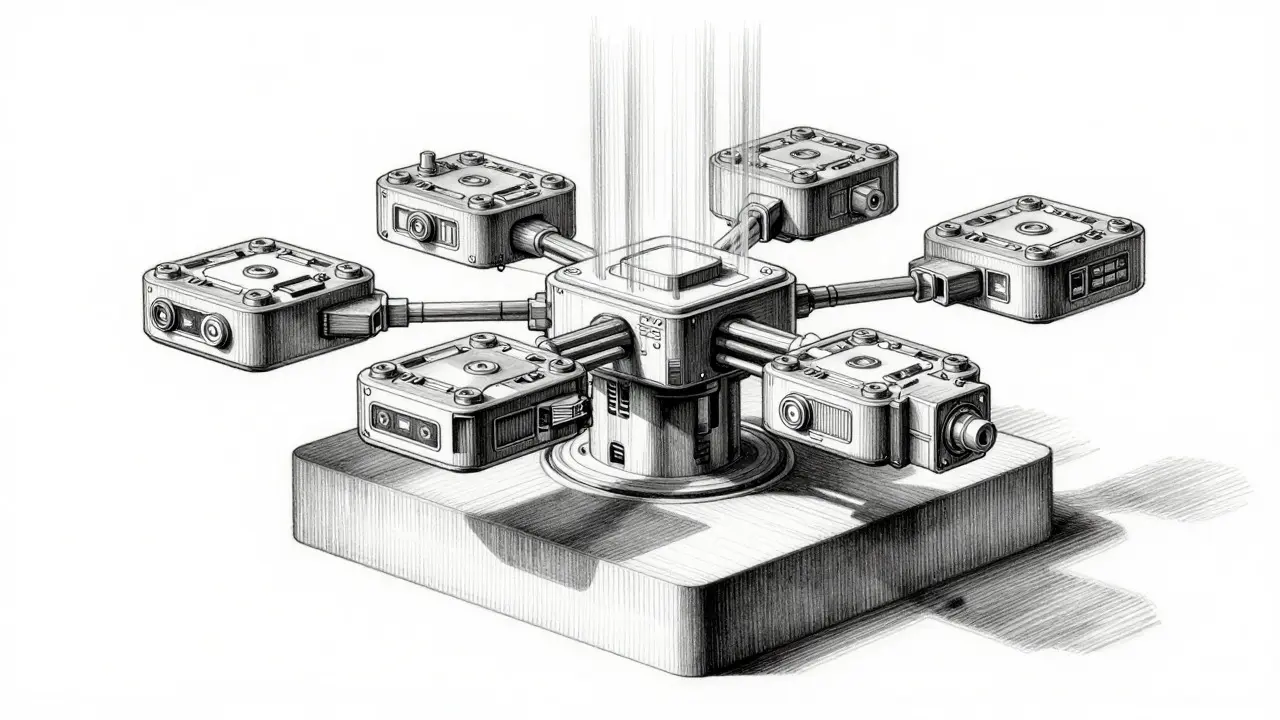
Imagine starting with an instruction-tuned base model (so it knows how to chat and follow rules). Then, you attach lightweight, task-specific adapters for sensitive operations. Meta’s release of Llama3-70B-Instruct in January 2026 introduced "modular instruction tuning," which allows selective specialization. Their tests showed only 4.2% performance degradation on unrelated tasks, compared to 18.7% with conventional methods.
This hybrid strategy solves the biggest pain point: maintaining general competence while adding deep expertise. JPMorgan Chase deployed a similar setup in 2024. Their instruction-tuned Llama2-13B model handled 12 different financial tasks with 89.4% accuracy. When they compared it to their previous task-specific-only model, the older version scored higher on its primary task (94.1%) but crashed on secondary tasks (58.3%). The hybrid approach kept the lights on across the board.
Practical Decision Framework
So, what should you do today? Use this quick checklist to decide your strategy:
- Do you need the model to interact with humans directly? If yes, choose Instruction Tuning. Users expect natural conversation, not robotic outputs.
- Is the task highly regulated or safety-critical? If yes, consider Task-Specific Fine-Tuning on top of an instruction-tuned base. Do not start from a raw base model.
- Do you have limited compute resources? If yes, use LoRA for Instruction Tuning. Avoid full-parameter task-specific fine-tuning unless absolutely necessary.
- Will the task change frequently? If yes, stick to Instruction Tuning. Retraining a task-specific model every time requirements shift is a maintenance nightmare.
Avoid the trap of "over-tuning." Dr. Percy Liang from Stanford warned in his November 2025 NeurIPS keynote that over-reliance on instruction tuning without proper domain adaptation can create brittle models. Ensure your instruction dataset includes edge cases and out-of-distribution examples.
Conclusion
There is no single "best" way to fine-tune an LLM. There is only the right way for your specific constraints. Instruction tuning gives you a reliable partner; task-specific fine-tuning gives you a precise tool. In 2026, the smartest engineers are combining both. Start with a strong instruction-tuned foundation, then layer on specialized knowledge only where it adds measurable value. Keep your data clean, your compute efficient, and your expectations realistic.
What is the main difference between instruction tuning and task-specific fine-tuning?
Instruction tuning trains a model on diverse prompts to improve its ability to follow general commands and handle multiple types of requests. Task-specific fine-tuning trains a model on a narrow dataset to maximize performance on one specific task, such as sentiment analysis or code generation, often at the expense of general capabilities.
Does instruction tuning cause catastrophic forgetting?
Generally, no. Instruction tuning is designed to preserve general knowledge while adding command-following skills. However, aggressive task-specific fine-tuning can cause catastrophic forgetting, where the model loses up to 38% of its unrelated capabilities. Using techniques like LoRA helps mitigate this risk in both approaches.
How much data do I need for instruction tuning?
While results vary, effective instruction tuning typically requires thousands of high-quality, diverse instruction-response pairs. Datasets like Stanford’s HELM use over 15,000 examples. Quality matters more than quantity; diverse, well-formatted instructions yield better zero-shot performance than large volumes of repetitive data.
Can I use LoRA for task-specific fine-tuning?
Yes, LoRA (Low-Rank Adaptation) is highly effective for both instruction tuning and task-specific fine-tuning. It reduces memory requirements significantly (e.g., from 80GB to 8-10GB for a 7B model) by updating only a small fraction of parameters, making it accessible for teams with limited GPU resources.
Which approach is better for production chatbots?
Instruction tuning is the standard for production chatbots. As of late 2025, 92% of ChatGPT-like interfaces rely on instruction-tuned models because they handle varied user inputs naturally. Task-specific tuning is reserved for backend processes or highly specialized sub-tasks within the chatbot workflow.


